

 IND
IND UAE
UAE SA
SA


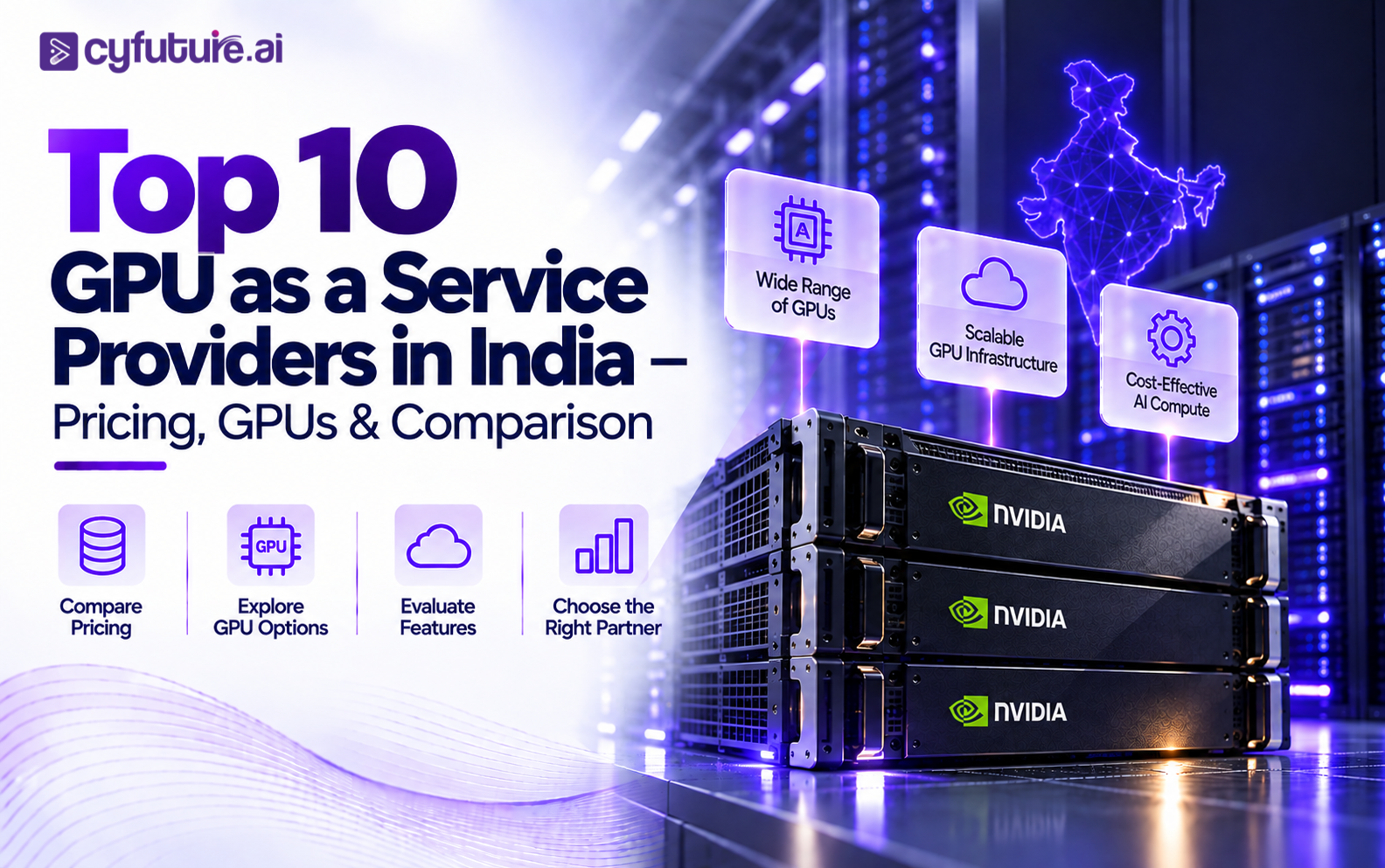
Ask any AI engineer in Bangalore or a data scientist in Hyderabad what their biggest infrastructure headache is, and the answer is almost always the same: GPU access. Not ideas, not talent — compute. The Indian AI market is growing at over 25% annually, but the GPU shortage is real, and making the wrong provider choice can quietly drain your runway.
This guide is built specifically for Indian teams. We've gone beyond generic global rankings to factor in rupee pricing, DPDP Act 2023 compliance, latency from Indian data centres, and support quality that actually matters when your training job crashes at midnight.
Why GPU Cloud Selection Is Different in India
Most GPU comparison guides are written for US or European audiences. They rank providers on raw pricing and performance — which matters — but miss the factors that make or break deployments for Indian businesses specifically.
Here's what changes when you're operating in India:
- DPDP Act 2023 compliance: India's Digital Personal Data Protection Act requires personal data of Indian users to be processed in India. For BFSI, healthcare, and HR applications, this isn't optional — it's law. Foreign providers don't automatically comply.
- Latency from Indian users: If your inference API serves Indian end-users, hosting in Mumbai gives you 5–15ms latency vs. 120–180ms from US-East servers. That's the difference between a fast product and a frustrating one.
- Currency risk: Dollar-denominated GPU costs fluctuate with the USD/INR rate. India-native providers billing in rupees remove this variable from your cost model.
- Support time zones: A critical issue at 2 AM IST is 10:30 PM UTC — outside most Western support windows. India-based support teams matter more than most buyers realize until they need them.
- Data egress costs: Transferring large training datasets between US-hosted providers and your Indian team adds up fast. India-local providers eliminate this entirely.
An H100 at $3.20/hr on AWS ap-south-1 often ends up costing 50–70% more than the headline rate once data egress, currency conversion, compliance consulting fees, and latency-related re-work are factored in. India-native providers eliminate most of these hidden costs.
What Is GPU as a Service? (Quick Refresher)
GPU as a Service (GPUaaS) is a cloud computing model where you rent high-performance GPUs by the hour — without buying or managing the physical hardware. Think of it like renting a supercomputer for exactly as long as you need it, then returning the keys.
Instead of spending Rs 3 crore+ on a single H100 server — and then dealing with data centre space, power bills, cooling, and driver updates — you provision a GPU instance in under 60 seconds, run your workload, and pay only for the time used.
GPUaaS is the infrastructure layer powering most modern AI work: LLM fine-tuning, real-time inference, computer vision pipelines, rendering, and scientific simulations.
How GPU as a Service Works (Technical Breakdown)
From the user's side, GPUaaS feels simple: log in, pick a GPU, launch. But understanding what actually happens under the hood helps you evaluate providers more intelligently — because the quality of each layer directly affects your workload's performance and reliability.
Layer 1 — Physical Infrastructure
Every GPUaaS platform sits on top of physical GPU servers in data centres. For Indian teams, this layer is the most consequential: where those servers live determines your latency, data residency compliance, and support response time. A provider with Mumbai-based servers gives your Indian users 5–15ms round-trip latency. A US-hosted provider adds 120–180ms — which is fine for batch training but breaks real-time inference APIs.
The hardware itself matters too. Enterprise GPUaaS runs on data-centre-grade NVIDIA GPUs (H100 SXM5, A100, L40S) with NVLink for GPU-to-GPU bandwidth within a node (up to 900 GB/s) and InfiniBand HDR between nodes (200 Gb/s) for distributed training. Providers using commodity Ethernet for multi-node clusters are 5–10× slower on distributed jobs.
Layer 2 — Virtualization & GPU Access
Providers use one of three approaches to deliver GPU access:
- Bare-metal: You get direct, exclusive access to a physical GPU — no hypervisor overhead, maximum performance. Best for latency-sensitive inference and large training runs.
- GPU passthrough (Virtual Machine): A VM with dedicated GPU access via SR-IOV or PCIe passthrough. Near-native performance with added isolation. Most common for enterprise deployments.
- Shared/MIG (Multi-Instance GPU): A single H100 or A100 is partitioned into smaller slices. Cheapest option, but lower memory and bandwidth per slice. Suitable for inference and development, not full-scale training.
Layer 3 — Software Stack & Container Orchestration
A good GPUaaS platform comes pre-configured so your team isn't spending the first day wrestling with CUDA driver versions. The standard enterprise stack includes:
- CUDA 12.x + cuDNN pre-installed
- PyTorch, TensorFlow, JAX environment images
- vLLM and Hugging Face pre-configured for LLM inference
- Kubernetes and Docker support for containerized workloads
- Custom Docker image upload for complex dependency requirements
Providers that don't offer pre-built environments force your engineers to spend hours on setup for every new instance — a hidden tax on development velocity that adds up fast.
Layer 4 — Networking, Storage & Monitoring
Beyond the GPU itself, production workloads depend on high-throughput storage (NVMe SSDs reading at 6–7 GB/s) to prevent the GPU from sitting idle waiting for data, low-latency networking between instances, and real-time monitoring dashboards showing GPU utilization, memory usage, and job status. The best providers expose all of this through an API so your team can automate provisioning, scaling, and monitoring without logging into a dashboard manually.
When evaluating providers, ask specifically: what interconnect do you use for multi-node clusters (InfiniBand vs Ethernet), what's the NVMe read speed on attached storage, and do you offer bare-metal options? These three answers separate enterprise-grade GPU infrastructure from consumer-grade instances with a GPU attached.
GPU as a Service Use Cases in India
GPU cloud isn't a one-size-fits-all tool. Different workloads have vastly different GPU requirements — and Indian teams increasingly span all of them. Here's where GPUaaS delivers the most impact across Indian industries:
Training LLMs above 30B parameters → H100. Fine-tuning up to 70B or research workloads → A100 80GB. Inference serving, image generation, rendering → L40S. Embeddings, RAG pipelines, light inference → V100 or L40S. When in doubt, benchmark your actual workload on on-demand instances before committing to reserved pricing.
5 Factors That Actually Matter When Choosing a GPU Provider in India
Before comparing providers, get clear on what matters for your workload. These five factors separate genuinely useful providers from ones that look great on paper:
GPU Availability & Model Selection
Does the provider actually have H100s, A100s, or L40S available on demand — not on a 6-week waitlist? Verify real-time availability before signing up.
Data Residency & DPDP Compliance
For regulated industries, India-hosted infrastructure isn't a nice-to-have — it's a legal requirement. Check for Indian data centres and Data Processing Agreements.
Network & Interconnect Quality
Multi-GPU training jobs are only as fast as the network between GPUs. NVLink within nodes and InfiniBand between nodes are non-negotiable for distributed training.
Total Cost of Ownership
Compare on-demand, reserved, and spot pricing. Factor in data egress fees, currency conversion, and setup costs — not just the headline hourly rate.
Support Quality & Time Zone
24/7 India-based engineers who understand GPU infrastructure are worth paying for. A ticket queue with 24-hour SLAs is useless when a training run fails after 18 hours.
Top 10 GPU as a Service Providers in India (2026) — Detailed Breakdown
Below is an honest assessment of every major provider relevant to Indian teams — covering what they do well, where they fall short, and exactly who they're right for.
Cyfuture AI is the only major GPU cloud built specifically for Indian enterprises — not a global provider that added an Indian region as an afterthought. Its data centres in Jaipur, Noida, and Bangalore keep your data within Indian borders, which matters enormously for BFSI, healthcare, and government workloads under the DPDP Act 2023.
What sets it apart from global players is the combination: competitive rupee pricing, genuine H100 and A100 availability, India-local support, and compliance infrastructure that regulated industries need. For an AI startup in Pune or a BFSI team in Mumbai, this is the most practical choice.
| GPU | Memory | vCPUs | RAM | Storage | On-Demand/hr (INR) | On-Demand/hr (USD) |
|---|---|---|---|---|---|---|
| H100 SXM5 | 80GB HBM3 | 26 | 250GB | 3TB NVMe | Rs 219 | ~$2.62 |
| A100 | 80GB HBM2e | 16 | 128GB | 1TB NVMe | Rs 170 | ~$2.03 |
| L40S | 48GB GDDR6 | 16 | 64GB | 1TB NVMe | Rs 61 | ~$0.73 |
| V100 | 32GB HBM2 | 8 | 32GB | 500GB NVMe | Rs 39 | ~$0.47 |
✅ Strengths
- 100% India-hosted — DPDP compliant
- 37–54% cheaper than AWS/GCP for same GPU
- No data egress fees for Indian teams
- 24/7 India-based GPU engineer support
- Rupee billing — no currency risk
- NVLink + InfiniBand for multi-node clusters
⚠️ Limitations
- None
Indian enterprises, BFSI and healthcare teams needing DPDP compliance, AI startups optimizing cost, and anyone who needs India-local latency for their inference APIs.
CoreWeave is a GPU-native hyperscaler purpose-built for large AI training runs. If your team is training a 70B+ parameter model and needs access to 64-GPU or 128-GPU clusters simultaneously, CoreWeave is one of the few platforms that can reliably deliver that at scale. Its infrastructure is optimized for dense GPU clusters with InfiniBand interconnects and Kubernetes-native orchestration.
For Indian teams, the catch is the lack of India-hosted infrastructure — making it unsuitable for regulated workloads — and dollar-denominated pricing that's 20–30% higher than Cyfuture AI.
| GPU | Memory | On-Demand/hr (USD) | Reserved/hr (USD) |
|---|---|---|---|
| H100 | 80GB | $2.69 | $2.15 |
| A100 | 80GB | $2.06 | $1.65 |
| L40S | 48GB | $0.89 | $0.71 |
✅ Strengths
- Massive GPU cluster availability
- Excellent for distributed LLM training
- Strong Kubernetes/container support
⚠️ Limitations
- No India-hosted infrastructure
- Not DPDP compliant for regulated data
- Higher cost than India-native options
Lambda Labs has earned a strong following among ML researchers because its platform genuinely feels designed by people who train models, not by enterprise sales teams. Pre-configured PyTorch and TensorFlow environments mean you're coding within minutes of provisioning, not debugging driver conflicts for hours.
For Indian teams doing research or early-stage development, Lambda is a solid choice for experiments. For production or regulated workloads, the lack of India infrastructure is a dealbreaker.
| GPU | Memory | On-Demand/hr (USD) | Monthly (USD) |
|---|---|---|---|
| H100 | 80GB | $2.49 | $1,795 |
| A100 | 80GB | $1.29 | $930 |
| A10 | 24GB | $0.75 | $541 |
✅ Strengths
- Excellent developer experience
- Pre-built ML environments
- Competitive pricing for research
⚠️ Limitations
- No India data centres
- Limited enterprise governance controls
RunPod is where cost-sensitive teams go for GPU experimentation. Its spot and community pricing is the cheapest in the market — an RTX 4090 from $0.29/hr is hard to beat for testing and hyperparameter tuning. The trade-off is reliability: spot instances can be interrupted, and the community GPU pool has inconsistent uptime.
Use RunPod for experiments and batch jobs where interruption is acceptable. Don't use it for production APIs or any workload where data residency matters.
| GPU | Memory | On-Demand/hr | Spot/hr | Community/hr |
|---|---|---|---|---|
| H100 | 80GB | $2.99 | $1.99 | $1.77 |
| A100 | 80GB | $2.72 | $1.69 | $1.39 |
| RTX 4090 | 24GB | $1.10 | $0.34 | $0.29 |
✅ Strengths
- Cheapest spot GPU pricing available
- Wide GPU model selection
- Serverless GPU functions
⚠️ Limitations
- No India infrastructure
- Spot instances can be interrupted
- Not suitable for production workloads
AWS has the deepest enterprise integrations and the most compliance certifications of any provider. If your organization has already built its entire infrastructure on AWS — IAM, S3, RDS, CloudWatch — the switching cost is real and the integration value is genuine.
But for GPU compute specifically, AWS is consistently the most expensive option. Its H100 pricing in ap-south-1 is roughly 24% higher than Cyfuture AI and involves dollar billing with all the currency risk that entails. Teams that choose AWS GPUs usually do so because of ecosystem lock-in, not because it's the best GPU choice.
| GPU | Memory | Instance | On-Demand/hr | Spot/hr | 1-Yr Reserved/hr |
|---|---|---|---|---|---|
| H100 | 80GB | p5.4xlarge | $3.25 | $0.98 | $2.34 |
| A100 | 80GB | p4d.24xlarge | $2.73 | $0.82 | $1.97 |
| L4 | 24GB | g6.xlarge | $0.84 | $0.25 | $0.61 |
✅ Strengths
- ap-south-1 (Mumbai) region available
- Deepest compliance certifications
- Best AWS ecosystem integration
- Spot pricing competitive for fault-tolerant jobs
⚠️ Limitations
- 40–54% more expensive than India-native providers
- Dollar billing — currency risk
- Complex pricing with many hidden costs
- Limited GPU availability during demand spikes
GCP makes the most sense when your team is already invested in Google's AI ecosystem — Vertex AI, BigQuery ML, or TensorFlow. The Mumbai region reduces latency for Indian users, and the 3-year committed-use pricing can bring H100 costs down to $1.59/hr — competitive with Cyfuture AI's on-demand rates. But without committed reservations, GCP's GPU costs sit roughly 20–30% above India-native providers.
| GPU | Memory | On-Demand/hr | 1-Year/hr | 3-Year/hr |
|---|---|---|---|---|
| H100 | 80GB | $3.18 | $2.23 | $1.59 |
| A100 | 80GB | $2.64 | $1.85 | $1.32 |
| L40S | 48GB | $1.28 | $0.90 | $0.64 |
✅ Strengths
- Mumbai region available
- Excellent AI/ML tooling (Vertex AI)
- TPU options alongside GPUs
- Competitive 3-year committed pricing
⚠️ Limitations
- Expensive on on-demand rates
- Complex pricing models
- Not DPDP compliant without custom DPAs
Azure GPUs make the most sense for organizations already running on Microsoft infrastructure — Active Directory, Azure DevOps, Microsoft 365 — where GPU workloads are an extension of an existing investment. GPU provisioning on Azure is slower than purpose-built providers, and on-demand pricing is among the highest in the market. The 3-year reserved pricing ($1.53/hr for H100) is more competitive, but requires a significant commitment.
| GPU | Memory | VM Series | On-Demand/hr | 3-Year RI/hr |
|---|---|---|---|---|
| H100 | 80GB | NC40ads_H100_v5 | $3.06 | $1.53 |
| A100 | 80GB | NC24ads_A100_v4 | $2.70 | $1.35 |
| V100 | 32GB | NC12s_v3 | $1.48 | $0.74 |
✅ Strengths
- Best Microsoft ecosystem integration
- Widest GPU instance variety among hyperscalers
- Strong enterprise compliance posture
⚠️ Limitations
- Slowest GPU provisioning of major providers
- Highest on-demand GPU pricing
- Complexity overhead for GPU-only use cases
Vultr offers straightforward GPU pricing across 32+ global locations. It's a reasonable choice for small teams needing GPU instances without the complexity of hyperscaler pricing models. H100 pricing ($2.49/hr) is comparable to Lambda Labs but without the ML-specific tooling. Not competitive for India-specific requirements.
✅ Strengths
- Simple, transparent pricing
- Good global coverage
- Easy Kubernetes integration
⚠️ Limitations
- No India-hosted infrastructure
- Limited high-end GPU selection
- Not optimized for large training runs
Paperspace's Gradient platform is genuinely the easiest GPU environment to start with — GPU-backed Jupyter notebooks with PyTorch pre-installed mean non-DevOps engineers can run models without any infrastructure knowledge. It's ideal for learning, prototyping, and demos. It's not competitive at scale, and pricing ($2.30/hr for A100) isn't particularly compelling for production workloads.
✅ Strengths
- Simplest onboarding experience
- Jupyter notebook GPU environment
- Good for learning and prototyping
⚠️ Limitations
- No India infrastructure
- Not cost-competitive at production scale
- Limited enterprise controls
Genesis Cloud is Europe's answer to sustainable GPU computing — 100% renewable energy, GDPR compliance, and competitive pricing for EU workloads. For Indian teams, it's not a practical choice unless you have a specific European data residency requirement. Worth knowing for global teams with a European presence.
✅ Strengths
- 100% renewable energy
- Strong GDPR compliance
- Competitive EU GPU pricing
⚠️ Limitations
- No India infrastructure
- Limited GPU model selection
- Not relevant for DPDP compliance
Spin Up an H100, A100, or L40S in Under 60 Seconds
India-hosted, DPDP-compliant GPU instances — priced in rupees, backed by engineers available around the clock. No procurement delays, no hidden fees, no currency risk.
Side-by-Side Pricing Comparison: H100 & A100 Across All Providers
Here's how on-demand GPU pricing stacks up across all ten providers for the two most commonly requested models. Cyfuture AI pricing is shown in both INR and USD for direct comparison.
| Provider | H100 80GB / hr | A100 80GB / hr | L40S / hr | India Hosted? | DPDP Ready? | Best For |
|---|---|---|---|---|---|---|
| Cyfuture AI | Rs 219 (~$2.62) | Rs 170 (~$2.03) | Rs 61 (~$0.73) | Yes | Yes | Indian enterprises, regulated workloads |
| CoreWeave | $2.69 | $2.06 | $0.89 | No | No | Large-scale LLM training clusters |
| Lambda Labs | $2.49 | $1.29 | N/A | No | No | ML research and experimentation |
| RunPod (Spot) | $1.99 | $1.69 | $0.89 | No | No | Budget experiments, batch jobs |
| AWS (ap-south-1) | $3.25 | $2.73 | N/A | Mumbai region | Custom DPA needed | AWS-locked enterprises |
| GCP (Mumbai) | $3.18 | $2.64 | $1.28 | Mumbai region | Custom DPA needed | Google AI stack users |
| Azure | $3.06 | $2.70 | N/A | India region | Custom DPA needed | Microsoft ecosystem teams |
| Vultr | $2.49 | $1.29 | N/A | No | No | SMBs, global inference |
| Paperspace | N/A | $2.30 | N/A | No | No | Learning, prototyping |
| Genesis Cloud | N/A | $2.20 | N/A | No | No | EU sustainable AI workloads |
AWS, GCP, and Azure all have Mumbai or India region data centres, but hosting data there does not automatically make them DPDP-compliant. Compliance requires specific Data Processing Agreements, data residency guarantees, and audit documentation — none of which are included by default. Request these explicitly or work with a provider that has them built in.
H100 vs A100 vs L40S: Which GPU Do You Actually Need?
The most common mistake Indian teams make isn't choosing the wrong provider — it's choosing the wrong GPU. Paying H100 prices for a workload that runs perfectly on an L40S wastes significant budget.
| GPU | Memory | Memory BW | Best Use Case | Cost/hr (Cyfuture) | Choose If... |
|---|---|---|---|---|---|
| H100 SXM5 | 80GB HBM3 | 3,350 GB/s | Training 70B+ LLMs, multi-node distributed training | Rs 219 | You're training large foundation models or need maximum throughput per token |
| A100 80GB | 80GB HBM2e | 2,039 GB/s | Fine-tuning 7B–70B models, research, regulated inference | Rs 170 | You need a versatile workhorse for training and inference without H100 cost |
| L40S | 48GB GDDR6 | 864 GB/s | 7B model inference, image generation, video, hybrid AI+graphics | Rs 61 | You're serving inference, generating images, or running hybrid AI workloads cost-efficiently |
| V100 | 32GB HBM2 | 900 GB/s | Light inference, embeddings, RAG pipelines, legacy models | Rs 39 | You need the cheapest option for embeddings or small model serving |
If you're fine-tuning or doing inference on models up to 13B parameters, the A100 80GB is your best price-performance choice. If you're building an inference API that serves thousands of requests, the L40S at Rs 61/hr delivers strong throughput at roughly one-third the cost of an H100. Reserve H100s for serious training runs above 30B parameters.
DPDP Compliance & Data Residency: What Indian Enterprises Actually Need to Know
India's Digital Personal Data Protection Act 2023 (DPDP Act) has changed the compliance calculation for GPU cloud deployments. Here's what it means in practice for AI teams:
Who it affects: Any organization processing personal data of Indian users — which includes names, phone numbers, email addresses, financial records, health data, HR data, and more. If your AI model trains on or processes this data, DPDP applies.
What it requires: Personal data must be processed on infrastructure that meets the government's data localization requirements. The act also requires Data Processing Agreements (DPAs) with any vendor handling this data on your behalf.
Of the ten providers reviewed, only Cyfuture AI satisfies all five criteria by default, without requiring custom enterprise negotiations. The hyperscalers (AWS, GCP, Azure) can potentially be made compliant but require separate DPA requests and custom data residency configurations that add cost and complexity.
Cost Optimization Tips for Indian AI Teams
Choosing the right provider is step one. These practices reduce your actual monthly GPU spend by 30–60% on top of that:
- Benchmark before committing: Run your actual workload on on-demand instances for 2–4 weeks to understand your real GPU-hours usage before moving to reserved pricing. Reserved instances on Cyfuture AI are 30–50% cheaper, but only make sense if you have predictable demand.
- Separate training and inference infrastructure: Use H100s or A100s for training runs (short duration, high compute), and switch to inference-optimized instances like L40S for production serving (continuous, lower compute). This alone can cut monthly costs by 40%.
- Use spot instances for fault-tolerant training: Break long training runs into checkpointed jobs that can survive interruption. Spot pricing can reduce training costs by 40–70%. Not for production inference.
- Monitor utilization weekly: Most teams over-provision and run GPUs at 40–60% utilization. Right-sizing to your actual workload — or switching to serverless inferencing for variable demand — removes wasted spend entirely.
- Consider reserved instances at 3+ months of consistent usage: If your usage patterns are stable, a 3–6 month reservation on Cyfuture AI saves 30–50% compared to on-demand rates while guaranteeing capacity.
India's fastest-scaling AI teams run a base of reserved GPU capacity on Cyfuture AI for stable production workloads, and use on-demand instances for training bursts and experiments. This combination typically delivers 40–55% lower total GPU spend than a pure on-demand strategy while maintaining the flexibility to scale instantly.
Need a GPU Cloud Built for India's Compliance and Cost Requirements?
From single on-demand H100 instances to 64-GPU InfiniBand clusters — Cyfuture AI is India's most complete GPU cloud platform. DPDP-compliant, rupee-priced, and backed by engineers available around the clock.
Frequently Asked Questions
Straight answers to the most common questions Indian teams ask about GPU cloud providers.
GPU as a Service (GPUaaS) in India is a cloud computing model where businesses and researchers rent high-performance NVIDIA GPUs — H100, A100, L40S — by the hour from cloud providers. You pay only for usage time, with no upfront hardware investment, no procurement delays, and no infrastructure management. India-native providers like Cyfuture AI additionally offer rupee billing, India-local data centres, and DPDP compliance for regulated workloads.
Cyfuture AI is the leading India-native GPU cloud provider in 2026, offering H100 from Rs 219/hr, A100 from Rs 170/hr, and L40S from Rs 61/hr — all hosted in Indian data centres in Mumbai, Noida, and Chennai. It is DPDP-compliant and 37–54% cheaper than AWS and GCP for equivalent GPU capacity. For global providers, CoreWeave offers the best infrastructure for large-scale training and Lambda Labs offers the best developer experience — but neither can satisfy India's data residency requirements for regulated workloads.
On Cyfuture AI, H100 SXM5 80GB costs Rs 219/hr (~$2.62). On AWS ap-south-1 (Mumbai), equivalent H100 capacity costs ~$3.25/hr — roughly 24% more before data egress and DPA costs. On GCP Mumbai, H100 is $3.18/hr on-demand. Reserved pricing on Cyfuture AI reduces the H100 rate by 30–50% for teams with consistent monthly usage above 500 GPU-hours.
It depends entirely on the provider. India's DPDP Act 2023 requires that personal data of Indian users be processed on India-hosted infrastructure with appropriate Data Processing Agreements. Cyfuture AI's GPU cloud is 100% India-hosted (Mumbai, Noida, Chennai) and provides DPAs for regulated industries including BFSI and healthcare. AWS, GCP, and Azure have India regions but are not automatically DPDP-compliant — you need to request specific DPAs and configure data residency settings, which adds cost and complexity. Foreign-only providers like CoreWeave, Lambda, and RunPod cannot satisfy DPDP requirements for personal data processing.
H100 is best for training large language models (30B+ parameters) and multi-node distributed jobs where maximum memory bandwidth matters. A100 80GB is the versatile choice for fine-tuning models up to 70B parameters, research, and regulated industry deployments. L40S is the cost-efficient pick for inference serving, image generation (Stable Diffusion, Flux), and hybrid AI+graphics workloads — at Rs 61/hr, it's about 65% cheaper than an A100 for tasks that don't require HBM memory bandwidth. For most Indian AI startups, the A100 or L40S delivers the best cost-per-result.
The biggest levers are: (1) Right-size your GPU — don't use H100s for workloads that run fine on L40S; (2) Separate training and inference infrastructure — use high-memory GPUs for training bursts and switch to cost-efficient inference instances for production serving; (3) Move to reserved pricing once you have 3+ months of stable usage data — this saves 30–50% vs on-demand; (4) Use spot instances for fault-tolerant batch training jobs; (5) Monitor GPU utilization weekly — idle instances are the most common source of wasted GPU spend. India-native providers also eliminate data egress fees, which can add 15–30% to total hyperscaler costs for data-heavy workloads.
Meghali is a tech-savvy content writer with expertise in AI, Cloud Computing, App Development, and Emerging Technologies. She specializes in translating complex GPU infrastructure concepts into clear, actionable guidance for Indian businesses navigating the AI adoption journey.