


 IND
IND UAE
UAE SA
SA


The phone rings at 3 AM. A customer needs urgent help. Your human agents are offline, but your AI voicebot? It's already handling the conversation with the sophistication of your best agent, resolving 95% of queries without escalation. This isn't science fiction—it's the operational reality reshaping call centers in 2026.
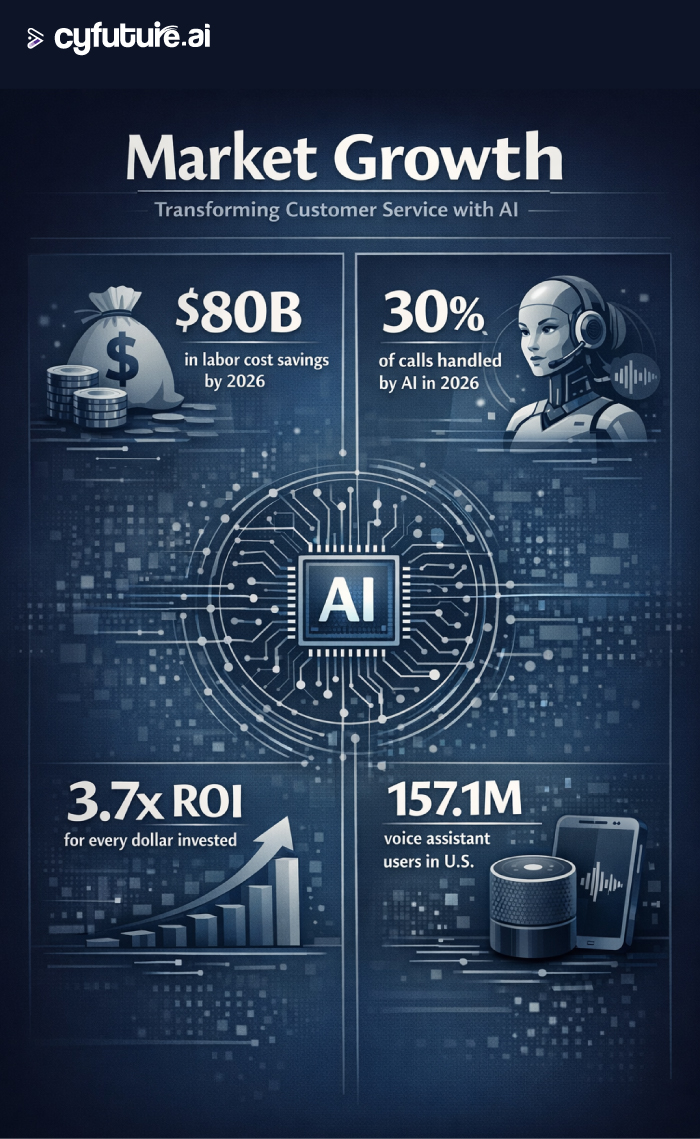
As conversational AI is projected to reduce contact center labor costs by $80 billion by 2026 and automate one in ten agent interactions, the question isn't whether to implement AI voicebots, but how quickly you can capture this competitive advantage. With 30% of calls expected to be handled by AI agents in 2026 across e-commerce, hospitality, banking, utilities, and telecom, the transformation is accelerating faster than most predictions anticipated.
Understanding AI Voicebot Technology in Call Centers
AI voicebots represent a fundamental shift from traditional Interactive Voice Response (IVR) systems to intelligent conversational agents powered by Natural Language Processing (NLP), Machine Learning, and advanced speech recognition. Unlike their rigid predecessors that forced customers through "press 1 for sales, press 2 for support" mazes, modern AI voicebots engage in human-like conversations, understand context, detect emotional nuances, and execute complex multi-step workflows autonomously.
The technology stack behind enterprise-grade AI voicebots includes:
Natural Language Understanding (NLU): Interprets customer intent beyond keyword matching, understanding colloquialisms, context, and even emotional undertones.
Automatic Speech Recognition (ASR): Converts speech to text with accuracy rates now exceeding 95% across multiple languages and accents.
Text-to-Speech (TTS): Generates natural-sounding voice responses that eliminate the robotic feel of earlier systems.
Machine Learning Models: Continuously improve performance by learning from every interaction, adapting to emerging patterns and customer preferences.
Integration Capabilities: Connect seamlessly with CRM systems, databases, and backend applications to access real-time information and execute actions.
Quantifiable Benefits of AI Voicebot Implementation
Operational Cost Reduction
The financial impact of AI voicebots extends far beyond simple automation. Organizations implementing voice AI solutions are reporting 3.7x ROI for every dollar invested, making the business case increasingly compelling for CFOs evaluating contact center modernization.
The cost differential is stark: AI phone agents typically cost between $0.09 and $0.29 per minute, while human agents range from $0.42 to $1.08 per minute. For enterprise contact centers handling millions of interactions annually, this translates to substantial savings. A typical enterprise managing 1 million calls per year can realize $3-5 million in annual savings through strategic voicebot deployment.
Breaking down the cost structure reveals multiple savings layers. First, direct labor cost reduction occurs as voicebots handle routine inquiries that previously required human intervention. Companies have reported a notable decrease of up to 70% in calls, chats, or emails necessitating human agent intervention, resulting in potential savings of up to 30% in customer service expenses.
Second, infrastructure costs decline as cloud-based AI voicebot platforms eliminate the need for expensive on-premises hardware and complex telecommunication equipment. Third, training expenses decrease significantly—while human agents require weeks of onboarding and continuous training, AI voicebots can be deployed and updated instantly across all interactions.
Enhanced Customer Experience Metrics
Customer experience improvements represent another critical benefit dimension, with direct correlation to revenue retention and growth. The latest 2025 data shows voicebots deliver improved first-call resolution rates reaching 95%, reduced average handling time down by 37% on average, and increased customer satisfaction scores with CSAT improvements of 15-20%.
The 24/7 availability factor alone transforms customer engagement dynamics. 62% of customers prefer engaging with chatbots over waiting for human agents, highlighting the value proposition of immediate assistance. For global enterprises serving customers across time zones, AI voicebots eliminate the wait time barrier that historically frustrated customers and drove churn.
Response time acceleration represents another measurable benefit. Bank of America's AI assistant Erica has handled 2 billion interactions and resolved 98% of customer queries within 44 seconds, demonstrating enterprise-scale success. This speed improvement cascades into customer satisfaction improvements and reduced abandonment rates.
Scalability and Agent Productivity
AI voicebots provide unprecedented scalability advantages, handling volume spikes without requiring proportional staffing increases. During peak periods—product launches, seasonal surges, or marketing campaigns—voicebots absorb the additional load while maintaining consistent quality.
For human agents, AI voicebot implementation paradoxically enhances rather than threatens their roles. By automating routine queries like password resets, order status checks, and FAQ responses, voicebots free agents to focus on complex problem-solving that requires human empathy, creativity, and judgment. 64% of customer service representatives who use AI say it helps them personalize their correspondences, demonstrating how AI augments rather than replaces human capabilities.
Calculating AI Voicebot ROI: The Technical Approach
Understanding AI voicebot ROI requires a structured methodology that accounts for both tangible and intangible benefits while realistically assessing implementation and operational costs.
The ROI Formula
The fundamental ROI calculation follows this structure:
ROI (%) = [(Total Benefits - Total Costs) / Total Costs] × 100
For example, consider an enterprise implementing an AI voicebot solution with the following parameters:
Annual Costs:
- Platform licensing and subscription: $120,000
- Initial setup and integration: $80,000 (year 1)
- Ongoing maintenance and optimization: $40,000
- Training and change management: $30,000
- Total Year 1 Investment: $270,000
Annual Benefits:
- Labor cost reduction (30% of $2M agent costs): $600,000
- Reduced average handling time (value): $150,000
- Improved first-call resolution (reduced transfers): $100,000
- 24/7 availability (additional coverage value): $80,000
- Reduced training costs: $40,000
- Total Annual Benefits: $970,000
Year 1 ROI = [(970,000 - 270,000) / 270,000] × 100 = 259%
This calculation demonstrates why companies using voice AI report a return on investment (ROI) of over 155% in the first year, with subsequent years showing even higher returns as initial setup costs are amortized.
Cost Components to Consider
Implementation costs vary based on deployment scale and customization requirements. Small to mid-size deployments typically range from $50,000 to $200,000, while enterprise solutions can exceed $500,000 for highly customized implementations with extensive integrations.
Ongoing operational costs include platform subscriptions (typically $2,000-$10,000 monthly for mid-market solutions), API usage fees for speech recognition and natural language processing services, maintenance and updates, and human oversight for quality assurance and continuous improvement.
Benefit Quantification Strategies
Beyond direct cost savings, organizations should quantify revenue impact through improved conversion rates. E-commerce conversion rates improve by up to 30% with AI chatbots, and similar improvements occur with voice interactions. For businesses with transactional customer service functions, this revenue uplift significantly impacts overall ROI.
Customer lifetime value improvements represent another critical metric. Reduced churn from improved satisfaction, increased cross-sell and upsell opportunities through intelligent recommendations, and enhanced brand reputation from superior service experiences all contribute to long-term financial performance.
Market Growth and Adoption Trends in 2026
The AI voicebot market is experiencing exponential growth, driven by technological maturation and proven business results. The conversational AI market in intelligent contact centers is growing at a CAGR of 18.66% from 2025 to 2030, reflecting accelerating enterprise adoption.
Industry-specific adoption varies, with retail and e-commerce holding a 21.2% market share in conversational AI adoption, followed by financial services and healthcare. The banking, financial services, and insurance (BFSI) sector leads with 32.9% market share, leveraging voice AI for fraud detection, account services, and real-time transaction support.
Search trends validate this acceleration. Searches for "AI contact center" surged by 350% in just one year, while "Voice AI" queries increased by 50%, indicating explosive interest and active evaluation by decision-makers globally.
The technology infrastructure supporting this growth continues advancing. The number of voice assistant users in the United States is expected to reach 157.1 million by 2026, demonstrating consumer comfort with voice AI interfaces that translates to higher acceptance in customer service contexts.
Also Check: Voicebot vs Chatbot: Differences & Which to Choose?
Implementation Strategy: From Planning to Deployment
Successful AI voicebot implementation requires strategic planning beyond technology selection. Leading organizations follow a phased approach that prioritizes quick wins while building toward comprehensive automation.
Identifying High-Value Use Cases
Start with high-volume, low-complexity queries where ROI is measurable and risk is manageable. Common starting points include password resets and account access issues, order status and tracking inquiries, appointment scheduling and rescheduling, frequently asked questions, and basic troubleshooting for common problems.
Organizations should start with the top 5-10 intents (status, FAQs, scheduling, payments, password resets), route them first to the AI voice agent, and keep a clean human handoff with auto-summaries into the CRM.
Platform Selection Criteria
Choosing the right AI voicebot platform determines long-term success. Evaluation criteria should include sub-second response times for natural conversation flow, natural speech quality that eliminates robotic interactions, enterprise-grade security and compliance certifications, seamless CRM and backend system integration capabilities, multilingual support for global operations, and scalability to handle volume growth without performance degradation.
Cyfuture AI's voicebot solutions excel in these areas, offering seamless integration with existing contact center infrastructure while maintaining the security standards required by regulated industries. The platform's no-code customization capabilities enable business users to refine conversational flows without IT dependencies, accelerating time-to-value.
Change Management and Agent Training
Technology deployment represents only 20% of successful implementation—the remaining 80% involves organizational change management. Agents require training not on how to compete with AI, but on how to leverage it for enhanced productivity. Position AI voicebots as tools that eliminate mundane work, allowing agents to focus on complex, rewarding customer interactions.
Communication strategies should emphasize augmentation over replacement, skill development opportunities in higher-value work, and transparent performance metrics that demonstrate improvements benefiting both agents and customers.
Cyfuture AI: Driving Enterprise Voicebot Innovation
Cyfuture AI has emerged as a trusted partner for enterprises seeking to transform their contact center operations through intelligent automation. With proven deployments across banking, e-commerce, healthcare, and telecommunications sectors, Cyfuture AI combines cutting-edge natural language processing with industry-specific customization.
The platform's differentiators include multilingual support spanning 100+ languages and dialects, emotional intelligence capabilities that detect customer sentiment and adapt responses accordingly, and hybrid deployment models supporting cloud, on-premises, or hybrid architectures based on security requirements.
Recent customer implementations have demonstrated measurable impact, with enterprises achieving 40-60% reduction in average handling time, 95%+ first-call resolution rates for automated interactions, and customer satisfaction score improvements of 15-25 percentage points. These results validate Cyfuture AI's approach of combining advanced technology with deep industry expertise.
Addressing Common Implementation Challenges
While AI voicebot benefits are substantial, successful deployment requires navigating several common challenges that can impact ROI if not properly addressed.
Data Privacy and Security
Contact centers handle sensitive customer information, making security and compliance paramount. AI voicebot implementations must adhere to regulations including GDPR for European customers, CCPA for California residents, HIPAA for healthcare interactions, and PCI DSS for payment card information.
Leading platforms employ end-to-end encryption, data anonymization techniques, regular security audits and penetration testing, and role-based access controls limiting data exposure. Cyfuture AI maintains SOC 2 Type II certification and industry-specific compliance validations, ensuring enterprise-grade security.
Integration Complexity
Legacy contact center infrastructure often creates integration challenges that can delay deployment and inflate costs. Successful implementations require comprehensive API connectivity to CRM systems (Salesforce, Microsoft Dynamics, HubSpot), ticketing platforms (Zendesk, ServiceNow, Freshdesk), telephony infrastructure (traditional PBX and modern cloud systems), and knowledge bases for real-time information retrieval.
Maintaining Conversational Quality
AI voicebots must deliver consistently high-quality interactions to maintain customer trust and satisfaction. This requires continuous monitoring and optimization through regular analysis of conversation transcripts, identification of failure points where customers express frustration or request human agents, refinement of NLU models based on actual customer language patterns, and expansion of knowledge bases to handle emerging questions.
82% of customers would rather talk to an AI chatbot than wait for a human representative, but only if that chatbot provides accurate, helpful responses. Quality assurance processes should include automated evaluation of every interaction combined with targeted human review of edge cases.
Read More: AI Voicebot Features: Understanding Speech Recognition and NLP
Future-Proofing Your AI Voicebot Investment
The AI voicebot landscape continues evolving rapidly, with several trends shaping future capabilities and value propositions.
Agentic AI Capabilities
The evolution from conversational AI to agentic AI represents the next frontier. Agentic AI voice systems maintain context over longer conversations, make autonomous decisions about when to escalate, and coordinate simultaneously across multiple backend systems to execute complete business processes from initiation to completion.
This capability expansion enables voicebots to handle increasingly complex scenarios. Rather than just answering questions, agentic voicebots can independently resolve multi-step processes like processing returns with automatic refund initiation, coordinating service appointments across multiple systems, and conducting proactive outreach for appointment reminders or service renewals.
Emotional Intelligence Advancement
Next-generation voicebots incorporate sophisticated emotional intelligence, detecting customer frustration, confusion, or satisfaction through vocal tone analysis and adapting responses accordingly. When detecting escalating frustration, the system can proactively offer human agent assistance before the customer explicitly requests it, dramatically improving experience metrics.
Multimodal Integration
The future of customer service isn't voice-only—it's seamlessly integrated across channels. Modern voicebot platforms enable customers to start conversations via voice, receive visual confirmation via SMS or email, and complete actions through web or mobile interfaces, all within a single coherent interaction.
Frequently Asked Questions
How long does it take to see ROI from AI voicebot implementation?
Teneo's customers typically see ROI within 3 months of implementation. The timeline depends on deployment scale and use case complexity. Organizations starting with high-volume, straightforward use cases like password resets or order status queries often achieve positive ROI within the first quarter. More complex implementations involving extensive integrations may require 6-12 months to reach full ROI potential, though incremental benefits begin immediately upon deployment.
Will AI voicebots replace human agents entirely?
No—the most effective contact center strategies combine AI automation with human expertise. By 2028, humans will focus on ultra-complex and sensitive cases, with 70% of routine interactions handled by AI. This evolution elevates rather than eliminates human roles, shifting agents toward work requiring empathy, complex problem-solving, and creative thinking that AI cannot replicate. Organizations report higher agent satisfaction as repetitive work is automated.
What accuracy levels should we expect from AI voicebots?
Leading AI voicebot platforms achieve 95%+ accuracy in intent recognition for well-defined use cases. However, accuracy varies based on several factors including clarity of customer speech and background noise, complexity of the query or request, quality of training data and conversational design, and continuous optimization efforts. Initial deployments typically start at 85-90% accuracy and improve through machine learning as the system processes more interactions.
How do AI voicebots handle multiple languages and accents?
Modern AI voicebots leverage advanced multilingual models that support 100+ languages and regional dialects. The technology has advanced significantly, with accent recognition accuracy approaching human-level performance. For global enterprises, this capability eliminates the need for language-specific agent pools, dramatically reducing operational complexity while improving customer experience for non-native speakers.
Conclusion: The Strategic Imperative
As we progress through 2026, AI voicebot implementation has transitioned from competitive advantage to strategic necessity. 87% of call centers are projected to integrate some form of AI technology, creating a landscape where organizations without voice automation risk falling behind on customer experience expectations and operational efficiency.
The financial case is compelling—3.7x ROI, $80 billion in projected labor cost savings, and measurable improvements across every contact center metric. The technology has matured beyond experimental deployments to mission-critical infrastructure powering customer engagement at unprecedented scale.
For technology leaders, enterprises, and developers evaluating AI voicebot solutions, the question isn't whether to implement but how to execute strategically. Start with high-value use cases, choose platforms offering enterprise-grade security and seamless integration, invest in change management alongside technology, and monitor performance continuously to optimize ROI.
The contact center of 2026 looks fundamentally different from its 2024 predecessor—more efficient, more scalable, and more capable of delivering exceptional customer experiences. Organizations embracing this transformation position themselves for sustainable competitive advantage in an increasingly AI-driven business landscape.
Author Bio:
Meghali is a tech-savvy content writer with expertise in AI, Cloud Computing, App Development, and Emerging Technologies. She excels at translating complex technical concepts into clear, engaging, and actionable content for developers, businesses, and tech enthusiasts. Meghali is passionate about helping readers stay informed and make the most of cutting-edge digital solutions.