


 IND
IND UAE
UAE SA
SA


Are You Ready to Build Your First AI Agent?
Are you wondering how to build an AI agent from scratch but feel overwhelmed by the technical complexity? You're not alone. In 2025, AI agents have emerged as the most transformative technology trend, yet only 48% of organizations have successfully moved beyond pilot implementations. An AI agent is an autonomous software system that perceives its environment, reasons about data, makes intelligent decisions, and executes actions to achieve specific goals without constant human oversight—combining large language models (LLMs), specialized tools, and structured guidance to solve complex, multi-step problems.
Here's the reality:
By 2028, nearly 33% of enterprise software applications will incorporate agentic AI capabilities, a massive leap from less than 1% in 2024. The market is exploding—the U.S. AI agent market generated $1.6 billion in 2024 and is projected to reach $13.5 billion by 2030, representing a compound annual growth rate of 43.3%.
But here's what most guides won't tell you:
Building AI agents isn't about following a cookie-cutter template. It's about understanding the fundamental architecture, selecting the right frameworks, and implementing battle-tested best practices that separate successful deployments from failed pilots.
What is an AI Agent? Understanding the Core Concept
An AI agent is fundamentally different from traditional automation or chatbots. Unlike basic automation tools, AI agents integrate decision-making, learning, memory, and multi-step planning capabilities, making them suitable for complex real-world tasks.
Think of it this way:
A chatbot responds to queries. An AI agent reasons, plans, and acts.
AI agents possess several cognitive faculties: perception (processing multimodal inputs like text, images, and code), reasoning (logical deduction and chain-of-thought analysis), planning (breaking complex goals into actionable steps), memory (handling short-term context and long-term retrieval), action (executing steps via APIs and tools), and learning (adapting through feedback and environmental signals).
The Reality Check
According to a 2025 RAND study, 80-90% of AI projects never leave the pilot phase, while Gartner expects 40% of agent projects to be scrapped by 2027. This sobering statistic underscores the importance of proper implementation.
The Strategic Landscape: Why AI Agents Matter in 2025
Let's cut through the hype with data:
Market Momentum
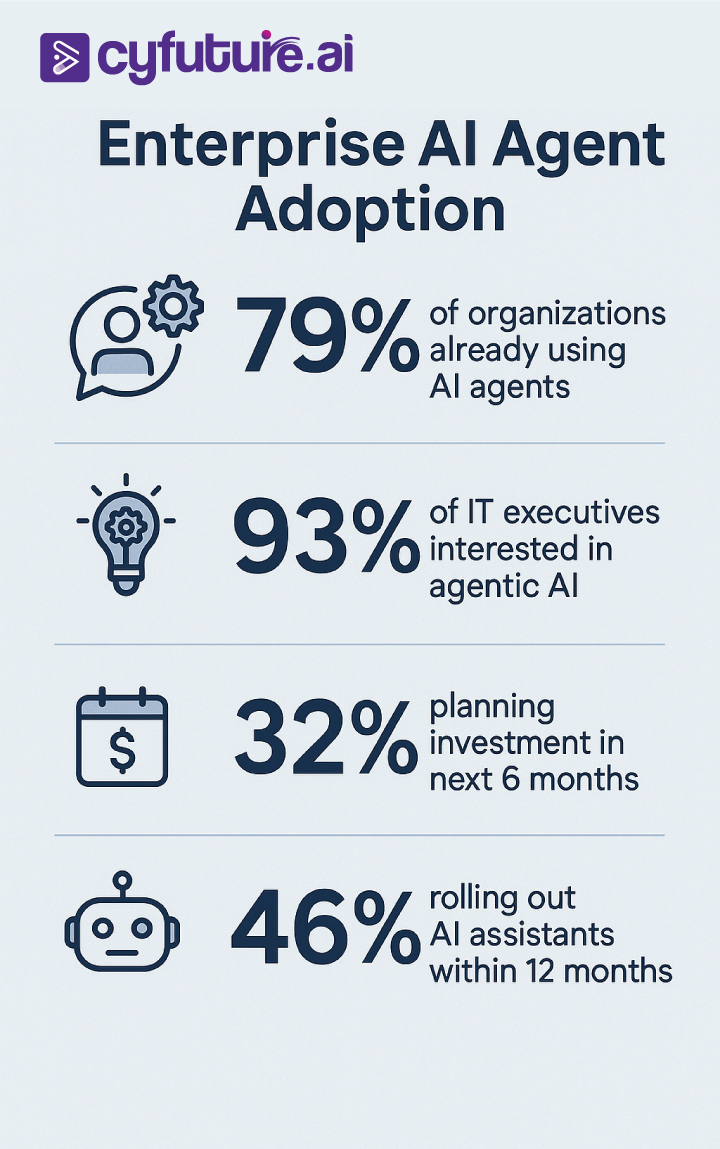
93% of IT executives express strong interest in agentic AI technology, with 32% planning to invest within the next six months. The adoption is accelerating rapidly—79% of organizations report they have already adopted AI agents to some extent.
ROI Reality
62% of organizations expect more than 100% return on investment from agentic AI deployment, with companies projecting an average ROI of 171%. These aren't speculative numbers—they're based on actual use cases delivering measurable results.
A leading consumer packaged goods company reduced costs by 95% and improved speed by 50x using intelligent agents to create blog posts, while a global bank reduced customer service costs by 10x with AI virtual agents.
Cyfuture AI's Edge in the Market
At Cyfuture AI, we've witnessed firsthand how properly architected AI agents transform business operations. Our platform has enabled enterprises to reduce operational overhead by 40% while maintaining the flexibility to scale agents across multiple departments. With our infrastructure supporting over 10,000 concurrent agent deployments, we've learned that success isn't just about the technology—it's about the architecture that supports it.
"The organizations that get this right early will have sustainable advantages that late movers simply can't replicate." - Industry Expert on AI Agent Implementation
Core Architecture Patterns: The Foundation of AI Agents
Understanding architecture is where most teams stumble. Let me break it down:
The Three Fundamental Components
AI agents in early 2025 commonly follow compound system architectures, where they're not monolithic entities but structures built around a foundation model (typically an LLM) augmented by external resources or modules, often referred to as "scaffolding."
Common architectural modules include: a Perception Module responsible for gathering input from the environment, a Processing/Decision-Making Module (the core "brain" that analyzes information and determines actions), and various supporting components for memory and tool interaction.
Single-Agent vs. Multi-Agent Systems
Here's where strategy meets technology:
Single-Agent Architecture:
- Simpler to implement and debug
- Lower infrastructure costs (3-10x difference)
- Ideal for focused, domain-specific tasks
- Limited scalability for complex workflows
Multi-Agent Systems: Frameworks like Microsoft AutoGen, AgentVerse, and LangGraph enable multi-agent orchestration through collaboration mechanisms like debate, voting, and task division, wrapping top models into agent collectives that cooperate to solve complex problems.
Memory Architecture: The Overlooked Critical Component
Memory separates functional agents from exceptional ones:
- Working Memory: Immediate context and active task state
- Episodic Memory: Historical interactions and past decisions
- Long-term Memory: Domain knowledge and learned patterns
By late 2024, architects emphasize modularity, event-driven communication, and stateful collaboration as core design principles for agent-based systems.
Top AI Agent Frameworks in 2026: Your Implementation Toolkit
The framework landscape has consolidated around proven solutions. Here's what actually works:
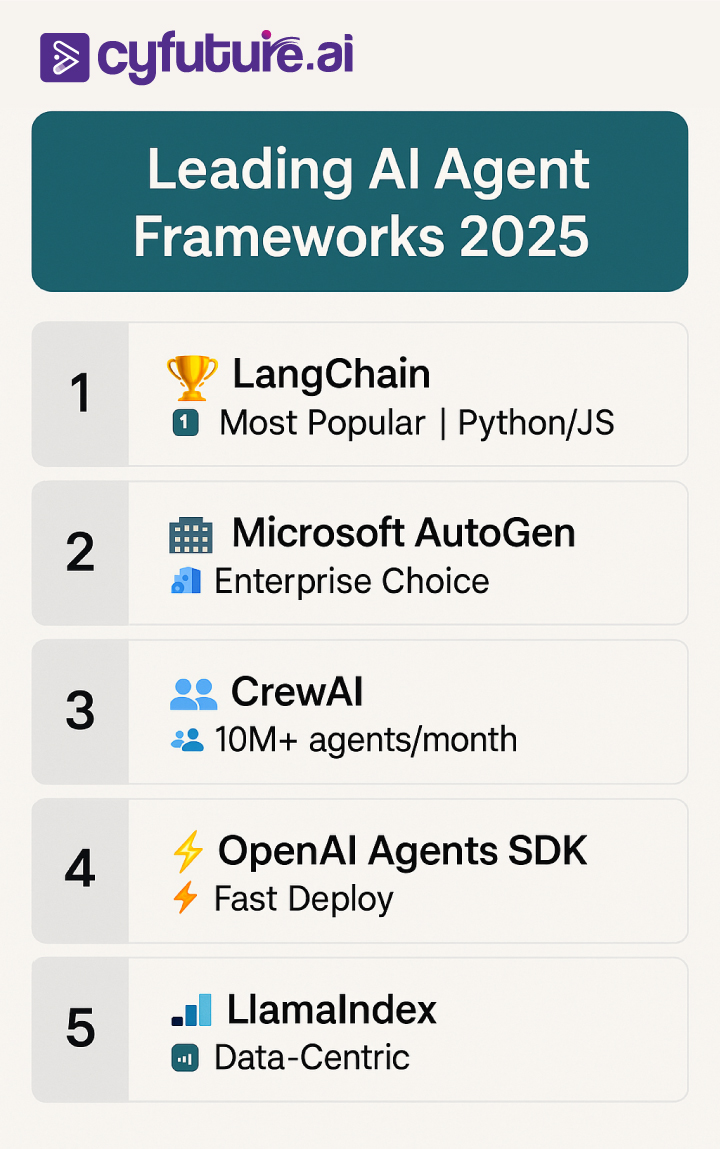
1. LangChain: The Swiss Army Knife
LangChain has emerged as a go-to framework for developers building LLM-powered applications, simplifying the handling of complex workflows with modular tools and robust abstractions that integrate with APIs, databases, and external tools.
Best for: Custom multi-agent workflows with extensive tooling needs Language: Python, JavaScript Strength: Composable architecture with vast integration ecosystem
2. Microsoft AutoGen: Enterprise Powerhouse
Microsoft AutoGen is an open-source framework that helps build and deploy AI agents that collaborate to solve complex problems, offering flexibility, scalability, and multi-agent conversation support.
Best for: Multi-agent systems requiring transparency and observability Strength: Cross-platform compatibility and enterprise integration
3. CrewAI: Role-Based Collaboration
CrewAI specializes in creating intelligent agents capable of collaborating, sharing tasks, and optimizing actions through real-time communication and decision-making, effectively managing multiple agents in a shared environment.
CrewAI's platform generates over 10 million agents monthly, with 40% of Fortune 500 companies using its AI agent crews as part of pilot projects.
Best for: Marketing teams, research departments, and coordinated workflows Strength: Low-barrier entry with visual builders
4. OpenAI Agents SDK: Minimalist Precision
OpenAI's Agents SDK introduces core primitives—agents, tools, handoffs, and guardrails—for building agents that interact, delegate, and complete tasks in structured workflows with a minimalist design.
Best for: Production-ready autonomous agents with strong guardrails Limitation: Currently tied closely to OpenAI models
5. LlamaIndex Agents: Data-Centric Excellence
Best for: Organizations focused on advanced data retrieval and analysis Strength: Enhanced tools for handling structured and unstructured data
Framework Selection Criteria
80% of teams are searching for simpler, more visual tools to leverage advanced AI systems, as the biggest hurdle remains the complexity of development.
Consider:
- Learning Curve: Time to productivity for your team
- Community Support: Documentation quality and active community
- Integration Needs: Compatibility with existing tech stack
- Scalability: Growth potential without architectural rewrites
Building Your First AI Agent: A Practical Blueprint
Let's get tactical. Here's how successful teams actually build agents:
Phase 1: Foundation (Weeks 1-2)
Define Clear Objectives: For most enterprises, starting with low- to medium-complexity use cases with repetitive tasks that require human intervention for domain knowledge allows teams to learn, iterate, and build trust while minimizing risk.
Select Your Framework: Based on:
- Team technical expertise
- Budget constraints (frameworks require larger upfront investment vs. provider solutions)
- Long-term customization needs
Phase 2: Data Preparation (Weeks 2-4)
Remove duplicates, correct inconsistencies, and normalize formats to ensure your agent learns from consistent examples, reducing noise and preventing the model from reinforcing bad patterns.
Critical Steps:
- High-accuracy data annotation
- Diversity in data selection (different customer profiles, scenarios)
- Bias mitigation strategies
- Ongoing retraining cycles
Phase 3: Core Development (Weeks 4-8)
Architecture Implementation:
1. Perception Layer
↓
2. LLM Processing Core
↓
3. Tool Integration Layer
↓
4. Memory Management System
↓
5. Action Execution Layer
Tool Integration: Centralized AI gateways or agent hubs emerged as a key development, providing platforms through which organizations manage, monitor, and deploy agents.
Phase 4: Testing & Iteration (Weeks 8-12)
Performance Metrics:
- Task completion accuracy
- Response latency
- Error rate and failure patterns
- User satisfaction scores
Use A/B testing to validate improvements before full rollout, letting performance data guide optimization decisions rather than relying on intuition alone.
Best Practices for Production-Ready AI Agents
Success isn't accidental. Here's what separates production systems from abandoned prototypes:
1. Start Narrow, Scale Strategically
"Start with one core feature that solves the main pain point, then expand based on user feedback." - Reddit Developer Community
82% of organizations plan to integrate AI agents by 2026, with most focusing initially on tasks like email generation, coding, and data analysis.
Also Check: Generative AI vs Agentic AI: Key Differences, Use Cases, and Future Impact
2. Implement Robust Guardrails
Deployments need guardrails and frameworks to scale without compromising trust, compliance, and security, with AI agent platforms addressing transparency, fragility, and trust problems through enterprise-grade APIs with governance frameworks.
Essential Guardrails:
- Input validation and sanitization
- Output filtering for harmful content
- Rate limiting and resource management
- Audit logging for compliance
3. Human-in-the-Loop Architecture
Klarna's "all-in" approach to AI customer service received customer blowback until it reintroduced human agents in the mix.
Balance is key:
- Critical decisions require human approval
- Agents handle routine operations autonomously
- Clear escalation paths for edge cases
4. Continuous Learning Systems
Conduct regular model retraining as business needs evolve and new data becomes available, with quarterly reviews at minimum to maintain accuracy and relevance.
Implementation Strategy:
- Monitor performance KPIs continuously
- Collect feedback from users and teams
- Retrain on regular cadence
- Validate with A/B testing before rollout
5. Context Window Management
Memory matters: Since Claude has no memory between completions, always include all relevant state in each request, sending the full conversation history each time for multi-turn flows.
For stateful applications like games or complex workflows, maintain complete state and history in every request.
6. Security-First Design
Critical Considerations:
- Prompt injection defense
- Data exfiltration prevention
- Compliance requirements (HIPAA, GDPR)
- Memory poisoning protection
7. Cost Optimization
AI-enabled workflows tripled their profit contribution, improving operating profit from 2.4% in 2022 to 3.6% in 2023 and 7.7% in 2024, with top-performing organizations achieving up to 18% ROI.
Cost Management Strategies:
- Model selection based on task complexity
- Efficient prompt engineering
- Caching frequently used responses
- Batch processing where possible
Real-World Implementation Patterns
Let me show you what's working right now:
Customer Service Automation
85% of customer service representatives at organizations using AI report it saves them time, as AI handles basic queries allowing human agents to focus on complex cases.
Implementation Pattern:
- Agent handles tier-1 support (70% of tickets)
- Escalates complex issues to humans
- Learns from resolution patterns
- Reduces response time by 50-75%
Software Development Assistance
Software development remained a prime area in early 2025, with agents developed for code generation, debugging, automated testing, code review, and documentation.
Key Applications:
- Automated code reviews
- Test generation
- Documentation creation
- Bug detection and fixing
Data Analysis & Research
Use Case: Reddit Research Agent
Companies like Webflow created agents that automatically report on brand mentions across social media and Reddit, providing sentiment analysis and insights without manual monitoring.
Sales & Marketing Operations
Instacart's sales team created an automated high-value outreach agent using Salesforce data, which doubled the number of new meetings booked without adding human headcount.
Common Pitfalls and How to Avoid Them
Let's talk about what goes wrong—and how to prevent it:
Pitfall #1: Over-Engineering from Day One
62% of enterprises exploring AI agents lack a clear starting point, while 41% still treat them as a side project.
Solution: Start with a single, well-defined use case. Prove value before scaling.
Pitfall #2: Ignoring Data Quality
"Poorly labeled data can misguide the learning process and undermine performance." - AI Implementation Expert
Solution: Invest 40% of development time in data preparation and cleaning.
Pitfall #3: Lack of Monitoring
32% of enterprises exploring AI agents stall after pilot and never reach production.
Solution: Implement comprehensive observability from day one. Track:
- Model performance metrics
- User satisfaction scores
- Error patterns and failure modes
- Cost per interaction
Pitfall #4: Vendor Lock-In
Solution: Build abstraction layers. LangChain is not tied to any single LLM provider, enabling flexibility in model selection.
The Future: What's Next for AI Agents
The trajectory is clear. Here's what's coming:
2025-2026: Mainstream Adoption
By 2025, 85% of enterprises will be using AI agents to enhance productivity, streamline operations, and improve customer interactions.
Deloitte predicts that 25% of companies using generative AI will launch agentic AI pilots in 2025, growing to 50% in 2027.
Advanced Capabilities on the Horizon
AI agents will offer hyper-personalized responses in 2025, with tools like Salesforce's Einstein GPT enabling agents to craft customized content based on user preferences, background, and context.
Emerging Trends:
- Multi-Agent Orchestration: Organizations will deploy multi-agent systems to manage business processes, with platforms like OpenAI Swarm and Microsoft's Magentic AI leading agent orchestration.
- Contextual Awareness: AI-powered data analytics will help agents anticipate user needs based on past behaviors and real-time data.
- Industry-Specific Agents: Specialized agents for healthcare, finance, legal, and manufacturing.
Cyfuture AI's Vision
At Cyfuture AI, we're not just following trends—we're shaping them. Our roadmap includes:
- Enhanced multi-agent coordination platforms
- Industry-specific agent templates
- Advanced security and compliance frameworks
- Seamless integration with existing enterprise systems
Our commitment: Making AI agents accessible, reliable, and transformative for businesses of all sizes.
Read More: Top 10 AI Agents That Will Transform Your Workflow This Year
Transform Your Operations with AI Agents Today
The window of opportunity is narrowing. Here's the truth:
46% of executives plan to introduce AI-driven assistants for human employees within the next 6-12 months. Your competitors aren't waiting. Neither should you.
Building AI agents from scratch requires:
✓ Clear architectural understanding
✓ The right framework for your needs
✓ Best practices from day one
✓ Continuous iteration and improvement
The good news? You don't have to figure it out alone.
Ready to build your first AI agent? Cyfuture AI provides the infrastructure, expertise, and support to turn your vision into reality. Our platform has powered thousands of successful agent deployments, delivering measurable ROI from day one.
The question isn't whether to build AI agents. It's whether you'll lead—or follow.
Take the next step. Transform your operations. Build with confidence.

Frequently Asked Questions (FAQs)
1. What's the difference between an AI agent and a chatbot?
A chatbot responds to queries using predefined rules or basic NLP. An AI agent reasons about complex situations, plans multi-step actions, uses external tools, maintains memory, and makes autonomous decisions to achieve goals. Agents are cognitive systems; chatbots are conversational interfaces.
2. How long does it take to build a production-ready AI agent?
For a focused use case with an experienced team using frameworks like LangChain or AutoGen, expect 8-12 weeks from concept to production. This includes data preparation, development, testing, and iteration. Complex multi-agent systems may require 4-6 months.
3. What are the typical costs involved in AI agent development?
Costs vary widely based on complexity. Expect:
- Framework-based custom development: $50,000-$200,000+ upfront
- Provider solutions: $5,000-$50,000/month ongoing
- Infrastructure: $1,000-$10,000/month (depending on scale)
- Maintenance: 15-20% of development costs annually
4. Which AI agent framework should I choose?
It depends on your needs:
- LangChain: Best for custom workflows with extensive integrations
- AutoGen: Ideal for enterprise multi-agent systems
- CrewAI: Great for teams wanting low-code options
- OpenAI Agents SDK: Perfect for production-ready single agents Choose based on team expertise, budget, and long-term scalability needs.
5. What are the most common use cases for AI agents?
Based on 2025 data:
- Customer service automation (handling 60% of interactions)
- Software development assistance (code generation, debugging)
- Data analysis and research
- Sales automation and lead qualification
- Content creation and marketing
- Process automation in HR and operations
6. How do I ensure my AI agent is secure and compliant?
Implement these practices:
- Input validation and sanitization
- Output filtering for harmful content
- Audit logging for all decisions
- Role-based access controls
- Regular security audits
- Compliance with GDPR, HIPAA, SOC 2
- Human oversight for critical decisions
7. What ROI can I expect from AI agent implementation?
62% of organizations expect more than 100% ROI, with companies projecting an average ROI of 171%. Realistic benefits include:
- 40-60% reduction in operational costs
- 50-75% faster response times
- 10x cost reduction in specific workflows
- 25-35% time efficiency gains ROI typically materializes within 6-12 months.
8. How do AI agents handle errors and unexpected situations?
Well-designed agents include:
- Error detection and classification
- Graceful degradation strategies
- Escalation protocols to human operators
- Logging for post-mortem analysis
- Continuous learning from mistakes
- Fallback responses for edge cases
9. Can AI agents work together in teams?
Yes. Multi-agent systems are rapidly advancing. Frameworks like Microsoft AutoGen enable multi-agent collaboration through debate, voting, and task division. Agents can specialize in different roles (researcher, writer, reviewer) and coordinate to solve complex problems.
Author Bio:
Meghali is a tech-savvy content writer with expertise in AI, Cloud Computing, App Development, and Emerging Technologies. She excels at translating complex technical concepts into clear, engaging, and actionable content for developers, businesses, and tech enthusiasts. Meghali is passionate about helping readers stay informed and make the most of cutting-edge digital solutions.