



 IND
IND UAE
UAE SA
SA


The year is 2026, and businesses worldwide are witnessing an unprecedented shift in customer engagement paradigms. Picture this: A customer reaches out at 2 AM with a critical query, your CRM automatically pulls their entire purchase history, your AI chatbot delivers a personalized response within 1.2 seconds, and simultaneously creates a support ticket if escalation is needed—all without human intervention. This isn't science fiction; it's the reality organizations are building today through sophisticated AI chatbot integration.
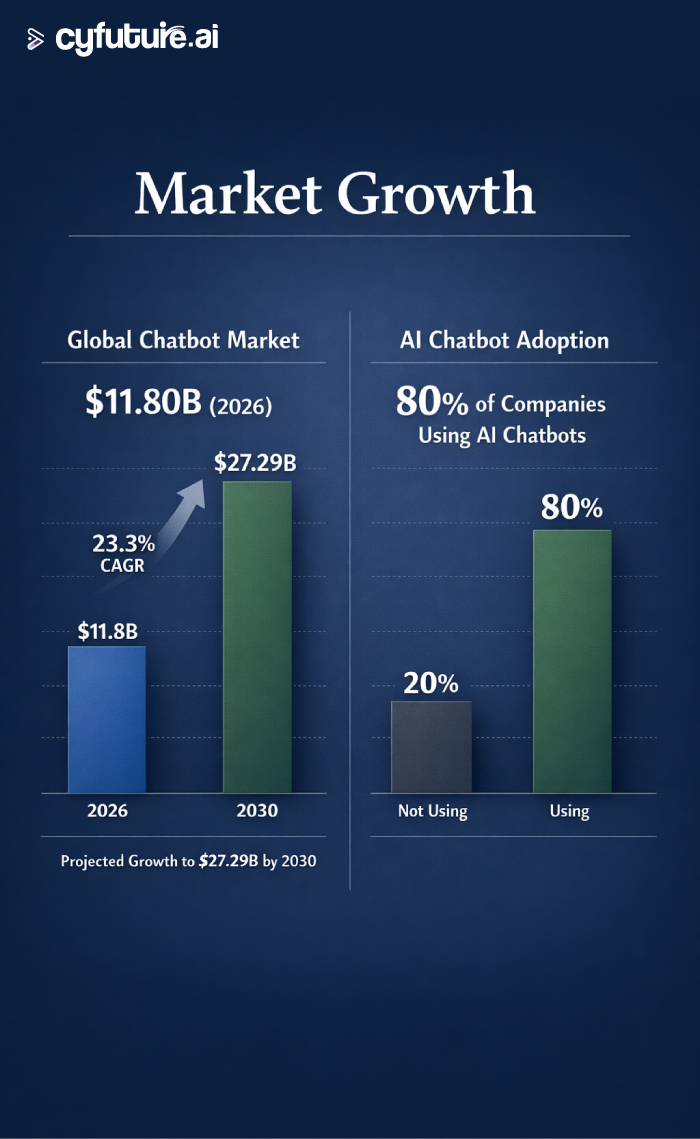
With the global chatbot market projected to reach $11.80 billion in 2026 and an explosive trajectory toward $27.29 billion by 2030, the integration of AI chatbots across enterprise systems has become mission-critical for organizations seeking competitive advantage. Recent data reveals that 80% of companies have already implemented or are planning to adopt AI-powered chatbots for customer service, while 95% of customer interactions are expected to be AI-powered by 2025.
Understanding AI Chatbot Integration Architecture
AI chatbot integration represents a sophisticated convergence of natural language processing, machine learning algorithms, and enterprise system connectivity. At its core, integration involves establishing bidirectional communication channels between chatbot engines and existing business infrastructure—enabling real-time data synchronization, contextual awareness, and automated workflow orchestration.
Core Technical Components
The foundation of successful chatbot integration rests on three pillars: API connectivity layers that facilitate seamless data exchange, middleware systems that translate chatbot requests into system-readable commands, and webhook implementations that trigger real-time event notifications. Leading organizations are achieving 35% improvement in customer satisfaction scores through well-executed CRM integration strategies.
Modern chatbot architectures leverage large language models capable of processing multimodal inputs—text, images, voice, and documents. According to industry research, the multimodal AI market is projected to reach $4.5 billion by 2028, with 40% of generative AI solutions incorporating multimodal capabilities by 2027. This technological evolution enables chatbots to understand context with unprecedented accuracy, achieving diagnostic accuracy rates of 79.6% when combining text and image analysis.
CRM Integration: Building Unified Customer Intelligence
Customer Relationship Management integration represents the most transformative application of AI chatbot technology. When chatbots connect directly with CRM platforms like Salesforce, HubSpot, or Zoho, they gain immediate access to comprehensive customer profiles, interaction histories, and behavioral patterns.
Technical Implementation Framework
Successful CRM chatbot integration follows a structured approach. Organizations must first establish secure API connections using OAuth 2.0 authentication protocols. The middleware layer then maps chatbot intents to specific CRM operations—customer record retrieval, lead creation, opportunity updates, or case management. Statistics show that 83% of CRM leaders report enhanced customer service response times following AI integration, with 92% of CRM professionals citing improved response times from AI adoption.
The integration enables sophisticated use cases: automated lead qualification, where chatbots collect prospect information and score leads based on predefined criteria; personalized customer engagement, where bots reference past interactions to deliver contextual responses; and proactive outreach, where CRM triggers initiate chatbot conversations based on customer behavior patterns. Organizations implementing these capabilities report conversion rate improvements of up to 30% and see businesses with AI chatbots achieving 3x better conversion rates than those using traditional website forms.
Data Synchronization and Workflow Automation
Real-time data synchronization ensures that every customer interaction updates the CRM instantly. When a chatbot captures a new lead, the information flows directly into the CRM system, triggering automated workflows—assignment to sales representatives, enrollment in nurture campaigns, or scheduling follow-up tasks. This bidirectional flow eliminates manual data entry, reduces human error, and ensures consistent customer data across all touchpoints.
Cyfuture AI's advanced integration capabilities excel in this domain, offering pre-built connectors for major CRM platforms alongside customizable integration frameworks. Our solution processes over 12,600 automated scans using AI systems to ensure data integrity and compliance with regulatory requirements.
Ticketing System Integration: Intelligent Support Orchestration
Integrating AI chatbots with ticketing platforms like Zendesk, Freshdesk, or ServiceNow creates an intelligent support ecosystem that dramatically enhances operational efficiency. Research indicates that AI chatbots can handle 80% of routine customer inquiries, with 95% of simple queries being resolved autonomously.
Multi-Tier Resolution Strategy
The integration implements a sophisticated escalation framework. First-tier resolution occurs when chatbots autonomously resolve common issues using knowledge base content, achieving resolution rates of 67% for leading implementations. When queries exceed chatbot capabilities, the system seamlessly creates support tickets, automatically populating them with conversation context, customer information, and preliminary troubleshooting steps.
Advanced implementations leverage AI to analyze ticket sentiment and urgency, dynamically routing issues to appropriate support specialists. Organizations report 40% reduction in ticket resolution times and 30% faster response times through automation. The chatbot continuously learns from resolved tickets, expanding its resolution capabilities and reducing future ticket volumes.
Knowledge Base Synchronization
Effective ticketing integration requires continuous synchronization with organizational knowledge bases. Chatbots monitor frequently asked questions, identify knowledge gaps, and automatically suggest content updates. This creates a virtuous cycle—better content enables higher autonomous resolution rates, which reduces agent workload and improves customer satisfaction. Companies implementing these strategies report 96% customer satisfaction scores and handle significantly higher inquiry volumes without proportional increases in support staff.
WhatsApp Integration: Conversational Commerce at Scale
WhatsApp Business API integration has emerged as a critical channel for customer engagement, with over 2 billion active users making it the world's most popular messaging platform. However, organizations must navigate evolving platform policies—Meta's 2026 policy updates prohibit general-purpose AI chatbots while explicitly permitting business-focused implementations for customer support, booking systems, and transactional updates.
Technical Integration Process
WhatsApp chatbot integration requires Meta Business verification and API access provisioning. Organizations establish webhook connections that receive incoming messages, process them through the chatbot engine, and deliver responses via the WhatsApp Cloud API or Business Solution Provider platforms. The integration supports rich media—images, documents, location sharing, and quick reply buttons—enabling sophisticated conversational experiences.
Statistics demonstrate compelling business value: 83% of customers use messaging apps like WhatsApp to inquire about products, with 75% subsequently making purchases. Organizations deploying WhatsApp chatbots report 15% increases in conversion rates during peak shopping periods and 20-30% reductions in cart abandonment through strategic re-engagement campaigns.
Compliance and Best Practices
Organizations must adhere to WhatsApp's strict message template policies and opt-in requirements. Customer-initiated conversations enable 24-hour response windows for free-form messaging, while business-initiated messages require pre-approved templates. Successful implementations balance automation with personalization, using chatbots for immediate response while seamlessly transferring complex inquiries to human agents. The platform charges based on conversation categories—authentication, marketing, utility, and service—requiring careful conversation design to optimize costs.
Cyfuture AI's WhatsApp integration framework ensures full compliance with Meta's 2026 policy updates while delivering sophisticated automation capabilities that drive measurable business outcomes.
Website Integration: Conversational User Experience
Website chatbot integration transforms passive browsing into interactive engagement. Modern implementations extend beyond simple embedded chat widgets to encompass intelligent visitor tracking, behavioral triggering, and personalized content delivery.
Implementation Architecture
Website integration typically involves JavaScript embedding that initializes the chatbot interface while establishing secure connections to backend services. Advanced implementations leverage visitor analytics—tracking page views, time on site, scroll depth, and interaction patterns—to trigger contextual chatbot engagements at optimal moments.
Research shows that site visitors who engage with high-intent chatbot messages prove 5x more likely to convert into qualified opportunities. Organizations implementing proactive engagement strategies—triggering chatbots when visitors show exit intent or spend extended time on pricing pages—report significant improvements in lead capture rates.
Technical Optimization Strategies
Performance optimization remains critical for website chatbot success. Implementations must minimize page load impact through asynchronous script loading and lazy initialization. The chatbot interface should adapt responsively across desktop, tablet, and mobile devices while maintaining consistent functionality. Integration with website analytics platforms enables comprehensive measurement of chatbot impact on key metrics—bounce rates, time on site, and conversion events.
Leading implementations incorporate visual AI capabilities, enabling chatbots to understand screenshots, analyze error messages, and provide contextual assistance within applications. These capabilities have proven particularly valuable for SaaS platforms and e-commerce sites, where visual guidance significantly enhances user experience.
Integration Best Practices and Security Considerations
Successful AI chatbot integration demands meticulous attention to architecture, security, and continuous optimization. Organizations must implement robust authentication mechanisms, encrypt data in transit and at rest, and maintain strict access controls for sensitive customer information.
Technical Architecture Principles
Scalable integration architectures leverage microservices design patterns, enabling independent scaling of chatbot components based on demand. Message queuing systems ensure reliable delivery even during traffic spikes, while caching strategies reduce database load and improve response times. Organizations should implement comprehensive logging and monitoring to track system performance, identify bottlenecks, and detect anomalies.
API rate limiting and throttling protect backend systems from overload while ensuring fair resource allocation. Implementations must include graceful degradation mechanisms—when integrated systems become unavailable, chatbots should acknowledge the issue and provide alternative support channels rather than failing silently.
Data Privacy and Compliance
With increasingly stringent data protection regulations—GDPR in Europe, CCPA in California, and emerging frameworks globally—chatbot integrations must implement privacy-by-design principles. This includes obtaining explicit consent for data collection, providing transparent privacy policies, enabling data portability, and supporting right-to-deletion requests.
Organizations must carefully evaluate data flows, ensuring that customer information shared with chatbot platforms complies with contractual agreements and regulatory requirements. Particular attention should be paid to cross-border data transfers and third-party service provider agreements.
Measuring Integration Success: Key Performance Indicators
Effective chatbot integration requires comprehensive measurement frameworks that track both technical performance and business outcomes. Organizations should establish baseline metrics before integration and continuously monitor improvements.
Technical Performance Metrics
Key technical indicators include average response time (industry-leading implementations achieve 1-2 second responses), API availability (target 99.9% uptime), error rates (maintain below 1% for production systems), and conversation success rates (measure percentage of conversations achieving user intent).
Business Impact Metrics
Business-focused measurements encompass customer satisfaction scores (leading implementations report 87.2% positive chatbot experiences), cost per interaction (averaging $0.50 for chatbot interactions versus $6.00 for human support), first contact resolution rates (top performers achieve 95% autonomous resolution for routine queries), and revenue impact (organizations report up to 200% ROI from chatbot deployments).
Leading organizations conduct regular conversation analysis, identifying failure patterns, detecting emerging customer needs, and optimizing conversation flows. Machine learning models continuously improve chatbot performance, with implementations showing measurable accuracy improvements over time.
Future Trends: The Evolution of AI Chatbot Integration
The chatbot integration landscape continues evolving rapidly, with several transformative trends emerging for 2026 and beyond. Agentic AI represents the next frontier—autonomous agents capable of multi-step reasoning, proactive problem-solving, and independent action-taking within defined parameters. Gartner predicts that 40% of enterprise applications will feature task-specific AI agents by 2026, up from less than 5% in 2025.
Voice-enabled chatbot integration is gaining momentum, with implementations supporting natural language voice interactions across phone systems, smart speakers, and mobile applications. The convergence of chatbots with augmented reality creates immersive support experiences, while blockchain integration enables secure, verifiable transactions directly within conversation flows.
Organizations are also exploring emotional intelligence capabilities, where chatbots detect user sentiment and adapt communication styles accordingly. These systems analyze tone, word choice, and conversation patterns to identify frustrated customers and escalate appropriately, ensuring optimal support experiences.
Conclusion: Strategic Imperatives for 2026
AI chatbot integration has transcended from experimental technology to business-critical infrastructure. Organizations that excel in integration strategy—connecting chatbots seamlessly with CRM platforms, ticketing systems, messaging channels, and websites—gain significant competitive advantages through enhanced customer experience, operational efficiency, and scalable growth.
The technical complexity of integration should not deter organizations. With sophisticated platforms like Cyfuture AI providing pre-built connectors, visual integration builders, and expert implementation support, businesses of all sizes can deploy enterprise-grade chatbot solutions. Our platform's ability to process 33% of new code through auto-generation significantly accelerates implementation timelines while maintaining quality standards.
As we progress through 2026, the question is not whether to integrate AI chatbots, but how quickly and effectively organizations can execute their integration strategies. The data is unequivocal—companies implementing comprehensive chatbot integration report dramatic improvements across all key metrics, from customer satisfaction to operational costs to revenue growth.
The future belongs to organizations that embrace conversational AI not as an isolated tool, but as an integrated ecosystem that amplifies human capabilities, delivers exceptional customer experiences, and drives sustainable business value.
Frequently Asked Questions
Q1: What are the primary challenges in AI chatbot integration with existing systems?
The main challenges include ensuring data synchronization accuracy, managing authentication and security protocols, handling API rate limits, and maintaining system performance during peak loads. Organizations must also address data privacy compliance, legacy system compatibility, and user adoption barriers. Successful integration requires comprehensive planning, robust testing frameworks, and ongoing optimization based on performance metrics.
Q2: How long does it typically take to implement comprehensive chatbot integration across CRM, ticketing, and messaging platforms?
Implementation timelines vary based on organizational complexity and customization requirements. Basic integrations with pre-built connectors can be operational within 2-4 weeks. Comprehensive implementations involving multiple systems, custom workflows, and extensive training data typically require 8-12 weeks. Organizations should allocate additional time for user acceptance testing, staff training, and gradual rollout to ensure smooth adoption.
Q3: What security measures are essential for chatbot integration in enterprise environments?
Critical security measures include end-to-end encryption for data transmission, OAuth 2.0 authentication for API access, role-based access controls for sensitive information, regular security audits and penetration testing, and compliance with industry-specific regulations (HIPAA for healthcare, PCI-DSS for payment processing). Organizations should implement comprehensive logging, monitor for unusual activity patterns, and maintain incident response procedures.
Q4: How can organizations measure the ROI of AI chatbot integration investments?
ROI measurement should encompass both cost savings and revenue impact. Key metrics include reduction in support agent workload (quantified by hours saved), decreased average handling time, lower cost per interaction, improved conversion rates, increased customer lifetime value, and enhanced customer satisfaction scores. Organizations should establish baseline metrics before implementation and track improvements over 6-12 month periods, accounting for implementation costs, licensing fees, and ongoing maintenance expenses.
Author Bio:
Meghali is a tech-savvy content writer with expertise in AI, Cloud Computing, App Development, and Emerging Technologies. She excels at translating complex technical concepts into clear, engaging, and actionable content for developers, businesses, and tech enthusiasts. Meghali is passionate about helping readers stay informed and make the most of cutting-edge digital solutions.