



 IND
IND UAE
UAE SA
SA


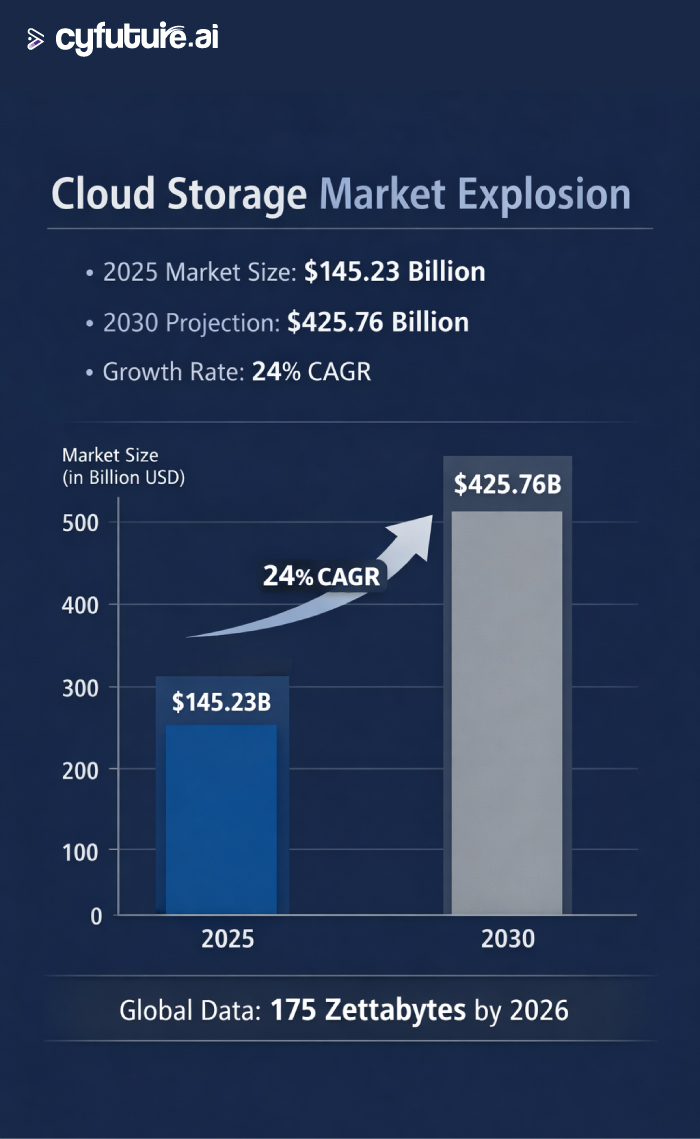
Picture this: The global cloud storage market reached USD 145.23 billion in 2025 and is projected to surge at a 24% CAGR to USD 425.76 billion by 2030. This isn't just growth—it's a fundamental transformation in how enterprises, developers, and organizations manage their most critical asset: data. With global data creation expected to reach 175 zettabytes by 2026, the question isn't whether to adopt cloud storage, but how to choose the right solution for your specific needs.
The explosion in AI workloads, remote work infrastructure, and digital transformation initiatives has pushed cloud storage from a convenience to a strategic imperative. Whether you're a tech leader optimizing infrastructure costs, a developer building scalable applications, or an enterprise architecting a multi-cloud strategy, understanding the nuanced landscape of cloud storage services has never been more critical.
Understanding Cloud Storage: Core Features That Matter in 2026
Storage Tier Architecture
Modern cloud storage operates on sophisticated tiering systems designed to optimize both performance and cost:
Hot Storage serves frequently accessed data with millisecond latency, ideal for production databases, active applications, and real-time analytics workloads. SaaS remains the largest cloud layer, valued at around USD 250 billion in 2025, driving significant demand for high-performance hot storage.
Cool Storage balances cost and accessibility for infrequently accessed data, such as monthly reports, seasonal datasets, and backup archives. This tier typically offers retrieval within seconds to minutes at 30-50% lower costs than hot storage.
Cold/Archive Storage provides the most economical option for long-term retention, compliance archives, and disaster recovery scenarios, with retrieval times measured in hours but costs as low as $0.001 per GB per month for solutions like Amazon Glacier Deep Archive.
Scalability and Performance Metrics
Enterprise-grade cloud storage delivers on-demand scalability without the capital expenditure of traditional infrastructure. Public Cloud accounted for 45.7% of market share in 2026 due to its scalability and cost-effectiveness, while hybrid cloud emerges as the fastest-growing segment for organizations requiring flexibility and data control.
Performance characteristics vary significantly:
- Object Storage excels at handling unstructured data with virtually unlimited scalability
- Block Storage delivers consistent low-latency for database workloads and virtual machines
- File Storage provides shared access with familiar hierarchical structures for collaborative environments
Security and Compliance Framework
Zero-trust architecture has become the baseline for cloud storage security in 2026. Leading providers implement multiple security layers including encryption at rest and in transit, identity-first access controls, immutable audit logs, and automated threat detection.
Compliance certifications matter increasingly for regulated industries. Enterprise solutions now routinely support SOC 2, HIPAA, GDPR, FedRAMP, and industry-specific frameworks, with built-in data residency controls for sovereign cloud requirements.
Pricing Deep Dive: AWS vs Azure vs Google Cloud Platform
Market Share and Positioning
AWS leads the market with a 32% share, Microsoft Azure holds 20%, and Google Cloud Platform captures 13% of global cloud spending. Together, these hyperscalers command approximately 65% of the market, but their pricing strategies differ significantly.
Storage Pricing Comparison
For the first terabyte of standard storage in US East regions:
Amazon S3 offers tiered pricing starting at approximately $0.023 per GB/month for standard storage, with automatic cost reduction as volume scales. AWS covers 38 geographic regions with 120 Availability zones, providing extensive global reach.
Azure Blob Storage positions competitively at $0.020-$0.022 per GB/month for hot tier storage, with aggressive volume discounts and reserved capacity options that can reduce costs by 20-30%.
Google Cloud Storage typically starts at $0.020 per GB/month for standard class storage across 42 cloud regions and 127 zones available in 200+ countries, with per-second billing providing potential cost advantages for variable workloads.
Read More: Cloud Storage Providers Compared: Finding the Right Fit
Hidden Cost Considerations
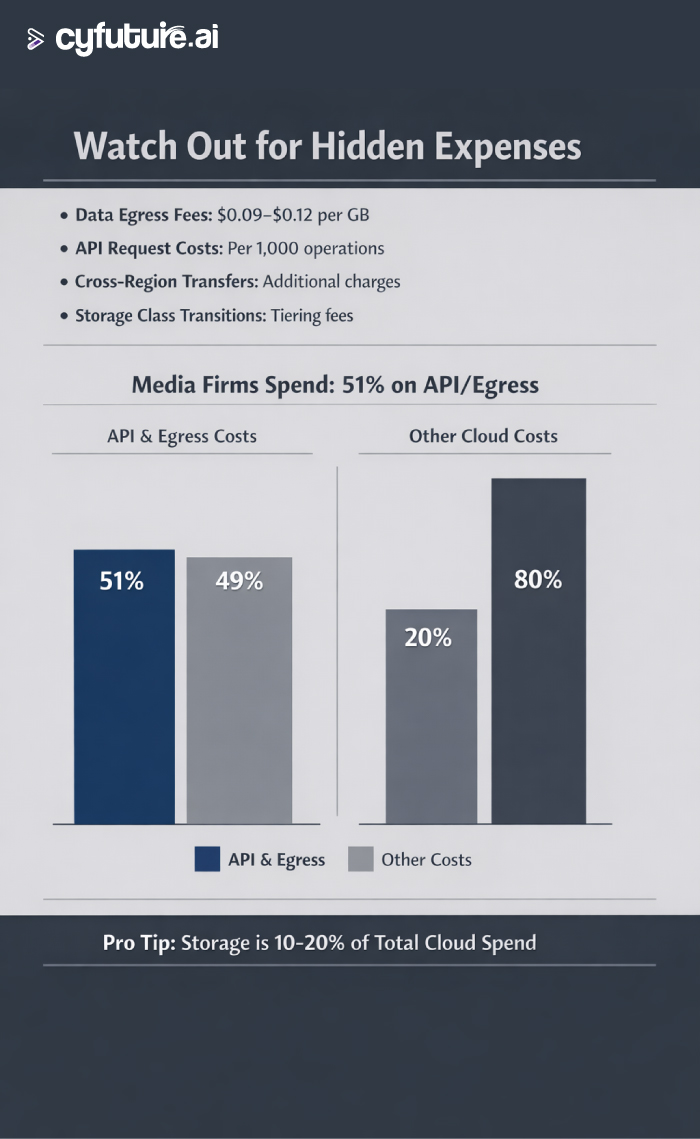
The true cost of cloud storage extends beyond list prices. Cloud storage costs typically represent 10% to 20% of total cloud spending, but several factors can inflate actual expenses:
Data Egress Fees represent one of the most significant hidden costs. While inbound data transfer is typically free, outbound transfers cost $0.09-$0.12 per GB depending on the provider and destination. Cross-region and cross-availability-zone transfers add additional charges.
API Request Costs accumulate rapidly in high-transaction environments. PUT, POST, and GET requests are billed per thousand operations, potentially adding substantial costs for applications with frequent small file operations.
Storage Class Transition Fees apply when moving data between tiers, though intelligent tiering services can automate optimization while minimizing transition costs.
Cyfuture AI Advantage
Cyfuture AI distinguishes itself in the competitive cloud storage landscape through cost-effective solutions that reduce infrastructure expenses by up to 30% compared to direct hyperscaler engagement. Our managed services expertise enables enterprises to optimize storage architectures across multiple providers while maintaining performance SLAs and compliance requirements.
Enterprise Use Cases: Where Cloud Storage Drives Business Value
AI and Machine Learning Workloads
Generative AI workloads are multiplying enterprise data volumes by an order of magnitude, with storage footprints for single training runs scaling from 30 TB in 2025 to 100 TB by 2030. Object storage becomes essential for managing training datasets, model checkpoints, and inference results.
Vector databases for retrieval-augmented generation (RAG) require high-throughput storage with low-latency access. Organizations increasingly leverage cloud-native storage with built-in versioning and immutability for reproducible ML experiments and model governance.
Hybrid and Multi-Cloud Architectures
90% of enterprises now operate hybrid or multi-cloud strategies, with hybrid cloud spending reaching $235 billion in 2026. This architectural pattern enables organizations to maintain sensitive data on-premises while leveraging cloud elasticity for burst capacity and disaster recovery.
Storage gateways provide seamless integration between on-premises environments and cloud object storage, enabling transparent tiering and cloud-based backup without application modification.
Media and Content Distribution
Media and gaming studios plan to raise storage budgets in 2025, with 97% increasing investment as streaming and real-time rendering expand. Cloud gaming's rapid growth requires distributed caches maintaining sub-50ms latency across regions.
Content delivery networks integrate with cloud storage to optimize global distribution, automatically caching popular content closer to end users while maintaining master copies in cost-effective storage tiers.
Business Continuity and Disaster Recovery
Immutable backups stored in geographically dispersed cloud regions provide protection against ransomware, natural disasters, and regional outages. Modern backup-as-a-service solutions automate protection policies, retention management, and recovery orchestration.
Cross-region replication ensures business continuity with RPO (Recovery Point Objective) and RTO (Recovery Time Objective) measured in minutes rather than hours, critical for mission-critical applications.
Big Data Analytics and Data Lakes
Cloud object storage serves as the foundation for data lakes supporting petabyte-scale analytics. Enterprise cloud infrastructure spending reached USD 330 billion in 2024, representing a USD 60 billion year-over-year increase, largely driven by data platform expansion.
Query-in-place capabilities enable analytics tools to process data directly from storage without expensive ETL operations, reducing time-to-insight while controlling costs through storage tiering.
Regional Growth Dynamics and Market Evolution
Asia Pacific Expansion
Asia Pacific charts a 24.98% CAGR with China's cloud spending hitting USD 46 billion in 2025. Government digitization programs and sovereign cloud mandates drive adoption, with India's cloud market targeting USD 25 billion by 2026.
Local data residency requirements accelerate regional cloud infrastructure buildout, with hyperscalers and domestic providers expanding capacity to meet compliance demands.
Also Check: 10 Signs Your Business Needs to Switch to Object Storage
North American Leadership
Nearly 70% of businesses in North America implemented multi-cloud strategies in 2024, with the region investing over USD 25 billion in cloud infrastructure by 2025. AI model training and remote collaboration tools drive demand for scalable, high-performance storage.
Enterprise adoption focuses on hybrid architectures balancing regulatory compliance with cloud elasticity, particularly in healthcare and financial services where data governance remains paramount.
European Compliance-Driven Growth
GDPR and data localization mandates shape European cloud storage adoption, with organizations prioritizing local providers and regional availability zones. European cloud service providers like OVHcloud are gaining market share by offering GDPR-compliant alternatives to US-based hyperscalers.
Sovereign cloud frameworks ensure data remains within jurisdictional boundaries while maintaining interoperability with global networks, critical for government and regulated industries.
Cyfuture AI: Your Strategic Cloud Storage Partner
Cyfuture AI brings over a decade of cloud infrastructure expertise, helping enterprises navigate the complex landscape of cloud storage services. Our platform-agnostic approach enables optimal provider selection based on workload requirements rather than vendor lock-in.
We deliver tangible business outcomes through intelligent storage architecture design, automated cost optimization that reduces spending by 25-40%, and comprehensive managed services ensuring 99.99% availability SLAs. Our AI-powered analytics provide continuous optimization recommendations, identifying opportunities for tiering, compression, and deduplication that traditional management approaches miss.
Selecting the Right Cloud Storage Strategy
Choosing optimal cloud storage requires aligning technical requirements with business objectives:
Workload Characteristics determine storage tier selection. Transactional databases demand low-latency block storage, while batch analytics benefit from cost-effective object storage with high throughput.
Data Lifecycle Management automates transitions between storage tiers based on access patterns, balancing performance requirements with cost optimization.
Geographic Requirements influence provider and region selection, considering data residency regulations, latency to end users, and disaster recovery objectives.
Integration Ecosystem matters increasingly in cloud-native architectures. S3 API compatibility has become the de facto standard, enabling application portability across providers.
Total Cost of Ownership extends beyond storage pricing to include data transfer, operations, management overhead, and opportunity costs of performance limitations.
Future-Proofing Your Cloud Storage Architecture
The cloud storage landscape continues rapid evolution. Edge computing integration brings storage closer to data sources for IoT and industrial applications. Kubernetes-native storage systems simplify container-based deployments with dynamic provisioning and automated lifecycle management.
Sustainability considerations gain prominence, with providers offering carbon-aware placement and renewable energy commitments. Green cloud initiatives are expected to offset approximately 50% of emissions by 2030.
Artificial intelligence increasingly optimizes storage operations, predicting access patterns, automating tiering decisions, and identifying cost optimization opportunities through ML-driven analytics.
Organizations that succeed will treat cloud storage as strategic infrastructure requiring continuous optimization rather than one-time deployment. Investment in platform engineering, FinOps practices, and observability ensures alignment between storage spending and business value.

Frequently Asked Questions
Q: How do I determine the right storage tier for my workload?
A: Analyze access patterns over time. Data accessed daily belongs in hot storage for optimal performance. Data accessed monthly or quarterly suits cool storage, balancing cost and retrieval speed. Archive storage fits compliance data and long-term backups accessed rarely. Most workloads benefit from intelligent tiering that automatically moves data based on access patterns, optimizing costs without manual intervention.
Q: What's the real cost difference between cloud storage providers?
A: List prices appear similar, but total cost varies significantly based on usage patterns. Data egress fees, API request charges, and cross-region transfers can double actual costs. Media firms spend 51% of storage budgets on API calls and egress traffic. Evaluate complete TCO including transfer costs, operations fees, and management overhead. Multi-cloud strategies can optimize by placing workloads based on provider strengths and pricing models.
Q: How does cloud storage security compare to on-premises?
A: Modern cloud storage implements zero-trust architecture with encryption at rest and in transit, identity-based access controls, and immutable audit logs. Leading providers achieve SOC 2, ISO 27001, and industry-specific certifications. The shared responsibility model means providers secure infrastructure while customers manage data classification, access policies, and encryption keys. Cloud providers invest billions in security expertise and infrastructure that most organizations cannot match internally.
Q: Can I migrate between cloud storage providers easily?
A: Provider migration requires planning but is increasingly streamlined. S3 API compatibility enables application portability across providers supporting this standard. Data transfer remains the primary challenge—egress fees and bandwidth limitations can make large-scale migration expensive and time-consuming. Multi-cloud storage gateways and data fabric solutions abstract provider differences, enabling gradual migration or ongoing multi-cloud operations. Plan migrations during low-traffic periods and leverage parallel transfer tools to minimize downtime.
Author Bio:
Meghali is a tech-savvy content writer with expertise in AI, Cloud Computing, App Development, and Emerging Technologies. She excels at translating complex technical concepts into clear, engaging, and actionable content for developers, businesses, and tech enthusiasts. Meghali is passionate about helping readers stay informed and make the most of cutting-edge digital solutions.