


 IND
IND UAE
UAE SA
SA


Are You Searching for a Comprehensive Understanding of Enterprise AI Cloud Solutions?
Enterprise AI Cloud Solutions represent the convergence of artificial intelligence technologies with cloud computing infrastructure, enabling organizations to deploy, scale, and manage AI workloads without massive upfront capital investments. These solutions encompass machine learning platforms, natural language processing services, computer vision capabilities, and agentic AI systems delivered through scalable, pay-as-you-go cloud architectures that democratize access to enterprise-grade AI capabilities.
The transformation is already here:
Here's the thing...
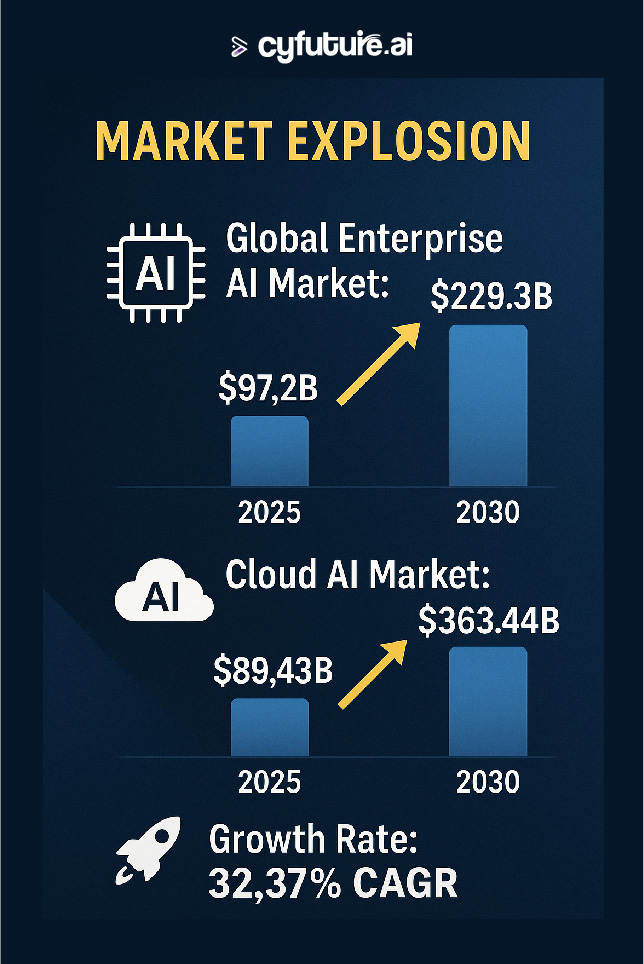
The global enterprise AI market has reached a staggering $97.2 billion in 2025 and is projected to explode to $229.3 billion by 2030, growing at an impressive 18.9% CAGR. But what's driving this unprecedented growth? And more importantly, how can your organization harness this revolution without drowning in complexity or cost overruns?
This comprehensive guide cuts through the noise. Whether you're a tech leader evaluating AI platforms, a developer building AI-powered applications, or an enterprise decision-maker concerned about ROI and security, you'll find actionable insights backed by the latest data, real-world statistics, and proven strategies.

Introduction: The Enterprise AI Cloud Revolution
The enterprise technology landscape is undergoing a seismic shift. Traditional on-premises infrastructure is giving way to intelligent, cloud-based AI platforms that promise unprecedented agility, scalability, and innovation velocity.
Consider this sobering reality: While 90% of organizations have deployed AI systems, only 5% feel confident in their security readiness. This gap between adoption and preparedness represents both the challenge and opportunity of our time.
The stakes couldn't be higher. Companies leveraging AI effectively are seeing returns as high as $10.30 for every dollar invested, according to IDC research. Yet, 42% of companies abandoned most of their AI projects in 2025—up dramatically from just 17% the previous year—citing cost overruns and unclear value propositions.
This guide will help you navigate these treacherous waters by examining:
- The current state and explosive growth trajectory of enterprise AI cloud markets
- Critical deployment models and their respective advantages
- Security challenges that keep CISOs awake at night
- ROI optimization strategies that separate winners from failures
- Implementation frameworks that actually work in production
Let's begin with the fundamentals.
What is Enterprise AI Cloud?
Enterprise AI Cloud refers to cloud-based platforms and services that provide organizations with on-demand access to artificial intelligence capabilities, including machine learning model training, natural language processing, computer vision, predictive analytics, and automated decision-making systems. These platforms eliminate the need for organizations to build and maintain expensive on-premises AI infrastructure while offering enterprise-grade security, compliance, and scalability.
The architecture typically includes:
1. Infrastructure Layer: High-performance computing resources, specialized GPU clusters (like NVIDIA A100s and H100s), and distributed storage systems optimized for massive datasets.
2. Platform Layer: Development frameworks (TensorFlow, PyTorch, scikit-learn), MLOps tooling for model deployment and monitoring, and automated pipeline orchestration.
3. Application Layer: Pre-built AI services for common use cases—chatbots, recommendation engines, fraud detection, predictive maintenance, and document processing.
4. Governance Layer: Security controls, compliance frameworks, data sovereignty management, and ethical AI guidelines.
Here's what makes it powerful...
Unlike traditional enterprise software that simply digitizes existing processes, Enterprise AI Cloud fundamentally reimagines how organizations operate by introducing autonomous decision-making, predictive capabilities, and adaptive learning systems that improve over time.
The Explosive Growth: Market Size and Projections
The numbers tell a compelling story:
Current Market Landscape (2025)
Cloud-based AI solutions command 69% of the enterprise AI market share, reflecting economies of scale and sophisticated tooling that would be prohibitively expensive to replicate on-premises. The cloud AI market specifically reached $89.43 billion in 2025 and is expected to surge to $363.44 billion by 2030, representing a remarkable 32.37% CAGR.
But here's where it gets interesting:
Hybrid and edge architectures are actually growing faster—at 24.05% CAGR through 2030—as organizations demand low-latency inference and tighter data control for sensitive workloads. This bifurcation suggests the future isn't "cloud vs. on-premises" but rather "intelligent orchestration across all environments."
Regional Dominance and Investment Patterns
North America controlled 41.50% of 2024 enterprise AI market revenue, fueled by hyperscaler capital expenditures exceeding $75 billion annually. Microsoft alone invested approximately $80 billion in AI-enabled data centers during fiscal year 2025 to support burgeoning demand.
Technology-Specific Growth Drivers
Natural Language Processing (NLP) dominated with the largest segment share in 2024, driven by explosive adoption of generative AI, chatbots, and automated customer service. Meanwhile, enterprise agentic AI—autonomous systems capable of multi-step workflows—is experiencing meteoric 47.2% CAGR growth, jumping from $3.6 billion in 2024 to a projected $171 billion by 2034.
The cloud service giants are responding aggressively:
- AWS logged $29.3 billion in Q1 2025 revenue, powered by over 1,000 generative AI projects in development
- Google Cloud achieved 28% top-line growth, reflecting traction for domain-tuned foundation models and in-house TPUs
- IBM accelerated enterprise GenAI transformation in August 2025, announcing capabilities to build AI agents in just 5 minutes
Deployment Models: Choosing Your Path
Not all cloud AI implementations are created equal. Understanding the three primary deployment models is critical to aligning technology choices with business requirements.
Cloud-Based Deployment (Dominant: 65.8% market share)
The Case For: Cloud deployment offers unmatched scalability, rapid time-to-market, and elimination of capital expenditure hurdles. Organizations can access cutting-edge AI capabilities—from GPT-4 class models to specialized computer vision APIs—without managing underlying infrastructure.
Key advantages include:
- Pay-as-you-go economics that align costs with usage
- Automatic scaling to handle variable workloads
- Access to latest model updates and capabilities
- Global distribution and low-latency endpoints
- Managed security and compliance certifications
The Complications: However, costs can spiral unpredictably with high usage. One financial services client we examined saw cloud API expenses increase 340% quarter-over-quarter as their AI-powered fraud detection scaled. Additionally, data sovereignty concerns persist, particularly for regulated industries in healthcare and finance.
Research shows that 82% of small and medium-sized businesses report genuine cost savings after cloud adoption, primarily from avoiding infrastructure capital expenditure. Yet large enterprises processing 500M+ tokens monthly often find investment breakeven for sovereign AI infrastructure occurs at just 12-18 months, making on-premises economically superior at scale.
On-Premises Deployment
The Strategic Rationale: Organizations handling sensitive data—patient health records, financial transactions, proprietary research—often require complete control over their AI infrastructure. On-premises deployment enables:
- Absolute data sovereignty and airgapped security
- Compliance with stringent regulatory requirements (GDPR, HIPAA, SOC 2)
- Sub-100ms latency for real-time applications
- Elimination of recurring cloud consumption costs at scale
- Prevention of data exfiltration to third-party model providers
The ROI Equation: New research from Enterprise Strategy Group reveals that deploying AI on-premises with Dell AI Factory and NVIDIA infrastructure can yield 1,225% four-year ROI and nearly $26 million in cost savings for mid-to-large enterprises. The platform proved 62% more cost-effective than public cloud and 75% more cost-effective than API-based services for sustained workloads.
The catch? Significant upfront capital investment, requirement for specialized in-house expertise, and slower adoption of latest model innovations compared to cloud providers' continuous updates.
Hybrid Deployment (The Pragmatic Middle Ground)
90% of organizations will adopt hybrid cloud approaches by 2027 according to Gartner predictions, recognizing that different workloads have different optimal deployment locations.
A typical hybrid architecture might include:
- Cloud: Development/testing environments, variable workload applications, and access to latest foundation models
- On-Premises: Production systems processing sensitive data, latency-critical applications, and high-volume inference workloads
- Edge: Manufacturing quality control, autonomous systems, IoT device intelligence requiring real-time processing
Manufacturers deploy edge devices to flag defects in milliseconds, cutting scrap rates and unplanned downtime. Healthcare providers run diagnostic imaging AI on-premises for HIPAA compliance while using cloud services for research and development.
The key is intelligent orchestration—federated learning spreads model training across local nodes, ensuring regional privacy compliance while preserving global model accuracy.
ROI Optimization: Turning Investment into Returns
The promise of AI ROI is real—but realizing it requires discipline, measurement, and strategic alignment.
The ROI Reality Check
The median enterprise AI ROI stands at just 5.9%, according to IBM Institute for Business Value research, despite billions in investment. This disappointing figure stems from:
- Weak data infrastructure preventing effective model training
- Lack of clear use case definition and success metrics
- Poor integration with existing business processes
- Underestimation of change management requirements
- Inadequate measurement and tracking mechanisms
But top performers tell a different story...
Leading organizations achieve returns of $10.30 for every dollar invested in AI, with some specialized implementations delivering even higher returns. The difference? They follow proven optimization frameworks.
ROI Optimization Framework
1. Strategic Alignment: Companies integrating AI into innovation strategies can potentially triple market cap compared to those limited to modernization efforts. Start by identifying high-impact use cases where AI creates measurable business value:
- Revenue generation (personalized recommendations, predictive sales, dynamic pricing)
- Cost reduction (process automation, predictive maintenance, supply chain optimization)
- Risk mitigation (fraud detection, cybersecurity, compliance monitoring)
- Customer experience enhancement (conversational AI, sentiment analysis, personalization)
2. Comprehensive TCO Calculation: Total Cost of Ownership extends beyond obvious software licensing:
- Initial costs: Integration, customization, data migration, training
- Ongoing costs: Compute/storage consumption, model retraining, maintenance, support
- Hidden costs: Data quality remediation, model drift monitoring, compliance overhead
- Opportunity costs: Internal team time diverted from other initiatives
3. Realistic Payback Expectations: Based on 2025 benchmark data:
- Small enterprises (50-200 developers): 150%-250% ROI over three years, payback in 12-18 months
- Mid-market firms (200-1000 developers): 200%-400% ROI, payback in 8-15 months
- Large enterprises (>1000 developers): 300%-600% ROI, payback in 6-12 months
Organizations with extensive AI security automation achieve $1.9 million savings per breach and reduce incident lifecycles by 80 days—highlighting the compounding value of well-implemented AI.
4. Measurable KPIs: Establish clear metrics before deployment:
Hard ROI Metrics:
- Labor cost reductions (hours saved × fully-loaded hourly rate)
- Revenue uplift (increased sales, improved conversion rates)
- Error rate improvements (quality defects prevented × cost per defect)
- Processing time reductions (transactions/hour improvement × value per transaction)
Soft ROI Metrics:
- Employee satisfaction and retention
- Customer satisfaction scores (NPS, CSAT)
- Faster decision-making velocity
- Competitive positioning and market share
5. Pilot-Scale-Optimize Approach: Use actual production data in pilot projects to validate assumptions before full-scale deployment. One insurance company implemented AI claims triage:
- Benefits: 20,000 adjuster hours saved annually ($800,000) + $500,000 fraud prevention = $1.3M/year
- Costs: $1M upfront + $200K/year ongoing = $1.2M Year 1, $200K thereafter
- ROI: Payback in 13 months, 565% five-year ROI
The Volume Threshold Decision
A critical strategic question: cloud APIs vs. sovereign infrastructure?
Research shows investment breakeven occurs at 12-18 months for workloads processing 500M+ tokens monthly. Organizations exceeding this threshold capture compounding savings as usage scales, while those below benefit from API flexibility without capital commitment.
However, strategic considerations beyond pure economics—data sovereignty, compliance requirements, vendor independence—often justify on-premises deployment even for lower-volume workloads.
Industry-Specific Applications
Enterprise AI Cloud finds unique expression across sectors:
Financial Services (18.9% market share)
- Fraud detection: Real-time transaction monitoring with 99%+ accuracy
- Credit risk modeling: Alternative data integration for underserved populations
- Algorithmic trading: High-frequency pattern recognition
- Customer service: Conversational AI handling routine inquiries
- Regulatory compliance: Automated reporting and anomaly detection
AI could contribute up to 13.6% of GCC's GDP through banking alone by 2030, indicating massive efficiency gains.
Healthcare (Highest growth: 36.50% CAGR)
- Diagnostic imaging: Radiology AI achieving human-expert accuracy
- Drug discovery: Molecular modeling accelerating R&D by 40-60%
- Clinical decision support: Evidence-based treatment recommendations
- Administrative automation: Prior authorization, billing, scheduling
- Patient monitoring: Wearable integration and early warning systems
97% of business enterprises are actively investing in AI and big data, with healthcare leading adoption.
Manufacturing
- Predictive maintenance: IoT sensor analysis preventing unplanned downtime
- Quality control: Computer vision detecting defects in milliseconds
- Supply chain optimization: Demand forecasting and inventory management
- Robotic process automation: Assembly, packaging, material handling
- Energy optimization: Smart power consumption and waste reduction
Retail and E-Commerce
- Personalization engines: Product recommendations driving 20-30% revenue uplift
- Inventory optimization: Demand prediction reducing stockouts and overstock
- Dynamic pricing: Real-time price optimization based on demand signals
- Customer service: Virtual shopping assistants and support chatbots
- Fraud prevention: Transaction monitoring and risk scoring
Future Trends: What's Coming Next
The enterprise AI cloud landscape continues evolving at breakneck pace. Here's what to watch:
1. Agentic AI Explosion
Enterprise agentic AI—autonomous systems executing multi-step workflows—is growing at 47.2% CAGR, reaching $171 billion by 2034. These AI agents will move beyond reactive assistance to proactive problem-solving:
- Self-healing IT infrastructure
- Autonomous procurement and vendor negotiation
- Intelligent process orchestration across departments
- Adaptive cybersecurity response
88% of organizations implementing agentic AI report positive ROI, with faster deployment and production readiness than traditional AI.
2. Edge and Hybrid Acceleration
70-75% of new enterprise AI applications will deploy primarily in cloud, but hybrid architectures pacing at 24.05% CAGR reflect growing need for edge intelligence:
- 5G-enabled real-time processing
- Federated learning for privacy-preserving collaboration
- Smart cities and IoT intelligence
- Autonomous vehicles and robotics
3. Regulatory Maturity
Following EU AI Act enforcement, expect comprehensive regulatory frameworks globally. Organizations must embed compliance by design:
- Automated audit trails and explainability
- Risk classification and impact assessments
- Mandatory human oversight for high-stakes decisions
- Transparency requirements for consumer-facing AI
4. Open Source Democratization
Open-source frontier models (Llama, Mistral, DeepSeek) are narrowing the gap with proprietary offerings, enabling:
- Sovereign AI deployments without vendor lock-in
- Customization for domain-specific needs
- Reduced per-inference costs by 70-90%
- Community-driven innovation and rapid improvement
5. No-Code/Low-Code AI
AI democratization through no-code platforms will become essential, engaging the "long tail" of enterprises:
- Citizen data scientists building custom models
- Drag-and-drop ML pipeline construction
- Pre-built industry templates and accelerators
- Automated feature engineering and hyperparameter tuning
IBM's announcement in August 2025 that enterprises can build AI agents in 5 minutes exemplifies this trend toward radical simplification.
Frequently Asked Questions (FAQs)
1. What is the difference between Enterprise AI and regular AI?
Enterprise AI refers to artificial intelligence solutions specifically designed for business use with requirements like:
- Enterprise-grade security, compliance, and governance
- Integration with existing business systems (ERP, CRM, HR)
- Scalability to handle large user bases and data volumes
- Service level agreements (SLAs) and support guarantees
- Audit trails and explainability for regulatory compliance
Regular AI might be consumer-focused applications or research prototypes lacking these business-critical features.
2. How much does Enterprise AI Cloud implementation cost?
Costs vary dramatically based on deployment model and scale:
- Cloud API Services: $0.002-$0.12 per 1,000 tokens for inference; training costs $50-$500/hour for GPU clusters
- Platform Subscriptions: $5,000-$50,000/month for enterprise AI platforms with included compute credits
- On-Premises Infrastructure: $500,000-$5M upfront capital expenditure; breakeven at 12-18 months for high-volume workloads
- Professional Services: $150-$400/hour for integration, customization, training
Cyfuture Cloud offers flexible pricing models including on-demand, reserved instances, and custom enterprise agreements starting with free trial credits.
3. How long does it take to see ROI from Enterprise AI investments?
Based on 2025 benchmarks:
- Small enterprises: 12-18 months payback period
- Mid-market companies: 8-15 months payback
- Large enterprises: 6-12 months payback
However, 42% of companies abandon AI projects due to unrealistic expectations. Success requires:
- Clear use case definition with measurable KPIs
- Strong data foundation and governance
- Proper change management and user adoption
- Continuous optimization and iteration
Organizations with AI-specific strategies and infrastructure readiness see ROI 2-3x faster.
4. Is cloud AI secure enough for sensitive enterprise data?
Cloud AI can be highly secure when properly implemented:
- Encryption: At rest, in transit, and during processing
- Access controls: Zero trust, least privilege, MFA
- Compliance certifications: SOC 2, ISO 27001, HIPAA, PCI-DSS
- Isolated environments: VPCs, private endpoints, dedicated tenancy
- Advanced protections: Encrypted inference, federated learning, differential privacy
However, 64% of organizations lack full visibility into AI risks, and 47% have no AI-specific security controls. Success requires:
- Comprehensive AI security framework implementation
- Vendor security posture assessment
- Data classification and handling policies
- Regular security audits and penetration testing
For highly sensitive workloads, hybrid deployment with on-premises processing of regulated data offers maximum control.
Also Check: AI Cloud vs On-Prem AI Labs: Pros, Cons, and Use Cases
5. What skills do I need in my team to implement Enterprise AI?
A successful AI team requires:
- Data Scientists: Model development, algorithm selection, experimentation
- ML Engineers: Production deployment, MLOps, infrastructure
- Data Engineers: Pipeline development, data quality, integration
- AI Architects: System design, technology selection, strategy
- Security Specialists: AI-specific security controls, compliance
- Domain Experts: Business context, use case identification, requirements
The global shortage of 3.5 million cybersecurity positions by 2025 creates talent constraints. Many organizations address this through:
- Managed AI services (like Cyfuture's 24/7 support with dedicated solution architects)
- Upskilling existing staff through training programs
- AI-powered tools that augment human capabilities (70% effectiveness improvement)
- Partnerships with AI consulting firms
6. How do I prevent Shadow AI in my organization?
Combat Shadow AI through:
- Governance policies: Clear AI usage guidelines and approved tool lists
- Easy alternatives: Provide sanctioned AI tools meeting user needs
- Education: Train employees on AI risks and proper usage
- Monitoring: Implement browser-based security monitoring unsanctioned AI access
- Enforcement: Block high-risk AI tools while allowing productive alternatives
Organizations without Shadow AI controls face $670,000 additional breach costs from unauthorized AI deployments. 59.9% of AI/ML transactions were blocked by enterprises in 2025, indicating widespread recognition of risks.
7. Should I choose cloud, on-premises, or hybrid AI deployment?
Decision factors:
Choose Cloud if:
- Variable or unpredictable workloads requiring elastic scaling
- Limited upfront capital budget
- Need for rapid deployment and experimentation
- Access to latest models and continuous updates important
- Global distribution requirements
Choose On-Premises if:
- Processing 500M+ tokens monthly (breakeven at 12-18 months)
- Strict data sovereignty or compliance requirements
- Sub-100ms latency critical for applications
- Vendor independence and cost predictability desired
Choose Hybrid (90% of organizations by 2027) if:
- Different workload types with varying requirements
- Need for both innovation velocity and data control
- Regulated and non-regulated data requiring separation
- Cost optimization through intelligent workload placement
8. What are the biggest mistakes organizations make with Enterprise AI?
Common pitfalls:
- Technology-first approach: Deploying AI without clear business use case
- Poor data quality: "Garbage in, garbage out" remains true
- Inadequate security: Leaving AI systems exposed to attacks and data leaks
- Underestimating change management: Technical success ≠ business success
- Unrealistic expectations: Expecting immediate ROI without proper foundation
- Vendor lock-in: Choosing platforms without exit strategy
- Ignoring ethics: Deploying biased or unexplainable systems
- Insufficient monitoring: Not tracking model drift and degradation
The 5.9% median enterprise AI ROI reflects these mistakes. Top performers systematically avoid these traps through disciplined implementation frameworks.
Read More: Top 10 AI Cloud Providers in India
9. How is AI regulation affecting Enterprise AI Cloud adoption?
The EU AI Act (enforced February 2025) established global precedent:
- Risk-based classification: Prohibited, high-risk, limited-risk, minimal-risk tiers
- Conformity assessments: Required for high-risk systems (hiring, credit scoring, medical)
- Transparency mandates: Disclosure when interacting with AI systems
- Human oversight requirements: For autonomous decision-making
55% of organizations are unprepared for AI regulatory compliance, risking:
- Massive fines (up to 6% of global revenue for EU violations)
- Reputational damage and customer trust erosion
- Operational disruptions from forced system shutdowns
- Legal liability from AI-driven decisions
Organizations operating globally must design for most stringent jurisdictional requirements, making EU compliance the practical baseline. Proactive governance frameworks with automated compliance monitoring provide competitive advantage.
Author Bio:
Meghali is a tech-savvy content writer with expertise in AI, Cloud Computing, App Development, and Emerging Technologies. She excels at translating complex technical concepts into clear, engaging, and actionable content for developers, businesses, and tech enthusiasts. Meghali is passionate about helping readers stay informed and make the most of cutting-edge digital solutions.