



 IND
IND UAE
UAE SA
SA


Are You Exploring How AI Fine-Tuning Can Transform Your Industry?
AI fine-tuning represents the strategic adaptation of pre-trained artificial intelligence models to specific organizational needs, enabling businesses to achieve superior performance in specialized tasks without the prohibitive costs of building models from scratch. This sophisticated approach involves training existing foundation models on domain-specific datasets, allowing organizations to harness the power of cutting-edge AI while maintaining relevance to their unique operational requirements and industry contexts.
The landscape of artificial intelligence deployment has fundamentally shifted:
Here's what's happening right now:
In 2024, 78% of organizations reported using AI in their operations—up from 55% just a year before. But generic AI models aren't enough anymore. The real competitive advantage lies in fine-tuning these models for industry-specific applications.
The number of new foundation models is doubling year over year, creating more choices of pre-trained models to fine-tune. This explosion of options means that businesses across every sector now have unprecedented opportunities to customize AI for their specific needs.
And the results?
They're staggering. By 2025, AI will help banks save up to $340 billion a year and add $450 billion in revenue. Healthcare organizations are deploying AI at more than twice the rate of the broader economy. Retail giants are seeing revenue increases of 10-12% through AI adoption.
What is AI Fine-Tuning?
AI fine-tuning is the process of taking a pre-trained foundation model—one that has already learned patterns from massive datasets—and further training it on a smaller, specialized dataset specific to a particular domain, task, or organization. Unlike building AI models from scratch, which requires millions of data points and enormous computational resources, fine-tuning leverages existing knowledge and adapts it efficiently.
Think of it this way: A general language model understands grammar and semantics, but it doesn't inherently know medical terminology or legal jargon. Through fine-tuning, organizations can retrain these models to recognize specialized terms and handle industry-specific tasks with remarkable accuracy.
Foundation models tailored to specific industries (finance, healthcare, law) are being released, which can be fine-tuned with far less data for those domains. This democratization of AI capabilities means even smaller organizations can now compete with tech giants.

The State of AI Fine-Tuning in 2025: Market Dynamics
The numbers tell a compelling story:
Market Growth Trajectory:
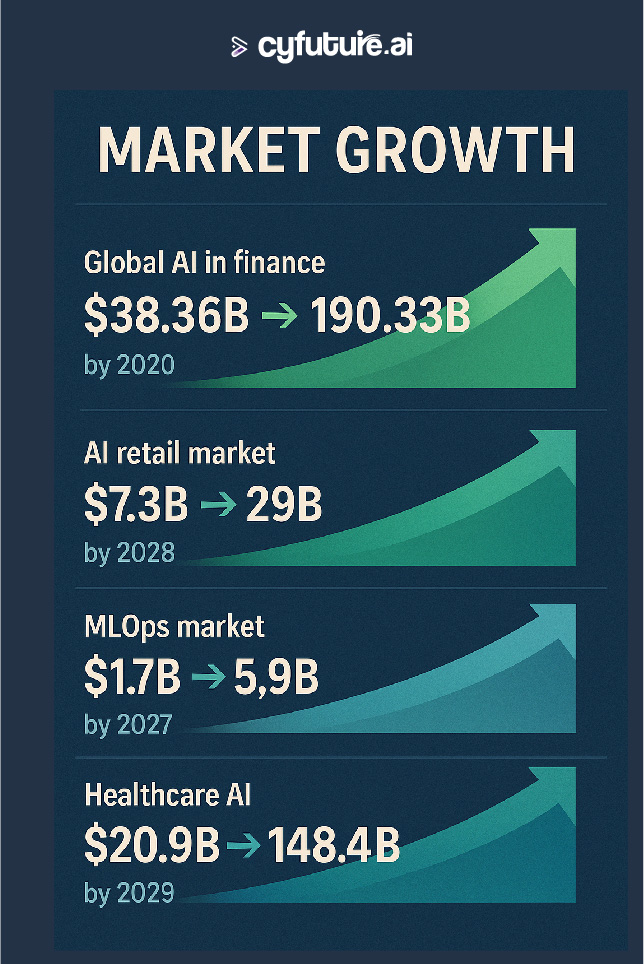
- The global AI in finance market stands at $38.36 billion in 2024 and is projected to reach $190.33 billion by 2030, growing at an impressive 30.6% CAGR
- The AI in retail market is expected to grow from $7.3 billion in 2023 to more than $29 billion by 2028, a compound annual growth rate of more than 30 percent
- The global MLOps market is growing from $1.7 billion in 2024 to a projected $5.9 billion by 2027, representing a compound annual growth rate of 37.4%
Adoption Acceleration:
- 71% of organizations regularly use generative AI in at least one business function, up from 65% in early 2024
- 22% of healthcare organizations have implemented domain-specific AI tools, a 7x increase over 2024 and 10x over 2023
- 58% of finance functions are using AI in 2024 - a rise of 21 percentage points from 2023
Top Use Cases of AI Fine-Tuning Across Industries
1. Healthcare: Precision Medicine and Clinical Excellence
The healthcare sector has emerged as America's AI powerhouse. Healthcare went from 3% adoption to becoming America's AI powerhouse in just two years, with health systems leading the charge at 27%, outpacing outpatient facilities (18%) and payers (14%).
Key Applications:
Medical Imaging Analysis: Google's Gemini model, fine-tuned for healthcare, showed improved performance on the benchmark for the U.S. Medical Licensing Exam–style questions at 91.1%. Fine-tuned models are detecting conditions from X-rays, MRIs, and CT scans with accuracy surpassing human experts.
Clinical Documentation: Healthcare providers account for roughly 75% of AI investment, or about $1 billion of the total spend, with the majority going toward easing administrative headaches, including clinical documentation ($600 million) and coding and billing automation ($450 million).
Drug Discovery: 66% of pharma and biotech companies surveyed are leading the charge in experimental AI across the drug development lifecycle by zeroing in on building or fine-tuning proprietary models.
Impact Statistics:
- The AI healthcare market will be worth $20.9 billion in 2024 and is projected to expand at a CAGR of 48.1% to $148.4 billion by 2029
- In 2023, the U.S. FDA approved 223 AI-powered medical devices, up from just 6 in 2015
- AI is expected to manage over 85% of customer interactions in healthcare by 2025
"As a doctor, it's thrilling to be part of this era at Google, where we can bring our most powerful technology to improve health." - Dr. Karen DeSalvo, Google's Chief Health Officer
2. Finance and Banking: Intelligent Risk Management
Financial institutions are at the forefront of AI adoption. In 2024, 75% of banking leaders reported having already deployed or being in the process of deploying GenAI.
Key Applications:
Fraud Detection: AI-driven fraud detection systems are now in use by 87% of global financial institutions. In 2025, these systems are intercepting 92% of fraudulent activities before transaction approval. Real-time fraud detection using AI has led to a 41% drop in financial losses due to cyberattacks.
Credit Scoring and Risk Assessment: Fine-tuned AI models analyze borrower financial behavior to determine creditworthiness more accurately than traditional methods. Machine learning models process large datasets in real time, identifying patterns that reveal hidden risks.
Personalized Banking: Four out of five banks worldwide are enhancing their processes with AI. AI-powered assistants like Bank of America's Erica help customers manage transactions, monitor account activity, and achieve savings goals with personalized experiences.
Investment Advisory: AI is anticipated to contribute between $200 billion and $340 billion annually to the global banking sector by 2025, primarily through enhanced productivity and operational efficiencies.
Impact Statistics:
- Financial sector's spending on AI is projected to grow from 35 billion U.S. dollars in 2023 to 97 billion U.S. dollars in 2027, representing a CAGR of 29 percent
- The Generative AI market in banking is projected to grow from $1.16 billion in 2024 to $3.39 billion by 2029 at a CAGR of 23.9%
- AI is expected to save banks up to $1 trillion globally by 2030
"With their data-rich and language-heavy operations, financial services businesses are uniquely positioned to capitalise on AI developments and have been doing so for years." - Industry Expert
3. Retail and E-Commerce: Hyper-Personalized Shopping
The retail revolution is powered by fine-tuned AI models that understand consumer behavior at unprecedented levels.
Key Applications:
Personalized Recommendations: During 2024 holiday shopping, 19% of all online orders, worth $229 billion, were highly influenced by personalized recommendations.
Inventory Management: JD logistics relied on AI algorithms to forecast sales during a Black Friday campaign, managing successfully the 70% increase in overseas outbound orders with an accuracy rate exceeding 95%.
Customer Service Automation: 80% of retail and ecommerce businesses use AI chatbots or plan to use them in the near future. 93% of customer questions are resolved without human intervention when handled through conversational AI.
Dynamic Pricing: Walmart and Amazon use AI price optimization capabilities to fine-tune their existing pricing strategies, maximizing revenue while meeting customer expectations.
Fraud Prevention: AI-powered fraud detection will save businesses $11 billion annually by the end of 2024.
Also Check: Top 10 Benefits of Fine Tuning AI for Industry Specific Tasks
Impact Statistics:
- The global AI-enabled eCommerce market is valued at $8.65 billion in 2025 and is expected to reach $22.60 billion by 2032 at a CAGR of 14.60%
- Companies leveraging AI are seeing an average revenue increase of 10-12%
- The global conversational commerce market is valued at $8.8 billion in 2025
- Voice commerce will be a $80 billion market by 2025
4. Manufacturing: Predictive Excellence
Manufacturing is experiencing a transformation through fine-tuned AI models optimized for production environments.
Key Applications:
Predictive Maintenance: Fine-tuned models detect anomalies in machine data early, improving uptime and enhancing Overall Equipment Effectiveness (OEE) metrics. This reduces unexpected downtime and extends equipment lifespan.
Quality Control: AI-powered visual inspection systems, fine-tuned on specific defect patterns, can identify microscopic flaws that human inspectors might miss.
Supply Chain Optimization: About 90% of large companies have tried using AI in their supply chains, and 29% say they plan to invest significantly in this area over the next three years. The AI in the supply chain market is projected to reach $11.73 billion in 2025, up from $9.15 billion in 2024.
Impact Statistics:
- The manufacturing sector will likely see the greatest benefit from AI, with a projected gain of $3.8 trillion by 2035
- The automotive sector has witnessed a 48% rise in the adoption of machine learning
5. Customer Service: Intelligent Support Systems
Fine-tuned conversational AI models are revolutionizing customer service across industries.
Key Applications:
Multi-Language Support: Models fine-tuned for specific languages and dialects provide authentic, culturally appropriate customer interactions.
Industry-Specific Knowledge: Netflix saved $1 billion by adopting machine learning technology. Fine-tuned models understand product catalogs, company policies, and industry regulations.
Sentiment Analysis: AI systems detect customer emotions and escalate to human agents when necessary, improving satisfaction rates.
Impact Statistics:
- AI is expected to improve employee productivity by 40%
- One-fourth of the travel and hospitality industry companies have adopted chatbot technology
Cyfuture AI: Your Partner in AI Transformation
At Cyfuture AI, we understand that successful AI implementation requires more than just technology—it demands strategic vision, industry expertise, and robust infrastructure. Our platform empowers organizations to:
- Deploy Fine-Tuned Models Efficiently: Leverage our optimized infrastructure for rapid model deployment
- Scale with Confidence: Our solutions grow with your business needs, from pilot projects to enterprise-wide implementations
With Cyfuture AI's comprehensive suite of AI services, businesses have achieved measurable results: improved operational efficiency, enhanced customer experiences, and significant cost savings. Our clients benefit from cutting-edge technology combined with industry-specific expertise, ensuring that AI implementations deliver tangible business value.
Challenges and Considerations in AI Fine-Tuning
Data Quality and Bias
The quality of training data directly impacts model performance. Organizations must ensure datasets are representative, unbiased, and compliant with data protection regulations.
Overfitting Risks
Fine-tuned models can become too specialized, losing their ability to generalize to new scenarios. Regular testing and validation are essential.
Resource Requirements
Only 14 percent of companies are fully ready to integrate AI into their business, despite recognizing its urgency. Organizations need expertise in handling large language models and their underlying infrastructure.
Regulatory Compliance
U.S. federal agencies issued 59 new AI-related rules in 2024—double the previous year's total. Staying compliant with evolving regulations is crucial.
Read More: AI Fine-Tuning Explained: Techniques, Tools & Benefits
Future Trends: What's Next for AI Fine-Tuning?
Smaller, More Efficient Models
By the end of 2024, AI systems delivering GPT-3.5-level performance cost over 280 times less per inference than they did in late 2022. This democratization enables smaller organizations to implement sophisticated AI solutions.
Edge AI Deployment
Edge AI deployment is experiencing remarkable growth, with the market valued at $20.78 billion in 2024 and growing at 21.7% annually. By 2025, 74% of global data will be processed outside traditional data centers.
Domain-Specific Foundation Models
Industry-tailored foundation models will emerge, requiring minimal fine-tuning for specialized applications.
Autonomous AI Systems
Conversational banking, powered by AI interfaces, is anticipated to take off in 2025, making digital interactions more natural and engaging with an expected push towards autonomous finance.
Key Success Factors for AI Fine-Tuning
- Clear Use Case Alignment: Select applications that directly address specific business problems with measurable outcomes
- Stakeholder Engagement: Ensure leadership support, user adoption, and cross-functional collaboration
- Iterative Development: Start with proof-of-concept projects and scale successful implementations
- Performance Monitoring: Continuously measure business impact, model performance, and user satisfaction
- Data Strategy: Invest in high-quality, representative datasets while maintaining privacy and security

Frequently Asked Questions (FAQs)
1. What is the difference between AI fine-tuning and training from scratch?
Fine-tuning adapts pre-trained models using specialized data, requiring significantly less computational resources and data than building models from scratch. It leverages existing foundational knowledge while customizing for specific tasks.
2. How much data is needed for effective AI fine-tuning?
The amount varies by use case, but fine-tuning typically requires far less data than initial training. Depending on the complexity, organizations can achieve good results with datasets ranging from hundreds to thousands of examples, compared to millions needed for base model training.
3. What industries benefit most from AI fine-tuning?
Healthcare, finance, retail, manufacturing, and customer service see the most significant benefits. However, virtually any industry handling specialized data or requiring domain-specific AI capabilities can benefit from fine-tuning.
4. How long does it take to fine-tune an AI model?
Fine-tuning timelines vary based on model size, dataset complexity, and computational resources. Simple fine-tuning can take hours to days, while complex enterprise implementations may require weeks for development, testing, and deployment.
5. What are the costs associated with AI fine-tuning?
Costs include computational resources, data preparation, expertise, and infrastructure. However, fine-tuning is significantly more cost-effective than training from scratch, with cloud-based solutions making it accessible to organizations of all sizes.
6. How do you ensure AI models remain unbiased during fine-tuning?
Organizations must use diverse, representative datasets, implement regular bias testing, establish oversight committees, and maintain transparency in model development. Continuous monitoring and retraining help address emerging biases.
7. Can fine-tuned models be updated with new data?
Yes, fine-tuned models can undergo iterative refinement with new data. This continuous learning approach helps models stay current with evolving industry trends, regulations, and business requirements.
8. What security considerations exist for fine-tuned AI models?
Organizations must protect proprietary training data, secure model endpoints, implement access controls, ensure compliance with data protection regulations, and monitor for adversarial attacks or data poisoning attempts.
9. How do you measure the ROI of AI fine-tuning initiatives?
ROI measurement includes quantifying efficiency gains, cost savings, revenue increases, customer satisfaction improvements, and error reduction. Establishing baseline metrics before implementation enables accurate impact assessment.
Author Bio:
Meghali is a tech-savvy content writer with expertise in AI, Cloud Computing, App Development, and Emerging Technologies. She excels at translating complex technical concepts into clear, engaging, and actionable content for developers, businesses, and tech enthusiasts. Meghali is passionate about helping readers stay informed and make the most of cutting-edge digital solutions.