


 IND
IND UAE
UAE SA
SA


Are You Ready to Navigate the $236 Billion AI Agent Revolution?
Here's the thing:
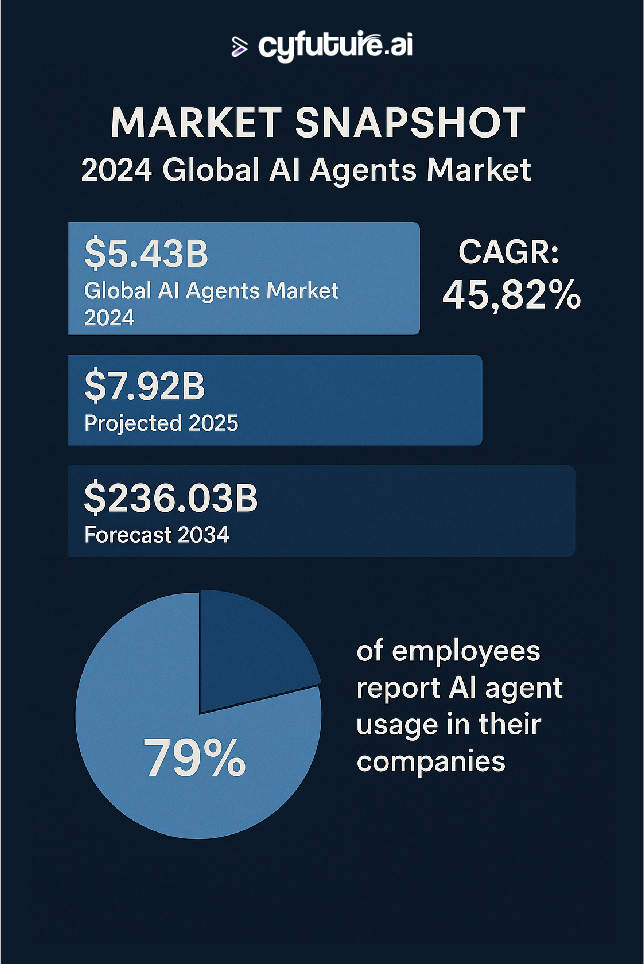
The AI agent landscape is exploding at an unprecedented pace. The global AI agents market has surged from $5.43 billion in 2024 to a projected $7.92 billion in 2025, with forecasts indicating explosive growth to $236.03 billion by 2034—representing a staggering CAGR of 45.82%. These aren't just impressive numbers; they represent a fundamental shift in how businesses operate, compete, and deliver value in an increasingly automated world.
Whether you're a tech leader evaluating AI integration strategies, a developer building the next generation of intelligent systems, or an enterprise seeking competitive advantages, understanding the different types of AI agents is no longer optional—it's mission-critical.
Understanding the Foundation: What is an AI Agent?
Before diving into the different types, let's establish a clear foundation.
An AI agent is an autonomous software system that perceives its environment, processes information, makes decisions, and takes actions to achieve specific goals without constant human intervention. Unlike traditional software that simply executes predefined instructions, AI agents possess the ability to reason, plan, adapt, and learn from their experiences.
AI agents operate within explicitly defined scopes, engaging dynamically with inputs and producing actionable outputs in real-time environments, distinguishing them from large language models that primarily function as reactive prompt followers.
Think of it this way:
Traditional software is like following a recipe step-by-step. AI agents, on the other hand, are like experienced chefs who understand the principles of cooking, can adapt recipes based on available ingredients, learn from past dishes, and create entirely new recipes to achieve a specific culinary goal.
The Core Characteristics of AI Agents
Three foundational characteristics recur across architectural taxonomies and empirical deployments of AI agents: autonomy, task-specificity, and reactivity with adaptation.
Autonomy represents the agent's ability to operate independently post-deployment, minimizing human-in-the-loop dependencies and enabling large-scale, unattended operations. This doesn't mean complete independence from human oversight, but rather the capacity to make informed decisions and execute tasks without requiring constant supervision for every action.
Task-specificity encapsulates the design philosophy where AI agents are specialized for narrowly scoped tasks, allowing high-performance optimization within defined functional domains such as scheduling, querying, filtering, or data analysis. This specialization enables deeper expertise and more reliable performance compared to generalist systems.
Reactivity and adaptation refer to an agent's capacity to respond to environmental changes, including user commands, software states, or API responses. When extended with adaptive capabilities, this includes feedback loops and learning heuristics that enable the agent to improve performance over time.
The Market Reality: Why 2025 is the Breakthrough Year
Let me share something that might surprise you:
As of 2025, 79% of employees report that their companies are already using AI agents, while 51% of organizations are actively exploring ways to integrate AI agents into their business processes. This isn't future technology—it's happening right now.
Here's what the numbers tell us:
The global AI agents market size was estimated at USD 5.40 billion in 2024 and is projected to reach USD 50.31 billion by 2030, growing at a CAGR of 45.8% from 2025 to 2030. The primary drivers? Increased demand for automation, advancements in Natural Language Processing (NLP), and rising demand for personalized customer experiences.
And it gets even more interesting:
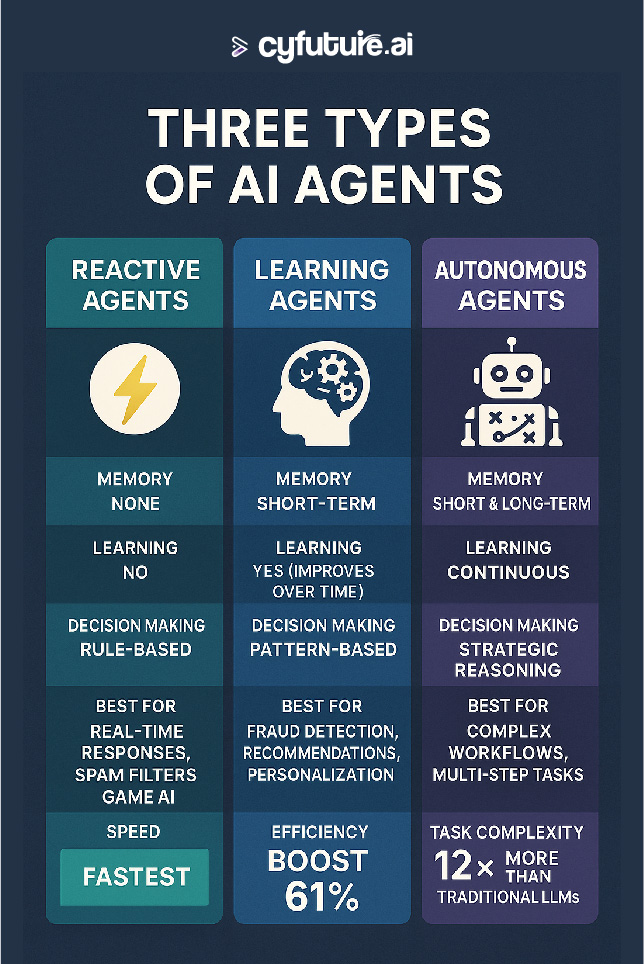
Around 45% of Fortune 500 companies are actively piloting agentic systems in 2025, with these systems capable of completing up to 12 times more complex tasks compared to traditional LLMs, thanks to dynamic feedback loops and autonomous decision-making.
The investment momentum speaks volumes: AI agent start-ups raised $3.8 billion in 2024, nearly tripling the investments from the previous year, highlighting investor confidence in the sector.
Type 1: Reactive AI Agents—The Foundation of Intelligent Systems
Let's start with the basics:
Reactive agents represent the foundational tier of AI systems. These agents operate on a simple but powerful principle: perceive the current state and respond with predefined actions. They don't maintain memory of past interactions, don't learn from experience, and don't plan for the future.
How Reactive Agents Work
Think of reactive agents as highly sophisticated reflex systems. They:
- Perceive the current environment through sensors or data inputs
- Map inputs directly to outputs using predefined rules or trained models
- Respond immediately based on current conditions
- Reset after each interaction without retaining historical context
Here's the thing about reactive agents:
Their simplicity is their strength. Without the overhead of memory management or complex reasoning, reactive agents deliver lightning-fast responses with predictable behavior—critical attributes for specific use cases.
Real-World Applications of Reactive Agents
1. Recommendation Systems
Netflix's content recommendation engine operates reactively by analyzing your current viewing session and immediate preferences to suggest the next show. It doesn't create a comprehensive profile of your entire viewing history for each recommendation—it reacts to your present context.
2. Spam Filters
Email spam filters examine each incoming message independently, applying pattern recognition to current content without necessarily referencing the entire history of previous emails. The decision is made reactively: spam or not spam, based on present indicators.
3. Game AI Opponents
Classic video game opponents, like those in chess or checkers, evaluate the current board state and respond with optimal moves without maintaining a "memory" of the game's psychological progression. Deep Blue, IBM's chess-playing system, exemplified reactive AI at its finest—analyzing millions of current positions without emotional memory of previous games.
Advantages and Limitations
Advantages:
- Predictable and reliable behavior
- Fast response times
- Lower computational requirements
- Easier to debug and maintain
- Suitable for real-time applications
Limitations:
- No learning capability
- Cannot adapt to new patterns
- Lacks context from past interactions
- Limited to predefined scenarios
- Cannot improve performance over time
Type 2: Learning AI Agents—The Adaptive Intelligence
Now here's where things get interesting:
Learning agents represent a significant evolutionary leap from reactive systems. These agents can improve their performance over time by analyzing past experiences, identifying patterns, and adapting their behavior accordingly.
The Architecture of Learning Agents
Learning agents typically consist of four essential components:
Performance Element: The component that selects actions based on percepts (current inputs and past learning)
Learning Element: Analyzes feedback to improve the performance element's decision-making
Critic: Provides feedback on how well the agent is performing relative to a fixed performance standard
Problem Generator: Suggests exploratory actions to discover new, potentially better behaviors
Read More: AI Agents Explained: The Building Blocks of Distributed AI Systems
Machine Learning Foundations
The machine learning segment led the AI agents market in 2024, accounting for over 30.5% of global revenue, as machine learning algorithms enable AI agents to analyze vast amounts of data and make informed decisions quickly.
Here's why that matters:
Machine learning models can scale efficiently as data increases, allowing AI agents to adapt to new patterns and trends—essential for industries facing rapidly changing environments like finance and healthcare.
Types of Learning Mechanisms
Supervised Learning Agents These agents learn from labeled training data, where each example is paired with the correct output. They excel in classification and prediction tasks where historical patterns are available.
Example: Medical diagnosis systems that learn from thousands of labeled patient records to identify diseases from symptoms.
Reinforcement Learning Agents These agents learn through trial and error, receiving rewards for desirable actions and penalties for undesirable ones. They optimize their behavior to maximize cumulative rewards over time.
Example: Tesla's Autopilot continuously analyzes its surroundings while referencing recent data to make driving decisions, demonstrating how limited memory enhances awareness and reacts swiftly to unexpected events like a pedestrian crossing the street.
Unsupervised Learning Agents These agents discover hidden patterns in unlabeled data without explicit feedback, identifying structures and relationships that weren't predefined.
Example: Customer segmentation systems that automatically group users based on behavior patterns without predefined categories.
Real-World Applications of Learning Agents
1. Fraud Detection Systems
Financial institutions use limited memory agents to analyze transaction patterns, detecting anomalies promptly to enhance security and minimize financial risks. These systems learn normal behavior patterns and flag deviations that could indicate fraud.
2. Personal Digital Assistants
Modern virtual assistants like Siri, Alexa, and Google Assistant learn from your interactions, preferences, and routines to provide increasingly personalized responses. They adapt to your speech patterns, understand context from previous conversations, and anticipate needs.
3. Dynamic Pricing Systems
E-commerce platforms employ learning agents to optimize pricing based on demand patterns, competitor pricing, inventory levels, and customer behavior. These systems continuously refine their pricing strategies to maximize revenue while maintaining competitive positioning.
4. Content Personalization Engines
Spotify's Discover Weekly and YouTube's recommendation algorithms learn from billions of user interactions to predict what content you'll enjoy. They adapt to your evolving tastes, discover patterns across similar users, and continuously refine recommendations.
The Learning Agent Advantage
What makes learning agents particularly powerful is their ability to handle uncertainty and complexity. They:
- Adapt to changing conditions without reprogramming
- Improve performance through experience
- Discover patterns humans might miss
- Scale learning across millions of interactions
- Transfer knowledge to similar but new situations
And here's a critical insight:
Companies using AI agents see a 61% boost in employee efficiency, largely attributed to learning agents that continuously optimize workflows and reduce repetitive tasks.
Challenges and Considerations
Data Quality and Quantity Learning agents require substantial amounts of quality data. Garbage in, garbage out applies even more critically to learning systems.
Training Time and Resources Initial training can be computationally expensive and time-consuming, requiring significant infrastructure investment.
Overfitting Risks Agents may become too specialized in training data and fail to generalize to new situations.
Explainability Concerns As learning systems become more complex, understanding why they make specific decisions becomes challenging—a critical issue in regulated industries.
Type 3: Autonomous AI Agents—The Future is Now
Here's where the paradigm truly shifts:
Autonomous agents represent the most advanced tier of AI systems, capable of operating independently, making complex decisions, and achieving goals with minimal human intervention. These systems don't just react or learn—they reason, plan, and execute multi-step strategies to accomplish objectives.
Also check: Generative AI vs Agentic AI: Key Differences, Use Cases, and Future Impact
What Defines True Autonomy?
An AI agent is a software program capable of acting autonomously to understand, plan and execute tasks, with true autonomous agents possessing reasoning and planning capabilities that can independently take action.
Autonomous agents exhibit several sophisticated capabilities:
Goal-Oriented Behavior: They understand high-level objectives and decompose them into actionable sub-tasks without step-by-step human guidance.
Environmental Awareness: They perceive and interpret complex, multi-modal environments, integrating data from various sources to build comprehensive situational awareness.
Strategic Planning: They formulate multi-step plans, anticipate obstacles, and adjust strategies dynamically as conditions change.
Independent Execution: They take actions, monitor outcomes, and iterate without requiring approval for each decision.
Continuous Learning: They improve performance through experience while maintaining operational continuity.
The Architecture of Autonomous Agents
Modern autonomous agents integrate multiple AI technologies:
Large Language Models (LLMs): Provide natural language understanding, reasoning capabilities, and communication interfaces.
Memory Systems: Maintain short-term working memory for current tasks and long-term memory for experiences, preferences, and learned knowledge.
Tool Integration: Connect with external APIs, databases, and services to access information and execute actions in the real world.
Planning Engines: Decompose complex goals into executable steps, sequence actions, and optimize strategies.
Monitoring Systems: Track progress, identify failures, and trigger corrective actions or human escalation when necessary.
Real-World Applications Transforming Industries
1. Autonomous Coding Assistants
Cursor, the coding editor, has an AI agent built in that can write, refactor, and debug code for a user from a single prompt. These agents understand project context, coding standards, and can autonomously implement features across multiple files.
In software engineering, agentic AI enables 4x faster code debugging, solidifying its role in DevOps workflows.
2. Healthcare Diagnostic and Monitoring Systems
AI agents are being deployed for patient monitoring, medical record analysis, and treatment recommendation systems that can process vast amounts of medical data autonomously. These systems continuously monitor patient vitals, detect anomalies, alert medical staff, and even suggest diagnostic pathways based on symptoms and test results.
3. Autonomous Financial Trading
Investment firms use AI agents for automated trading, risk assessment, and fraud detection that can analyze market conditions and execute trades without human intervention. These agents monitor global markets 24/7, identify opportunities, execute trades within risk parameters, and adjust strategies based on market dynamics.
4. Advanced Customer Service Agents
Advanced customer service agents can handle complex multi-step support tickets, escalate issues appropriately, and maintain context across multiple interaction channels.
But here's what's really exciting:
In July 2024, Verizon integrated Google Cloud's conversational AI into its customer service operations, deploying Gemini-powered virtual assistants trained on more than 15,000 internal documents. By early 2025, 28,000 agents had used the system, which led to a 40% increase in revenue and a decrease in average call handling times.
5. Supply Chain Optimization
Autonomous agents manage end-to-end supply chain operations—forecasting demand, optimizing inventory placement, selecting sustainable suppliers, routing shipments, and responding to disruptions in real-time.
6. Autonomous Research Assistants
Executive assistant AI agents integrated with Google Calendar and Slack can interpret commands like "Find a 45-minute window for a follow-up with the product team next week," parse requests, check availability for all participants, account for time zone differences, avoid meeting conflicts, and autonomously propose alternative windows if conflicts arise.
The Autonomous Agent Ecosystem in 2025
The landscape is rapidly evolving:
Most importantly, gen AI agents of all kinds need to be reliable for enterprises to use them: Getting the job right most of the time isn't enough. There are some use cases and applications in late 2024 that show encouraging signs of being reliable enough for adoption in early 2025.
Here's what enterprise adoption looks like:
81% of leaders expect AI agents to be integrated into their company's AI strategy within the next 12 to 18 months, while 82% of leaders believe 2025 is an important year to rethink strategy and operations in light of AI and agent adoption.
And the commitment is real:
24% of company leaders have already integrated AI into their workforce, while 47% of leaders see upskilling existing employees as a top priority in the next 12–18 months.
Framework and Platform Ecosystem
Building autonomous agents requires AI agent frameworks—software platforms designed to simplify creating, deploying, and managing AI agents through built-in features and functions that help streamline and speed up the process.
Popular frameworks include:
- LangChain/LangGraph: Flexible framework for building language model-powered agents with state management
- AutoGPT: Autonomous AI assistant based on GPT-4 for goal-oriented activities
- Microsoft AutoGen: Framework for building sophisticated multi-agent systems with conversational AI
- CrewAI: Focused on collaborative, role-based AI systems that mimic human team structures
- Semantic Kernel: Microsoft's framework for incorporating AI capabilities into business applications
Challenges and Considerations for Autonomous Systems
Reliability and Hallucinations
In multiagent systems, "hallucinations" can spread from one agent to another; they can persuade other agents to take the wrong steps and give incorrect answers. This cascading error problem requires robust validation mechanisms and human oversight protocols.
Human-in-the-Loop vs. Human-on-the-Loop
Although agentic AI can be mainly autonomous, having a human review decisions after they've been made (known as "human on the loop" rather than the more restrictive "human in the loop") can make agentic AI more suitable for deployment today.
Think of it this way: autonomous agents are like junior employees who can perform valuable work while learning by experience, but benefit from human mentorship when encountering novel challenges.
Accountability and Governance
As AI agents become more autonomous, determining accountability for their actions becomes challenging. Clear guidelines and regulations are needed to address issues of responsibility and liability.
Security Considerations
Autonomous agents with access to sensitive data and systems require robust security frameworks, including role-based access controls, sandboxed execution environments, and comprehensive audit trails.
Comparing the Three Types: A Strategic Framework
Let's break this down clearly:
|
|
|
|
|
|
|
|
|
|
|
|
|
|
|
|
|
|
|
|
|
|
|
|
|
|
|
|
|
|
|
|
|
|
|
|
|
|
|
|
|
|
|
|
|
Selecting the Right Type for Your Use Case
Choose Reactive Agents When:
- You need predictable, consistent responses
- Real-time performance is critical
- The environment is stable and well-defined
- Explainability and auditability are paramount
- Budget and resources are constrained
Choose Learning Agents When:
- Patterns in data drive value
- The environment changes over time
- Performance improvement through experience is valuable
- You have sufficient quality training data
- Personalization enhances user experience
Choose Autonomous Agents When:
- Complex, multi-step tasks require coordination
- Human resources are scarce or expensive
- 24/7 operation is necessary
- Strategic planning and reasoning are required
- Integration across multiple systems is needed
The Cyfuture AI Advantage: Powering Next-Generation Intelligence
At Cyfuture AI, we're not just observing the AI agent revolution—we're architecting it.
Our enterprise-grade AI infrastructure provides the computational foundation that powers autonomous agents at scale. With cutting-edge GPU clusters, optimized inference pipelines, and robust orchestration frameworks, we enable organizations to deploy sophisticated AI agents that deliver measurable business outcomes.
Here's what sets Cyfuture AI apart:
Scalable Infrastructure: Our cloud-native architecture scales seamlessly from prototype to production, supporting everything from simple reactive agents to complex multi-agent orchestrations handling millions of transactions.
Performance Optimization: Through intelligent caching, model optimization, and efficient resource allocation, we deliver the low-latency responses critical for real-time agent operations—ensuring your AI agents perform at peak efficiency.
Whether you're building customer service automation, autonomous trading systems, or intelligent manufacturing controls, Cyfuture AI provides the technological foundation to turn vision into reality.
The Future Trajectory: What's Next for AI Agents?
Multi-Agent Ecosystems
The next frontier involves multiple specialized agents collaborating to accomplish complex goals—each agent contributing unique expertise while coordinating with others.
Microsoft's AutoGen framework is being used by 40% of Fortune 100 firms to automate tasks in IT and compliance, demonstrating the growing importance of multi-agent coordination.
Embodied AI and Physical Agents
Embodied agents and multi-agent systems are expanding due to more complex use cases in sectors like defense and logistics, which call for practical, simulation-based training for mobility and teamwork.
We're moving beyond digital agents into physical robotics—autonomous vehicles, warehouse robots, surgical assistants, and manufacturing systems that operate in the physical world.
Enhanced Reasoning and Planning
Google DeepMind's SIMA agent has demonstrated the ability to learn more than 600 skills across 9 game engines, showcasing the potential for agents to master complex, multi-domain tasks.
Future agents will exhibit even more sophisticated reasoning, approaching human-level problem-solving in specialized domains.
Democratization of Agent Development
Citizen developer and role-based training are making AI agent creation more accessible across teams, with platforms like Automation Anywhere's Citizen Developer Career Quest assisting non-technical staff in creating agents using low-code technologies.
Regulatory and Ethical Frameworks
As agents become more autonomous, expect increased regulation addressing:
- Accountability for agent actions
- Transparency requirements
- Safety standards
- Bias prevention
- Privacy protection
"We're defining agentic AI as systems that can plan autonomously and take actions to meet goals." — Tom Coshow, Senior Director Analyst at Gartner
Accelerate Your AI Journey with Cyfuture AI Today
The AI agent revolution isn't coming—it's here.
The question isn't whether to adopt AI agents, but how quickly you can implement them effectively. Every day of delay represents missed opportunities for efficiency, innovation, and competitive advantage.
Here's what we know with certainty:
By 2028, 33% of enterprise applications will feature Agentic AI, a significant leap from less than 1% in 2024. The organizations that begin their AI agent journey today will be the market leaders tomorrow.
At Cyfuture AI, we've built the infrastructure that powers tomorrow's intelligent systems today. Our platform provides:
✓ Enterprise-grade computational resources optimized for AI workloads ✓ Scalable architecture supporting rapid prototyping to production deployment ✓ Expert guidance from AI engineers who understand both technology and business ✓ Security and compliance frameworks meeting the highest industry standards ✓ Flexible integration capabilities with your existing technology stack
The transformation starts with a conversation.

Frequently Asked Questions
1. What is the main difference between reactive and autonomous AI agents?
Reactive agents respond to current inputs with predefined actions without memory or planning capabilities, while autonomous agents possess reasoning, memory, and planning abilities that enable them to independently pursue complex goals through multi-step strategies. Reactive agents are like thermostats (reacting to current temperature), whereas autonomous agents are like personal assistants (understanding context, planning steps, and adapting to achieve objectives).
2. How long does it take to implement learning AI agents in an enterprise environment?
Implementation timelines vary significantly based on use case complexity, data availability, and organizational readiness. Simple learning agents for specific tasks might be deployed in 2-3 months, while comprehensive systems requiring extensive training data and integration could take 6-12 months. Most organizations follow a phased approach: pilot projects (1-3 months), validation and refinement (2-4 months), and scaled deployment (3-6 months).
3. What level of technical expertise is required to work with AI agents?
Requirements vary by agent type and implementation approach. Low-code platforms now enable business users to configure simple agents without programming skills. However, implementing learning or autonomous agents typically requires data science expertise, software engineering skills, and understanding of AI/ML principles. Many organizations adopt hybrid approaches—using pre-built agent platforms while maintaining internal AI expertise for customization and optimization.
4. Are AI agents replacing human jobs or augmenting human capabilities?
The evidence strongly indicates augmentation rather than replacement. Human–AI collaborative teams demonstrated 60% greater productivity than human-only teams. AI agents excel at repetitive, data-intensive, and computational tasks, freeing humans for creative, strategic, and relationship-focused work. Most successful implementations position agents as "digital colleagues" that enhance human capabilities rather than replace them.
5. How do you measure ROI for AI agent implementations?
Effective ROI measurement combines quantitative and qualitative metrics: efficiency gains (time saved, throughput increases), cost reduction (labor costs, error rates), revenue impact (increased sales, better pricing), customer satisfaction improvements, employee satisfaction, and strategic benefits (competitive positioning, innovation capacity). Companies using AI agents see a 61% boost in employee efficiency and companies adopting agentic AI report an average revenue increase of 6% to 10%.
Author Bio:
Meghali is a tech-savvy content writer with expertise in AI, Cloud Computing, App Development, and Emerging Technologies. She excels at translating complex technical concepts into clear, engaging, and actionable content for developers, businesses, and tech enthusiasts. Meghali is passionate about helping readers stay informed and make the most of cutting-edge digital solutions.