


 IND
IND UAE
UAE SA
SA


Are You Searching for Ways to Accelerate Your App Development in 2026?
The landscape of application development has undergone a seismic transformation. AI app builders in 2026 represent a revolutionary convergence of artificial intelligence, low-code platforms, and enterprise-grade deployment capabilities that are fundamentally reshaping how organizations create software. These intelligent platforms leverage large language models (LLMs), natural language processing, and automated code generation to transform simple text prompts into fully functional, production-ready applications—reducing development time from months to mere hours while maintaining enterprise security standards and scalability requirements.
Here's the thing:
Traditional software development has always demanded specialized skills, substantial time investments, and significant financial resources. But 2026 marks the year AI app builders crossed the chasm from experimental tools to mission-critical enterprise infrastructure.
What Are AI App Builders?
AI app builders are sophisticated platforms that utilize artificial intelligence—specifically large language models trained on millions of code samples—to automatically generate functional applications from natural language descriptions. Unlike traditional low-code/no-code platforms that require manual configuration through visual interfaces, AI app builders interpret user intent, generate appropriate code, configure databases, implement authentication systems, and deploy applications with minimal human intervention.
These platforms combine several core technologies:
- Natural Language Processing (NLP) to understand user requirements
- Code generation engines powered by models like GPT-4, Claude, and DeepSeek
- Automated testing frameworks that validate functionality
- Integrated deployment pipelines for production environments
- Security and compliance frameworks that meet enterprise standards
The Market Explosion: Numbers That Command Attention
Unprecedented Growth Trajectory
The statistics paint a compelling picture of this technological revolution:
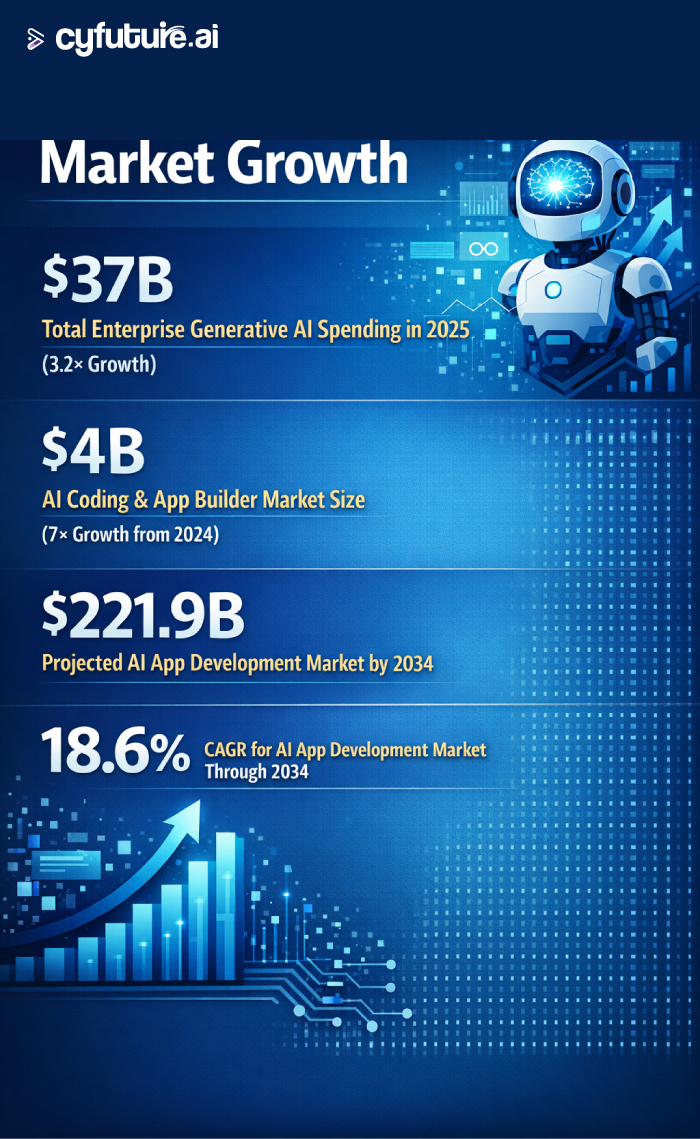
The enterprise generative AI market surged to $37 billion in 2025, representing a remarkable 3.2x year-over-year increase from $11.5 billion in 2024. Within this ecosystem, coding and app development emerged as the dominant use case.
Departmental AI spending for coding specifically exploded from $550 million to $4 billion in 2025, with code agents and AI app builders growing from near-zero. This sharp acceleration reflects a fundamental shift in capability—models can now interpret entire codebases and execute multi-step tasks autonomously.
The broader AI app development market tells an equally impressive story. The Global AI App Development Market reached $40.3 billion in 2024 and is projected to grow to $221.9 billion by 2034, representing a compound annual growth rate (CAGR) of 18.60%.
Looking specifically at the low-code/no-code segment that AI builders compete within: The autoML and no-code AI builders segment is expected to grow at a CAGR of 33% from 2025 to 2034—the fastest-growing functionality category in the entire artificial intelligence software platform market.
Developer Adoption Accelerates
The developer community has embraced these tools with remarkable speed:
In 2025, 84% of developers report using or planning to use AI tools in their development process, and 41% of all code written is now AI-generated. More specifically, 50% of developers now use AI coding tools daily, with that number jumping to 65% in top-quartile organizations.
According to Stack Overflow's 2025 Developer Survey, 65% of developers now use AI coding tools at least weekly, demonstrating mainstream adoption across the industry.
Productivity Gains: The Real Business Case
The productivity numbers justify the massive investments flowing into this space:
Companies using low-code platforms reduce app development time by up to 90%, and when businesses use no-code platforms, they use 70% fewer resources than with conventional app development platforms.
Teams leveraging no-code platforms demonstrate 2.7× faster delivery than traditional development approaches, with projects completing in 3-4 weeks versus 6-8 months traditionally. This 6× improvement transforms how organizations approach project planning and resource allocation.
Teams report 15%+ velocity gains as they've adopted AI tools across the software development lifecycle, from prototyping to deployment.
The financial impact is equally compelling: Tools that require little or no code allow companies to avoid hiring two additional software developers, saving an estimated $4.4 million in business value over three years.
What Is Driving the Shift to AI App Builders in 2026?
1. The Developer Shortage Crisis
82% of companies struggle to hire qualified engineers, leading 84% of enterprises to adopt low-code and no-code platforms. This talent scarcity has created urgent demand for tools that democratize development capabilities.
Demand for citizen developer apps is growing 5 times faster than IT can handle, with 70% of new applications shipped by large enterprises expected to use low-code and no-code development platforms by 2025.
2. Model Capability Breakthroughs
The quality of AI-generated code crossed a critical threshold in 2024-2025. Anthropic's Claude Sonnet 3.5 triggered the category's initial breakout in mid-2024, as models reached economically meaningful performance levels.
3. Enterprise Readiness Maturation
Modern AI app builders now offer:
- SOC 2, GDPR, and HIPAA compliance built into the platform
- Role-based access control (RBAC) and enterprise authentication
- On-premises deployment options for sensitive data
- API integrations with existing enterprise systems
- Version control and CI/CD pipelines for production workflows
Read More: No-Code vs Low-Code AI App Builders: Which One Should You Choose?
The Prototype-to-Production Challenge: What's Different in 2026?
The Old Paradigm: Demo vs. Reality
Historically, AI-generated code suffered from the "demo problem"—applications looked impressive in controlled environments but failed when exposed to real-world complexity:
- Scalability issues: Code that worked for 10 users collapsed at 1,000
- Security vulnerabilities: Missing authentication, SQL injection risks
- Technical debt: Unmaintainable spaghetti code requiring complete rewrites
- Integration gaps: Inability to connect with enterprise systems
- Performance problems: Inefficient database queries, memory leaks
The 2026 Solution: Production-First Architecture
Modern AI app builders address these challenges through several innovations:
1. Context-Aware Code Generation
Unlike first-generation tools, 2026 platforms maintain awareness of:
- Entire codebase architecture
- Database schemas and relationships
- API contracts and dependencies
- Security requirements and compliance needs
- Performance optimization patterns
2. Automated Quality Assurance
Code quality rose by 3.4% with AI tools when properly implemented. Leading platforms now include:
- Automated unit test generation
- Security vulnerability scanning
- Performance profiling and optimization
- Code review automation
- Regression testing suites
3. Incremental Refinement Workflows
Rather than generating complete applications in one shot, production-ready platforms support:
- Iterative enhancement through conversational interfaces
- Granular component-level modifications
- A/B testing of different implementations
- Rollback capabilities for failed deployments
4. Enterprise Integration Frameworks
Connection to existing systems through:
- Pre-built connectors for Salesforce, SAP, Oracle, and other enterprise software
- RESTful and GraphQL API generation
- Message queue integration (Kafka, RabbitMQ)
- Legacy system adapters
Real-World Implementation: What Success Looks Like
Case Study Context: Enterprise Adoption Patterns
98% of tech leaders reported development time savings with low-code and no-code solutions, with nearly four out of five companies (78%) saving up to 50% of development time.
More impressively, 62% of companies that use low-code and no-code tools have reduced software development costs, with 67% reducing costs up to 30% and 10% reducing costs by more than half.
The Hybrid Development Model
Smart organizations aren't replacing developers—they're amplifying their capabilities:
Strategic Use Cases for AI App Builders:
- Internal tools and dashboards (70% of use cases)
- MVP and prototype development
- Automating CRUD applications
- Data visualization interfaces
- Workflow automation tools
When to Keep Traditional Development:
- Complex algorithmic problems
- Performance-critical systems
- Highly regulated environments requiring audit trails
- Custom machine learning implementations
- Real-time systems with microsecond latency requirements
The Leading Platforms: A Technical Comparison
1. Enterprise-Grade Solutions
ToolJet (Open-source, AI-native)
- Specializes in production-ready internal tools
- SOC 2 and GDPR compliant
- On-premises deployment option
- 89% of enterprises report 40%+ reduction in development time
Microsoft Power Apps
- Deep integration with Microsoft ecosystem
- 87% of enterprise developers use for some development work
- AI Builder for custom model integration
- Leader in Forrester Wave 2025 for low-code platforms
Quickbase
- Enterprise-grade compliance and governance
- Workflow automation and process management
- Role-based security architecture
- Central hub for business information
2. Developer-Focused Platforms
Cursor & GitHub Copilot
- IDE-integrated AI assistance
- GitHub Copilot users report up to 81% faster task completion, with 55% higher productivity
- Project-wide context awareness
- Agent mode for autonomous task execution
Replit Agent
- Browser-based full-stack development
- Instant deployment capabilities
- Collaborative coding environment
- $100M ARR in 2025, demonstrating market validation
3. Rapid Prototyping Tools
Bolt.new & Lovable.dev
- Single-prompt application generation
- Built-in authentication and payment integration
- Claude-powered code generation
- Ideal for MVPs and side projects
v0.dev by Vercel
- Frontend-focused React component generation
- Figma design import
- One-click deployment to Vercel
- Next.js ecosystem integration
Critical Success Factors: Making AI App Builders Work
1. Prompt Engineering Mastery
Effective AI app building requires structured communication:
Poor Prompt: "Make an employee directory"
Effective Prompt: "Create an employee directory application with the following requirements:
- Fields: Full Name, Job Title, Department, Email, Phone, Office Location
- Features: Search by name/department, filter by department, export to CSV
- Security: Role-based access—managers see full directory, employees see only their department
- Tech stack: React frontend, PostgreSQL database, REST API
- Deployment: Docker container, scalable to 5,000 employees"
2. Iterative Refinement Strategy
Success comes from treating AI as a collaborative partner:
- Generate baseline application (15 minutes)
- Test core functionality (30 minutes)
- Iteratively refine based on edge cases (2-3 hours)
- Security hardening and performance optimization (4-6 hours)
- Production deployment with monitoring (2 hours)
Total time: 1-2 days vs. 4-6 weeks traditional development
3. Testing and Validation Protocols
Never skip these steps:
- Unit testing: Verify individual components
- Integration testing: Confirm system interactions
- Load testing: Validate performance under stress
- Security scanning: Identify vulnerabilities
- User acceptance testing: Ensure business requirements met
4. Governance and Oversight
70% of new applications will use no-code or low-code tools by 2025, making governance critical:
- Establish coding standards and design systems
- Implement code review processes
- Create application catalogs
- Monitor shadow IT risks
- Audit AI-generated applications regularly
What Are the Limitations and Challenges?
Technical Constraints
Despite impressive capabilities, AI app builders face real limitations:
In a controlled study of experienced open-source developers, when developers used AI tools, they took 19% longer than without—AI made them slower. However, developers estimated they were sped up by 20% on average when using AI, revealing a perception-reality gap.
Projects that relied too much on AI saw 41% more bugs and a 7.2% drop in system stability, demonstrating the importance of human oversight.
The Trust Problem
Almost half of all developers, around 46%, say they do not fully trust AI results, with only 33% saying they trust them and a small 3% "highly trust" AI-generated outputs.
Developer positive views of AI tools fell to 60% in 2025, down from over 70% in 2023 and 2024, suggesting growing skepticism as initial enthusiasm meets reality.
Skill Atrophy Concerns
Employment among software developers aged 22 to 25 fell nearly 20% between 2022 and 2025, coinciding with the rise of AI-powered coding tools, raising questions about junior developer career paths.
Enterprise Deployment Challenges
Organizations report several persistent issues:
- Vendor lock-in: Difficulty migrating between platforms
- Customization limits: Highly unique requirements face constraints
- Cost unpredictability: Model API costs can scale unexpectedly
- Compliance complexity: Ensuring AI-generated code meets regulatory standards
- Change management: Training teams to work effectively with AI tools
How Cyfuture AI Is Bridging the Gap
At Cyfuture AI, we've witnessed firsthand how enterprises struggle to transform AI prototypes into production-grade applications. Our platform addresses these challenges through:
Intelligent Code Generation with Context Awareness
Unlike generic AI tools, Cyfuture AI maintains deep understanding of your:
- Existing application architecture
- Data governance requirements
- Security and compliance standards
- Performance benchmarks
- Integration dependencies
This context awareness ensures generated code fits seamlessly into your technology ecosystem rather than creating isolated islands of functionality.
Production-Ready Security Framework
Every application generated through Cyfuture AI includes:
- OAuth 2.0 authentication by default
- Role-based access control (RBAC)
- SQL injection prevention
- XSS attack mitigation
- CSRF token protection
- API rate limiting
- Audit logging for compliance
Enterprise Integration Hub
Pre-built connectors accelerate time-to-value:
- Salesforce, ServiceNow, SAP integrations
- Microsoft 365 and Google Workspace
- AWS, Azure, GCP cloud services
- Major database platforms (PostgreSQL, MySQL, MongoDB, Oracle)
- Data warehouses (Snowflake, Databricks, Redshift)
Governance and Oversight Dashboard
Maintain control over AI-generated applications:
- Central application catalog
- Code quality metrics
- Security vulnerability tracking
- Deployment pipeline visibility
- Usage analytics and optimization recommendations
Organizations using Cyfuture AI report 65% reduction in time-to-production and 40% decrease in post-deployment bug rates compared to unmanaged AI coding tools.
Also Check: What an AI App Builder Can Do for Teams With Limited Coding Skills
The Future Landscape: What's Coming in 2026 and Beyond
Autonomous AI Agents
Autonomous LLM-powered coding tools that can take a high-level plan and build entire programs independently represent the latest frontier in AI coding.
Gartner predicts that by the end of 2026, over 80% of enterprises will have deployed GenAI-enabled applications in production environments, with increasing autonomy.
Multi-Modal Development
Future platforms will incorporate:
- Voice-to-code: Describe applications verbally
- Visual-to-code: Convert UI mockups directly to functional interfaces
- Data-to-code: Automatically generate applications from example datasets
- Documentation-to-code: Build systems from specification documents
Predictive Performance Optimization
AI systems will proactively:
- Identify performance bottlenecks before deployment
- Suggest architectural improvements
- Auto-scale resources based on predicted usage
- Optimize database queries automatically
Industry-Specific Solutions
Low-code technology is evolving into industry-specific solutions with pre-built templates and compliance features. Expect specialized AI builders for:
- Healthcare (HIPAA-compliant patient portals)
- Financial services (SOX-compliant reporting systems)
- Manufacturing (IoT integration platforms)
- Retail (omnichannel commerce applications)
Accelerate Your Digital Transformation with Cyfuture AI
The data is clear: AI app builders have crossed the chasm from experimental tools to production-grade development platforms. Organizations leveraging these technologies report 6× faster delivery, 70% cost reductions, and unprecedented ability to respond to business needs.
But success requires more than just adopting tools—it demands strategic implementation, proper governance, and platforms built for enterprise reality.
Don't let your competition outpace your innovation.
Transform your application development lifecycle today.
Frequently Asked Questions (FAQs)
1. Can AI app builders truly create production-ready applications?
Yes, but with important caveats. Modern platforms like ToolJet, Microsoft Power Apps, and Cyfuture AI generate applications that meet enterprise security and scalability standards. However, complex business logic, performance optimization, and edge case handling typically require developer review. The key is using AI builders for their strengths (rapid scaffolding, boilerplate generation, standard patterns) while applying human expertise for critical decisions.
2. What is the typical timeline from concept to production using AI app builders?
For internal tools and standard business applications, organizations report 1-2 weeks from concept to production—compared to 2-3 months with traditional development. Projects complete in 3-4 weeks versus 6-8 months traditionally, representing a 6× improvement in delivery speed. However, highly complex applications with custom algorithms or performance-critical requirements may still require 4-8 weeks.
3. How do AI app builders handle data security and compliance requirements?
Enterprise-grade platforms include security by design: built-in authentication, encryption at rest and in transit, RBAC, and audit logging. Leading solutions are SOC 2, GDPR, and HIPAA compliant. However, organizations remain responsible for configuring security properly, conducting security reviews, and ensuring AI-generated code follows their specific compliance requirements. Never deploy without security validation.
4. Will AI app builders replace software developers?
No, but they will transform the developer role. Employment among entry-level software developers aged 22-25 fell nearly 20% between 2022 and 2025, but experienced developers are becoming more valuable. The future developer focuses on architecture, integration, optimization, and complex problem-solving—while AI handles routine coding. Organizations need skilled developers to guide AI tools, review generated code, and handle sophisticated requirements.
5. What are the hidden costs of using AI app builders?
Beyond subscription fees, consider: (1) Model API costs that scale with usage—can reach thousands monthly for high-volume applications; (2) Training time for teams to master prompt engineering; (3) Potential technical debt from generated code requiring later refactoring; (4) Integration costs connecting to existing systems; (5) Ongoing maintenance and updates. Companies save an estimated $4.4 million over three years by avoiding two developer hires, but factor in total cost of ownership.
6. Can AI app builders integrate with our existing technology stack?
Modern platforms offer extensive integration capabilities through REST APIs, webhooks, and pre-built connectors for major enterprise systems (Salesforce, SAP, AWS, Azure). However, legacy systems or highly customized internal applications may require custom integration work. Always verify integration capabilities during evaluation—request proof-of-concept integrations before committing.
7. How do we choose between no-code, low-code, and AI app builders?
Choose based on use case complexity and team skills: No-code platforms (Bubble, Webflow) for simple applications with standard requirements and non-technical users. Low-code platforms (Power Apps, OutSystems) for business applications requiring some customization and workflows. AI app builders (Cyfuture AI, Replit, Cursor) for rapid prototyping, internal tools, and when developers want to accelerate their work. Many organizations use all three for different scenarios.
8. What types of applications are NOT suitable for AI app builders in 2026?
Avoid AI builders for: (1) Real-time systems requiring microsecond latency (trading platforms, industrial control); (2) Safety-critical systems (medical devices, aviation software); (3) Applications with novel algorithms requiring deep mathematical optimization; (4) Systems with strict regulatory requirements demanding complete audit trails; (5) Highly specialized domains lacking training data. Use traditional development for these scenarios.
9. How do we maintain and update applications built with AI platforms?
Leading platforms support iterative refinement through natural language—describe changes and regenerate components. However, establish version control (Git), documentation standards, and change management processes. Some platforms lock you into their ecosystem, while others (ToolJet, Replit) allow code export. Always ensure you can maintain applications if you leave the platform or switch tools.
Author Bio:
Meghali is a tech-savvy content writer with expertise in AI, Cloud Computing, App Development, and Emerging Technologies. She excels at translating complex technical concepts into clear, engaging, and actionable content for developers, businesses, and tech enthusiasts. Meghali is passionate about helping readers stay informed and make the most of cutting-edge digital solutions.