



 IND
IND UAE
UAE SA
SA


Experience Your Team’s Potential with AI App Builders
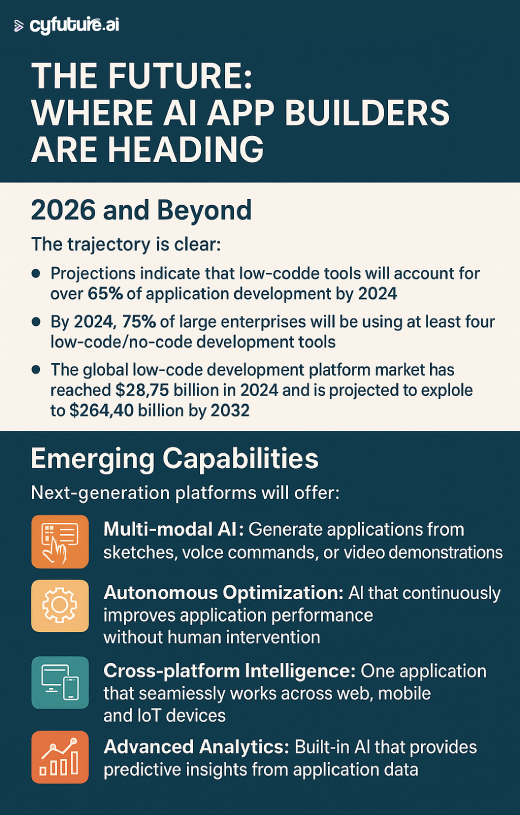
Wondering how your team can build powerful apps without dedicated developers? By 2026, 70% of new apps will use low-code/no-code platforms, letting business users create software without coding.
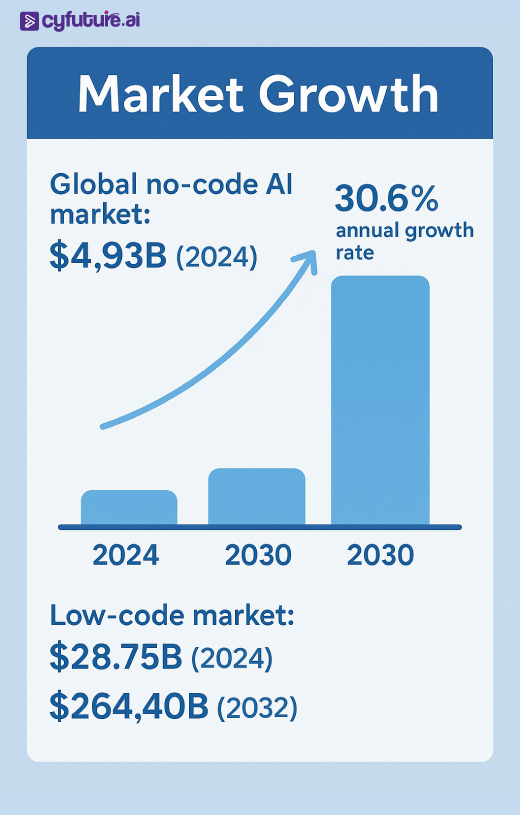
The no-code AI market is booming—from $4.93 billion in 2024 to $24.42 billion by 2030—transforming software development. Marketing, operations, and HR teams can now build tools and workflows in weeks instead of months, cutting development time by up to 90%. This is more than improvement—it’s a revolution.
What Is an AI App Builder?
An AI app builder is an intelligent, no-code or low-code platform that leverages artificial intelligence to enable users—regardless of technical background—to create fully functional applications through visual interfaces, natural language prompts, and automated workflows.
These platforms combine drag-and-drop simplicity with sophisticated AI capabilities that can generate code, suggest optimal components, automate debugging, and even predict what functionality you'll need next. Think of it as having a senior developer sitting beside you, translating your business requirements into production-ready applications.
The technology represents a fundamental shift:
Instead of teams learning complex programming languages, the software learns to understand what teams need.
The Developer Shortage Crisis: Why AI App Builders Matter Now
Let's talk numbers.
By 2024, an estimated 80% of technology products and services will be created by individuals who are not specifically from a technical background. That's not because developers are becoming obsolete—it's because demand has simply outstripped supply.
Consider these realities:
- 47% of developers state they lack access to the tools needed to create products and apps fast enough to meet deadlines
- 72% of IT leaders say that project backlogs prevent them from working on strategic projects
- Citizen developers are on track to outnumber professional developers 4:1 by 2025
The math is simple:
Traditional development can't keep pace with digital transformation demands. Organizations need applications faster than development teams can deliver them. AI app builders bridge this gap by enabling what we now call "citizen developers"—business users who can build their own solutions.
How AI App Builders Transform Non-Technical Teams
1. Natural Language to Functional Applications
Modern AI app builders interpret plain English descriptions and convert them into working applications. You describe what you need: "I want an app where trainers can book clients and get paid." The AI generates the interface, database structure, authentication systems, and payment integration.
No syntax errors. No debugging sessions. Just results.
2. Intelligent Automation and Predictive Assistance
Here's where it gets interesting:
AI doesn't just build what you ask for—it anticipates what you'll need next. When you create a booking system, it proactively asks: "Would you like to send confirmation emails automatically?" or "Do you want to make this a subscription?"
The platforms learn from millions of application patterns to suggest:
- Optimal data structures
- Security best practices
- Performance improvements
- Integration opportunities
3. Dramatic Speed Increases
The numbers tell a compelling story:
- Organizations report 40% lower development costs when using AI-powered platforms versus traditional development
- Between 60–75% of users reported they feel more fulfilled with their job, feel less frustrated when coding, and can focus on more satisfying work
- Projects that traditionally required 6-8 months now complete in 3-4 weeks
4. Cost Efficiency That Actually Matters
Traditional app development for a medium-complexity project can cost $40,000 to $250,000.
AI app builders flip this model:
- Companies leveraging no-code AI platforms report average annual savings of $4.5 million
- Ricoh achieved 253% ROI with payback in just 7 months after replacing legacy systems
- Educational institutions like Georgia Tech have saved $540,000 on programming costs
The average company avoided hiring two IT developers using these tools, resulting in about a $4.4 million increase in business value over three years.
Real-World Applications: What Teams Are Building
Operations Teams
Inventory management systems, quality control trackers, vendor portals, and supply chain monitoring tools. Teams create applications that connect directly to their Google Sheets or databases, transforming static data into dynamic, actionable tools.
Marketing Departments
Customer feedback collectors, campaign tracking dashboards, lead management systems, and content approval workflows. One marketing team built a community management platform in three days—something that would have taken their IT department three months.
HR and People Operations
Employee onboarding portals, performance review systems, time tracking applications, and benefits management tools. Non-technical HR professionals are building sophisticated applications that integrate with existing systems.
Sales Teams
CRM customizations, proposal generators, territory management tools, and commission calculators. Sales managers create exactly what they need without waiting for IT resource allocation.
Read More: Step-by-Step: How to Build an AI App Without Coding
The Cyfuture AI Advantage: Enterprise-Grade Meets User-Friendly
Speaking of powerful platforms, Cyfuture AI stands out in the crowded AI infrastructure space by delivering enterprise-grade computing power that makes these AI app builders possible.
With advanced GPU acceleration and scalable cloud infrastructure, Cyfuture AI provides the robust backbone that enables AI app builders to process natural language requests, generate code, and deploy applications at lightning speed. Their platform ensures that whether you're building a simple internal tool or a complex customer-facing application, you have the computational power needed for instant response times.
Moreover, Cyfuture AI's commitment to security and compliance means that applications built on their infrastructure meet enterprise standards from day one—a critical consideration for businesses in regulated industries.
Breaking Down the Technology: How It Actually Works
The AI Engine
At the core sits sophisticated machine learning models trained on millions of code patterns, design systems, and application structures. When you describe your needs, the AI:
- Interprets your intent using natural language processing
- Maps requirements to proven application patterns
- Generates appropriate code, database schemas, and user interfaces
- Applies security best practices automatically
- Optimizes performance based on expected usage patterns
Visual Development Layer
The drag-and-drop interface isn't just cosmetic—it's a powerful abstraction layer that:
- Represents complex code logic as visual blocks
- Enables data flow visualization
- Provides real-time previews
- Allows granular customization without code
Integration Ecosystem
Modern AI app builders connect to 50+ data sources out of the box:
- Cloud databases (PostgreSQL, MySQL, MongoDB)
- Spreadsheets (Google Sheets, Airtable, Excel)
- CRM systems (Salesforce, HubSpot)
- APIs and webhooks
- Payment processors
- Communication tools
Overcoming Common Concerns
"But What About Security?"
Enterprise AI app builders implement:
- Role-based access controls
- Data encryption at rest and in transit
- SOC 2 and GDPR compliance
- Regular security audits
- Single sign-on (SSO) integration
"Will This Scale?"
Teams can quickly create, test, iterate, and deploy apps, and platforms like ToolJet provide enterprise-grade governance features including audit logs, multi-environment support, and deployment pipelines.
"What If We Outgrow It?"
Many platforms offer code export capabilities. Build your MVP with no-code, then when needed, export the codebase and hand it to developers for further customization. You're never locked in.
Also Check: AI App Builder: How to Build AI Apps Without Code (Android, Web & SaaS)
"Isn't This Just For Simple Apps?"
Today's AI app builders power:
- Multi-tenant SaaS platforms
- Real-time collaboration tools
- Complex workflow automation
- Data-intensive analytics dashboards
- Mobile-first customer applications
The Business Case: ROI That Executives Care About
Quantifiable Benefits
- Time to Market: Teams leveraging no-code platforms demonstrate 2.7× faster delivery than traditional development approaches
- Resource Optimization: IT teams focus on strategic projects while business teams handle departmental tools
- Innovation Velocity: 90% of no-code users believe their company has experienced accelerated growth thanks to using no-code
- Adaptability: Modify applications in real-time as business requirements evolve
Strategic Advantages
83% of tech leaders have implemented a Citizen Development program, with 92% agreeing that it plays a vital role in achieving their digital transformation objectives.
The data shows:
- 76% of tech leaders expect faster response times to market changes
- 75% anticipate increased solution customization
- 58% predict implementing Citizen Development will lead to over a 10% increase in individual productivity
Potential Challenges and Mitigation Strategies
Challenge 1: Governance Concerns
Risk: Uncontrolled application sprawl, data security issues
Solution: Implement:
- Centralized platform administration
- Required security reviews for customer-facing apps
- Data classification policies
- Regular audits of deployed applications
Challenge 2: Technical Debt
Risk: Poorly designed applications that become maintenance burdens
Solution:
- Establish design patterns and templates
- Require peer reviews for complex applications
- Create documentation standards
- Plan regular refactoring cycles
Challenge 3: Integration Complexity
Risk: Difficulty connecting to legacy systems
Solution:
- Start with modern cloud-based systems
- Use integration platforms like Zapier or Make
- Build API wrappers for legacy systems
- Consider hybrid approaches (some no-code, some custom code)
Cyfuture AI: Powering Your Digital Transformation
As organizations embrace AI app builders, the underlying infrastructure becomes crucial. Cyfuture AI delivers:
- Scalable Computing: Auto-scaling GPU and CPU resources that grow with your application portfolio
- Global Reach: Low-latency access across regions ensuring fast performance for all users
- Security First: Enterprise-grade security controls, compliance certifications, and data sovereignty options
- Cost Optimization: Pay only for what you use with transparent pricing and no hidden fees
Whether your team is building its first citizen development application or scaling to hundreds of internal tools, Cyfuture AI provides the reliable, secure infrastructure that makes it all possible.
Accelerate Your Digital Future with AI-Powered Development
AI app builders are revolutionizing software development, enabling non-coders to create powerful applications faster and more affordably. Development cycles shrink from months to weeks, boosting quality and functionality.
The real question is how quickly your organization can adopt these tools. Every delay lets competitors gain ground. Empower your teams, speed innovation, and transform your digital capabilities—because the future is about enabling everyone to be a developer.
FAQs:
1. What is an AI app builder?
An AI app builder is a no-code or low-code platform that helps teams create AI-powered applications using visual tools, templates, and prebuilt AI models—without deep programming knowledge.
2. Can non-developers build apps using an AI app builder?
Yes. AI app builders are designed for non-technical users, allowing business teams, marketers, and product managers to build apps using drag-and-drop interfaces and simple configurations.
3. What types of applications can be built with an AI app builder?
Teams can build chatbots, voicebots, workflow automation tools, recommendation engines, data analysis dashboards, and customer support applications.
4. How does an AI app builder reduce development time?
By eliminating manual coding and offering pre-trained AI models, templates, and integrations, AI app builders significantly shorten development cycles from months to days or even hours.
5. Are AI app builders scalable for growing teams?
Yes. Most AI app builders support cloud deployment, API integrations, and modular scaling, making them suitable for startups as well as enterprise-level growth.
6. Is an AI app builder secure for business use?
Reputable AI app builders include enterprise-grade security features such as data encryption, role-based access, compliance support, and secure cloud infrastructure.
Author Bio:
Meghali is a tech-savvy content writer with expertise in AI, Cloud Computing, App Development, and Emerging Technologies. She excels at translating complex technical concepts into clear, engaging, and actionable content for developers, businesses, and tech enthusiasts. Meghali is passionate about helping readers stay informed and make the most of cutting-edge digital solutions.