


 IND
IND UAE
UAE SA
SA


Introduction: The AI Chatbot Revolution Reshaping Business in 2026
Are you struggling to choose the right AI chatbot solution from hundreds of options flooding the market?
Here's the reality:
The global AI chatbot market reached $11.80 billion in 2026 and is projected to surge to $27.30 billion by 2030, growing at a remarkable 23.3% CAGR. With 987 million people worldwide now using AI chatbots daily and ChatGPT dominating with an 81.85% market share, selecting the right conversational AI solution has become a critical business decision that directly impacts customer experience, operational efficiency, and competitive positioning.
The stakes have never been higher.
In 2026, businesses face an unprecedented challenge: navigating a crowded marketplace where every vendor promises "intelligent," "context-aware," and "revolutionary" solutions. Yet beneath the marketing hype lies a complex technical landscape requiring careful evaluation of natural language processing capabilities, integration architectures, security protocols, and ROI potential.
This comprehensive guide cuts through the noise.
We'll walk you through data-driven selection criteria, real-world implementation challenges, and strategic frameworks that enterprise leaders, developers, and decision-makers need to deploy AI chatbot solutions that deliver measurable business value—not just impressive demos.
What is an AI Chatbot Solution?
An AI chatbot solution is a sophisticated software application powered by artificial intelligence technologies—including natural language processing (NLP), machine learning (ML), and large language models (LLMs)—that simulates human conversation to automate customer interactions, streamline business operations, and deliver personalized experiences across digital channels.
Unlike traditional rule-based chatbots limited to scripted responses, modern AI chatbots in 2026 understand context, interpret intent, learn from interactions, and handle complex multi-turn conversations with remarkable accuracy. These systems leverage generative AI to create dynamic responses, employ sentiment analysis to detect emotional nuances, and integrate seamlessly with CRM platforms, knowledge bases, and enterprise systems.
Key differentiators include:
- Context awareness: Maintaining conversation history across sessions
- Multimodal capabilities: Processing text, voice, images, and documents
- Autonomous learning: Continuous improvement through interaction data
- Omnichannel deployment: Consistent experience across websites, mobile apps, WhatsApp, and social platforms
The Explosive Growth of AI Chatbots: 2026 Market Landscape
Let's examine the numbers:
The conversational AI market exploded from $8.27 billion in 2024 to $10.32 billion in 2025, representing a staggering 24.8% year-over-year growth. By 2029, the chatbot market is expected to reach $29.5 billion, driven by innovations in generative AI, enterprise adoption, and improved natural language understanding.
Critical market insights for 2026:
- Adoption velocity: 78% of organizations have integrated AI into at least one business function, with 25% of companies projected to use chatbots as their primary customer service channel by 2027
- Cost savings potential: AI chatbots can reduce contact center labor costs by $80 billion globally, with businesses reporting up to 30% reduction in customer service operational expenses
- Automation rates: 95% of customer interactions are expected to be AI-powered by 2025, with chatbots successfully resolving 70% of conversations without human intervention
- Revenue impact: Companies implementing chatbots report a 67% increase in sales, with e-commerce businesses experiencing revenue boosts of 7-25% through cart abandonment recovery alone
- ROI performance: Leading implementations achieve 148-200% ROI with $300,000+ annual cost savings, while solutions like Gupshup's WhatsApp bot demonstrated a 270% return over three years
The geographic distribution reveals interesting patterns: North America leads with 31.1% market share, while Asia Pacific—particularly India—is projected to grow at a blistering 32.9% CAGR through 2034, becoming the fastest-growing region globally.
Industry-specific adoption:
Retail and e-commerce dominate with 32.4% market share, followed by BFSI (financial services) at 43% adoption, healthcare at 31%, and real estate at 28%. The healthcare chatbot market alone is projected to reach $543.65 million by 2026, with 52% of patients acquiring health data through conversational interfaces.
Why AI Chatbot Selection Matters More Than Ever
Choosing the wrong chatbot solution carries severe consequences:
Financial implications:
Poor selection leads to failed implementations costing $2-8 million for mid-market companies when factoring in development, integration, training, and opportunity costs. With 44% of organizations reporting negative AI consequences according to McKinsey, the risk of choosing incorrectly has never been higher.
Competitive disadvantage:
In 2026, customer expectations have evolved dramatically. 62% of respondents prefer engaging with AI chatbots over waiting for human agents, and 87.2% rate their chatbot interactions as neutral or positive. Businesses without effective conversational AI risk losing customers to competitors offering 24/7, instant support.
Operational efficiency:
The right chatbot automates 30% of contact center tasks, handles 75-90% of customer queries independently, and reduces response times from minutes to seconds. Conversely, poorly implemented solutions frustrate users, increase agent workload, and damage brand reputation.
Read More: AI Chatbot Solutions vs. Human Agents: Who Wins the Customer Experience Battle?
Core Selection Criteria: Technical Capabilities
1. Natural Language Processing & Understanding
The foundation of any effective AI chatbot lies in its NLP capabilities.
Advanced NLP features to evaluate:
- Intent recognition accuracy: The system must identify user intent with 95%+ accuracy, even with misspellings, slang, or ambiguous phrasing
- Entity extraction: Ability to identify and extract relevant data (names, dates, product codes, account numbers) from unstructured conversation
- Contextual understanding: Maintaining conversation context across multiple turns and remembering previous interactions
- Multilingual support: Native processing of multiple languages without translation layers, critical for global operations
- Sentiment analysis: Real-time detection of user emotions (frustration, satisfaction, urgency) to adjust responses accordingly
Testing methodology:
Request live demos with your actual use cases. Present edge cases, complex queries, and multi-step scenarios. A chatbot that excels in vendor demonstrations but fails with real customer language is worthless.
Technical depth indicators:
Top providers explain model architectures, discuss fine-tuning approaches, and clarify how they handle low-confidence situations. They should articulate why they chose specific models (GPT-4, Claude, custom LLMs) for different scenarios and demonstrate optimization strategies like inference caching.
2. Large Language Model Architecture
In 2026, chatbot intelligence stems from underlying LLM capabilities.
Key architectural considerations:
- Model selection: Does the provider use cutting-edge models (GPT-4, Claude Sonnet 4.5, Gemini 1.5 Pro) or outdated architectures?
- Fine-tuning capabilities: Can you train the model on your proprietary data, industry terminology, and brand voice?
- Retrieval-Augmented Generation (RAG): Integration with knowledge bases for accurate, source-attributed responses
- Hallucination mitigation: Mechanisms to detect and prevent fabricated information
- Fallback protocols: Graceful handling when the model encounters unfamiliar scenarios
Advanced implementations employ hybrid approaches—combining generative AI for complex queries with rule-based flows for straightforward transactions, ensuring both intelligence and reliability.
3. Integration & Scalability
A chatbot exists within an ecosystem.
Critical integration requirements:
- CRM connectivity: Seamless data flow with Salesforce, HubSpot, Zoho, Microsoft Dynamics
- Help desk integration: ProProfs Help desk, Zendesk, Freshdesk, ServiceNow for ticket creation and escalation
- E-commerce platforms: Shopify, WooCommerce, Magento for product recommendations and order tracking
- Payment gateways: Secure handling of transactions within conversational interfaces
- Analytics platforms: Google Analytics, Mixpanel for comprehensive tracking
- API flexibility: RESTful APIs for custom integrations with legacy systems
Scalability considerations:
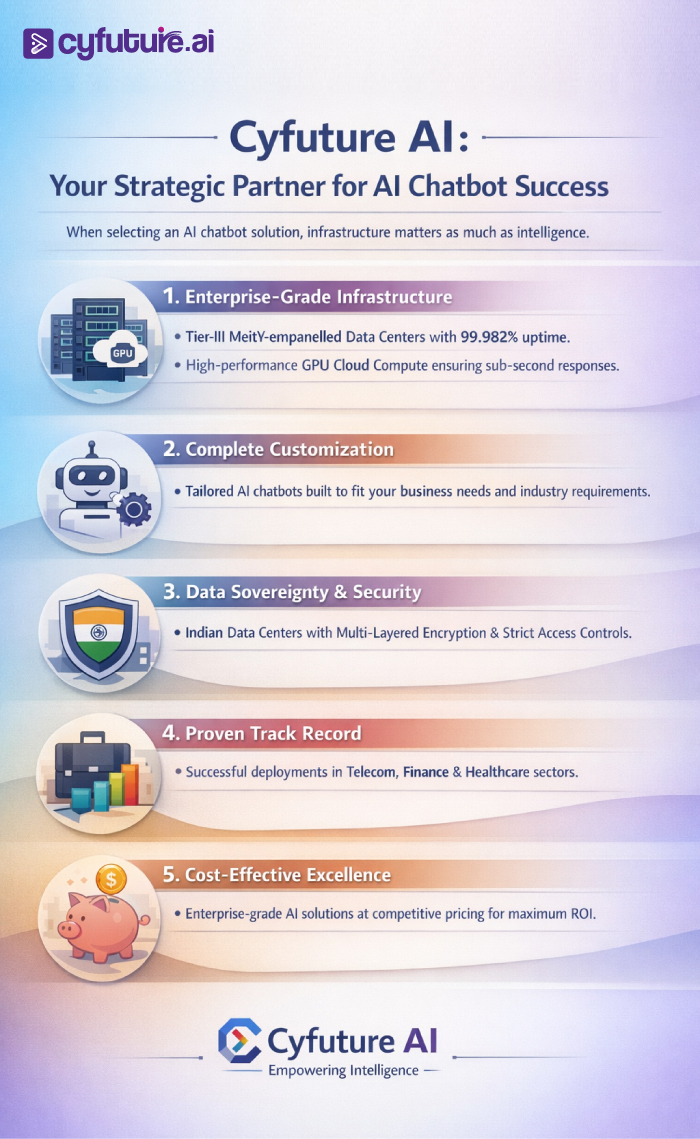
Cloud-native architectures handle traffic spikes without degradation. Solutions like Cyfuture AI's GPU Cloud Infrastructure ensure chatbots maintain sub-second response times during peak loads, processing thousands of concurrent conversations without performance impact.
Technical requirements:
- Load balancing across distributed systems
- Horizontal scaling capabilities
- Kubernetes-native deployments
- Multi-region availability
- Auto-scaling based on demand
4. Security & Compliance
With chatbots handling sensitive customer data, security cannot be an afterthought.
Essential security features:
- Encryption: End-to-end encryption for data in transit and at rest
- Authentication: Multi-factor authentication and role-based access control
- Compliance certifications: GDPR, HIPAA, SOC 2, ISO 27001 adherence
- Data sovereignty: Ability to host data in specific geographic regions
- Audit trails: Comprehensive logging for compliance and troubleshooting
- PII handling: Automatic detection and masking of personally identifiable information
Cyfuture AI, with Tier-III MeitY-empanelled data centers across India and 99.982% uptime guarantee, provides enterprise-grade security ensuring data sovereignty and regulatory compliance—critical for organizations in finance, healthcare, and government sectors.
Business Evaluation Framework
Define Clear Objectives
Before evaluating vendors, establish measurable goals.
Common objectives:
- Customer service automation: Reduce support ticket volume by 40-60%
- Lead generation: Increase qualified leads by 30%
- Sales enablement: Boost conversion rates by 15-25%
- Cost reduction: Decrease customer service costs by 25-30%
- 24/7 availability: Provide instant responses outside business hours
Setting KPIs:
Define metrics before implementation: response time, resolution rate, customer satisfaction (CSAT), Net Promoter Score (NPS), cost per conversation, automation rate, escalation frequency, and revenue attribution.
Calculate Expected ROI
Use structured ROI formulas:
Basic ROI calculation:
ROI = (Total Benefits - Total Costs) / Total Costs × 100
Cost components:
- Platform license/subscription fees
- Implementation and customization
- Integration development
- Training and change management
- Ongoing maintenance and updates
- API usage costs
Benefit quantification:
- Labor cost savings: Agent hours saved × average hourly rate
- Efficiency gains: Faster resolution × increased capacity
- Revenue generation: Leads generated × conversion rate × average deal value
- Churn prevention: Customers retained × customer lifetime value
Real-world benchmark: Organizations implementing AI chatbots report average cost savings of $0.50-$0.70 per interaction compared to $5-$7 for human agent support—representing 90%+ cost reduction for automated queries.
Also Check: AI Chatbots vs. Live Agents: Which One Do Customers Prefer?
Assess Technical Fit
Match solution capabilities to organizational resources.
For enterprises with development teams:
Consider API-first platforms allowing extensive customization, custom LLM fine-tuning, and white-label deployments. Providers like Cyfuture AI offer comprehensive AI development services enabling bespoke solutions aligned with complex enterprise architectures.
For mid-market companies:
No-code platforms with visual builders, pre-built templates, and managed services balance sophistication with implementation speed. Solutions should deploy within 2-4 weeks rather than 3-6 months for custom builds.
For small businesses:
Prioritize plug-and-play solutions with transparent pricing, quick setup, and intuitive interfaces requiring minimal technical expertise.
Top AI Chatbot Platforms for 2026
Here's an objective comparison of leading solutions:
Enterprise-Grade Platforms
1. ChatGPT (OpenAI)
- Strengths: Cutting-edge language understanding, multimodal capabilities, extensive API ecosystem
- Best for: Organizations requiring maximum intelligence and flexibility
- Considerations: Higher API costs at scale, data privacy concerns with external hosting
2. Microsoft Copilot
- Strengths: Native integration with Microsoft 365 ecosystem, enterprise security, compliance
- Best for: Microsoft-centric organizations
- Market share: 4.83% in generative AI chatbot segment
3. Google Gemini
- Strengths: Superior search integration, real-time data access, Google Workspace connectivity
- Best for: Organizations heavily invested in Google ecosystem
- Market share: 2.19% but growing rapidly
Business-Focused Solutions
4. Cyfuture AI Chatbot
- Strengths: Enterprise-grade infrastructure, data sovereignty (Indian data centers), customizable solutions, 24/7 support, cost-effective pricing, free trial availability
- Best for: Indian enterprises, organizations requiring data localization, businesses needing scalable GPU-powered infrastructure
- Unique advantage: Combines advanced AI capabilities with robust cloud infrastructure, offering complete control over data and deployment
5. Intercom
- Strengths: Comprehensive customer service platform, proven track record
- Best for: SaaS companies, customer support-centric organizations
6. Drift
- Strengths: Sales-focused conversational marketing, lead qualification
- Best for: B2B companies prioritizing lead generation
Open-Source & Developer Platforms
7. Rasa
- Strengths: Complete control, on-premise deployment, extensive customization
- Best for: Organizations with strong development teams requiring full ownership
8. Botpress
- Strengths: Open-source flexibility, visual flow builder
- Best for: Developers seeking balance between control and ease of use
Industry-Specific Considerations
Retail & E-commerce
Requirements:
- Product catalog integration
- Order tracking automation
- Cart abandonment recovery
- Personalized recommendations
- Multi-currency support
Expected impact: 30-40% reduction in support tickets, 15-25% increase in conversions through proactive engagement.
Healthcare
Requirements:
- HIPAA compliance
- Appointment scheduling
- Symptom checking
- Patient data security
- Integration with EHR systems
Market projection: Healthcare chatbot market reaching $543.65 million by 2026, with 52% of patients using chatbots for health information.
Financial Services
Requirements:
- Banking-grade security
- Regulatory compliance (SOC 2, PCI DSS)
- Transaction processing
- Fraud detection
- Account management
Adoption rate: 43% of financial services organizations have implemented AI, with 70% of banking customers using chatbots repeatedly.
Education
Requirements:
- Student engagement tools
- Admissions support
- Course recommendations
- Learning assistance
- Multilingual capabilities
Growing segment: Education AI chatbots facilitate personalized learning experiences and reduce administrative burden on faculty.
Making the Final Decision: 10-Point Checklist
Before committing to a vendor, validate these critical factors:
- Technical proof of concept: Conduct live testing with your actual use cases, not vendor demonstrations
- Reference customers: Speak with 3-5 existing clients in your industry about real-world performance
- Transparent pricing: Ensure clear cost structure without hidden fees for API calls, data storage, or support
- Scalability roadmap: Confirm the solution grows with your business without requiring migration
- Support quality: Evaluate response times, available channels, and expertise of support team
- Data ownership: Clarify data rights, portability, and usage policies
- Vendor stability: Assess financial health, funding status, and long-term viability
- Customization flexibility: Ensure ability to modify conversation flows, branding, and integrations
- Performance SLAs: Demand guaranteed uptime, response times, and resolution commitments
- Exit strategy: Understand data export processes and transition support if you change vendors
Future-Proof Your Chatbot Strategy
The AI chatbot landscape evolves rapidly.
Emerging trends to consider:
- Agentic AI: Autonomous agents capable of multi-step reasoning and task completion
- Multimodal interactions: Seamless switching between text, voice, image, and video
- Emotion AI: Advanced sentiment analysis detecting subtle emotional cues
- Predictive engagement: Proactive outreach based on behavior patterns
- Voice-first interfaces: Integration with smart speakers and voice assistants
Strategic recommendations:
Choose platforms with clear innovation roadmaps, active development communities, and commitment to staying current with AI advances. Cyfuture AI's continuous investment in GPU infrastructure and partnerships with leading AI model providers ensures your chatbot solution remains competitive as technology evolves.
Accelerate Your AI Journey with Cyfuture AI
The difference between chatbot success and failure isn't just technology—it's strategic implementation, robust infrastructure, and ongoing optimization.
In 2026's hyper-competitive landscape, the right AI chatbot solution delivers:
- 40-60% reduction in customer service costs
- 24/7 instant support improving customer satisfaction by 25%+
- 75-90% automation of routine queries
- 148-200% ROI within the first year
- Competitive advantage through superior customer experience
Don't let decision paralysis cost you market position.
Frequently Asked Questions
1. What's the typical implementation timeline for an AI chatbot?
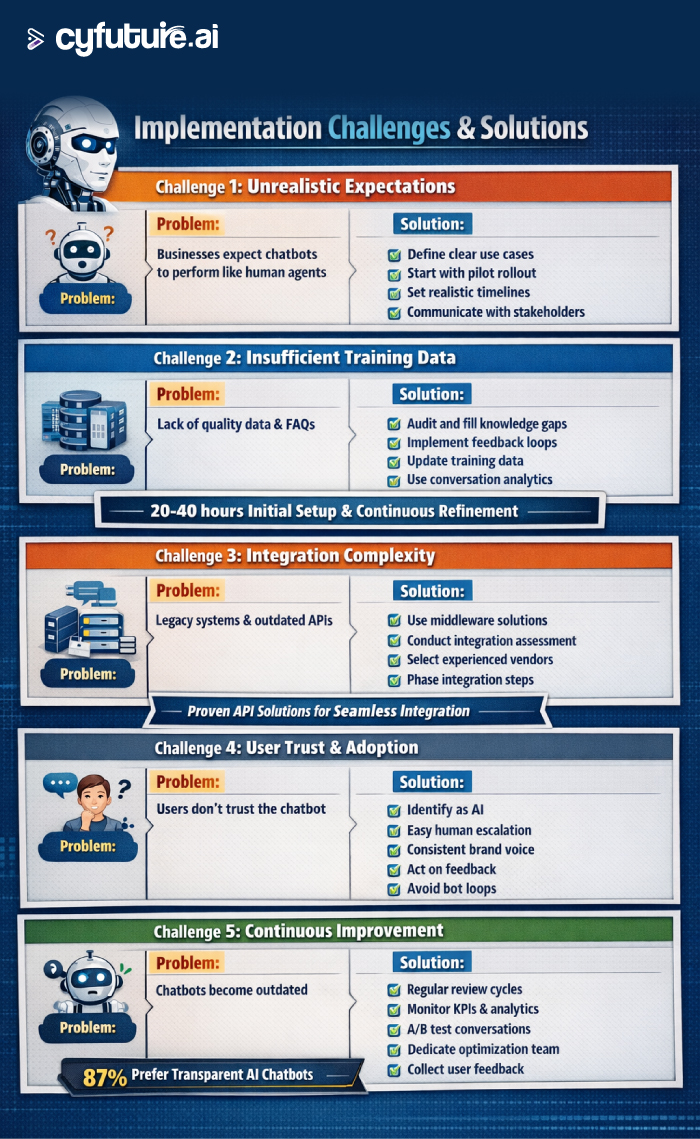
Implementation timelines vary based on complexity. Simple deployments using pre-built templates launch within 2-4 weeks. Mid-complexity implementations with custom integrations require 6-8 weeks. Complex enterprise deployments with extensive customization, legacy system integration, and regulatory requirements take 3-6 months. Cyfuture AI's phased approach allows businesses to start with core functionality and expand iteratively.
2. How much does an AI chatbot solution cost?
Pricing varies dramatically by provider and requirements. Small business solutions range from $50-$300/month for basic functionality. Mid-market platforms cost $2,000-$8,000/month for comprehensive capabilities. Enterprise solutions start around $10,000+/month with custom pricing based on scale. Consider total cost of ownership including implementation, training, API usage, and ongoing optimization—not just subscription fees.
3. What ROI can I expect from an AI chatbot implementation?
Leading implementations achieve 148-200% ROI with $300,000+ annual cost savings through reduced labor costs, increased efficiency, and revenue generation. Businesses typically see 25-30% reduction in customer service operational costs, 40-60% decrease in support ticket volume, and 15-25% increase in conversion rates. ROI timeframes range from 6-18 months depending on implementation quality and scale.
4. How do I measure chatbot success?
Track key metrics including automation rate (percentage of queries handled without human intervention), resolution rate (successfully resolved conversations), average response time, customer satisfaction scores (CSAT), Net Promoter Score (NPS), escalation rate to human agents, cost per conversation, and revenue attribution. Establish baseline metrics pre-implementation and monitor improvements monthly.
5. Can chatbots replace human customer service agents?
Chatbots excel at automating routine, repetitive queries (70-90% of typical support volume) but cannot replace human agents for complex issues, emotional situations, or scenarios requiring judgment and empathy. The optimal approach combines AI automation for straightforward queries with seamless escalation to human agents for complex cases—improving efficiency while maintaining service quality.
6. What about data privacy and security?
Reputable chatbot providers implement enterprise-grade security including end-to-end encryption, multi-factor authentication, role-based access control, and compliance certifications (GDPR, HIPAA, SOC 2, ISO 27001). Cyfuture AI's Tier-III data centers ensure data sovereignty for organizations requiring geographic data localization. Always review security documentation and conduct audits before handling sensitive customer information.
7. How does AI chatbot performance improve over time?
Modern AI chatbots employ machine learning to continuously improve through feedback loops. They analyze successful and failed interactions, identify patterns in user queries, and refine responses based on performance data. Regular training updates incorporating new conversation data, updated knowledge base content, and refined intent models enhance accuracy. Organizations should allocate resources for ongoing optimization—typically 10-20 hours monthly.
8. What's the difference between rule-based and AI-powered chatbots?
Rule-based chatbots follow predetermined decision trees and scripted responses, handling only anticipated scenarios with keyword matching. AI-powered chatbots leverage natural language processing and machine learning to understand context, intent, and nuance—handling unexpected queries, maintaining conversation flow, and providing dynamic responses. In 2026, most effective solutions employ hybrid approaches combining rule-based reliability for straightforward tasks with AI intelligence for complex interactions.
9. How do I handle chatbot failures and user frustration?
Implement clear escalation paths allowing users to reach human agents easily. Design fallback responses acknowledging confusion and offering alternatives. Monitor conversations in real-time to identify failure patterns and optimize quickly. Never trap users in endless bot loops. Transparency about chatbot capabilities and limitations builds trust—87% of consumers prefer chatbots that clearly identify as AI and provide easy exit options.
Author Bio:
Meghali is a tech-savvy content writer with expertise in AI, Cloud Computing, App Development, and Emerging Technologies. She excels at translating complex technical concepts into clear, engaging, and actionable content for developers, businesses, and tech enthusiasts. Meghali is passionate about helping readers stay informed and make the most of cutting-edge digital solutions.