

 IND
IND UAE
UAE SA
SA


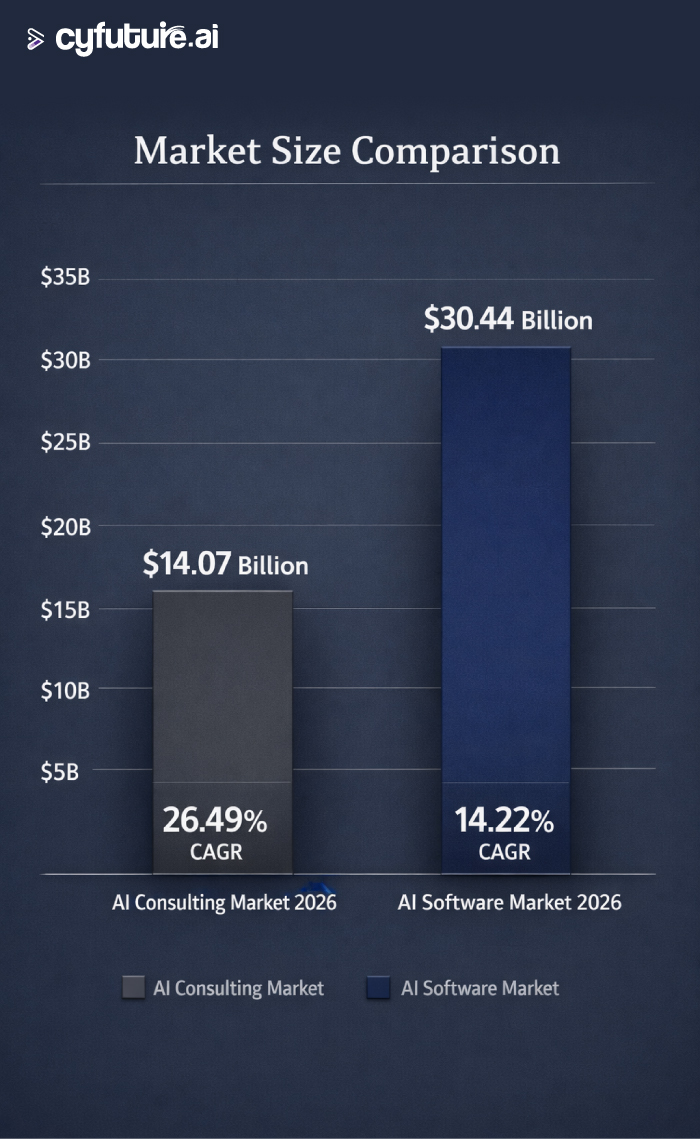
The boardroom debate is no longer whether to adopt AI—it's about choosing the right implementation path. As enterprises race toward digital transformation in 2026, two distinct approaches have emerged: AI consulting services and AI software platforms. With the global AI consulting market valued at USD 14.07 billion in 2026 and projected to reach USD 116.63 billion by 2035 at a CAGR of 26.49%, and AI software dominating 44.94% of the market share in 2026, the stakes have never been higher. This isn't just about technology selection—it's about aligning your AI strategy with business outcomes, budget constraints, and long-term competitive advantage.
The question tech leaders, CTOs, and decision-makers face today: Which path delivers measurable results for your unique organizational context?
Understanding the AI Consulting Landscape in 2026
AI consulting has evolved from advisory-heavy engagements to comprehensive transformation partnerships. These services guide organizations through the complex journey of AI adoption, from strategy formulation to deployment and optimization.
What AI Consulting Services Deliver
AI consulting encompasses strategic planning, custom solution design, implementation guidance, and change management. Over 68% of enterprises have adopted AI-driven analytics, enhancing decision-making efficiency and automation across multiple industry verticals, largely through consulting-led initiatives.
Modern AI consulting firms provide:
Strategic AI Roadmapping: Consultants assess your current technological infrastructure, identify high-value AI use cases, and develop implementation timelines aligned with business objectives. This strategic layer ensures AI investments target areas with maximum ROI potential.
Custom Model Development: Rather than one-size-fits-all solutions, consulting teams build bespoke machine learning models trained on your specific data, industry requirements, and operational constraints. This customization drives differentiated competitive advantages.
Integration Architecture: IBM, Accenture, PwC, TCS, and Capgemini report 2-3x growth in demand for AI consulting services from 2022 to 2024, reflecting the complexity of integrating AI into existing enterprise systems. Consultants bridge legacy infrastructure with cutting-edge AI capabilities.
Workforce Transformation: AI adoption requires cultural and skill shifts. Consulting engagements include training programs, role redesign, and organizational change management to ensure successful AI integration.
The AI Consulting Market Reality
The global AI consulting services market is estimated to be worth USD 257.60 billion by 2033, underscoring sustained enterprise demand. However, only 30 percent of AI consulting projects are considered completely successful by clients, highlighting implementation complexity and the critical importance of selecting experienced partners.
Large enterprises captured over 69.4% share in the AI consulting market in 2024, reflecting that organizations with complex requirements, multiple stakeholder groups, and significant technical debt benefit most from consulting-led approaches.
AI Software Services: The Platform Approach
AI software services represent productized solutions built for broader market applicability. These platforms provide pre-configured AI capabilities that organizations can deploy, customize, and scale rapidly.
Core Characteristics of AI Software Platforms
The global artificial intelligence software platform market size is estimated at USD 26.65 billion in 2025 and is predicted to increase from USD 30.44 billion in 2026 to approximately USD 88.19 billion by 2034, expanding at a CAGR of 14.22%.
Cloud-Based Deployment: The cloud-based segment held a 66% share of the AI software market in 2024, enabling organizations to leverage managed services from AWS, Microsoft Azure, and Google Cloud without significant infrastructure investments.
Pre-Built AI Capabilities: Software platforms offer ready-to-deploy modules for natural language processing, computer vision, predictive analytics, and automation. Organizations can activate these capabilities through APIs and configuration rather than ground-up development.
Scalable Architecture: Platform solutions support enterprise growth, allowing organizations to expand AI usage across departments, geographies, and use cases without proportional cost increases.
Continuous Innovation: Software vendors invest heavily in R&D, ensuring customers access latest AI advancements through regular platform updates and new feature releases.
Market Dynamics Driving AI Software Adoption
Over 115,000 businesses globally implemented AI-powered software systems in 2023 to enhance operations, analytics, and customer engagement. The platform approach appeals to organizations seeking faster time-to-value and predictable cost structures.
In North America, more than 74% of large enterprises have embedded AI into software suites for customer service, supply chain optimization, and fraud detection, demonstrating platform maturity for production workloads.
Read More: How to Choose AI Software Services for Your Organisation: Key Questions?
AI Consulting vs AI Software Service: The Strategic Comparison
When AI Consulting Makes Strategic Sense
Complex Organizational Requirements: If your enterprise operates in highly regulated industries, manages sensitive data, or requires AI solutions tightly integrated with proprietary systems, consulting delivers necessary customization.
Competitive Differentiation Needs: Organizations seeking AI-driven competitive advantages need unique capabilities that off-the-shelf software cannot provide. Consulting enables the development of proprietary algorithms and models.
Transformation Scale: AI-mature companies are already generating 72% of their AI value in core functions like operations, marketing, and sales. Enterprise-wide transformations spanning multiple functions benefit from consulting's holistic approach.
Limited Internal AI Expertise: Organizations without established data science teams, AI engineering capabilities, or machine learning expertise require consulting partners to build these capabilities while delivering immediate value.
When AI Software Platforms Deliver Optimal Value
Standardized Use Cases: For common applications like chatbots, document processing, predictive maintenance, or recommendation engines, proven software platforms offer faster deployment and lower total cost of ownership.
Budget Constraints: PwC estimates that AI initiatives cost an average of $250,000 to $1 million per project for consulting-led approaches. Software platforms with subscription pricing provide more predictable economics for cost-conscious organizations.
Speed-to-Market Pressure: When competitive dynamics demand rapid AI deployment, software platforms enable organizations to activate capabilities in weeks rather than months required for custom development.
Proven ROI Models: Platform vendors provide case studies, benchmarks, and success metrics from similar organizations, reducing implementation risk and enabling more accurate ROI projections.
The Hybrid Approach: Combining Consulting and Software
Forward-thinking enterprises increasingly adopt hybrid models, leveraging software platforms for standardized capabilities while engaging consultants for strategic differentiation and complex integration.
At Cyfuture AI, our approach recognizes that optimal AI transformation often requires both elements. We combine consulting expertise in strategy, change management, and custom development with partnerships across leading AI software platforms, enabling clients to maximize value from both approaches.

Industry-Specific Considerations for 2026
Financial Services and Banking
Finance and banking hold a 22.3% share in the AI consulting market, driven by AI in fraud detection and customer service automation. Regulatory compliance requirements and data security concerns often necessitate consulting-led approaches for core banking functions, while software platforms excel in customer-facing applications.
Healthcare and Life Sciences
The healthcare and life sciences sector accounts for a quarter of all AI consulting projects globally, reflecting complex regulatory environments, patient privacy requirements, and the need for clinically validated AI models.
Retail and E-Commerce
Retail and e-commerce are forecast to account for 33% of the enterprise generative AI market by 2030. Software platforms for personalization, inventory optimization, and customer service dominate this sector due to proven ROI and rapid deployment timelines.
Cost Analysis: Total Cost of Ownership Comparison
AI Consulting Investment Structure
Consulting engagements typically involve:
- Initial discovery and strategy phase: $50,000-$150,000
- Custom development and implementation: $250,000-$2,000,000+
- Ongoing optimization and support: 15-25% of initial investment annually
Entry-level engagements start at $50,000-$75,000 for proof-of-concept projects or AI strategy consulting, with enterprise-scale transformations extending over 12-24 months.
AI Software Platform Economics
Software platforms operate on subscription models:
- Platform licensing: $10,000-$100,000+ annually based on usage
- Implementation and integration: $25,000-$200,000
- Training and change management: $15,000-$75,000
- Ongoing subscription and support: Predictable annual costs
The platform approach front-loads less capital but requires ongoing subscription commitments. Consulting requires higher initial investment but can deliver proprietary capabilities with long-term competitive advantages.
Making the Decision: Framework for Selection
Assess Your Organizational AI Maturity
Organizations at early AI maturity stages benefit from consulting guidance to establish foundations. Those with established data infrastructure and AI literacy can leverage software platforms for acceleration.
Evaluate Strategic vs Operational Priorities
If AI represents a core strategic differentiator for your business model, consulting investment delivers necessary customization. For operational efficiency improvements, software platforms often suffice.
Consider Resource Availability
LinkedIn reported 271% growth in AI-related job postings from 2021-2024, with median AI engineer salaries reaching $185,000 in the U.S. Organizations unable to recruit and retain AI talent internally require either consulting partnerships or managed software platforms.
Timeline and Competitive Pressures
The median AI project takes 7.3 months from contract signing to production launch for consulting approaches. Software platforms can achieve production deployment in 6-12 weeks for standard use cases.
The Cyfuture AI Advantage
Cyfuture AI recognizes that enterprises need partners who understand both consulting and platform approaches. Our team combines deep consulting expertise with technical knowledge across leading AI platforms, enabling us to recommend optimal paths for each client's unique context.
We've successfully guided organizations through complex AI transformations while maintaining focus on measurable business outcomes. Our client retention rate exceeds industry averages because we align AI investments with ROI realization, not just technology deployment.
Future Trends Shaping the AI Services Landscape
Regulatory Complexity Driving Consulting Demand
Over 130 countries are enforcing or drafting AI-related data protection laws, increasing compliance steps and deployment timelines. This regulatory complexity increases the value of consulting partnerships with compliance expertise.
Platform Consolidation and Integration
The AI software market will experience significant consolidation, with leading platforms expanding capabilities through acquisitions and partnerships. Organizations must evaluate vendor viability and integration roadmaps when selecting platforms.
Hybrid Delivery Models
Early experiments in August 2025 showed that hybrid teams combining human consultants with AI systems could deliver projects 35% faster than traditional consulting teams while maintaining similar quality standards. Expect consulting firms to increasingly leverage AI tools in their own service delivery.
Industry-Specific Solutions
Both consulting and software approaches will increasingly specialize by industry vertical, with deeper domain expertise and pre-configured solutions for sector-specific requirements.
Conclusion: Your AI Transformation Partner
The choice between AI consulting and AI software services isn't binary—it's strategic. Your organization's industry, maturity level, competitive requirements, budget constraints, and timeline pressures all influence the optimal path forward.
By 2026, executives expect consulting spend to exceed 4% of total revenue, and 86% of consulting buyers say they are actively looking for services that incorporate AI and technology assets. The integration of consulting expertise with software capabilities represents the future of enterprise AI transformation.
At Cyfuture AI, we help organizations navigate this complexity by providing objective guidance, whether that means consulting-led transformation, platform implementation, or hybrid approaches that maximize value from both methodologies.
The AI revolution is here. The question is whether your organization has the right implementation partner to turn AI potential into competitive reality.
Frequently Asked Questions
What is the primary difference between AI consulting and AI software services?
AI consulting provides customized strategy, development, and implementation guidance tailored to your organization's unique requirements. AI software services deliver pre-built platforms with configurable AI capabilities that can be deployed rapidly across standard use cases. Consulting is relationship-driven and custom; software is product-driven and scalable.
How long does it typically take to see ROI from each approach?
AI software platforms can deliver initial ROI within 3-6 months for well-defined use cases, as deployment is faster and outcomes are more predictable. AI consulting projects typically require 6-12 months to demonstrate meaningful ROI, though they can deliver more substantial long-term value through competitive differentiation and custom capabilities tailored to strategic priorities.
Can small and medium enterprises benefit from AI consulting or should they focus on software platforms?
Small and medium-sized enterprises are expected to register the highest CAGR of 32.10% during the forecast period for AI adoption. SMEs can benefit from both approaches depending on their specific needs. Software platforms often provide better economics for standardized requirements, while focused consulting engagements can help SMEs develop differentiated AI capabilities in niche markets where customization provides competitive advantages.
What happens if our chosen AI approach doesn't deliver expected results?
Both consulting and software approaches carry implementation risks. For consulting, ensure contracts include clear milestones, success metrics, and exit provisions. For software platforms, leverage trial periods, proof-of-concept engagements, and vendor references before full commitment. The hybrid approach mitigates risk by combining platform speed with consulting expertise for complex requirements
Author Bio:
Meghali is a tech-savvy content writer with expertise in AI, Cloud Computing, App Development, and Emerging Technologies. She excels at translating complex technical concepts into clear, engaging, and actionable content for developers, businesses, and tech enthusiasts. Meghali is passionate about helping readers stay informed and make the most of cutting-edge digital solutions.