

 IND
IND UAE
UAE SA
SA


Were You Searching for "How to Choose AI Software Services for Your Organisation"?
Here's what you need to know:
Choosing the right AI software services for your organisation has become mission-critical in 2026, with the global AI software market projected to reach $1,458.89 billion by 2034. Yet, only 25% of AI initiatives deliver their expected ROI, and fewer than 20% scale across the enterprise successfully. The difference between success and failure often lies in asking the right questions before vendor selection—questions about data security, integration capabilities, scalability, compliance, and long-term strategic alignment that can make or break your AI transformation journey.
The stakes have never been higher.
With 78% of companies now using AI in at least one business function, the pressure to adopt AI technologies is mounting across every industry sector. But here's the challenge:
Recent industry research reveals that only about one in four AI initiatives actually deliver their expected ROI, and fewer than 20% have been fully scaled across the enterprise. The gap between AI's promise and actual delivery is widening, and organizations are paying the price—both financially and strategically.

Transform Your Business With Expert AI Guidance
Let Cyfuture AI guide you through every step—from strategy to deployment.
Schedule Now
What is AI Software Service Selection?
AI software service selection is the strategic process of evaluating, comparing, and choosing artificial intelligence platforms, tools, and vendors that align with your organization's specific business objectives, technical infrastructure, and long-term growth trajectory. It encompasses assessing everything from machine learning capabilities and natural language processing features to data governance protocols, integration ecosystems, and vendor reliability.
This process goes beyond simple feature comparison—it requires a comprehensive understanding of your organization's AI maturity level, risk tolerance, budget constraints, and strategic goals. The right AI software service becomes an enabler of digital transformation, while the wrong choice can result in wasted resources, security vulnerabilities, and missed opportunities.
The Current State of AI Adoption: What the Numbers Tell Us
Let's cut through the hype and look at the data:
Market Growth Trajectory:
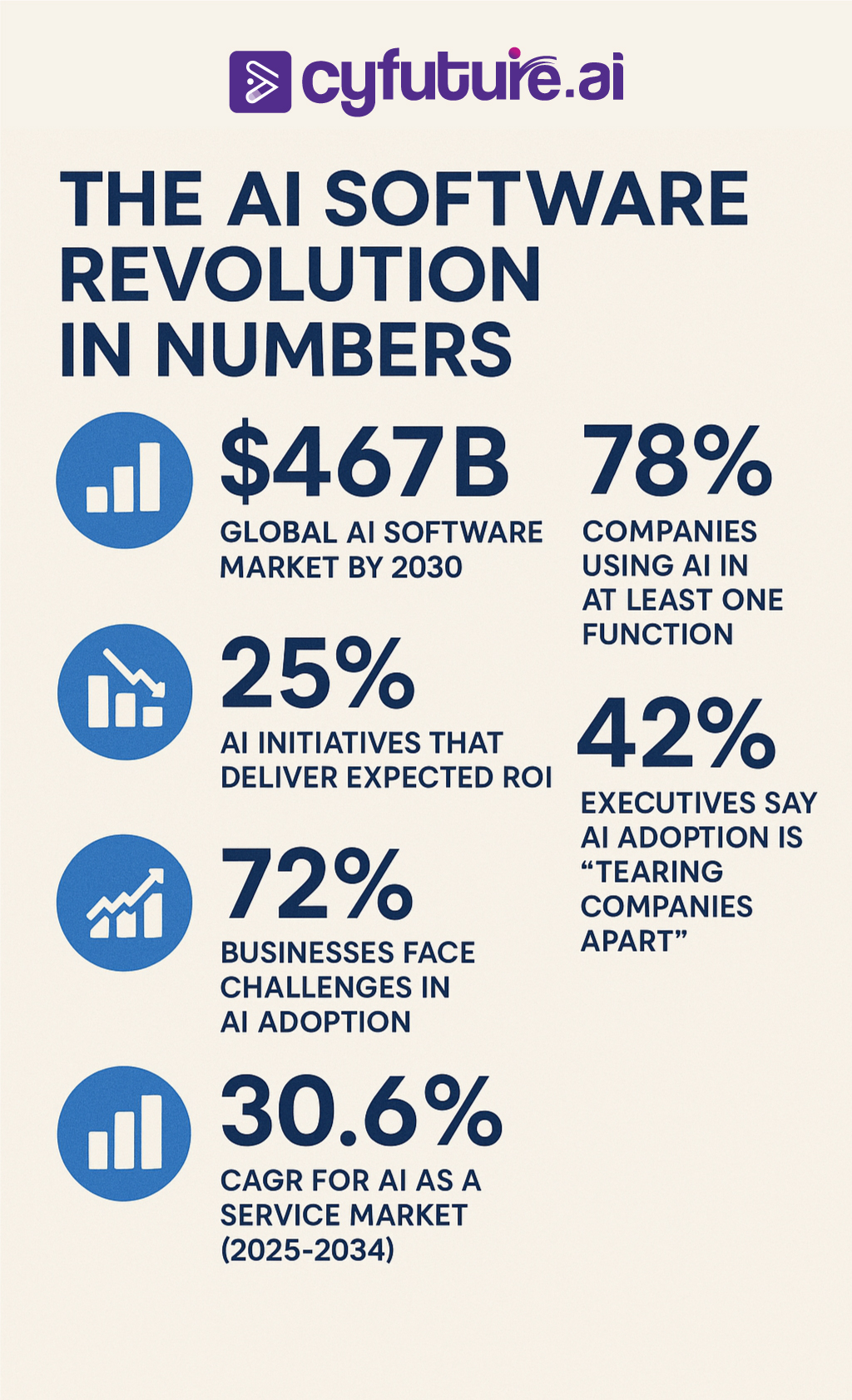
- The Artificial Intelligence (AI) software market size was valued at $122 billion in 2024, growing at a CAGR of 25%, projected to reach $467 billion by 2030
- The global AI as a Service (AIaaS) market was valued at $12.7 billion in 2024 and is estimated to register a CAGR of 30.6% between 2025 and 2034
- The cloud segment accounts for 70.80% of the market share in 2025 and is expecting a remarkable CAGR of 30.70% during the forecast period
Enterprise Adoption Reality:
- IBM reports that approximately 42% of large enterprises have implemented AI in their business operations
- 23% of organizations are scaling an agentic AI system somewhere in their enterprises, with an additional 39% experimenting with AI agents
- McKinsey found that 72% of businesses have adopted AI in at least one business function
The Investment Reality:
- In the first half of 2024, organizations boosted their spending on compute and storage hardware for AI deployments by 97% year-over-year, totaling $47.4 billion
- A SAP study suggests that SMEs can anticipate a 6-10% increase in their revenue by adopting AI
But here's the uncomfortable truth:
42% of C-suite executives report that AI adoption is tearing their company apart, with 72% facing at least one significant challenge on their journey to AI adoption. These challenges include power struggles, conflicts, organizational silos, and even sabotage.
Why Traditional Vendor Selection Fails for AI Software Services
The conventional approach to software vendor selection doesn't work for AI.
Here's why:
The Black Box Problem: Unlike traditional software, AI models often behave unpredictably. Nearly half of organizations surveyed in late 2024 reported worries about AI accuracy and bias as a top barrier to adoption. You're not just buying software—you're buying algorithmic decision-making that can have profound business implications.
The Speed-to-Obsolescence Factor: AI technology evolves at breakneck speed. What's cutting-edge today might be outdated in six months. This makes long-term vendor commitments risky without proper exit strategies and migration paths.
The Data Dependency Dilemma: According to Deloitte's 2024 State of AI in the Enterprise report, 62% of leaders cite data-related challenges, particularly around access and integration, as their top obstacle to AI adoption. Your AI is only as good as your data infrastructure.
The 10 Critical Questions Every Organisation Must Ask
Question 1: What Specific Business Problems Are You Solving?
Before you evaluate a single vendor, get crystal clear on this:
Don't say "we want to use AI." That's like saying "we want to use computers."
Instead, define concrete business outcomes:
- Reduce customer service response time by 40%
- Increase fraud detection accuracy to 99.5%
- Automate 70% of invoice processing
- Generate personalized content at scale for 100,000+ customers
"Organizations that connect AI to true business value and achieve organizational alignment will move fastest." — Mark Relph, Director of Go-to-Market Strategy at AWS
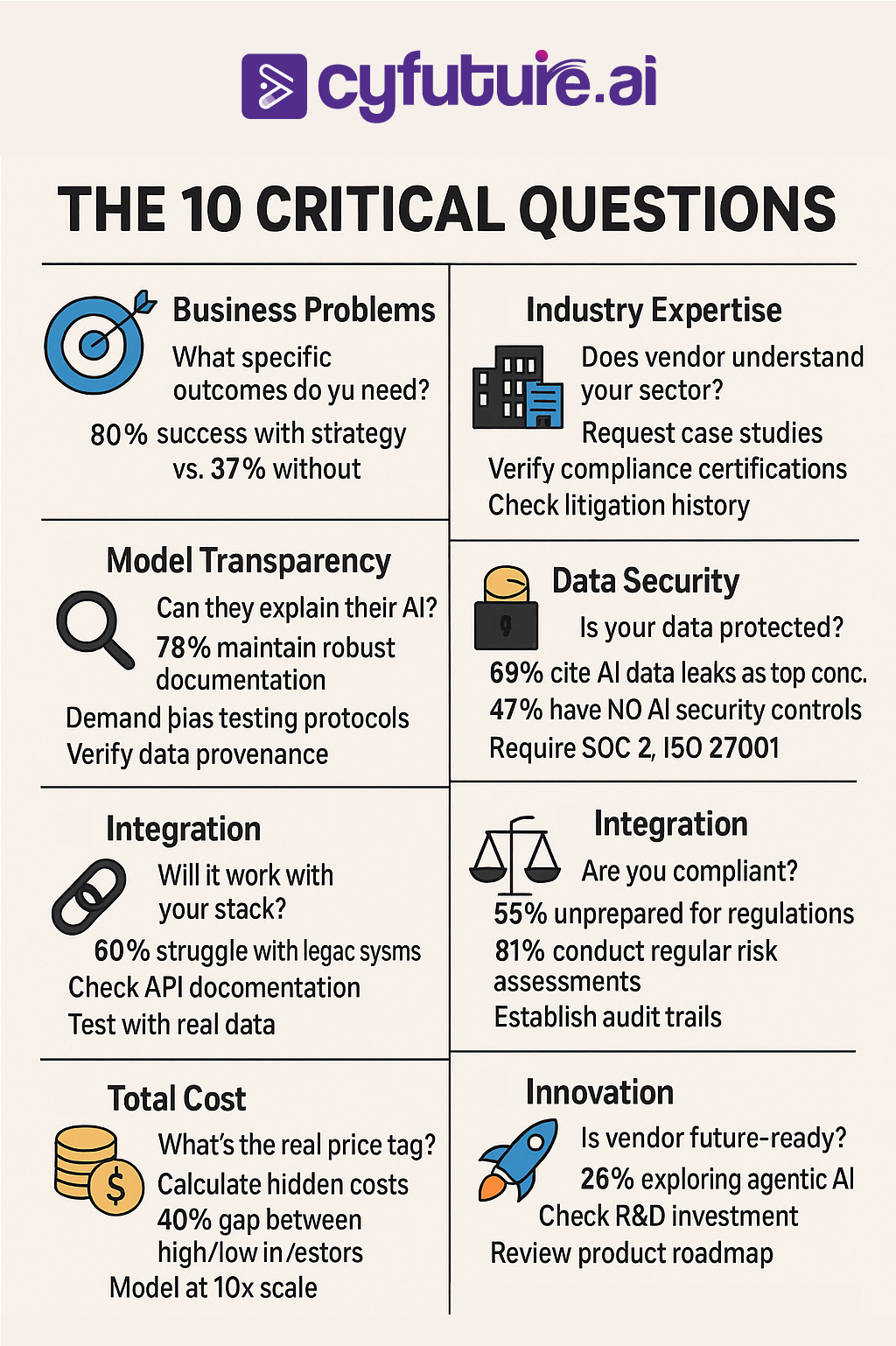
At companies without a formal AI strategy, only 37% of executives report being very successful at adopting and implementing AI, compared to 80% at companies with a strategy.
Action Step: Create a problem statement document that includes:
- Current baseline metrics
- Target improvement metrics
- Timeline for impact
- Stakeholders affected
- Budget constraints
Question 2: Does the Vendor Have Proven Industry Expertise?
Generic AI solutions rarely work well in specialized industries.
Healthcare AI needs HIPAA compliance. Financial services AI requires anti-money laundering capabilities. Manufacturing AI demands integration with IoT sensors and legacy SCADA systems.
Evaluation Criteria:
- Request case studies from your specific industry vertical
- Ask for customer references you can speak with directly
- Verify regulatory compliance certifications (SOC 2, ISO 27001, GDPR, CCPA)
- Check litigation history related to data breaches or AI failures
- Review the vendor's domain expertise in your sector
IBM, Accenture, PwC, TCS, and Capgemini report 2–3x growth in demand for AI consulting services from 2022 to 2024, indicating that organizations increasingly recognize the value of specialized expertise.
Question 3: How Transparent Is Their AI Model Development?
This is where many vendors start to squirm.
Ask them to explain:
- What data sources train their models?
- How often do they refresh training datasets?
- What techniques do they use to detect and mitigate bias?
- Can they explain how their model arrives at specific decisions?
- Do they use proprietary models or third-party foundation models?
78% of organizations maintain robust documentation to enhance the explainability of how gen AI models work and were trained. If your potential vendor can't match this transparency, that's a red flag.
Warning Signs:
- Vague responses about "proprietary algorithms"
- Inability to explain model architecture in understandable terms
- No documentation on data provenance
- Lack of bias testing protocols
Question 4: What's Your Data Security and Privacy Architecture?
This isn't optional—it's existential.
69% of organizations cite AI-powered data leaks as their top security concern in 2026, yet nearly half (47%) have no AI-specific security controls in place.
Must-Have Security Features:
- End-to-end encryption for data in transit and at rest
- Role-based access controls (RBAC)
- Data residency options for regulatory compliance
- Regular third-party security audits
- Incident response protocols
- Data anonymization and pseudonymization capabilities
- Clear data retention and deletion policies
Critical Questions:
- Will our data be used to train your models?
- Where is our data physically stored?
- Who has access to our data?
- What happens to our data if we terminate the contract?
- Do you have cyber insurance coverage?
Question 5: How Does This Integrate With Our Existing Tech Stack?
According to nearly 60% of AI leaders surveyed, their organization's primary challenges in adopting agentic AI are integrating with legacy systems and addressing risk and compliance concerns.
Integration complexity kills AI projects.
Integration Assessment Checklist:
- API availability and documentation quality
- Support for common data formats (JSON, XML, CSV, Parquet)
- Compatibility with your data warehouse (Snowflake, Databricks, BigQuery)
- Integration with your CRM, ERP, and other core systems
- Support for your cloud infrastructure (AWS, Azure, GCP, hybrid)
- Availability of pre-built connectors
- Technical support during integration phase
Cyfuture AI Advantage: With deep expertise in multi-cloud integration and enterprise architecture, Cyfuture AI ensures seamless integration with your existing infrastructure, reducing deployment time by up to 60% compared to industry averages.
Question 6: What's the Total Cost of Ownership (TCO)?
Sticker price is just the beginning.
Hidden Costs to Calculate:
- Initial licensing fees
- Implementation and customization costs
- Training and change management expenses
- Ongoing subscription or usage-based pricing
- Data storage and compute costs
- Integration and API call costs
- Maintenance and support fees
- Staff training and upskilling
- Potential costs of vendor lock-in
There's a 40 percentage-point gap in success rates between companies that invest the most in AI and those that invest the least. Under-investment is as dangerous as over-spending.
Financial Due Diligence:
- Request a detailed pricing breakdown
- Model costs at different usage scales
- Understand billing increments (per user, per API call, per GB)
- Clarify what's included vs. premium add-ons
- Negotiate volume discounts and multi-year commitments
Question 7: Can This Solution Scale With Our Growth?
You don't want to migrate AI platforms every two years.
Scalability Dimensions:
- Data Volume: Can it handle 10x your current data volume?
- User Concurrency: What happens during peak usage?
- Geographic Expansion: Does it support multi-region deployment?
- Feature Expansion: Can you add capabilities without platform migration?
- Computational Resources: Are there hard limits on processing capacity?
The software as a service (SaaS) segment dominated the AIaaS market in 2024 with a market share of around 46%, operating on a subscription-based pricing model that provides businesses with powerful AI tools without significant capital expenditure.
Test Scenario: Ask vendors to demonstrate performance under stress conditions relevant to your business—Black Friday traffic, month-end financial close, seasonal peaks.
Question 8: What's Your Model Governance and Compliance Framework?
This is where regulatory nightmares are prevented.
Nearly 55% of organizations are unprepared for AI regulatory compliance, risking potential fines and reputational damage as new regulations take effect.
Governance Requirements:
- Model versioning and lineage tracking
- Audit trails for all AI decisions
- Explainability frameworks for regulated industries
- Compliance with emerging AI regulations (EU AI Act, US state laws)
- Regular bias and fairness audits
- Dispute resolution processes for AI decisions
- Data subject access request (DSAR) capabilities
80% of organizations have a separate part of their risk function dedicated to risks associated with AI or gen AI, and 81% conduct regular risk assessments to identify potential security threats introduced by gen AI.
Question 9: What's Your Track Record on Innovation and R&D?
The AI landscape changes weekly. Your vendor must keep pace.
Innovation Indicators:
- R&D investment as percentage of revenue
- Frequency of platform updates and new feature releases
- Academic partnerships and research publications
- Participation in industry standards bodies
- Beta testing and early access programs
- Vision for emerging AI trends (agentic AI, multimodal models)
More than one in four leaders (26%) say their organizations are already exploring agentic AI to a large or very large extent. Is your potential vendor ahead of this curve or playing catch-up?
Cyfuture AI Leadership: Cyfuture AI invests heavily in R&D partnerships with leading AI research institutions, ensuring our clients benefit from cutting-edge capabilities while maintaining enterprise-grade stability.
Question 10: What Does Success Look Like, and How Do We Measure It?
The panel identified measuring AI's impact and building convincing business cases as emerging challenges in 2024.
Success Metrics Framework:
- Business KPIs: Revenue impact, cost reduction, time savings
- Technical KPIs: Model accuracy, latency, uptime
- User Adoption KPIs: Active users, feature utilization, satisfaction scores
- Risk KPIs: Incidents, compliance violations, security events
Establish baseline measurements before deployment, and create a dashboard that tracks these metrics in real-time.
Red Flags That Should Stop You in Your Tracks
Some warning signs are non-negotiable deal-breakers:
Immediate Disqualifiers:
- Vendor can't explain their AI methodology clearly
- No customer references in your industry
- Lack of security certifications (SOC 2, ISO 27001)
- Unclear data ownership and usage policies
- No documented incident response plan
- Resistance to third-party security audits
- "Black box" models with zero explainability
- Vendor pushing inappropriate use cases
- Unrealistic promises about accuracy or results
- No clear product roadmap or innovation strategy
"Without meaningful access to enterprise data, even the most powerful AI fails to generate relevant or actionable results. Context-aware AI means more than better answers; it means outputs you can trust." — Industry Expert, World Economic Forum
Common Pitfalls in AI Vendor Selection (And How to Avoid Them)
Pitfall #1: Falling for the Demo Effect
Vendor demos are choreographed performances with perfect data.
Solution: Insist on PoCs using your actual data, with all its messiness and edge cases.
Pitfall #2: Ignoring Change Management
Only about one-third of companies in late 2024 said they were prioritizing change management and training as part of their AI rollouts.
Solution: Budget 25-30% of your total project cost for change management, training, and organizational adoption initiatives.
Pitfall #3: Underestimating Integration Complexity
That "simple API integration" often turns into six months of custom development.
Solution: Request detailed technical architecture documents and involve your engineering team early in the evaluation.
Pitfall #4: Vendor Lock-In Blindness
Solution: Negotiate data portability clauses, insist on standard formats, and maintain exit strategy documentation from day one.
Pitfall #5: Overlooking the Human Element
Only 45% of employees—compared to 75% of the C-suite—believe their organization has successfully adopted and used generative AI over the past year.
Solution: Include end-users in the selection process, not just executives and IT leaders.
Building Your AI Vendor Selection Scorecard
Create a weighted scorecard that reflects your organization's priorities:
Sample Weighting (adjust to your needs):
- Business fit and use case alignment: 25%
- Technical capabilities and performance: 20%
- Security and compliance: 20%
- Integration and scalability: 15%
- Total cost of ownership: 10%
- Vendor stability and support: 5%
- Innovation and roadmap: 5%
Score each vendor on a 1-10 scale for each criterion, multiply by weight, and sum for a total score.
Empower Your Organisation With the Right AI Partner
The choice you make today about AI software services will ripple through your organization for years to come.
Get it right, and you'll unlock competitive advantages, operational efficiencies, and innovative capabilities that transform your business. Get it wrong, and you'll waste millions, create security vulnerabilities, and fall behind competitors who made better choices.
The data is unequivocal: AI is expected to have a cumulative global economic impact of $19.9 trillion through 2030. Organizations that approach AI vendor selection strategically—asking the right questions, conducting thorough due diligence, and planning for long-term success—will capture their share of this value.
Don't rush this decision. Don't let vendor pressure or competitive FOMO override due diligence. Take the time to ask the ten critical questions outlined in this guide. Run comprehensive PoCs. Involve all stakeholders.
Most importantly, choose a partner, not just a vendor—someone who understands your industry, shares your risk philosophy, and is committed to your long-term success.
The AI revolution is here. Make sure you're partnered with the right technology and the right team to win it.
Frequently Asked Questions (FAQs)
1. How long should an AI vendor selection process take?
A comprehensive AI vendor selection process typically takes 12-21 weeks, including initial research (2-3 weeks), deep due diligence (4-6 weeks), proof of concept (4-8 weeks), and final selection and negotiation (2-4 weeks). Rushing this process increases the risk of selecting the wrong vendor, which can cost millions in wasted resources and lost opportunities.
2. What's the difference between AI-native and AI-enabled vendors?
AI-native vendors build AI capabilities into their core architecture from the ground up, while AI-enabled vendors layer AI features onto existing software platforms. AI-native solutions typically offer better integration, performance, and scalability, but AI-enabled platforms might integrate more easily with your existing enterprise software ecosystem.
3. Should we build custom AI solutions in-house or buy from vendors?
This depends on your organization's AI maturity, available talent, and specific use cases. For most organizations, buying proven AI solutions for common use cases (customer service, fraud detection, predictive maintenance) makes sense, while reserving in-house development for truly unique competitive differentiators. Consider that 42% of large enterprises have implemented AI, with the majority using vendor solutions.
4. How do we prevent AI vendor lock-in?
Negotiate data portability clauses in your contract, insist on standard data formats and APIs, maintain comprehensive documentation of your AI workflows, and build abstraction layers in your architecture. Always have an exit strategy documented before you sign a contract. Consider multi-vendor approaches for critical capabilities.
5. What security certifications should AI vendors have?
At minimum, look for SOC 2 Type II, ISO 27001, and industry-specific certifications (HIPAA for healthcare, PCI DSS for payments, FedRAMP for government). Also verify GDPR compliance documentation, regular penetration testing results, and cyber insurance coverage. 81% of organizations conduct regular risk assessments to identify potential security threats introduced by gen AI.
6. How do we measure ROI from AI software investments?
Define clear baseline metrics before implementation, establish quantifiable success criteria, and track both financial metrics (cost savings, revenue increase) and operational metrics (time savings, accuracy improvements, user satisfaction). Only about one in four AI initiatives actually deliver their expected ROI, making rigorous measurement critical. Create a dashboard that tracks KPIs in real-time and report results regularly to stakeholders.
7. What's the typical total cost of ownership (TCO) for enterprise AI solutions?
TCO varies dramatically based on use case, but budget approximately: 40% for licensing and subscriptions, 30% for implementation and customization, 20% for training and change management, and 10% for ongoing maintenance. In the first half of 2024, organizations boosted their spending on compute and storage hardware for AI deployments by 97% year-over-year, totaling $47.4 billion. Don't forget hidden costs like data preparation, integration, and infrastructure upgrades.
8. How important is the vendor's financial stability?
Critical. AI implementations typically span multiple years, and vendor bankruptcy or acquisition can derail your entire strategy. Research the vendor's funding history, revenue growth, customer retention rates, and financial backing. Look for vendors with diverse customer bases (not dependent on a few large clients) and sustainable business models.
9. Should we prioritize specialized AI vendors or large tech platforms (AWS, Azure, Google Cloud)?
Each has advantages. Large tech platforms offer comprehensive ecosystems, proven scalability, and competitive pricing, but may lack specialized industry expertise. Specialized vendors offer deeper domain knowledge and targeted features but might have integration challenges. Consider hybrid approaches—using cloud platforms for infrastructure and specialized vendors for industry-specific AI capabilities. The cloud segment accounts for 70.80% of the market share in 2025, indicating strong preference for cloud-based deployments.
Author Bio:
Meghali is a tech-savvy content writer with expertise in AI, Cloud Computing, App Development, and Emerging Technologies. She excels at translating complex technical concepts into clear, engaging, and actionable content for developers, businesses, and tech enthusiasts. Meghali is passionate about helping readers stay informed and make the most of cutting-edge digital solutions.