


 IND
IND UAE
UAE SA
SA


The Compounding Compute Problem
AI infrastructure demand is no longer growing linearly. It is compounding. Every generation of foundation models — larger, multimodal, longer context — doubles down on the compute requirements of the last. The GPU has become the rate-limiting factor for how fast the AI industry can move.
The H100 generation, launched in 2022, redefined what was possible for LLM training. Within 18 months it wasn't enough. Teams building frontier models were already cluster-constrained, running into the limits of what an 80GB device could hold, how fast it could move data between GPUs, and how efficiently it could serve inference at scale.
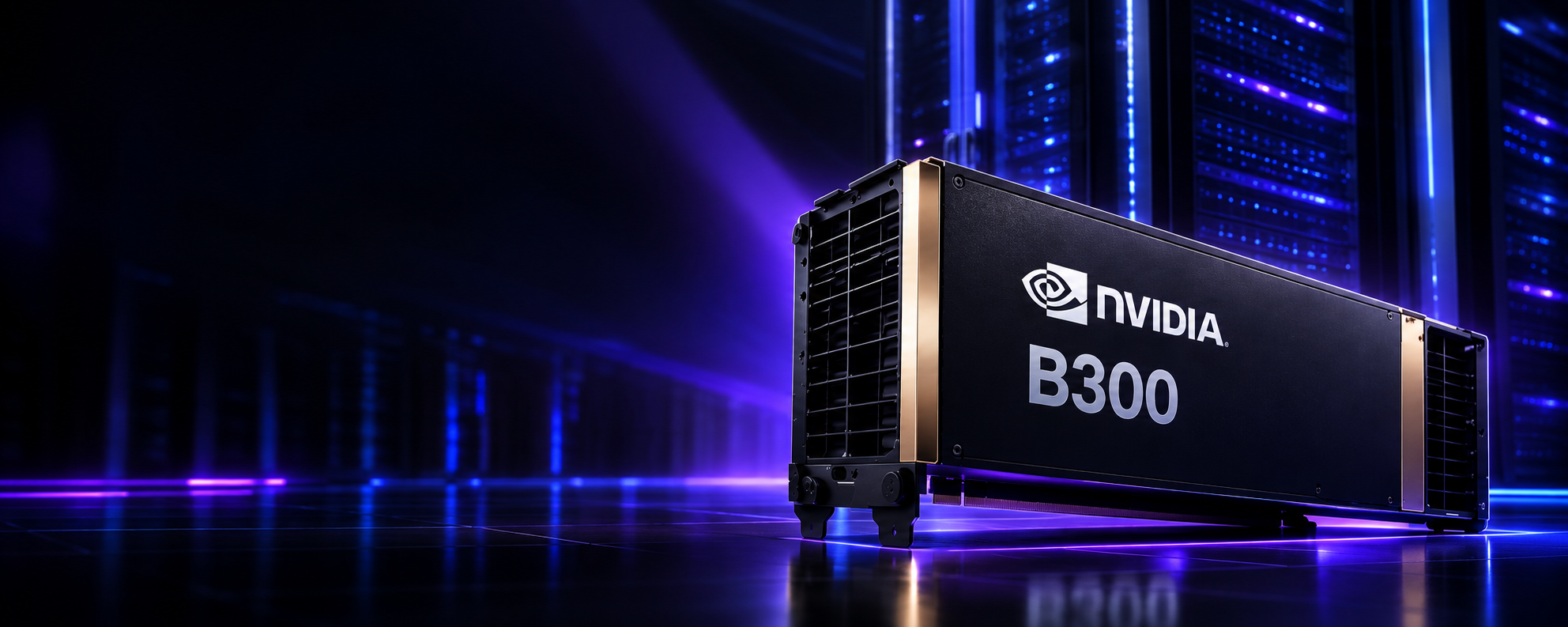
The NVIDIA B300 GPU is the answer to what comes next. Not a minor revision — a generational step designed to keep enterprise AI workloads feasible as model scale, context lengths, and inference throughput requirements continue to push past what current hardware can absorb economically.
Raw FLOPS numbers dominate GPU launch coverage and almost none of it tells you what matters in production. Memory capacity determines which models fit without sharding. Memory bandwidth determines how fast the GPU feeds its compute units. Interconnect bandwidth determines whether multi-GPU scaling is efficient. The B300 pushes all three — not just the headline compute number.
What Is the NVIDIA B300 GPU?
The NVIDIA B300 GPU is NVIDIA's next-generation data center AI accelerator in the Blackwell Ultra architecture series, designed to succeed the B200 for large-scale LLM training and high-concurrency AI inference. It targets workloads that exceed the memory capacity and compute throughput of H100 and B200 hardware — specifically frontier model training at 200B+ parameters and long-context inference at production concurrency.
It is not a consumer GPU. It is not designed for workstations or graphics. The B300 is a data center AI accelerator built for NVLink cluster configurations, DGX SuperPOD deployments, and enterprise AI infrastructure where raw memory capacity and sustained compute throughput are the defining constraints.
Where the B200 extended Blackwell architecture with HBM3e and improved tensor cores, the B300 represents the performance ceiling of the Blackwell generation — positioned for use cases that are emerging now but will be mainstream by late 2026 and 2027.
Blackwell Architecture Evolution — NVIDIA GPU Timeline
Understanding where B300 sits requires seeing the full generational trajectory. Each step solved a specific bottleneck; the B300 addresses the constraints the B200 leaves unsolved at frontier scale.
Why NVIDIA Keeps Building Bigger AI GPUs
The answer isn't ambition. It's memory — and the compounding math of what frontier models actually require at runtime.
LLMs are fundamentally memory-bound at inference time. A 70B parameter model in BF16 requires roughly 140GB just to hold the weights — before KV cache, activations, or intermediate buffers. A 405B parameter model needs north of 800GB. No single GPU can hold a frontier model's weights without tensor parallelism across multiple cards. More cards means more NVLink and InfiniBand traffic, higher latency, and greater operational complexity. Every doubling of per-GPU memory cuts the required card count in half.
Context Window Explosion
Production models now handle 128K–1M token context windows. The KV cache for a single 128K-context inference at 70B parameters can consume tens of gigabytes of GPU memory per request. At 100 concurrent requests, KV cache alone exceeds the total capacity of an H100. Larger per-GPU memory is the only architectural solution that doesn't involve aggressive cache eviction — which directly hurts latency.
Frontier Model Training
Training 500B+ parameter models with optimizer states and gradient buffers multiplies the memory footprint per GPU by 8–12× beyond just weights. Fitting larger shards per card directly reduces cluster size — which simplifies scheduling, reduces failure surface area, and cuts the cost per training token proportionally to the reduction in node count.
Inference Latency at Production Scale
As AI moves to real-time applications — agents, voice interfaces, tool-use pipelines — the constraint shifts from throughput to time-to-first-token. Memory bandwidth determines how fast the GPU loads model weights for each forward pass. Higher bandwidth means lower latency per request, regardless of the FLOPS ceiling. The B300's expected HBM3e bandwidth improvements translate directly into lower time-to-first-token in production.
Expected NVIDIA B300 Specifications [Projected]
NVIDIA has not published confirmed B300 specifications. The table below represents engineering projections based on Blackwell architecture trajectory, NVIDIA roadmap disclosures, and documented supply chain information. Do not use these for procurement decisions — wait for official NVIDIA disclosure.
| Specification | H100 SXM5 (Confirmed) | B200 SXM (Confirmed) | B300 [Projected] |
|---|---|---|---|
| Architecture | Hopper | Blackwell | Blackwell Ultra |
| HBM Memory | 80GB HBM3 | 192GB HBM3e | 288GB+ HBM3e |
| Memory Bandwidth | 3.35 TB/s | ~8 TB/s | >8 TB/s [est.] |
| BF16 Tensor FLOPS | 3.35 PFLOPS | ~9 PFLOPS | Higher [unconfirmed] |
| FP8 Training | Limited | Full support | Full + FP4 [expected] |
| NVLink Generation | NVLink 4.0 | NVLink 4.0 | NVLink 5.0 [expected] |
| GPU-GPU Bandwidth | 900 GB/s | 1.8 TB/s | Higher [projected] |
| TDP | 700W | 1000W | 700–1000W [range est.] |
| Form Factor | SXM5 | SXM6 | SXM6 [expected] |
B300 vs H100 vs B200 — Visual Comparison
The practical trade-offs — not just spec-sheet numbers — for teams making infrastructure decisions today.
| GPU | Architecture | Memory | Best Workload | Availability | Key Constraint |
|---|---|---|---|---|---|
| H100 SXM5 | Hopper | 80GB HBM3 | 7B–70B inference, fine-tuning, RAG | Wide | Memory limits for 70B+ without sharding |
| H100 NVL | Hopper | 188GB HBM3 | 70B single-card inference, multi-tenant | Available | Higher cost than standard H100 |
| B200 SXM | Blackwell | 192GB HBM3e | Frontier training, FP8 workloads | Hyperscaler first | Limited enterprise availability; high cost |
| B200 NVL | Blackwell | 288GB HBM3e | 405B inference, multimodal, long-context | Limited | Infrastructure power/cooling demands |
| B300 [Projected] | Blackwell Ultra | 288GB+ HBM3e | Frontier training 200B+, agentic AI scale | 2026–2027 | Availability and infrastructure requirements |
Don't Wait on B300 — Deploy AI on India's Most Compliant GPU Infrastructure Now
Run LLM training, inference, RAG pipelines, and fine-tuning on NVIDIA A100 and H100 infrastructure in Cyfuture AI's India data centers. DPDP Act compliant, ISO 27001:2022 certified. INR billing + GST invoices. 500+ enterprises running production AI today.
What B300 Means for AI Workloads
LLM Training at Frontier Scale
Training 200B+ parameter models is where B300 changes the economics. H100's 80GB forces aggressive tensor parallelism — more GPUs per model shard, more all-reduce operations per step, lower GPU utilisation. B300's projected memory capacity means larger shards per card, fewer required nodes, and proportionally lower training cost. For teams whose largest training runs consume hundreds of H100s, the B300 is an infrastructure rethink, not just a hardware upgrade.
AI Inference and Long-Context Serving
Production inference has three key metrics: tokens per second per GPU (throughput), time to first token (latency), and KV cache capacity (bounds concurrent requests). B300's higher memory bandwidth reduces time-to-first-token directly — loading weights and KV cache is faster. Larger HBM capacity enables larger batch sizes and longer context windows without eviction. For real-time applications — AI agents, voice interfaces — these translate to measurable user experience improvements.
Agentic AI
Agentic systems run in loops. Context accumulates. KV cache per session grows with each step. At scale — dozens of concurrent agent sessions, each maintaining multi-step context — the memory pressure is substantial. B300's capacity advantage matters here more than its raw FLOPS: the difference between serving 200 concurrent agent sessions versus 80 on the same hardware footprint.
Multimodal Models
Vision-language models generate thousands of vision tokens per image. A multimodal request's KV cache is proportionally larger than text-only, and embedding models for visual inputs add memory overhead. Larger HBM capacity makes multimodal serving economically viable without aggressive batching constraints that hurt latency.
RAG Pipelines and Enterprise AI Applications
Direct answer: RAG pipelines don't need B300. The bottleneck in a RAG platform is retrieval quality and embedding latency, not GPU memory capacity. If you're running AI chatbots or AI voicebots, document search, or customer support automation on 7B–70B models, H100 and A100 inference handles these workloads comfortably. B300's cost and availability constraints are not justified at this workload scale.
Real Infrastructure Challenges
GPU performance means nothing if infrastructure cannot feed it efficiently. The B300 generation is where this becomes a genuine architectural problem rather than a planning footnote.
Power: The Hard Ceiling
A single B200 SXM draws 1000W. Eight GPUs in a DGX B200 node pull ~14.4kW. A conventional data center row at 10–15kW per rack cannot host these systems. B300 deployments need 30–60kW per rack density — requiring three-phase power delivery and transformer upgrades. This is a 6–12 month infrastructure investment, not a procurement decision.
Cooling: Air Cooling Is Done
Traditional air-cooled racks cannot dissipate 30–60kW per rack economically. The B200 generation ended the viability of air cooling for GPU clusters. Direct liquid cooling (DLC) is the baseline for B200 and will be mandatory for B300. Immersion cooling is the alternative. None are plug-and-play retrofits to existing data center infrastructure.
Networking: Bottleneck Shifts
As GPU performance per node increases, inter-node networking becomes the constraint. InfiniBand NDR (400Gbps) is the current standard for training clusters. XDR (800Gbps) is the next generation — requiring new switch infrastructure and recabling. The GPU is only as fast as its slowest interconnect.
Cost and Allocation Reality
B300 GPUs will be expensive — and scarce initially. Initial production runs go to hyperscalers under existing supply agreements. For most organisations, the realistic path to B300 is through cloud GPU infrastructure once availability scales — not direct purchase. The procurement conversation is a 2026–2027 event for most enterprise teams.
Training a 500B parameter model generates checkpoint data in the tens of terabytes per save. Aggregate checkpoint data per training run can exceed a petabyte. Loading a checkpoint requires high-throughput distributed storage capable of saturating NVLink bandwidth across dozens of GPUs simultaneously. The storage infrastructure for frontier model training with B300-class hardware is as complex as the GPU cluster itself — and routinely underfunded.
AI Infrastructure Implications
NVLink Domain Design
NVLink enables GPU-to-GPU communication at memory bandwidth speeds — fundamentally different from PCIe or InfiniBand. The B300 generation expands NVLink domain sizes, allowing more GPUs to share a single high-bandwidth interconnect. For inference serving, models fitting within one NVLink domain avoid the latency penalty of cross-node communication entirely. Designing clusters around NVLink domain boundaries — rather than simply buying racks and connecting them — is the architectural discipline that separates efficient B300 deployments from expensive ones.
InfiniBand vs Ethernet for Scale-Out
Beyond the NVLink domain, InfiniBand NDR at 400Gbps remains the preferred fabric for training workloads — its RDMA implementation eliminates CPU involvement in GPU-to-GPU data transfer, which matters when collective operations happen thousands of times per training step. NVIDIA Spectrum-X Ethernet is viable for inference clusters with more forgiving latency requirements. For B300 training deployments, InfiniBand NDR is the standard; for inference at moderate scale, Spectrum-X Ethernet is a reasonable cost optimisation.
Liquid Cooling Infrastructure
DGX B300 configurations will require high-density rack deployments with liquid cooling loops, three-phase power feeds, and real-time power monitoring. GPUs spike 20–30% above TDP during matrix multiply operations. Power delivery infrastructure needs to handle peak draw without throttling — which requires overprovisioning by that margin. This is civil engineering, not IT procurement.
AI-Optimised Storage Fabric
Parallel file systems — GPFS, Lustre, WEKA — configured to stripe across enough NVMe drives to saturate GPU network bandwidth are the baseline for training clusters. For B300 training systems, storage IO is a first-class infrastructure component. Teams that underprovision storage discover this when GPU utilisation sits at 40% waiting for data — a common and expensive oversight.
Who Actually Needs B300 GPUs?
Fewer organisations than the coverage suggests — and more than are currently planning for it. B300 is necessary for: hyperscalers training 200B+ parameter models, AI labs building foundation models, and cloud GPU providers who need to offer next-generation capacity. B300 is not necessary for: teams running 7B–70B inference, RAG pipelines, fine-tuning shops, and most regulated enterprises in India whose immediate priority is DPDP-compliant H100 infrastructure.
Who Needs B300
- Hyperscalers training frontier models at 500B+ parameters where per-GPU memory determines cluster size and training cost
- AI labs building foundation models above 200B parameters where H100 cluster sizes become operationally unwieldy
- Cloud GPU providers needing to offer B300 capacity to remain competitive
- Enterprise teams running 405B class models at production scale requiring high per-GPU memory
- Multimodal AI platforms where long-context vision-language requests overflow H100 memory at production batch sizes
Who Doesn't Need B300 Yet
- 7B–70B inference teams — H100 or A100 handles these comfortably without B300's cost and availability constraints
- Fine-tuning shops — LoRA/QLoRA on sub-70B base models doesn't approach B300's memory limits
- RAG pipeline operators — bottleneck is retrieval quality, not GPU memory. Cyfuture's RAG platform runs efficiently on H100 with no B300 advantage
- BFSI and regulated enterprises in India — immediate priority is DPDP-compliant India-hosted GPU infrastructure, not hardware generation
- Early-stage startups — operational complexity and cost of B300 infrastructure exceeds what product-stage teams can absorb
India AI Infrastructure Perspective
The Future of AI GPUs
The Compute Arms Race Continues
- NVIDIA's roadmap through the Rubin architecture generation suggests HBM4 memory, enhanced NVLink, and continued FP4/FP6 precision training support.
- The real constraint isn't chip design — it's power grid capacity. Hyperscalers signing nuclear power agreements is a signal: energy is being taken seriously at the infrastructure planning level, not just as a sustainability footnote.
- AMD MI350 and MI400 series and Google TPU v5 provide competitive pressure that keeps NVIDIA's roadmap aggressive — which benefits enterprise customers through faster capability delivery.
Inference Specialisation Grows
- Dedicated inference accelerators — Groq, Cerebras, Tenstorrent, and NVIDIA's own inference variants — optimise throughput-per-dollar for serving rather than training flexibility.
- For teams where inference is the ongoing operational cost, purpose-built inference infrastructure will increasingly make sense over general-purpose training GPUs.
- Software efficiency — quantisation, speculative decoding, continuous batching — continues compounding on top of hardware improvements, not replacing them.
The importance of GPUs like the NVIDIA B300 is not just raw performance. It is the ability to make next-generation AI systems economically and operationally feasible. Larger memory per GPU reduces cluster size. Higher bandwidth reduces inference latency. More efficient compute reduces the cost per training token. Together, these make AI applications viable at scales that are economically prohibitive on current hardware. That is why the B300 matters — not the headline FLOPS number, but what becomes possible because of it.
Decision Framework: GPU Infrastructure in the B300 Era
Build Your AI Stack on India's Most Trusted GPU Infrastructure
Deploy production AI training, inference, RAG, and fine-tuning workloads on NVIDIA A100 and H100 GPU clusters in Cyfuture AI's India data centers — Noida, Jaipur, Raipur. ISO 27001:2022 certified. DPDP Act 2023 compliant. INR billing with GST invoices. Trusted by 500+ enterprises across BFSI, healthcare, and e-commerce.
Frequently Asked Questions
The NVIDIA B300 is part of the Blackwell Ultra architecture series — the performance ceiling of the current NVIDIA data center GPU generation, positioned above the B200 SXM. Where the B200 extended Blackwell architecture with HBM3e and improved tensor cores, the B300 offers higher projected HBM3e memory capacity, increased memory bandwidth, and enhanced throughput targeting workloads that strain B200 limits: frontier LLM training at 200B+ parameters and long-context inference at production concurrency. Note: final B300 specifications have not been confirmed by NVIDIA as of May 2026; architectural projections will be updated on official disclosure.
Yes, substantially — but the improvement is most impactful at specific scales. For 7B–70B model training, H100 hardware handles the workload efficiently with well-established software stacks. Where B300 changes the economics is at 200B+ parameters, where H100's 80GB HBM3 forces aggressive tensor parallelism, multiplying inter-GPU communication overhead. B300's higher per-GPU memory reduces required parallelism, cutting cluster size and cost per training token at frontier scales. For enterprise fine-tuning workloads on sub-70B models, the B300 advantage doesn't justify its cost and availability constraints.
B300 GPU availability in India will follow the same hyperscaler-first allocation pattern as every prior NVIDIA generation. Initial production runs in 2026 go to Google, Microsoft, Amazon, and Meta. Cloud GPU providers — including India-based operators — receive allocation as production scales, typically 12–24 months after initial launch. Realistic India-hosted B300 cloud access is expected in late 2026 to 2027. The practical recommendation: deploy production workloads on Cyfuture AI's India-hosted H100 infrastructure now and transition to B300 configurations as availability scales.
B300 deployments require purpose-built infrastructure most conventional data centers lack. Power: 30–60kW per rack, requiring three-phase feeds and high-density PDUs. Cooling: direct liquid cooling or immersion — air cooling is thermally infeasible at these densities. Networking: InfiniBand NDR (400Gbps) or better for training; Spectrum-X Ethernet for inference. Storage: parallel file systems (GPFS, Lustre, WEKA) capable of saturating GPU network bandwidth during data loading, with petabyte-scale checkpoint capacity for frontier training. These are purpose-built facility investments, not incremental upgrades — which is why B300 access through cloud GPU providers is the practical path for most organisations.
Yes — and you should. RAG pipelines, AI chatbots, AI voicebots, and most enterprise AI applications run efficiently on H100 and A100 hardware. The B300's advantages address frontier model training and very large model inference — not the profile of typical enterprise AI. Waiting for B300 means delaying production by 12–24 months for hardware advantages you won't meaningfully use. Cyfuture AI's India-hosted GPU infrastructure is production-ready for these workloads today.
The Digital Personal Data Protection Act 2023 creates data localisation obligations for personal data processed by Indian entities. AI systems processing customer conversations, financial records, health information, or employee data must run on India-jurisdiction infrastructure. For BFSI, healthcare, and e-commerce teams, this makes US-hosted hyperscaler GPU capacity non-compliant for personal data workloads. India-hosted GPU infrastructure — such as Cyfuture AI's data centers in Noida, Jaipur, and Raipur — satisfies this requirement. The same principle applies to B300: India-hosted B300 access from local cloud providers satisfies DPDP; US-hosted B300 capacity does not.
AMD MI350 (CDNA 4 architecture) is AMD's competitive response to Blackwell-class GPUs, with HBM3e configurations and ROCm software ecosystem support. The practical comparison as of May 2026: NVIDIA's CUDA ecosystem, NVLink interconnect, and software maturity (TensorRT, NCCL, vLLM optimisation) give H100 and B200 a significant deployment advantage for most production AI workloads. AMD's primary traction is in hyperscaler deals where procurement diversification is a strategic objective, and in HPC workloads where ROCm competes effectively. For enterprise AI teams selecting between B300 and MI350 for LLM workloads, NVIDIA's software ecosystem advantage typically outweighs raw hardware parity — though AMD's competitive pressure on pricing is a meaningful consideration for large GPU fleet decisions.
For workloads plausibly requiring B300-class hardware within 18–24 months — agentic AI with long-context sessions, multi-model inference serving, or training runs currently limited by H100 memory — yes. Design KV cache management for larger memory envelopes, build serving infrastructure that can scale GPU types without code changes, and avoid hardcoding memory constraints that become irrelevant when B300 arrives. For workloads comfortably within H100 capabilities, optimise for what's available now. The Cyfuture AI model library includes models suited for H100-optimised inference and fine-tuning deployments today.