

 IND
IND UAE
UAE SA
SA


The GPU Revolutionizing Large Language Model Training
The NVIDIA H100 Tensor Core GPU dramatically advances AI infrastructure, offering up to 9X faster training and 30X faster inference for large language models. Built on the Hopper architecture with specialized Tensor Cores and a Transformer Engine, it efficiently handles trillion-parameter AI models.
Powering projects like Meta’s Llama 3 and leading AI research, the H100’s high-speed interconnects and memory bandwidth transform generative AI. In 2026’s AI landscape, its intelligent design and scalability make it the go-to GPU for cutting-edge LLM development.
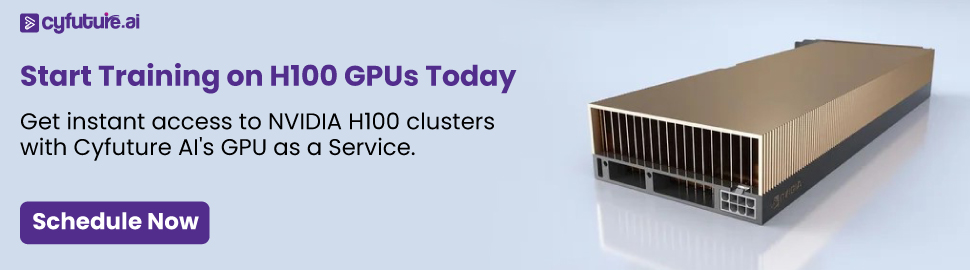
What is the NVIDIA H100 GPU?
The NVIDIA H100 Tensor Core GPU is NVIDIA's flagship data center accelerator, specifically engineered for AI, high-performance computing (HPC), and large-scale data analytics. Released in 2022 as part of the Hopper GPU architecture, the H100 represents a fundamental reimagining of GPU design for the AI era.
At its core, the H100 features 16,896 CUDA cores and 80GB of HBM3 memory, delivering 3,000 teraflops (TFLOPS) of FP8 tensor performance. What sets it apart is the Transformer Engine—a breakthrough innovation that dynamically switches between FP8 and FP16 precision to maximize performance while maintaining model accuracy for transformer-based architectures that power modern LLMs.
Why the H100 Dominates LLM Training: Technical Deep Dive
1. Revolutionary Transformer Engine with Native FP8 Support
The game-changer?
The H100's Transformer Engine represents the first GPU architecture purpose-built for transformer models. Unlike previous generations that relied on FP16 or FP32 precision, the H100 introduces native 8-bit floating-point (FP8) precision in two variants:
- E4M3 format: 4 exponent bits and 3 mantissa bits, optimized for forward passes with weights and activations (range: ±448)
- E5M2 format: 5 exponent bits and 2 mantissa bits, designed for backward passes with gradients (range: ±57,344)
Real-world impact: Training a 7B parameter GPT model with H100 using FP8 precision is 3X faster than A100 using BF16 precision—right out of the box. For 30B parameter models, benchmarks show a 3.3X speedup over the A100.
2. Unmatched Memory Architecture and Bandwidth
Let's talk about the bottleneck that nobody likes to discuss:
Memory bandwidth.
The H100 SXM5 variant delivers 3.35 TB/s of HBM3 memory bandwidth—nearly 2X faster than the A100's 2TB/s. This isn't just a numbers game. For LLM training, where models constantly shuffle billions of parameters between memory and compute units, this bandwidth translates directly to:
- 27% faster training at 512-GPU scale within just one year of software optimization
- 904 TFLOPS per GPU utilization in real-world workloads
- Reduced memory bottlenecks when training models with hundreds of billions of parameters
The numbers speak for themselves:
In MLPerf Training v4.0, NVIDIA demonstrated training GPT-3 175B in just 3.4 minutes using 11,616 H100 GPUs—more than tripling performance while tripling scale simultaneously.
3. Fourth-Generation NVLink: Multi-GPU Training Reimagined
Here's where things get interesting:
Modern LLMs are too large for single GPUs. Training a 175B parameter model requires distributing computation across dozens or hundreds of accelerators. The H100's fourth-generation NVLink provides 900GB/s bidirectional bandwidth—a 50% increase over the previous generation.
What does this mean practically?
- Near-linear scaling when training across thousands of GPUs
- Minimal communication overhead during distributed training
- Ability to train models that would be impossible on previous hardware
Meta's experience training Llama 3 on clusters of 24,576 H100 GPUs demonstrates this scalability. Despite the massive scale, the team maintained over 90% effective training time across 54 days—even while encountering 419 unexpected component failures.
4. Architectural Innovations for AI Workloads
Beyond raw specifications, the H100 introduces several architectural features purpose-built for LLM training:
CUDA Graphs Integration: At scale (several thousand GPUs), CPU overhead becomes pronounced. The H100's CUDA Graphs enable multiple GPU operations to launch with a single CPU operation, contributing to the 27% performance increase at 512-GPU scale.
Dynamic Precision Management: The Transformer Engine performs per-layer statistical analysis to determine optimal precision (FP16 or FP8) for each layer, preserving model accuracy while maximizing throughput.
Tensor Memory Accelerator (TMA): Reduces data movement overhead by efficiently managing tensor data transfers between global memory and shared memory.
Benchmark Performance: H100 vs A100 in LLM Training
Let's cut through the marketing and look at real numbers:
Training Speed Comparisons
|
Model Size |
H100 FP8 Performance |
A100 BF16 Performance |
Speedup |
|
7B parameters |
3X faster |
Baseline |
3X |
|
13B parameters |
2.8X faster |
Baseline |
2.8X |
|
30B parameters |
3.3X faster |
Baseline |
3.3X |
|
175B (GPT-3) |
4X faster |
Baseline |
4X |
Cost-Performance Analysis
Here's the surprising part:
While H100 hourly rates are approximately 2.2X higher than A100 ($4.76/hr vs $2.21/hr for on-demand pricing), the 2-3X performance advantage means:
- 30% lower total training costs for a 7B model trained to compute-optimal point
- 3X faster time-to-completion (critical when racing to deploy new models)
- Better utilization of limited GPU allocation windows
Inference Performance
While this article focuses on training, the H100's inference capabilities deserve mention:
- Up to 4.6X higher throughput compared to A100
- 10,000+ output tokens per second while maintaining 100ms first-token latency
- 50% memory savings with FP8, enabling larger batch sizes
Real-World Deployments: Who's Using H100 for LLM Training?
Meta's Llama 3 Infrastructure
Perhaps the most compelling validation comes from Meta's Llama 3 project:
- Two 24,576-GPU clusters dedicated to Llama 3 training
- Infrastructure roadmap expanding to 350,000 H100 GPUs by end of 2024 (equivalent to 600,000 H100s in compute power)
- Advanced networking with both RoCE and NVIDIA Quantum-2 InfiniBand at 400Gbps
- Successful training despite one failure every three hours at scale
Enterprise Adoption Across Industries
Healthcare & Life Sciences: Training medical diagnosis models and drug discovery networks requiring HIPAA compliance
Financial Services: Developing proprietary LLMs for market analysis, risk assessment, and automated trading systems
Technology Companies: Building next-generation conversational AI, coding assistants, and content generation platforms
Research Institutions: Pushing boundaries of multimodal AI, combining vision, language, and reasoning
Software Ecosystem: Maximizing H100 Performance
The H100's hardware excellence is complemented by a mature software stack:
NVIDIA Software Suite
TensorRT-LLM: Open-source inference optimization achieving 1.7-second inference for Llama 2 70B on 8x H100
NeMo Framework: End-to-end LLM development platform with FP8 training support
Transformer Engine: Available for PyTorch and JAX, handles FP8 scaling automatically
Framework Integration
- PyTorch: Native support via Transformer Engine integration
- TensorFlow: Optimized kernels for Hopper architecture
- JAX: FlashAttention-3 integration for maximum efficiency
Read More: GPU Cloud Pricing Explained: Factors, Models, and Providers
Cyfuture AI: Your Partner for H100-Powered AI Infrastructure
Accessing H100 GPUs doesn't require building your own data center. Cyfuture AI offers enterprise-grade GPU as a Service (GPaaS) with several competitive advantages:
Why Organizations Choose Cyfuture AI
Immediate H100 Access: Deploy GPU clusters within hours, not months of procurement cycles
Cost Optimization: Transparent pricing delivering up to 73% savings compared to major cloud providers, with pay-as-you-go flexibility reducing infrastructure costs by 60-70% versus on-premises hardware
Enterprise Support: 24/7 expert assistance with architecture guidance, performance optimization, and migration support—not just ticket-based help
Comprehensive Platform: Pre-configured environments with optimized libraries enable developers to deploy ML models 5X faster than conventional solutions
Security & Compliance: SOC 2, ISO 27001, GDPR-compliant infrastructure with end-to-end encryption and isolated compute environments
Global Infrastructure: Multiple geographic regions with 99.9% uptime SLA ensuring low-latency access regardless of location
As Cyfuture AI's infrastructure scales with your needs, from single GPU development to multi-node clusters for production training, their consulting team helps optimize resource allocation—potentially saving 30-40% on total infrastructure costs through right-sizing and efficient scheduling.
Future-Proofing Your AI Infrastructure
What's Next: H200 and Blackwell
NVIDIA H200: Shipping in 2024-2025 with 141GB HBM3e memory (1.4X capacity increase) and 4.8TB/s bandwidth
Blackwell (B200): Expected 2025 with NVLink 5.0 (1.8TB/s bidirectional) and enhanced tensor core capabilities
However, the H100 will remain the workhorse of enterprise AI infrastructure through 2026 and beyond, representing the sweet spot of performance, availability, and ecosystem maturity.

Planning Your H100 Deployment
Start small, scale strategically: Begin with single-node testing, validate workflows, then expand to multi-GPU training
Invest in software optimization: FP8 training, FlashAttention, efficient data loading can yield 2-3X improvements beyond hardware
Consider hybrid approaches: Mix on-premises H100 clusters with cloud burst capacity for peak workloads
Partner with experts: Whether through Cyfuture AI or other specialized providers, infrastructure expertise accelerates time-to-value
Also Check: H100 GPU Price in India (2026): PCIe vs SXM, Exact Price Range, Specs & Use Cases
Accelerate Your AI Journey with Cyfuture AI's H100 Infrastructure
The NVIDIA H100 GPU powers the next wave of AI innovation, delivering unmatched performance and scalability. Whether training large language models or optimizing AI workflows, the H100 meets modern demands for speed and efficiency.
With Cyfuture AI, you get instant access to H100 GPUs, enterprise support, and cost-effective solutions—making advanced AI infrastructure easy and accessible for every organization.
Frequently Asked Questions (FAQs)
1. Why is the NVIDIA H100 ideal for LLM training?
The H100 offers massive parallel processing, Transformer Engine support, and ultra-fast memory, making large model training faster and more efficient.
2. How does the H100 improve training speed for large models?
It uses Tensor Cores and FP8 precision to accelerate matrix operations, significantly reducing training time for large language models.
3. What role does the Transformer Engine play in LLM workloads?
The Transformer Engine optimizes AI workloads by dynamically managing precision, improving performance without sacrificing accuracy.
4. Is the NVIDIA H100 suitable for multi-GPU and cluster training?
Yes, it supports NVLink and high-speed interconnects, enabling efficient scaling across multiple GPUs and nodes.
5. How does the H100 reduce infrastructure costs for AI training?
By delivering higher performance per watt and faster time-to-train, the H100 lowers energy usage and overall operational costs.
Author Bio:
Meghali is a tech-savvy content writer with expertise in AI, Cloud Computing, App Development, and Emerging Technologies. She excels at translating complex technical concepts into clear, engaging, and actionable content for developers, businesses, and tech enthusiasts. Meghali is passionate about helping readers stay informed and make the most of cutting-edge digital solutions.