



 IND
IND UAE
UAE SA
SA


Your bank's customer service just answered 3.1 billion queries — this month alone. No lunch breaks. No hold music. No tired Monday mornings.
That's the reality of AI chatbots in BFSI (Banking, Financial Services & Insurance) in 2026. What started as a digital novelty is now mission-critical infrastructure — quietly processing loan requests, flagging fraud, filing insurance claims, and guiding customers through retirement planning, all in real time.
Here's the kicker: the market for AI chatbots in BFSI was valued at USD 1.65 billion in 2025 and is projected to hit USD 19.1 billion by 2035 — growing at a blistering CAGR of 27.75%. If you work in banking, fintech, insurance, or AI infrastructure, this wave isn't coming. It's already here.

|
DEFINITION: AI Chatbot in BFSI
An AI chatbot in BFSI (Banking, Financial Services & Insurance) is an artificial intelligence-powered conversational agent deployed by financial institutions to automate customer interactions, process transactions, detect fraud, assist with onboarding, and deliver personalized financial guidance — across digital channels including mobile apps, web portals, and messaging platforms — without requiring human intervention for routine tasks. |
The Numbers Don't Lie: BFSI Chatbots in 2026
|
Metric |
Figure |
Source |
|
Global BFSI chatbot market (2025) |
USD 1.65 Billion |
Spherical Insights |
|
Projected market size by 2035 |
USD 19.1 Billion |
Spherical Insights |
|
CAGR (2026–2035) |
27.75% |
Spherical Insights |
|
Banks deploying chatbots globally (2025) |
73% |
Multiple Research Firms |
|
Monthly banking chatbot interactions (2025) |
3.1 Billion |
CoinLaw Research |
|
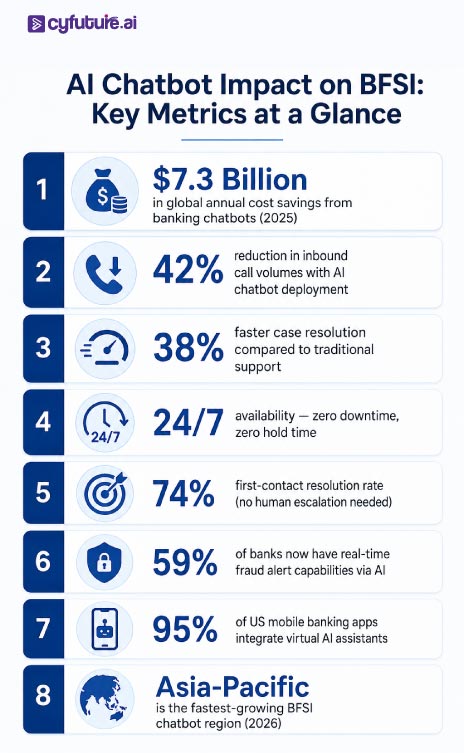
Annual global cost savings from chatbots |
USD 7.3 Billion |
Industry Analysis |
|
Avg. cost saving per chatbot interaction |
~USD 0.72 |
Backbase / CFPB |
|
Case resolution time reduction |
38% |
Backbase 2026 |
|
Customer satisfaction (chatbot interactions) |
84% |
CoinLaw Research 2025 |
|
AI in BFSI market size (2026) |
USD 11.59 Billion |
Business Research Insights |
Why Are BFSI Organizations Going All-In on AI Chatbots?
Think about the last time you called your bank. How long did you wait? How many departments were you transferred to? Now imagine your entire customer base having that same frustrating experience — millions of times per day. That's the problem AI chatbots solve.
But it's not just about convenience. The business case is airtight:
- 73% of global banks now deploy at least one customer-facing chatbot
- Chatbots reduce inbound call volumes by 42%, cutting staffing needs significantly
- Average chatbot integration lowered customer service operating costs by 29% per bank in 2025
- Banks using AI chatbots saw a 74% first-contact resolution rate — 3 in 4 issues resolved without human escalation
- Digital customer onboarding via AI now takes under 4 minutes, down from 20+ minutes manually
What Are AI Chatbots Actually Doing in BFSI?
Enough theory. Let's talk real-world applications — the actual workflows AI chatbots handle inside banks, NBFCs, and insurance firms today.
1. 24/7 Customer Support
Customers don't keep banking hours. AI chatbots handle balance inquiries, transaction histories, mini-statements, and account queries round-the-clock. Bank of America's Erica has surpassed 3 billion client interactions, supporting nearly 50 million users — averaging 58 million interactions every month.
2. KYC & Onboarding Automation
Manual KYC used to be a 20-minute ordeal. AI-driven KYC automation reduced onboarding times by 50% in many banks in 2025. Chatbots guide new customers through document submission, identity verification, and account setup in under 4 minutes.
3. Fraud Detection & Real-Time Alerts
59% of banks report real-time fraud alert capabilities powered by AI. Chatbots monitor behavioral patterns — flagging unusual withdrawals, cross-border transactions, or atypical logins instantly and guiding customers through security steps.
4. Loan & Credit Assistance
Chatbots pre-qualify applicants, collect documentation, and update loan status — all without human intervention. AI-driven underwriting has improved loan processing speed by 25% and loan approval accuracy by 34%.
5. Insurance Claims Processing
In insurance, chatbots guide policyholders through the entire claims journey: submission, document upload, status tracking, and settlement. This reduces processing time, lowers adjuster workload, and dramatically improves customer satisfaction.
6. Personalized Financial Guidance
Modern conversational AI analyzes spending patterns, savings history, and financial goals to offer personalized product recommendations, investment tips, and budgeting advice — experiences that were previously available only to high-net-worth clients.
BFSI Chatbot Use Cases: At a Glance
|
Use Case |
Function |
Key Benefit |
|
24/7 Customer Support |
Balance checks, queries, complaints |
Zero wait time, 84% satisfaction |
|
KYC & Onboarding |
Document verification, account setup |
50% faster onboarding |
|
Fraud Detection |
Behavioral analysis, real-time alerts |
59% of banks enabled |
|
Loan Processing |
Application, underwriting, status updates |
25% faster approvals |
|
Insurance Claims |
Submission, tracking, settlement |
Reduced human workload |
|
Financial Advisory |
Personalized recommendations |
Improved retention by 12% |
|
Internal Employee Support |
IT, compliance, HR queries |
71% adoption in institutions |
Wait — Is It All Roses? The Challenges That Still Exist
Here's the honest picture. AI chatbots are powerful, but they're not perfect — yet.
- Trust Gap: Only 29% of customers say they're fully satisfied with banking chatbots. Many still need human assistance after chatbot interactions.
- Generational Divide: Millennials and Gen Z embrace chatbots. Older customers often don't — requiring hybrid service models.
- Data Security: Banking transactions involve sensitive PII. Any breach erodes years of customer trust in seconds.
- Integration Complexity: Chatbots sitting on top of fragmented legacy core banking systems can only answer what they have data for — escalating everything else.
- Regulatory Compliance: In regulated markets like India, Europe, and the US, chatbots must navigate data sovereignty, explainability (XAI), and consumer protection mandates.
The solution? Infrastructure that matches the ambition. And that's where the AI compute layer becomes critical.
Where Cyfuture AI Fits In: Powering the Infrastructure Behind BFSI AI
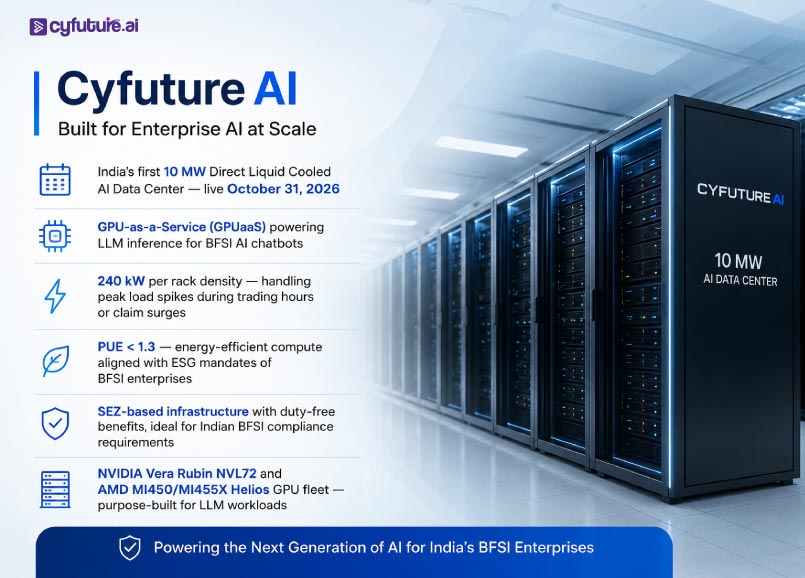
Deploying enterprise-grade AI chatbots in BFSI isn't just a software challenge — it's a hardware and infrastructure challenge. Large Language Models (LLMs) that power modern banking chatbots demand massive GPU compute, low-latency inference, and data-residency compliance. That's exactly what Cyfuture AI delivers.
When a BFSI institution deploys a chatbot that handles 3 million interactions monthly, the GPU infrastructure beneath it has to be flawless. That's the Cyfuture AI promise.

The Bottom Line
AI chatbots for BFSI aren't a future technology. They're today's competitive edge. From slashing call center costs by 42% to onboarding customers in under 4 minutes and flagging fraud in real time — the ROI is measurable, the adoption is accelerating, and the market is heading toward USD 19.1 billion by 2035.
But here's what separates the winners from the laggards: it's not just the chatbot. It's the AI infrastructure that runs it. Low-latency GPUs, high-density compute, and data-residency compliance — these aren't nice-to-haves for BFSI AI. They're the foundation.
Cyfuture AI is building that foundation for India and beyond — one liquid-cooled rack at a time.
Author Bio:
Meghali is a tech-savvy content writer with expertise in AI, Cloud Computing, App Development, and Emerging Technologies. She excels at translating complex technical concepts into clear, engaging, and actionable content for developers, businesses, and tech enthusiasts. Meghali is passionate about helping readers stay informed and make the most of cutting-edge digital solutions.