


 IND
IND UAE
UAE SA
SA


Introduction: The Voice AI Boom is Real — But the Terminology is Confusing
Picture this: You call your bank at 2 AM. A voice picks up instantly. It knows your name, your account history, your last transaction — and within 90 seconds, it has resolved your dispute and sent you a confirmation email. No hold music. No transfers. No human.
Was that a voicebot? Or a voice agent?
If you just shrugged, you are not alone. In 2026, these two terms are thrown around interchangeably in boardrooms, product roadmaps, and vendor pitch decks — and the confusion is costing businesses real money. Deploy the wrong one, and you will either under-automate or over-engineer.
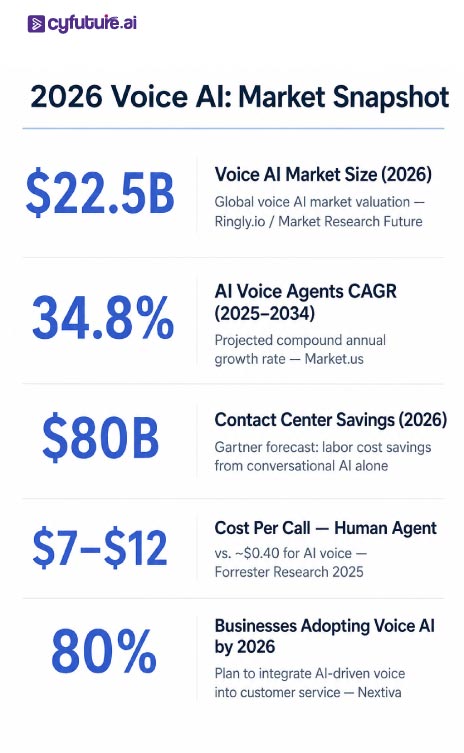
Here is the reality check: the voice AI market has crossed $22.5 billion in 2026, growing at a 34.8% CAGR. Gartner forecasts $80 billion in contact center labor cost savings this year from conversational AI alone. The stakes are enormous.
So let us settle this debate once and for all.
Definition Box: What is an AI Voicebot?
|
🔵 AI Voicebot — Definition An AI Voicebot is a rule-based, automated voice system that interacts with users through predefined scripts and decision trees. It uses Automatic Speech Recognition (ASR) to convert spoken input into text, matches that input against a fixed set of expected intents or keywords, and delivers a scripted text-to-speech (TTS) response. Voicebots are efficient, cost-effective tools for highly predictable, high-volume interactions — but they cannot reason, adapt, or act autonomously outside their programmed flow. |
Think of a voicebot as a very sophisticated phone menu. The moment a caller says something it did not expect, it breaks — and says the dreaded: "I'm sorry, I didn't understand that."
Definition Box: What is an AI Voice Agent?
|
AI Voice Agent An AI Voice Agent is a conversational AI system powered by Large Language Models (LLMs) that can understand intent, maintain full conversation context, reason through ambiguous inputs, and execute real-world actions via API integrations — all in real time through spoken voice. Unlike voicebots, AI Voice Agents do not follow scripts. They reason dynamically, personalize responses based on user history, and can perform multi-step tasks such as booking appointments, processing transactions, and updating CRM records — autonomously. |
An AI voice agent is less like a phone menu and more like a highly trained human employee — one that happens to be available 24/7, speaks 40+ languages, and costs a fraction of human support.
The Core Architecture Difference: Scripts vs. Intelligence
Here is where most explainers get lazy. The real difference is not just about "sounding more natural." It is about the underlying architecture.
AI Voicebot Architecture:
- Speech-to-Text (ASR): Converts spoken audio to text
- Intent Matching: Compares input against a fixed keyword/intent database
- Decision Tree Execution: Routes the caller down a predefined flow
- Text-to-Speech (TTS): Plays back a scripted response
- No Memory, No Reasoning, No External Actions
AI Voice Agent Architecture:
- Speech-to-Text (ASR): Captures and transcribes spoken audio in real time
- Natural Language Understanding (NLU via LLM): Interprets intent, context, and emotional tone
- Reasoning Engine: Determines the optimal next action — ask, respond, or execute
- Action Layer: Calls external APIs — CRM, ERP, calendar, payment gateway, etc.
- Natural Language Generation (NLG): Produces a contextually accurate, personalized response
- Text-to-Speech (TTS): Delivers the response in natural-sounding voice with latency <300ms
- Continuous Learning Loop: Improves from each interaction
In simpler terms: a voicebot follows a map. A voice agent navigates in real time.
AI Voicebots vs AI Voice Agents: Side-by-Side Comparison
|
Feature |
AI Voicebot |
AI Voice Agent |
|
Core Technology |
Rule-based scripts + ASR/TTS |
LLMs + NLU + Reasoning Engine |
|
Conversation Flow |
Predefined, rigid decision trees |
Dynamic, context-aware dialogue |
|
Memory/Context |
No memory across turns |
Maintains full conversation context |
|
Actions |
Informational only |
Executes real-world tasks via APIs |
|
Handling Off-Script Inputs |
Fails or loops on unexpected input |
Adapts naturally to any user input |
|
Personalization |
Low — same script for all users |
High — learns from user history |
|
Setup Complexity |
Low — quick to deploy |
Medium-High — requires LLM + integrations |
|
Cost Per Interaction |
$0.05–$0.15 (simple tasks) |
$0.20–$0.80 (complex tasks) |
|
Best For |
FAQ, IVR replacement, routing |
Sales, support, scheduling, complex CX |
|
Scalability |
High — low compute needs |
High — GPU-backed inference required |
|
Example Use Case |
"Press 1 for billing" replacement |
Full loan application via voice |
Real-World Use Cases: Who Should Use What?
When an AI Voicebot is the Right Call:
- High-volume, predictable inbound call routing ("Press 1 for sales")
- Simple FAQ automation: business hours, address, basic product info
- IVR (Interactive Voice Response) replacement for structured tasks
- Appointment reminders and confirmation calls with binary responses
- Basic payment status checks with no transactional actions
When You Need an AI Voice Agent:
- End-to-end loan application or account opening via voice
- Multi-turn troubleshooting for technical products (telecom, SaaS, hardware)
- Outbound sales qualification — calling leads, handling objections, booking demos
- Healthcare appointment scheduling with real-time calendar integration
- Retail voice commerce — browsing, ordering, tracking, and returns via voice
- Complex customer service requiring CRM lookups, policy checks, and live updates
|
Key Insight: Research from McKinsey's 2025 State of AI report indicates enterprises using AI voice agents for outbound sales workflows reduced cost-per-qualified-meeting by 68% compared to human-only teams. Forrester further projects that by 2026, AI voice agents will handle 35% of all B2B sales development interactions. |
The Hidden Infrastructure Story: Why Voice Agents Need GPU Power
Here is something most vendor blogs will not tell you: AI voice agents are computationally expensive. And that is where the data center story becomes critical.
A basic voicebot runs on commodity cloud compute — a few CPU-based containers, a speech API, and a database lookup. Total infrastructure cost? Minimal.
An AI voice agent, by contrast, runs real-time LLM inference at sub-300ms latency — for every single turn of every single conversation. At enterprise scale — thousands of concurrent calls — this demands:
- High-density GPU clusters for low-latency LLM inference
- NVMe-backed vector databases for context retrieval (RAG)
- Ultra-low latency networking (InfiniBand NDR or RoCEv2) between inference nodes
- Liquid-cooled data center infrastructure to sustain continuous GPU thermal loads
- Edge inference capability for real-time speech processing
This is exactly why enterprises building serious voice AI capabilities are turning to specialized AI cloud infrastructure providers — rather than generic hyperscalers.
|
🏢 Cyfuture AI Advantage: Cyfuture AI operates India's most advanced 10 MW Direct Liquid Cooled AI Data Center, purpose-built to power GPU-intensive AI workloads like real-time LLM inference for voice agents. With NVIDIA Vera Rubin NVL72 and AMD MI450X GPU clusters, InfiniBand NDR fabric, and a PUE of <1.3, Cyfuture delivers the compute density and reliability that enterprise voice AI deployments demand — available on a flexible GPU-as-a-Service model. The October 2026 go-live positions Cyfuture AI as India's premier infrastructure backbone for the voice AI revolution. |
Industry Adoption: Where is Voice AI Heading in 2026?
Want to know which industries are leaning hardest into voice AI agents? Here is the data:
|
Industry |
Adoption Driver |
Key Stat |
|
BFSI |
Fraud alerts, loan processing, account management |
32.9% of market share — Market.us |
|
Healthcare |
Appointment scheduling, patient reminders, triage |
90% of hospitals projected to use AI agents by 2025 — Market.us |
|
Retail / E-commerce |
Voice commerce, order tracking, returns |
Voice commerce market: $62B in 2025 — Capital One Shopping |
|
Telecom |
Network diagnostics, plan upgrades, complaint resolution |
CAGR 31.5% for voice AI in retail/telecom — Voiceaiwrapper |
How to Choose: A Decision Framework
Still not sure which technology your enterprise needs? Ask yourself these five questions:
- Is your call volume high and your interaction type predictable? → Start with a voicebot
- Do callers need to complete multi-step tasks (booking, purchasing, troubleshooting)? → You need a voice agent
- Does your use case require CRM, ERP, or payment gateway integration? → Voice agent, no question
- Is your budget constrained for initial deployment? → Voicebot to start, plan to evolve
- Are you in BFSI, healthcare, or enterprise sales? → AI voice agents will deliver 3–5x better ROI
|
💡 Pro Tip: The smartest enterprises in 2026 are not choosing between voicebots and voice agents — they are building a tiered voice AI stack. Voicebots handle tier-1 routing and FAQs. Voice agents take over for tier-2 complex resolution. Together, they achieve 80%+ automation rates with optimal cost efficiency. |
The Road Ahead: What Comes After Voice Agents?
By 2027, Gartner predicts that 50% of customer service phone interactions in developed markets will be handled by AI without human involvement. By 2028, voice AI will be the default first point of contact for 70% of businesses in North America and Western Europe (Forrester, 2026). By 2030, traditional IVR systems will be functionally extinct (Opus Research, 2026).
The implication for AI infrastructure providers is massive. Real-time voice AI at scale demands GPU-accelerated compute that is always on, always fast, and thermally stable. The enterprises that invest in the right AI infrastructure today — whether GPU-as-a-Service or dedicated liquid-cooled AI data centers — will be the ones setting the pace tomorrow.
|
🏢 Why Cyfuture AI for Voice AI Infrastructure: Cyfuture AI's GPU-as-a-Service platform gives AI teams and enterprises instant access to NVIDIA and AMD GPU clusters without the capital expense of owning hardware. Whether you are deploying a conversational AI voicebot or a full-stack real-time voice agent requiring LLM inference at scale, Cyfuture AI provides the compute, the uptime guarantees, and the latency profiles that production voice AI demands — all from India's most advanced liquid-cooled AI infrastructure. |
Conclusion: The Difference is Not Just Semantic — It is Strategic
At its core, the difference between an AI voicebot and an AI voice agent comes down to one word: autonomy.
Voicebots execute. Voice agents think, decide, and act.
In 2026, with voice AI growing at 34.8% CAGR and per-call costs dropping from $12 to $0.40, choosing the right architecture is a strategic decision — not a technical one. The wrong choice either leaves automation ROI on the table or deploys an over-engineered system for tasks that a simpler bot could handle cheaper and faster.
The winning strategy? Deploy both intelligently. Let voicebots handle the predictable volume. Deploy voice agents where personalization, reasoning, and real-world actions matter. And make sure your underlying AI infrastructure — your GPU compute, your network fabric, your inference latency — can support the ambitions of your voice AI roadmap.
Cyfuture AI is building exactly that infrastructure — for India's AI-first enterprises and the global teams that need it most.
Author Bio:
Meghali is a tech-savvy content writer with expertise in AI, Cloud Computing, App Development, and Emerging Technologies. She excels at translating complex technical concepts into clear, engaging, and actionable content for developers, businesses, and tech enthusiasts. Meghali is passionate about helping readers stay informed and make the most of cutting-edge digital solutions.