

 IND
IND UAE
UAE SA
SA


Why the AMD MI300X Matters Right Now
Every few years, one piece of silicon shifts the conversation in AI infrastructure. Right now, that piece is the AMD MI300X GPU. It didn't arrive with the same fanfare as NVIDIA's chips, but it solved a problem that had been quietly frustrating AI teams for a while: memory.
Large language models keep getting bigger, and every extra billion parameters means more GPU memory is needed just to load the model before a single token gets generated. Teams were splitting models across four, six, sometimes eight GPUs just to fit them in memory — adding networking overhead, complexity, and cost at every step. The AMD MI300X changed that math by packing 192 GB of HBM3 memory onto a single accelerator, nearly two and a half times what NVIDIA's H100 offers.
That single design decision is why AMD Instinct MI300X now shows up in serious conversations about LLM inference, fine-tuning, and enterprise AI deployment — not as a curiosity, but as a genuine alternative that's cheaper to rent, easier to fit large models onto, and increasingly well supported by AMD's ROCm software stack. This article breaks down what the MI300X actually is, how it performs, how it stacks up against the H100, H200, and B200, what it costs to rent, and how to decide if it's the right fit for your workload.
What is AMD Instinct MI300X?
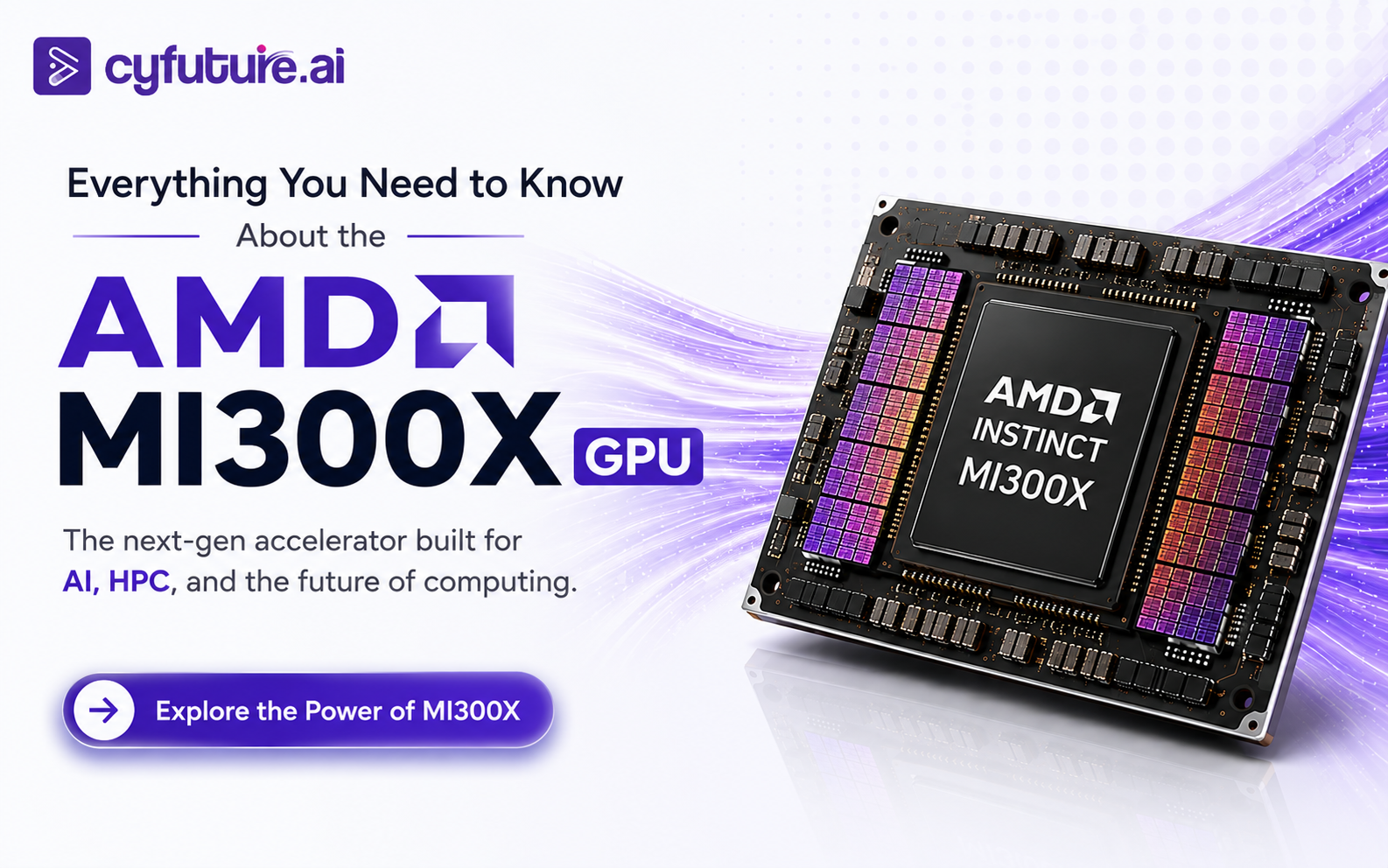
The AMD Instinct MI300X is a data-center GPU purpose-built for AI training, AI inference, and high-performance computing. It's part of AMD's Instinct MI300 family, sitting alongside the MI300A (a combined CPU+GPU accelerated processing unit aimed at HPC clusters), but the MI300X itself is a GPU-only design optimised specifically for AI workloads rather than mixed HPC/AI use.
It's built on AMD's CDNA 3 architecture, the company's compute-focused GPU design line, distinct from AMD's gaming-oriented RDNA architecture. Where CDNA 2 (used in the earlier MI200 series) was already competitive in HPC, CDNA 3 was designed from the ground up with generative AI and large language model workloads as a primary target — which explains the emphasis on memory capacity and bandwidth over raw clock speed.
Physically, the MI300X uses AMD's chiplet-based design: multiple compute dies and memory stacks are packaged together using advanced 3D packaging, connected via AMD's Infinity Fabric interconnect. This modular approach is part of why AMD was able to fit so much HBM3 memory onto a single package — the memory dies sit alongside the compute dies rather than being limited by the constraints of a single monolithic chip.
A 70-billion-parameter model in FP16 precision needs roughly 140 GB just to hold the weights, before accounting for the KV cache and activation memory needed during inference. On an 80 GB H100, that forces model sharding across at least two GPUs. On a single 192 GB MI300X, the same model — and considerably larger ones — can run on one GPU, cutting inter-GPU communication overhead entirely for many inference scenarios.
AMD MI300X Specifications
Here's the full specification sheet as published by AMD. A few of the AI-performance figures are peak theoretical numbers measured with sparsity enabled — real-world throughput will vary by workload, framework, and precision used.
| Specification | AMD MI300X |
|---|---|
| Architecture | AMD CDNA 3 |
| Compute Units | 304 |
| HBM3 Memory | 192 GB |
| Memory Bandwidth | Up to 5.3 TB/s |
| Infinity Fabric | Up to 896 GB/s aggregate GPU-to-GPU bandwidth (8-GPU OAM platform) |
| FP16 Performance | ~1,307 TFLOPS (peak, with sparsity) |
| FP8 Performance | ~2,614 TFLOPS (peak, with sparsity) |
| AI Performance | Optimised for LLM inference, fine-tuning, and generative AI training |
| Power Consumption (TDP) | ~750W |
| Host Interface | PCIe Gen 5 |
| Form Factor | OAM (OCP Accelerator Module) |
Architecture, compute unit count, memory capacity, memory bandwidth, TDP, form factor, and host interface are confirmed specifications published by AMD. Real-world AI performance (tokens/sec, training throughput) varies significantly by model, batch size, precision, and software stack — treat the TFLOPS figures as theoretical ceilings, not guaranteed throughput.
AMD MI300X Features
Specifications tell you what the chip is capable of on paper. These are the features that actually shape whether it's a good fit for your workload.
CDNA 3 Architecture
Purpose-built compute architecture for AI and HPC, with matrix cores tuned for the mixed-precision math (FP8, FP16, BF16) that generative AI workloads rely on most heavily.
192 GB HBM3 Memory
Enough on-package memory to hold large models — including many 70B–180B parameter class models — on a single GPU, avoiding the complexity and latency of multi-GPU model sharding for a wide range of inference use cases.
High Memory Bandwidth
5.3 TB/s of bandwidth keeps the compute units fed with data, which matters enormously for memory-bound operations like attention computation and KV-cache lookups during autoregressive generation.
Infinity Fabric
AMD's high-speed interconnect links multiple MI300X GPUs together with substantial aggregate bandwidth, enabling efficient scale-out for distributed training and tensor-parallel inference across an 8-GPU node.
ROCm Ecosystem
AMD's open-source ROCm software stack now has solid support for PyTorch and the major LLM inference frameworks, closing much of the gap with CUDA for common training and inference workflows.
Enterprise Security
Built for multi-tenant data-center deployment with hardware-level isolation features suited to shared cloud environments running sensitive enterprise or regulated workloads.
Multi-GPU Scaling
Standard 8-GPU OAM platform configurations let teams scale from single-GPU inference to large distributed training clusters using the same underlying hardware and interconnect topology.
Energy Efficiency
Higher memory capacity per GPU means fewer GPUs are needed to serve the same model, which can lower total power draw and rack density requirements compared to sharding across more, smaller-memory accelerators.
Put These Features to Work on Cyfuture AI
CDNA 3 architecture, 192 GB HBM3 memory, and full ROCm support are available today on Cyfuture AI's AMD MI300X GPU Cloud — provision a GPU in minutes instead of building a cluster from scratch.
AMD MI300X Performance
Raw TFLOPS numbers rarely tell the whole story. What matters is how the chip behaves across the workloads teams actually run day to day.
AMD MI300X vs NVIDIA H100
This is the comparison every buyer runs first, since the H100 has been the default enterprise AI GPU for the last two years.
| Factor | AMD MI300X | NVIDIA H100 |
|---|---|---|
| Architecture | CDNA 3 | Hopper |
| Memory | 192 GB HBM3 | 80 GB HBM3 |
| Memory Bandwidth | ~5.3 TB/s | ~3.35 TB/s |
| AI Performance (FP8, peak) | ~2,614 TFLOPS | ~1,979 TFLOPS |
| Tensor Operations | Matrix cores tuned for FP8/FP16/BF16 | Transformer Engine with FP8 support |
| Software Ecosystem | ROCm — improving rapidly, smaller library coverage | CUDA — mature, dominant ecosystem |
| Typical Rental Price | Generally lower per-GPU-hour | Higher, reflecting ecosystem maturity and demand |
| Best Workloads | Large-model inference, memory-bound workloads | Broadest framework support, mixed workloads |
On paper, the MI300X wins on memory capacity and bandwidth by a wide margin, and its published peak FP8 throughput is higher too. The H100's advantage is maturity — CUDA has years of optimisation, a larger library of pre-built kernels, and near-universal framework support. For teams already deep in a CUDA-specific stack, migration has a real cost. For teams building fresh or running inference-heavy workloads where memory is the bottleneck, the MI300X is a legitimate, often more economical, choice.
AMD MI300X vs NVIDIA H200
NVIDIA's H200 was released specifically to answer the memory-capacity gap the MI300X exposed, bumping memory to 141 GB HBM3e with roughly 4.8 TB/s bandwidth. It closes some of the distance, but the MI300X still holds a meaningful memory-capacity lead — 192 GB versus 141 GB — while the H200 benefits from HBM3e's efficiency gains and NVIDIA's more mature software ecosystem.
MI300X Advantages
- 51 GB more memory per GPU than the H200
- Higher peak memory bandwidth on paper
- Generally lower cloud rental pricing at comparable performance tiers
- Fits larger models on fewer GPUs, simplifying cluster design
H200 Advantages
- Newer HBM3e memory technology with efficiency gains
- Deep NVLink integration for tightly-coupled multi-GPU scaling
- CUDA ecosystem maturity reduces engineering migration cost
- Broadest out-of-the-box framework and library compatibility
AMD MI300X vs NVIDIA B200
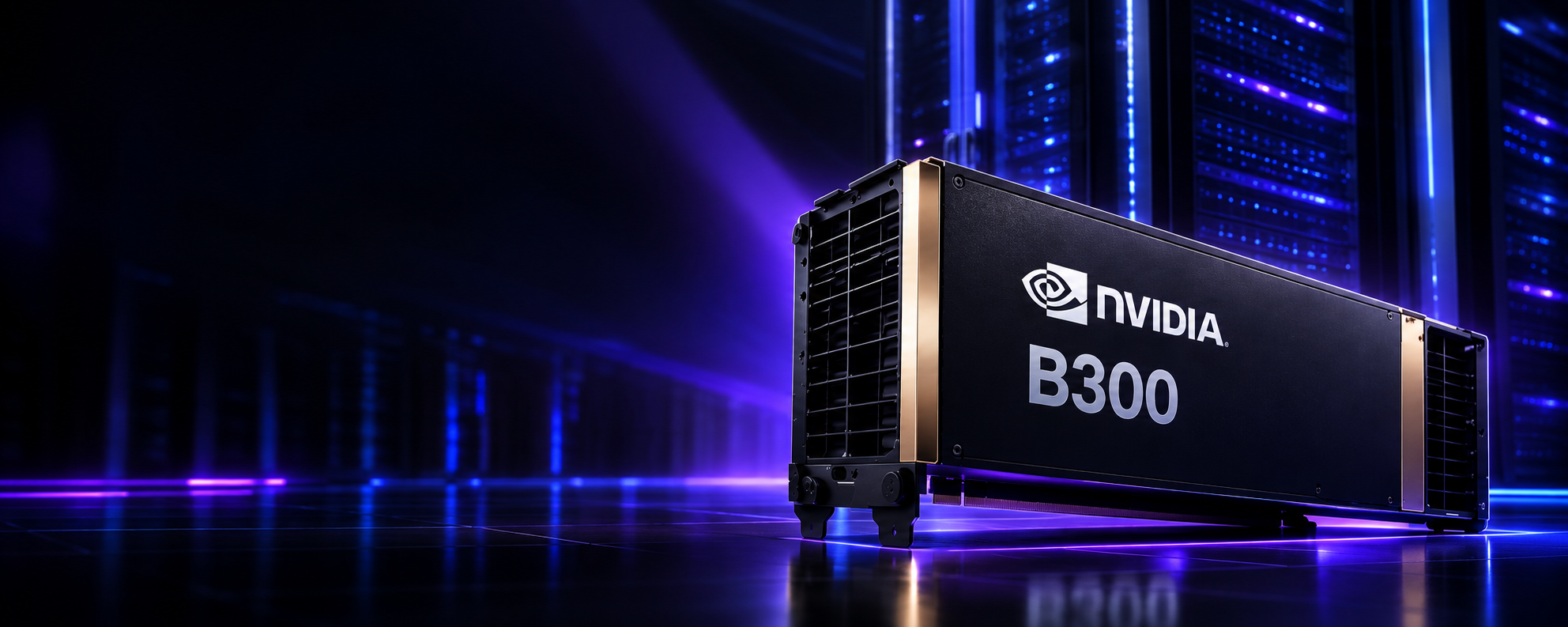
The B200, built on NVIDIA's Blackwell architecture, is a different class of chip altogether — a next-generation dual-die design aimed squarely at frontier-scale training and the largest inference deployments. It offers substantially higher raw compute throughput than both the H100 and MI300X, backed by NVIDIA's fifth-generation NVLink for extreme multi-GPU scaling.
The honest comparison here isn't really MI300X versus B200 head-to-head — they often serve different budget tiers and project stages. The B200 commands a premium price and is typically reserved for the largest training runs and highest-throughput inference at hyperscale. The MI300X, by contrast, offers a compelling memory-per-dollar proposition for teams whose primary constraint is fitting large models efficiently, not chasing the absolute peak of raw compute. For many enterprise inference and mid-scale training workloads, MI300X capacity at a lower price point is the more practical decision than paying a premium for B200-class compute that may go underutilised.
Already Compared the GPUs? See MI300X Cloud Pricing
Skip the guesswork on AMD MI300X GPU price — get live AMD MI300X Cloud Pricing across hourly and monthly billing, and see exactly what an AMD MI300X GPU Server costs for your workload before you commit.
AMD MI300X GPU Price
Buying MI300X hardware outright means capital expenditure running into the tens of lakhs of rupees per GPU, plus the cost of servers, networking, cooling, and the DevOps team required to run it reliably — before accounting for the fact that hardware depreciates and newer accelerators arrive every 12–18 months. That's why most teams, including large enterprises, now access MI300X capacity through cloud rental rather than direct purchase.
MI300X cloud GPU price varies by provider, region, contract length, and instance size. The rate card below reflects Cyfuture AI's current published pricing as of 2026 — other providers may price differently, and rates are subject to change, so always confirm the live rate card before budgeting a deployment.
AMD MI300X Instance Pricing on Cyfuture AI
To make the numbers concrete rather than abstract, here's the actual AMD MI300X GPU Cloud rate card from Cyfuture AI — covering single-GPU through 8-GPU instances, on-demand pricing, and reserved discounts across 1-month, 6-month, and 12-month commitments.
| Instance Name | Compute Unit Model | AI Compute Memory (GB) | Perf. FP32 (TFLOPS) | Perf. FP16 (TFLOPS) | vCPU | Instance Memory (GB) | Peer-to-Peer BW (GB/s) | Network BW (GB/s) | Peak Memory BW (GB/s) | On-Demand $/hr | 1-Month Reserved $/hr | 6-Month Reserved $/hr | 12-Month Reserved $/hr |
|---|---|---|---|---|---|---|---|---|---|---|---|---|---|
| 1MI300.16v.256m | AMD 1×MI300X (1X) | 192 | 163 | 1,307 | 16 | 256 | – | 400 | 580 | $3.04 | $2.43 20.08% off | $2.19 28.11% off | $1.82 40.16% off |
| 2MI300.32v.512m | AMD 2×MI300X (2X) | 384 | 326 | 2,614 | 32 | 512 | 900 | 800 | 580 | $6.02 | $4.77 20.89% off | $4.24 29.56% off | $3.50 41.98% off |
| 4MI300.64v.1024m | AMD 4×MI300X (4X) | 768 | 652 | 5,228 | 64 | 768 | 1,800 | 1,600 | 580 | $11.93 | $9.43 20.90% off | $8.40 29.57% off | $6.92 41.99% off |
| 8MI300.128v.2048m | AMD 8×MI300X (8X) | 1,536 | 1,304 | 10,456 | 128 | 1,536 | 3,600 | 3,200 | 580 | $23.61 | $18.68 20.91% off | $16.62 29.59% off | $13.70 42.02% off |
Scaling from 1X to 8X MI300X is close to linear on price — the 8-GPU instance costs roughly 7.8× the single-GPU on-demand rate, not a multiple with hidden premium. The real lever is commitment length: 12-month reserved pricing runs about 40–42% below on-demand across every instance size, while 1-month reserved still nets a 20%+ discount for teams not ready to commit long-term. Peer-to-peer bandwidth only applies once you're spanning multiple GPUs, which is why the 1X instance shows no P2P figure.
Cloud Pricing Models
MI300X Cloud GPU price is typically structured around two commercial models:
Hourly Rental
- Pay only for the compute hours actually consumed
- Ideal for experimentation, short training runs, and bursty inference load
- No long-term commitment — scale up or down as workloads change
- Generally the most cost-efficient option for AMD MI300X GPU Server access at variable usage levels
Monthly / Reserved Rental
- Lower effective per-hour rate in exchange for a committed term
- Suited to steady-state production inference or ongoing fine-tuning pipelines
- Predictable monthly budgeting for finance and procurement teams
- Often bundled with priority support and dedicated capacity guarantees
If you're comparing options, browsing an AMD MI300X GPU Cloud provider's current rate card is the most reliable way to see live MI300X Cloud GPU price figures, since published blog benchmarks age quickly in a market this fast-moving.
Why Renting Is Better Than Buying (For Most Teams)
Unless you're running AI infrastructure at a scale where you can keep GPUs at high utilisation around the clock for years, renting almost always wins on total cost of ownership. You avoid the upfront capital outlay, you're not stuck with hardware that's outdated within 18 months, and you don't need to build an in-house team to manage power, cooling, networking, and failure recovery for a physical GPU cluster.
Who Should Rent AMD MI300X?
AI Startups
Access large-memory GPU capacity without burning runway on hardware purchases, and scale rental capacity as the product and customer base grow.
Enterprises
Deploy internal LLM applications, copilots, and document intelligence systems on rented infrastructure without a multi-year hardware procurement cycle.
Research Labs
Run large-scale experiments and model fine-tuning on demand, matching GPU spend to grant cycles and research timelines rather than fixed hardware budgets.
SaaS Companies
Embed LLM-powered features into products with predictable, usage-aligned infrastructure cost rather than over-provisioning hardware for peak load.
Universities
Give students and faculty access to enterprise-grade AI compute for coursework and research without maintaining a dedicated GPU data center on campus.
FinTech
Run fraud detection, risk modelling, and conversational AI workloads on infrastructure that supports data residency and compliance requirements.
Healthcare
Power clinical documentation, diagnostic imaging models, and patient-facing AI tools on compliant infrastructure without owning physical hardware.
Manufacturing
Run predictive maintenance models, computer vision quality inspection, and simulation workloads on rented GPU capacity matched to production schedules.
Why Rent AMD MI300X Instead of Buying?
Lower Capital Expenditure
Renting converts a large upfront hardware purchase into predictable operating expense, freeing capital for product development, hiring, and go-to-market instead of tying it up in depreciating assets.
Faster Deployment
Provisioning a rented AMD MI300X GPU Server takes minutes to hours. Building and racking your own cluster — sourcing hardware, setting up networking and cooling, and hardening the environment — takes months.
Scalability
Scale from one GPU to a full multi-node cluster as demand grows, without waiting on procurement cycles or being locked into a fixed hardware footprint sized for today's needs.
No Maintenance Burden
Power delivery, cooling, firmware updates, hardware failure replacement, and network maintenance are handled by the provider — not your engineering team.
Access to the Latest Hardware
Cloud providers refresh their GPU fleets regularly, giving rental customers a path to newer accelerators without stranding capital in last-generation hardware.
Enterprise Support
Production deployments get access to dedicated support, SLAs, and infrastructure expertise that would otherwise require building an in-house platform team.
Rent AMD MI300X GPU on Cyfuture AI
Access AMD Instinct MI300X GPUs on-demand with flexible hourly and monthly billing, dedicated bare-metal options, high-speed networking, and 24×7 expert support — all from Indian data centers built for enterprise AI workloads.
Why Choose Cyfuture AI
If you've decided to rent rather than buy, the next question is which provider actually delivers on the promise of on-demand GPU access without the hidden friction. Cyfuture AI offers AMD MI300X GPU Cloud built specifically for enterprises that need serious AI infrastructure without the overhead of managing it themselves.
Billing is available on both hourly and monthly models, so teams can run short experiments on an hourly AMD MI300X GPU price basis or commit to monthly rental for steady production inference. Every deployment comes with 24×7 support, a secure cloud environment, and the option to move to dedicated bare-metal AMD MI300X GPU Server instances as workloads scale beyond shared capacity.
For teams comparing an AMD MI300X GPU Cloud setup against building in-house, Cyfuture AI's approach removes the procurement lag, the cooling and power engineering, and the ongoing operational burden — while keeping AMD MI300X Cloud Pricing transparent and predictable across both billing models.
Frequently Asked Questions
The AMD MI300X is used for large language model training and inference, retrieval-augmented generation, agentic AI, computer vision, recommendation systems, and general high-performance computing workloads that benefit from very large GPU memory capacity.
192 GB of HBM3 memory per GPU, with peak memory bandwidth of up to 5.3 TB/s — the largest memory capacity of any mainstream AI accelerator in its launch generation.
The MI300X offers significantly more memory (192 GB vs 80 GB) and higher memory bandwidth, which benefits large-model inference. The H100 has a more mature CUDA-based software ecosystem. Which is "better" depends on your workload, model size, and existing tooling.
MI300X offers 192 GB of memory versus the H200's 141 GB, giving it a meaningful capacity advantage. The H200 benefits from newer HBM3e memory technology and NVIDIA's more mature ecosystem. Pricing for MI300X is generally more competitive at comparable performance tiers.
Not directly — the B200 is a newer, higher-tier Blackwell-architecture chip aimed at frontier-scale training with substantially higher raw compute. MI300X is a more cost-effective choice for memory-bound inference and mid-scale training where B200-level compute would be underutilised.
Yes. Providers like Cyfuture AI offer AMD MI300X GPU Cloud on both hourly and monthly billing models, letting teams access MI300X capacity without purchasing hardware. Visit the AMD MI300X GPU Cloud page for current plans.
On Cyfuture AI, a single AMD MI300X GPU starts at $3.04/hour on-demand, scaling to $23.61/hour for a full 8-GPU instance. Reserved pricing brings the effective rate down significantly — 12-month commitments run roughly 40–42% below on-demand across all instance sizes. Pricing varies by provider, region, and commitment length, so always check the live rate card for exact current figures.
Yes, the MI300X runs on AMD's ROCm open-source software stack, which has strong support for PyTorch and the major LLM training and inference frameworks used in production AI deployments today.
For most teams, yes. Renting avoids large capital expenditure, removes maintenance burden, and provides access to newer hardware as it becomes available — while buying only makes sense at very high, sustained utilisation over a multi-year horizon.
Workloads that are memory-bound rather than purely compute-bound benefit most: large-model LLM inference, RAG pipelines with large context windows, agentic AI with long conversation histories, and fine-tuning jobs that need larger batch sizes without aggressive memory optimisation tricks.
MI300X GPUs are commonly deployed in 8-GPU OAM platform configurations connected via AMD's Infinity Fabric interconnect, supporting both tensor-parallel inference and distributed training across the node.
India-hosted infrastructure supports data localisation requirements under the DPDP Act, reduces latency for Indian enterprises, and typically comes at a lower cost basis than routing through US or EU regions. Cyfuture AI's data centers in Noida, Jaipur, and Raipur are ISO 27001:2022 and SOC 2 Type II certified.
Conclusion
The AMD MI300X GPU earned its place in enterprise AI infrastructure conversations for a straightforward reason: it solved a real memory bottleneck that was slowing teams down and forcing unnecessary GPU sprawl. With 192 GB of HBM3 memory, class-leading bandwidth, and a maturing ROCm software stack, it's a legitimate option for LLM inference, fine-tuning, and a wide range of enterprise AI workloads — not just a lower-cost alternative to NVIDIA, but in many memory-bound scenarios, a genuinely better-fit accelerator.
Whether it's the right choice for you depends on your workload profile, your team's existing tooling, and how the numbers work out between renting and buying. For most teams, renting AMD MI300X GPU capacity remains the faster, lower-risk path to production.
Ready to Deploy on AMD MI300X?
Looking to rent AMD MI300X GPUs for AI training, inference, or large language model deployments? Cyfuture AI offers enterprise-grade AMD MI300X GPU Cloud with flexible hourly and monthly pricing, high-performance infrastructure, liquid-cooled AI data centers, and expert deployment support. Explore our AMD MI300X GPU Cloud solutions today.
Related Articles