


 IND
IND UAE
UAE SA
SA


The AI Infrastructure Inflection Point
AI models are no longer just growing in capability — they're growing in appetite. The parameter counts that defined state-of-the-art two years ago now represent entry-level complexity. Frontier models routinely demand hundreds of billions of parameters in training, while production inference systems must serve thousands of simultaneous requests with sub-second latency. Conventional GPU infrastructure, designed for a different era of model scale, is struggling to keep up.
This shift is forcing a reckoning across the industry. Organizations that built their AI pipelines on older GPU generations are encountering hard ceilings — not because their engineering isn't capable, but because the underlying hardware wasn't designed for today's workload profiles. Memory bandwidth, inter-GPU communication speeds, and raw floating-point throughput have all become critical bottlenecks in ways they weren't before.
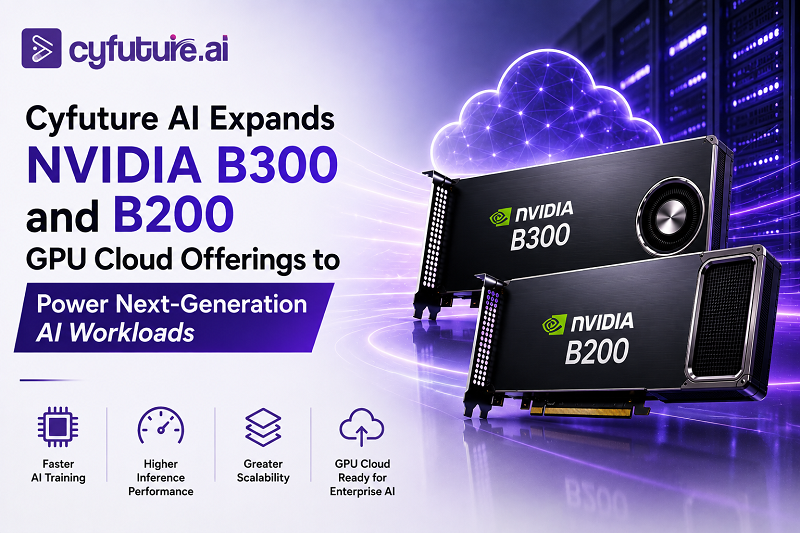
Against this backdrop, Cyfuture AI has expanded its GPU Cloud portfolio to include both NVIDIA B300 GPU and NVIDIA B200 GPU infrastructure — making Blackwell and Blackwell Ultra-class compute available to Indian enterprises, AI startups, research organizations, and global teams through its GPU as a Service platform.
The expanded offering is designed to support the full spectrum of demanding AI work: large language model pre-training and fine-tuning, generative AI, multimodal model development, agentic AI systems, RAG-based enterprise applications, high-performance computing, and real-time AI inference at production scale.
GPU specifications referenced throughout this article are sourced from NVIDIA's official product documentation. System-level capabilities — such as multi-GPU configurations, NVLink topology, and TDP at scale — vary by deployment configuration. Where specifications differ between GPU and DGX/HGX system contexts, this is noted explicitly.
Cyfuture AI Expands Its NVIDIA B300 and B200 GPU Cloud Portfolio
Cyfuture AI's GPU Cloud infrastructure has historically served enterprise AI teams across training, inference, and HPC workloads. With the addition of NVIDIA B300 and B200 GPU infrastructure, the platform now spans the full Blackwell generation — giving customers access to the highest-performance NVIDIA data center GPUs without the capital expenditure or operational overhead of owning and running the hardware themselves.
The expansion addresses a practical gap that many Indian organizations face: the time between NVIDIA releasing a new GPU generation and that hardware becoming practically accessible through managed cloud services. Building your own infrastructure with new-generation GPUs means months of procurement, data center integration, power and cooling upgrades, and ongoing maintenance — before a single model training run begins.
Through Cyfuture AI's NVIDIA B300 GPU Cloud and NVIDIA B200 GPU Cloud offerings, organizations can access this infrastructure on-demand or through reserved configurations, with deployment timelines measured in hours rather than months.
Faster Time to Compute
Skip the hardware procurement cycle. Access NVIDIA B300 or B200 GPU infrastructure within hours through Cyfuture AI's GPU Cloud platform — no lead times, no integration work on your end.
Elastic Scaling
Scale GPU count up or down based on actual workload requirements — a pre-training run, an inference burst, a research experiment — without committing to fixed hardware capacity permanently.
India-Hosted, Compliant Infrastructure
All GPU compute runs in Cyfuture AI's Tier III+ data centers in Noida, Jaipur, and Raipur. Data stays within India, supporting DPDP Act compliance without contractual workarounds.
CapEx to OpEx Shift
Convert a multi-crore hardware purchase into predictable operational expenditure. GPU Cloud infrastructure converts fixed capital costs into usage-based or reserved-capacity billing.
What Makes NVIDIA B300 Important for Next-Generation AI?
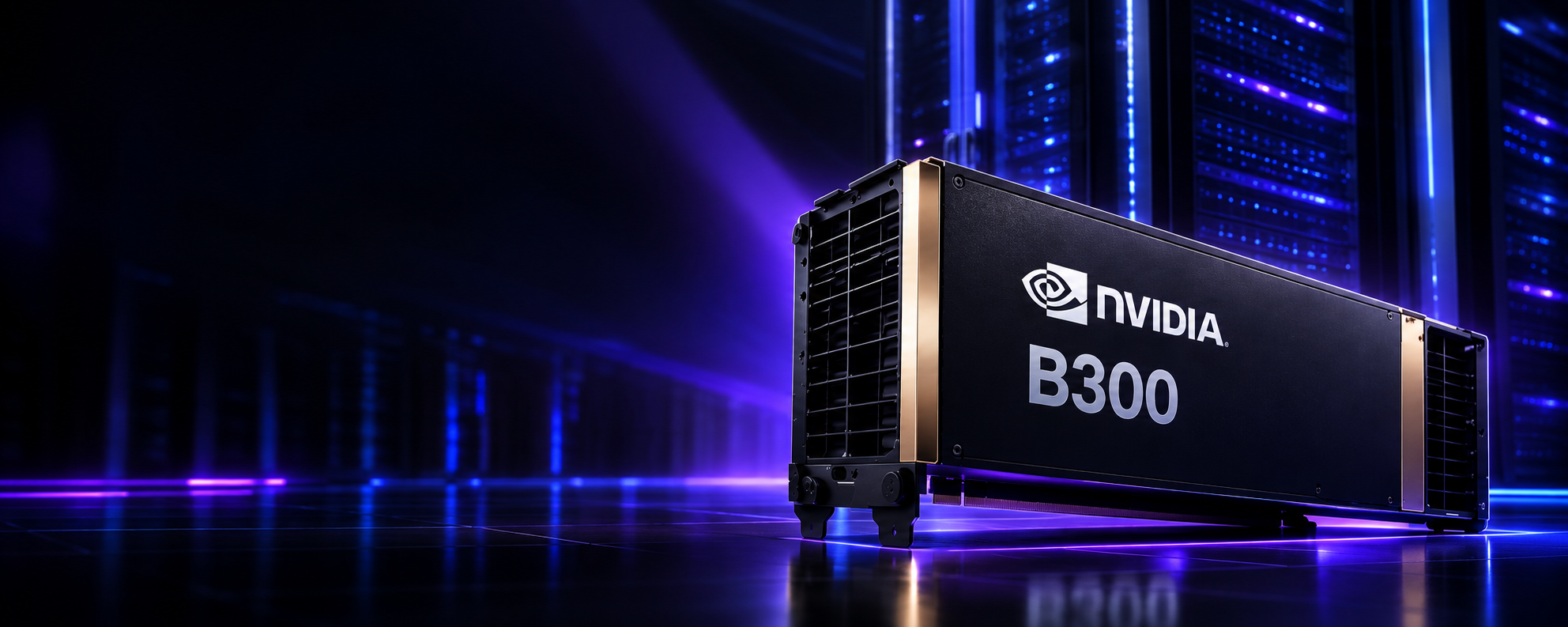
The NVIDIA B300 GPU represents the current apex of NVIDIA's data center GPU lineup. Built on the Blackwell Ultra architecture, it is engineered specifically for the class of AI workloads that have emerged over the past two years — workloads where the primary constraint isn't compute throughput alone, but the combination of memory capacity, memory bandwidth, and inter-GPU communication speed working together.
Memory Capacity: The Primary Differentiator
With 288 GB of HBM3e memory per GPU, the B300 can hold substantially larger model weights in GPU memory than previous generations. This matters in practice more than benchmark numbers suggest. When model weights fit entirely within GPU memory, the inference engine doesn't need to page data in from slower storage or rely on memory-efficient but computationally expensive techniques. Training runs can hold larger activations in memory, which reduces the need for gradient checkpointing and improves throughput.
For teams working with models in the 70B to 400B+ parameter range, this memory headroom directly affects what's architecturally possible in a single training or inference configuration.
Memory Bandwidth: Feeding the Compute at Scale
NVIDIA rates the B300 at approximately 8 TB/s of memory bandwidth. Raw compute throughput is meaningless if the memory subsystem can't supply data fast enough to keep the tensor cores busy. This bandwidth figure — shared with the B200 but enabled by the B300's larger HBM3e stack — is what allows sustained high utilization across demanding workloads rather than bursts of peak performance separated by memory bottlenecks.
Blackwell Ultra Architecture Improvements
The Blackwell Ultra designation indicates architectural refinements beyond the base Blackwell design found in the B200. These improvements are primarily aimed at the most computationally intensive AI scenarios — large-scale training runs, dense inference serving, and HPC workloads that stress every part of the GPU simultaneously.
Fifth-generation NVLink connectivity in the B300 enables high-bandwidth, low-latency GPU-to-GPU communication in multi-GPU configurations. For distributed training across multiple GPUs, this interconnect is the critical path — a slow interconnect creates synchronization bottlenecks that negate the benefits of adding more GPUs.
Practical Workload Impact
The B300 is designed for scenarios where you need to push the absolute limits of what's currently achievable: pre-training frontier-scale language models, running large-scale multimodal training jobs, serving the largest available models at low latency with high concurrency, and running HPC simulations that demand sustained precision across extended compute durations.
The NVIDIA B300 GPU is best understood not as an incremental upgrade but as a platform designed for AI workloads that previous hardware generations couldn't run efficiently. Its 288 GB HBM3e memory capacity, Blackwell Ultra architecture, and NVLink 5 connectivity make it the right choice when model scale and memory requirements are the primary planning constraints.
NVIDIA B200: A Powerful Foundation for Enterprise AI
Where the B300 targets the highest possible performance envelope, the NVIDIA B200 is the Blackwell architecture's enterprise workhorse. It's the GPU that most organizations doing serious AI work will encounter first — and for a large proportion of production deployments, it's the GPU that makes the most sense.
Built on the Blackwell architecture, the B200 offers 192 GB of HBM3e memory and approximately 8 TB/s of memory bandwidth — figures that substantially exceed the previous H100 generation and are more than sufficient for the majority of enterprise LLM training and inference scenarios.
Where B200 Excels
The B200's memory capacity handles models up to approximately 70B parameters comfortably in a single-GPU inference configuration, and substantially larger models in multi-GPU setups using NVLink. For training, the combination of HBM3e bandwidth and Blackwell's improved tensor core architecture enables faster iteration cycles on models in the practical enterprise range — the class of models that teams actually fine-tune and deploy rather than pre-train from scratch.
Enterprise AI applications — production LLM deployments, AI-powered analytics, recommendation systems, computer vision at scale, and financial modeling — typically don't require the extreme memory ceiling of the B300. What they require is consistent, high-throughput compute with the reliability and toolchain support that an established GPU platform provides. The B200 delivers both.
HPC and Scientific Computing
Beyond AI, the B200 supports high-precision scientific computing workloads including molecular dynamics, climate modeling, seismic analysis, and financial Monte Carlo simulations. These workloads benefit from the Blackwell architecture's improvements in FP64 throughput and memory bandwidth, even when they don't require the extreme scale of the B300.
The B200 supports fifth-generation NVLink, enabling multi-GPU configurations where aggregate GPU memory pools multiply. An eight-GPU NVLink-connected B200 system provides access to 1.5 TB of aggregate GPU memory — sufficient for extremely large model training scenarios without requiring the per-GPU memory ceiling of the B300. System-level specifications depend on the specific HGX or DGX configuration.
NVIDIA B300 vs B200: What Is the Difference?
Both GPUs are Blackwell-generation NVIDIA data center accelerators. They share architectural lineage, NVLink generation, and memory type. The differences are meaningful but focused — primarily around memory capacity, architectural tier, and the specific use cases each is optimized for.
| Feature | NVIDIA B300 | NVIDIA B200 |
|---|---|---|
| Architecture | Blackwell Ultra | Blackwell |
| GPU Memory | 288 GB HBM3e | 192 GB HBM3e |
| Memory Type | HBM3e | HBM3e |
| Memory Bandwidth | ~8 TB/s | ~8 TB/s |
| NVLink Generation | 5th Generation NVLink | 5th Generation NVLink |
| Precision Support | FP4, FP8, FP16, BF16, TF32, FP64 | FP4, FP8, FP16, BF16, TF32, FP64 |
| Architecture Tier | Blackwell Ultra — highest available tier | Blackwell — enterprise tier |
| AI Training | Frontier-scale LLM and multimodal training | Enterprise LLM training and fine-tuning |
| AI Inference | Large-model inference with maximum memory headroom | High-throughput enterprise inference |
| Best Use Cases | Largest models, maximum memory requirements, frontier AI | Enterprise AI production, LLM serving, HPC, fine-tuning |
| Target Workload | 100B+ parameter models, memory-constrained training | Up to 70B+ parameter models in single-GPU; larger in multi-GPU |
GPU-level specifications above are sourced from NVIDIA's official product documentation. TDP, system power requirements, and multi-GPU throughput figures depend on specific system configurations (DGX B300, HGX B300, DGX B200, HGX B200) and are not shown here because they vary by deployment. Contact Cyfuture AI for system-level configuration guidance relevant to your workload.
Rent NVIDIA B300 or B200 GPU Infrastructure — Start Today
Skip the hardware procurement cycle. Rent NVIDIA B300 or B200 GPU compute through Cyfuture AI's GPU Cloud — on-demand or reserved configurations, deployed within hours. No CapEx, no cooling complexity, no lead times.
How NVIDIA B300 and B200 GPUs Support AI Training
AI model training is fundamentally a memory and bandwidth problem wearing a compute hat. The tensor core throughput that GPU vendors advertise matters, but whether that throughput is usable in practice depends on whether the memory subsystem can keep the compute fed. This is the lens through which both the B300 and B200 are best understood.
Large Language Model Pre-Training
Pre-training frontier LLMs at the scale required to produce competitive models involves processing trillions of tokens across distributed GPU clusters. At each training step, model weights, optimizer states, and gradient tensors must all reside in GPU memory — and the sheer size of these tensors at 70B+ parameter scales has made previous GPU generations inadequate without extremely aggressive model parallelism schemes. The B300's 288 GB per GPU and the B200's 192 GB reduce the degree of parallelism required, which in turn reduces the communication overhead between GPUs and improves cluster utilization.
Fine-Tuning and Domain Adaptation
Not every organization needs to pre-train from scratch. Fine-tuning an existing foundation model on domain-specific data — medical records, legal documents, financial reports, customer interactions — is where most enterprise AI value gets created. This workload requires loading the full model weights plus fine-tuning framework overhead. For models like Llama 3.1 405B in full-precision fine-tuning, the B300's memory capacity enables configurations that simply aren't possible on smaller GPUs. For models up to the 70B range, the B200 handles full-precision fine-tuning effectively.
Multimodal and Vision-Language Training
Training models that process both text and images — or text, images, and audio together — compounds memory requirements further. Multimodal architectures maintain separate encoders for each modality alongside the fusion and language model components. These workloads represent some of the fastest-growing areas of enterprise AI investment, and they benefit disproportionately from higher-memory GPUs.
Computer Vision, Recommendation Systems, and Scientific AI
Beyond language models, both the B300 and B200 handle demanding computer vision training (large vision transformers, object detection at scale), deep learning-based recommendation systems serving billions of items, and scientific AI workloads including molecular property prediction, protein structure refinement, and materials science modeling. The combination of HBM3e bandwidth and Blackwell's improved sparse computation support accelerates many of these workloads meaningfully compared to previous GPU generations.
For most enterprise fine-tuning and mid-scale training workloads (up to 70B parameters), the NVIDIA B200 provides sufficient memory capacity with strong compute throughput. For pre-training frontier-scale models, training 100B+ parameter architectures in full precision, or workloads where memory is explicitly the bottleneck in existing configurations, the NVIDIA B300 is the appropriate choice. If you're unsure which configuration fits your workload, Cyfuture AI's infrastructure team can help assess your requirements.
NVIDIA B300 and B200 for AI Inference
Inference and training have different infrastructure signatures, and conflating them leads to over-provisioning in some areas while under-provisioning in others. Training demands sustained high throughput over long durations. Inference demands low latency and high concurrency — the ability to handle many simultaneous requests with response times that feel instantaneous to users.
Large Language Model Inference
Serving a large language model in production involves two phases: prefilling (processing the input prompt) and auto-regressive token generation (generating the output token by token). The generation phase is memory-bandwidth-bound rather than compute-bound — which is why the ~8 TB/s HBM3e bandwidth in both the B300 and B200 directly translates to faster token generation throughput.
For the largest models — 70B and above — the B300's additional 96 GB of memory enables more generous KV cache allocation. The KV cache stores attention keys and values for each token in a conversation, and at long context lengths (32K, 64K, 128K+ tokens), cache size becomes a meaningful throughput determinant. More memory equals larger KV caches equals higher concurrent user capacity per GPU.
Generative AI Applications
Image generation, video synthesis, and multimodal generative applications are inference workloads with distinct profiles — often involving large diffusion model weights and the ability to generate complex outputs in near-real-time. Both B300 and B200 support these workloads at production scale. The choice between them typically comes down to whether the application uses models large enough to stress the B200's memory ceiling.
Agentic AI and RAG Systems
Agentic AI systems — where models plan, reason, use tools, and execute multi-step workflows autonomously — place distinctive demands on inference infrastructure. They require lower latency than batch generation (because the agent is waiting on each response before taking the next step), and they often involve multiple model calls in sequence. RAG systems additionally require fast vector similarity search alongside LLM inference. Both the B300 and B200, deployed on Cyfuture AI's high-speed networking infrastructure, support these demanding inference patterns.
Enterprise Inference at High Volume
Enterprise inference at scale — serving internal AI assistants, processing document pipelines, running real-time analytics — requires GPU infrastructure that can sustain high utilization across extended periods without degradation. Both GPUs support this with their combination of high memory capacity and efficient Blackwell architecture compute. The B200 is often the more economical choice for established inference workloads; the B300 becomes compelling when model size or concurrent user counts push against the B200's memory limits.
Rent NVIDIA B300 or B200 GPUs for AI Inference Workloads
High-throughput inference demands the right GPU — not just the available one. Rent NVIDIA B300 GPU for maximum memory headroom at long context lengths, or rent NVIDIA B200 GPU for enterprise-grade LLM serving at scale. Both available through Cyfuture AI's GPU Cloud.
Why GPU Cloud Matters for Enterprise AI
The case for GPU Cloud isn't simply about cost per GPU-hour. It's about what organizations trade away when they own every piece of AI infrastructure themselves — and whether that trade makes sense given how fast the hardware landscape is moving.
Hardware Lifecycle Management
NVIDIA's GPU generations are advancing faster than many organizations' hardware procurement cycles. A data center built around H100 infrastructure in 2023 is now two GPU generations behind the frontier. GPU Cloud providers handle the lifecycle — when you need B300-class compute, it's available without waiting for your procurement cycle to catch up with NVIDIA's release schedule.
Power and Cooling Infrastructure
Modern AI GPUs consume 700W or more per card in demanding configurations. High-density GPU systems require specialized power delivery and cooling infrastructure — including liquid cooling for the densest B300 and B200 configurations. Cyfuture AI's liquid-cooled AI data center infrastructure handles these requirements as part of the service, not as a separate capital project for the customer.
High-Speed Networking
Distributed GPU training requires high-bandwidth, low-latency networking between GPUs. Building and operating this networking fabric in-house — InfiniBand or high-speed Ethernet at the scale required for multi-node GPU clusters — is a significant engineering and capital undertaking. GPU Cloud providers absorb this complexity into the infrastructure layer.
Elastic Scaling Without Stranded Capacity
AI workloads are rarely flat. Training runs happen in bursts, inference demand peaks at certain hours or events, research experiments require temporary large-scale compute. Owned hardware that's sized for peak demand sits idle between peaks — GPU Cloud eliminates stranded capacity by allowing scale-up and scale-down aligned to actual workload.
Faster Deployment for New Workloads
When a new AI use case emerges inside an organization, the bottleneck should be the model development team's velocity — not a 6-month hardware procurement timeline. GPU as a Service converts infrastructure deployment from a capital project into an operational decision, removing a significant drag on AI adoption velocity.
Reserve Your NVIDIA B300 or B200 GPU Infrastructure Today
Access Blackwell and Blackwell Ultra-class GPU compute through Cyfuture AI's GPU Cloud. On-demand and reserved configurations available. ISO 27001:2022 certified. DPDP Act compliant. Tier III+ data centers across India.
Cyfuture AI's NVIDIA B300 and B200 GPU Cloud
Cyfuture AI operates purpose-built AI infrastructure across its Tier III+ certified data centers in Noida, Jaipur, and Raipur. The NVIDIA B300 and B200 GPU Cloud offerings sit within the GPU as a Service platform — a managed infrastructure layer that handles provisioning, networking, power, cooling, and hardware operations so that customer teams can focus on model development and deployment rather than infrastructure management.
Who Can Benefit from NVIDIA B300 and B200 GPU Cloud?
The practical applicability of Blackwell GPU Cloud spans a wide range of organizations — the common thread is the need for substantial AI compute without the operational burden of running it in-house.
AI Startups
Startups building foundation models, AI applications, or ML-powered products need access to frontier GPU infrastructure without committing multi-crore capital to hardware before achieving product-market fit. GPU Cloud enables rapid experimentation, model development, and scaling as demand grows — with the ability to access B300-class compute from day one.
Enterprise Organizations
Large enterprises deploying production LLMs, AI-powered analytics platforms, and intelligent automation systems need reliable, high-throughput GPU infrastructure with enterprise-grade compliance. The B200 is typically the right configuration for established enterprise AI workloads; B300 becomes relevant for organizations fine-tuning or serving the largest available open-source models.
Research Organizations
Academic and corporate research teams running large-scale AI experiments, HPC simulations, and scientific computing workloads benefit from on-demand access to B300 and B200 infrastructure without the capital and maintenance requirements of dedicated research clusters. Reserved capacity options support extended multi-month research projects.
Healthcare and Life Sciences
Medical AI applications — diagnostic imaging analysis, drug discovery, genomics, protein structure prediction — often require both large GPU memory for model complexity and strict data localisation for patient data compliance. Cyfuture AI's India-hosted infrastructure addresses both simultaneously, making B300 and B200 GPU Cloud a natural fit for healthcare organizations under DPDP Act requirements.
Financial Services
BFSI organizations using AI for risk modeling, fraud detection, algorithmic trading, customer service automation, and regulatory compliance workloads need GPU infrastructure that satisfies RBI cloud framework requirements and DPDP Act data localisation obligations. Cyfuture AI's BFSI-aligned infrastructure serves this sector without requiring cloud exemption requests or complex data routing architectures.
Manufacturing and Industrial
Digital twin simulation, predictive maintenance modeling, computer vision quality control, and industrial process optimization all require substantial GPU compute. B200 GPU Cloud provides the compute capacity for these workloads with the operational reliability that industrial applications require — without the HVAC and power infrastructure complexity of running high-density GPU hardware on a factory floor.
B300 or B200: Which GPU Should You Choose?
Neither GPU is universally superior — the right choice depends on your specific workload characteristics. The decision framework below distills the key variables.
Why Renting NVIDIA B300 or B200 GPUs Can Make Sense
The economics of renting versus owning AI GPU infrastructure have shifted substantially as hardware costs have risen and generation cycles have compressed. A single NVIDIA B300-equipped server represents a multi-crore capital commitment, requires specialized power and cooling infrastructure, demands ongoing maintenance, and begins depreciating immediately — against a backdrop where the next GPU generation may arrive in 12–18 months.
To rent NVIDIA B300 GPU access through Cyfuture AI converts that capital expenditure into operational expenditure aligned to actual usage. For organizations that don't need permanent, dedicated GPU infrastructure running at high utilization 24/7, this conversion is straightforwardly economical.
Similarly, the ability to rent NVIDIA B200 GPU infrastructure without procurement delays means that teams can begin training or inference work as soon as the model architecture is ready — not after a 6-month hardware cycle. For AI teams where compute access speed is a competitive factor, this matters.
When Renting Makes Sense
- Variable or bursty compute needs — training runs, experimental phases, product launches
- Fast access to new GPU generations — no waiting for procurement cycles
- Avoiding power and cooling infrastructure — high-density GPU systems require significant facility upgrades
- Compliance-driven India localisation — managed data center handles DPDP Act requirements
- Team size doesn't justify dedicated GPU ops staff — GPU Cloud abstracts the infrastructure layer
When Owned Infrastructure May Be Better
- Very high, consistent utilization — 80%+ GPU utilization 24/7 shifts the economics toward ownership
- Highly specialized configurations — custom interconnect topologies that standard cloud offerings don't support
- Extremely sensitive data — airgapped environments where cloud connectivity itself is a risk
- Large organization with dedicated GPU infrastructure team — and the facilities already in place
Built for the Next Generation of AI Workloads
The AI workloads that will define the next two to three years look different from what dominated the previous era. Organizations are moving from AI experimentation — where the primary question was "can AI do this?" — to AI production, where the questions are "how do we run this reliably at scale, and how do we keep improving it?"
This transition has concrete infrastructure implications. Production AI systems handle higher volumes than experiments. They require lower and more consistent latency. They run continuously rather than in scheduled training bursts. And they increasingly involve agentic architectures — where models operate autonomously across extended workflows, making multiple inference calls per user request.
The NVIDIA B300 and B200 were designed for this production era rather than the experimental one. Their memory capacities, bandwidth figures, and Blackwell architecture improvements directly address the infrastructure requirements of:
- Agentic AI systems that chain multiple LLM calls and require low, consistent per-call latency
- Enterprise RAG applications that combine large embedding models, vector retrieval, and LLM generation in real-time
- Multimodal production systems processing text, images, audio, and structured data simultaneously
- High-volume inference APIs serving thousands of concurrent enterprise users
- Continuous fine-tuning pipelines that adapt models to new data on a regular cadence
GPU Cloud infrastructure from Cyfuture AI makes these workloads accessible without the lead time, capital expenditure, or operational complexity of building the same capability in-house.
Why Cyfuture AI
Cyfuture AI's position in the Indian AI infrastructure market is built on a combination of factors that matter specifically to Indian enterprise customers — and to international organizations with Indian data requirements.
India-Native Infrastructure
Tier III+ certified data centers in Noida, Jaipur, and Raipur provide multiple geographical options within India. All GPU compute and customer data stays within Indian borders — eliminating the compliance complexity of cross-border data transfer for regulated industries.
Enterprise Compliance Posture
ISO 27001:2022 certification and SOC 2 Type II attestation provide the compliance documentation that procurement and security teams require. DPDP Act compliance is built into the infrastructure architecture rather than addressed through contractual workarounds.
NVIDIA GPU Portfolio Breadth
With both NVIDIA B300 and B200 GPU Cloud now available alongside the existing GPU portfolio, customers can choose the right GPU tier for their specific workload rather than adapting their workload to available hardware. Organizations running multiple AI workloads with different requirements can access different GPU types through the same provider.
Liquid-Cooled AI Data Center
High-density GPU deployments — particularly at the B300 level — require liquid cooling to operate efficiently. Cyfuture AI's liquid-cooled AI data center infrastructure is designed specifically for modern high-TDP GPU systems, ensuring that thermal constraints don't limit GPU performance in practice.
Ready to Accelerate Your Next AI Workload?
Explore NVIDIA B300 and B200 GPU Cloud infrastructure from Cyfuture AI. Access Blackwell and Blackwell Ultra-class compute for AI training, LLM inference, generative AI, fine-tuning, and HPC — through India's enterprise GPU Cloud platform. Talk to our AI infrastructure team to discuss your GPU requirements and get the right configuration for your workload.
Frequently Asked Questions
The NVIDIA B300 is a data center GPU built on the Blackwell Ultra architecture. It provides 288 GB of HBM3e memory, approximately 8 TB/s of memory bandwidth, and fifth-generation NVLink for multi-GPU connectivity. It is designed for the most demanding AI training workloads — particularly large language model pre-training and fine-tuning at extreme parameter counts — as well as high-throughput inference and HPC applications. Cyfuture AI offers NVIDIA B300 GPU Cloud access through its NVIDIA B300 GPU Server platform.
The NVIDIA B200 is a data center GPU built on the Blackwell architecture — the generation that preceded the Blackwell Ultra. It offers 192 GB of HBM3e memory and approximately 8 TB/s of memory bandwidth, supported by fifth-generation NVLink. The B200 is suited for enterprise AI training and inference, large language models up to the 70B+ parameter range, generative AI applications, HPC workloads, and production AI deployments. Cyfuture AI provides NVIDIA B200 GPU Cloud access through its NVIDIA B200 GPU Server offering.
The primary difference is architecture tier and GPU memory capacity. The NVIDIA B300 uses the Blackwell Ultra architecture and provides 288 GB of HBM3e memory. The NVIDIA B200 uses the Blackwell architecture and provides 192 GB of HBM3e memory. Both share approximately 8 TB/s of memory bandwidth and fifth-generation NVLink. The B300 is positioned for the most memory-intensive and performance-demanding AI workloads; the B200 covers a broad range of enterprise AI training and inference scenarios effectively. TDP and system-level power requirements differ between configurations and should be assessed per deployment.
The B300 provides higher GPU memory capacity — 288 GB versus 192 GB — and the Blackwell Ultra architectural tier, which offers advantages for the most demanding workloads. For many enterprise AI applications, the B200 is the more appropriate choice because it provides sufficient memory and compute for the actual model sizes and concurrency levels involved. The B300 becomes clearly preferable when models exceed approximately 70B parameters in full-precision configurations, when context lengths are very long (requiring large KV caches), or when maximum achievable performance is the primary requirement rather than cost efficiency.
NVIDIA B300 supports the full range of GPU-accelerated AI and HPC workloads, with particular strength in memory-intensive scenarios: large language model pre-training at 100B+ parameter scales, full-precision fine-tuning of frontier models, multimodal model training, high-concurrency inference serving of large models, agentic AI systems, RAG infrastructure, generative AI applications, scientific simulation, molecular dynamics, materials science research, and financial computing. It is the appropriate choice whenever memory capacity is the binding constraint on what's architecturally achievable.
NVIDIA B200 handles enterprise AI training and fine-tuning of models up to approximately 70B parameters in full precision (and larger in quantized or parallelized configurations), production LLM inference serving, generative AI applications, computer vision model training, recommendation systems, financial risk modeling, fraud detection, healthcare AI, HPC scientific workloads, and enterprise analytics. For the majority of production enterprise AI deployments, the B200 provides the right combination of memory capacity, compute throughput, and cost efficiency.
Yes. Cyfuture AI provides NVIDIA B300 GPU Cloud access through its GPU as a Service platform. Organizations can access NVIDIA B300 GPU infrastructure on-demand or through reserved capacity configurations without purchasing hardware outright. All B300 infrastructure runs in Cyfuture AI's Tier III+ certified India data centers. Contact the Cyfuture AI infrastructure team to discuss B300 GPU rental configurations, capacity options, and pricing.
Yes. Cyfuture AI's NVIDIA B200 GPU Cloud is available through the same GPU as a Service platform. On-demand and reserved GPU rental configurations are available. B200 GPU infrastructure in Cyfuture AI's India data centers serves enterprise AI teams, AI startups, research organizations, and BFSI and healthcare customers requiring India-hosted compute. Visit the NVIDIA B200 GPU Server page for current availability and configuration options.
NVIDIA B300 GPU Cloud refers to cloud-based access to NVIDIA B300 Blackwell Ultra GPU infrastructure through a managed service provider. Rather than purchasing physical B300 GPU hardware, organizations access B300 compute capacity on-demand or through reserved configurations via the cloud provider's infrastructure. Cyfuture AI's NVIDIA B300 GPU Cloud provides this access through India-hosted, compliance-aligned infrastructure — eliminating hardware procurement, power and cooling management, and hardware lifecycle concerns from the customer's operational scope.
GPU Cloud helps AI companies in four primary ways: (1) it eliminates large upfront hardware investment, converting CapEx to OpEx; (2) it provides access to the latest GPU generations — including NVIDIA B300 and B200 — without waiting for procurement cycles; (3) it enables elastic scaling where compute capacity adjusts to actual workload demand rather than peak estimates; and (4) it removes the operational burden of managing GPU hardware, power infrastructure, cooling systems, and high-speed networking from the AI team's scope, allowing them to focus on model development and product delivery.
Both GPUs support LLM workloads effectively. The NVIDIA B300's 288 GB HBM3e memory makes it the stronger choice for pre-training or serving the largest models — those in the 70B to 400B+ parameter range — particularly where full-precision model weights and large KV caches are required simultaneously. The NVIDIA B200's 192 GB HBM3e handles a wide range of enterprise LLM use cases including fine-tuning up to 70B parameters, production inference serving, and RAG applications. For most organizations, the B200 is the starting point and the B300 becomes the natural upgrade when model scale exceeds the B200's memory capacity.