


 IND
IND UAE
UAE SA
SA


Artificial Intelligence infrastructure is evolving at a breathtaking pace. And here’s the thing — enterprises are no longer asking whether they need GPU acceleration. Instead, they are asking a much more strategic question:
Which NVIDIA AI platform should power the next generation of AI workloads?
That debate in 2026 is centered around two heavyweight contenders:
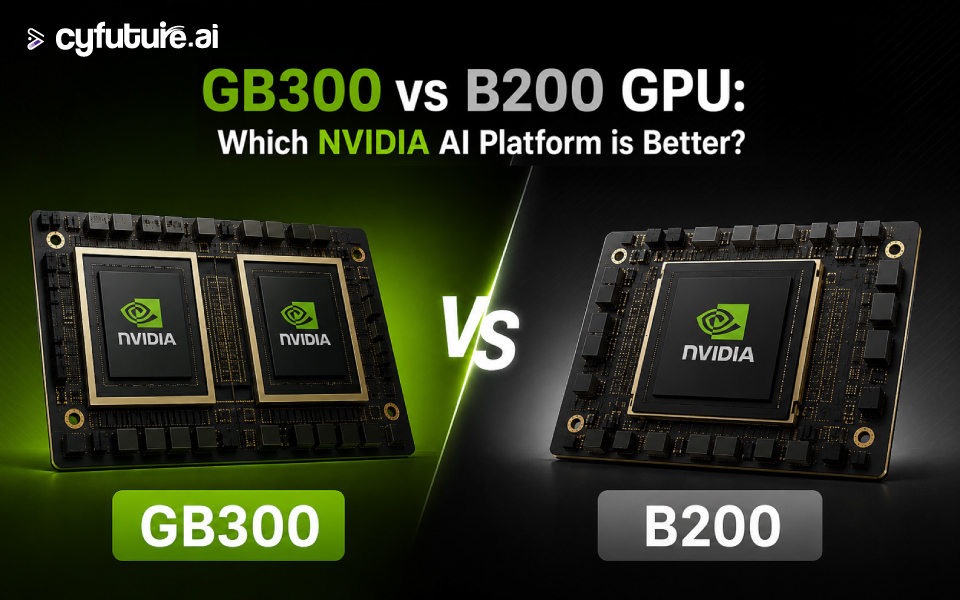
- NVIDIA B200
- NVIDIA GB300 NVL72
Both platforms are built on NVIDIA’s Blackwell architecture. Both are engineered for generative AI, LLM training, inference acceleration, and AI reasoning. But make no mistake — they target very different scales of AI deployment.
For tech leaders, developers, enterprises, and AI researchers, choosing the wrong platform could mean infrastructure bottlenecks, overspending, or poor scalability.
So, let’s break it down.
Definition Box
|
|
Why This Comparison Matters in 2026
The AI infrastructure market is exploding globally. According to NVIDIA and industry analysts, AI data center spending is expected to surpass hundreds of billions of dollars annually as enterprises race to deploy large-scale generative AI.
Meanwhile:
- AI model sizes are rapidly crossing trillion-parameter thresholds
- AI inference demand is growing faster than training demand
- Agentic AI and reasoning workloads require significantly more GPU memory and interconnect bandwidth
- Enterprises need lower latency and higher throughput AI clusters
And that’s exactly where B200 and GB300 enter the conversation.
NVIDIA B200 vs GB300: Core Architecture Comparison
Technical Comparison Table
|
|
|
|
|
|
|
|
|
|
|
|
|
|
|
|
|
|
|
|
|
|
|
|
|
|
|
|
|
|
|
|
|
|
|
|
|
|
|
|
|
|
|
|
What Makes NVIDIA B200 Powerful?
The NVIDIA B200 is essentially designed for organizations that need enterprise-ready AI acceleration without completely rebuilding their data center infrastructure.
Here’s why enterprises love it:
1. Easier Deployment
Unlike rack-scale AI systems, B200 nodes can fit into existing enterprise environments.
That means:
- Easier rack integration
- Lower infrastructure redesign costs
- Faster deployment cycles
- Better compatibility with existing AI clusters
And that matters a lot for enterprises scaling AI incrementally.
2. Balanced AI + HPC Performance
Now here’s where things get interesting.
The B200 delivers stronger FP64 throughput compared to many inference-optimized AI systems. As a result, it becomes highly valuable for:
- Scientific computing
- Engineering simulations
- Financial modeling
- AI-enhanced HPC workloads
In other words, it’s not just an AI accelerator. It’s a hybrid compute engine.
3. Cost Efficiency
Let’s face it — not every enterprise needs a massive AI factory.
For organizations running:
- Mid-scale LLM training
- AI inference
- RAG pipelines
- Enterprise copilots
- Computer vision applications
…the B200 often provides the best performance-to-cost ratio.
Why GB300 NVL72 Is a Different Beast Entirely
The GB300 is not just another GPU server.
It’s an entirely new AI infrastructure philosophy.
And here’s the kicker — NVIDIA designed it specifically for the era of reasoning AI and agentic AI systems.
Massive Unified NVLink Domain
Traditional GPU clusters suffer from networking bottlenecks.
The GB300 changes that dramatically.
Its 72-GPU NVLink domain behaves almost like one giant GPU cluster with ultra-fast memory sharing and low-latency communication.
That capability becomes transformational for:
- Trillion-parameter LLMs
- Multi-modal AI
- AI reasoning systems
- Autonomous AI agents
- Massive inference serving
Blackwell Ultra Performance Leap
NVIDIA states that the GB300 platform can deliver up to:
1.5×1.5\times1.5×
the AI performance of earlier GB200 systems for specific AI reasoning workloads.
That’s enormous for enterprises building next-generation AI factories.
Grace CPU Integration
The integration of 36 Grace CPUs enables tighter CPU-GPU memory coordination through NVLink-C2C.
This dramatically reduces:
- Data transfer overhead
- Memory bottlenecks
- Latency in distributed AI training
And in modern AI pipelines, memory architecture matters just as much as raw compute.
How Cyfuture AI Helps Enterprises Deploy NVIDIA AI Infrastructure
At Cyfuture AI, enterprises gain access to enterprise-grade AI infrastructure engineered for high-performance workloads.
Key advantages include:
- GPU-ready AI cloud infrastructure
- Scalable AI compute environments
- AI-optimized networking architecture
- Enterprise-grade security and compliance
- High-availability AI hosting solutions
And here’s the important part — Cyfuture AI helps businesses deploy scalable AI workloads without the operational complexity of building AI infrastructure from scratch.
Final Verdict
So, which platform wins?
The answer depends entirely on your AI ambition.
If your organization needs scalable enterprise AI infrastructure with flexibility and balanced economics, the NVIDIA B200 is the smarter choice.
But if you are building next-generation AI factories for trillion-parameter reasoning models, autonomous agents, and exascale AI workloads, the GB300 NVL72 is clearly the future.
One thing is certain:
The AI infrastructure race in 2026 will not be won by software alone. It will be won by organizations that choose the right compute architecture.
And NVIDIA’s Blackwell platforms are leading that transformation.
FAQ,s
1: What is the main difference between NVIDIA GB300 and B200 GPUs?
The NVIDIA GB300 is the latest AI platform designed to deliver higher performance, improved memory capacity, and greater energy efficiency compared to the B200. While the B200 remains a powerful solution for AI training and inference, the GB300 offers enhanced capabilities for next-generation large language models (LLMs) and AI workloads.
2: Is the GB300 better than the B200 for AI training?
Yes, the GB300 is generally considered better for large-scale AI training due to its increased computational power, faster memory bandwidth, and improved architecture. Organizations training advanced AI models can benefit from shorter training times and better scalability with the GB300.
3: Which GPU is more suitable for AI inference workloads?
Both the GB300 and B200 are optimized for AI inference, but the GB300 provides higher throughput and lower latency for complex generative AI applications. Businesses deploying large AI models at scale may achieve better performance with the GB300.
4: Should enterprises upgrade from B200 to GB300?
The decision depends on workload requirements and budget. Enterprises running cutting-edge AI models, generative AI applications, or large-scale training environments may benefit from upgrading to the GB300. However, organizations with existing B200 deployments may continue to achieve excellent performance for many AI workloads.
5: Which NVIDIA AI platform offers better long-term value?
The GB300 offers stronger future-proofing due to its advanced architecture, enhanced performance, and support for increasingly demanding AI applications. While the B200 remains a capable platform, the GB300 is better positioned to meet the evolving needs of enterprise AI and high-performance computing environments.
Author Bio:
Meghali is a tech-savvy content writer with expertise in AI, Cloud Computing, App Development, and Emerging Technologies. She excels at translating complex technical concepts into clear, engaging, and actionable content for developers, businesses, and tech enthusiasts. Meghali is passionate about helping readers stay informed and make the most of cutting-edge digital solutions.