


 IND
IND UAE
UAE SA
SA


Artificial intelligence did not become mainstream because models suddenly became smarter. It became practical because the hardware finally caught up with the ambition of researchers and enterprises.
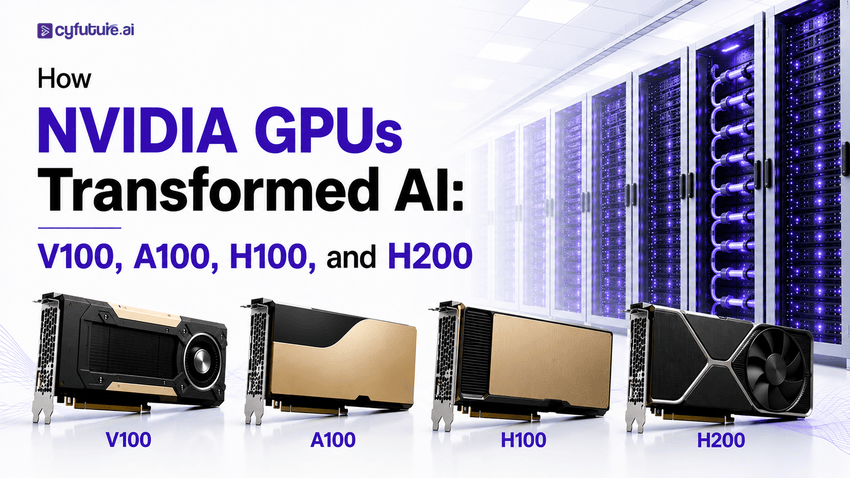
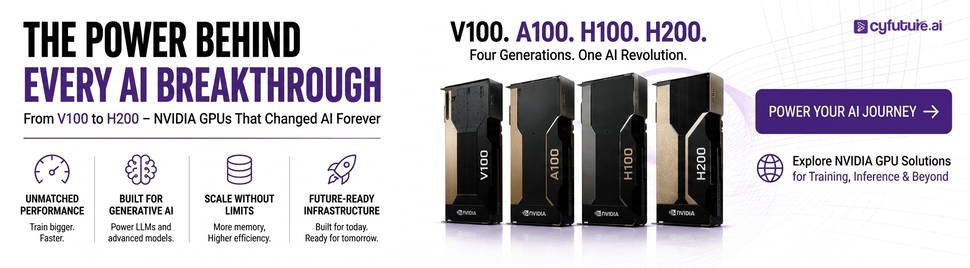
From powering early deep learning experiments to enabling trillion-parameter AI models, NVIDIA's data center GPUs have played a central role in every major AI breakthrough of the last decade. The evolution from the NVIDIA V100 to the A100, H100, and H200 reflects how AI infrastructure has adapted to increasing demands for compute, memory, and efficiency.
Today, organizations building AI products, training large language models (LLMs), or deploying enterprise AI applications rely heavily on NVIDIA GPUs. Understanding how these GPU generations evolved helps explain why modern AI looks the way it does.
Before NVIDIA GPUs Became the Foundation of AI
Before GPUs became central to AI development, most machine learning workloads ran on CPUs.
The Limitations of CPU-Based AI Training
While CPUs excel at sequential processing, deep learning requires massive parallel computation. Training neural networks on CPUs was often slow, expensive, and difficult to scale.
Researchers faced challenges such as:
- Long training times
- Limited scalability
- High infrastructure costs
- Difficulty processing large datasets
As AI models became more sophisticated, traditional computing architectures struggled to keep up.
Why GPUs Changed Everything
GPUs were originally designed for graphics rendering, but their ability to process thousands of operations simultaneously made them ideal for machine learning workloads.
NVIDIA's CUDA ecosystem provided developers with the tools needed to harness GPU acceleration for AI applications, laying the groundwork for the modern AI revolution.
NVIDIA V100: The GPU That Accelerated Deep Learning
What Is the NVIDIA V100?
Released in 2017, the NVIDIA V100 was built on the Volta architecture and introduced Tensor Cores, a technology specifically designed to accelerate AI computations.
|
Feature |
NVIDIA V100 |
|
Architecture |
Volta |
|
Memory |
Up to 32 GB HBM2 |
|
Tensor Cores |
First Generation |
|
Primary Focus |
Deep Learning Training |
Why Tensor Cores Were Revolutionary
Tensor Cores significantly accelerated matrix operations used in neural network training.
Before Tensor Cores, AI workloads relied on standard GPU processing. The V100 dramatically improved training speed and efficiency, making deep learning more accessible to enterprises and research institutions.
AI Workloads That Benefited from V100
The V100 became the preferred GPU for:
- Computer vision applications
- Recommendation systems
- Speech recognition
- Early transformer models
- Academic AI research
Many groundbreaking AI papers published between 2017 and 2020 were trained on NVIDIA V100 clusters.
NVIDIA A100: Scaling AI Beyond Research
What Is the NVIDIA A100?
The NVIDIA A100, launched in 2020, introduced the Ampere architecture and represented a major leap in AI infrastructure capabilities.
|
Feature |
NVIDIA A100 |
|
Architecture |
Ampere |
|
Memory |
Up to 80 GB HBM2e |
|
MIG Support |
Yes |
|
Primary Focus |
AI Training and Inference |
Why the A100 Became an Enterprise Favorite
The A100 arrived as organizations began building increasingly large AI models.
Key advantages included:
- Higher memory capacity
- Faster memory bandwidth
- Improved AI performance
- Multi-Instance GPU (MIG) technology
- Better utilization across workloads
The Role of A100 in the Foundation Model Era
As transformer models grew into billions of parameters, the A100 became the infrastructure backbone for many large-scale AI initiatives.
The A100 helped organizations:
- Train larger language models
- Fine-tune AI models faster
- Deploy AI workloads efficiently
- Scale AI infrastructure economically
Many of the technologies that paved the way for modern generative AI were developed using A100-based infrastructure.
NVIDIA H100: The Engine Behind Generative AI
What Is the NVIDIA H100?
Introduced in 2022, the NVIDIA H100 is based on the Hopper architecture and was specifically optimized for transformer-based AI workloads.
|
Feature |
NVIDIA H100 |
|
Architecture |
Hopper |
|
Memory |
80 GB HBM3 |
|
Transformer Engine |
Yes |
|
FP8 Precision |
Yes |
Why the H100 Changed AI Infrastructure
The rise of ChatGPT and generative AI created unprecedented demand for computing power.
The H100 introduced several critical innovations:
- Transformer Engine
- FP8 precision acceleration
- Improved NVLink connectivity
- Higher memory bandwidth
- Enhanced AI inference capabilities
These improvements significantly reduced training times for large language models.
Workloads That Thrive on H100
The H100 quickly became the preferred choice for:
- Large language model training
- Generative AI applications
- AI copilots
- Enterprise AI assistants
- Advanced research workloads
For many organizations, the H100 became synonymous with modern AI infrastructure.
NVIDIA H200: Solving the AI Memory Bottleneck
What Is the NVIDIA H200?
The NVIDIA H200 builds on the Hopper architecture but focuses heavily on memory improvements.
|
Feature |
NVIDIA H200 |
|
Architecture |
Hopper |
|
Memory |
141 GB HBM3e |
|
Focus |
AI Inference and Large Models |
Why Memory Has Become the New Challenge
Training AI models is only part of the equation.
Today's enterprises must also serve millions of AI requests in production. This requires:
- Large context windows
- Retrieval-Augmented Generation (RAG)
- AI agents
- Real-time inference
These workloads demand enormous amounts of memory.
How H200 Improves Enterprise AI
The H200 offers:
- Increased memory capacity
- Higher memory bandwidth
- Better inference economics
- Improved scalability for AI deployments
This makes it particularly valuable for production AI environments.
NVIDIA V100 vs A100 vs H100 vs H200
GPU Comparison Table
|
GPU |
Architecture |
Memory |
Major Innovation |
AI Impact |
|
V100 |
Volta |
Up to 32 GB HBM2 |
Tensor Cores |
Accelerated deep learning |
|
A100 |
Ampere |
Up to 80 GB HBM2e |
MIG Technology |
Enabled foundation model growth |
|
H100 |
Hopper |
80 GB HBM3 |
Transformer Engine |
Powered generative AI |
|
H200 |
Hopper |
141 GB HBM3e |
Expanded Memory |
Optimized AI inference |
How Each GPU Generation Changed AI Workloads
Deep Learning
The V100 made large-scale neural network training commercially practical.
Natural Language Processing
The A100 enabled researchers to train increasingly complex transformer models.
Generative AI
The H100 accelerated the development of foundation models and generative AI systems.
AI Inference and AI Agents
The H200 focuses on serving AI models efficiently in production environments.
The Hidden Infrastructure Behind AI Success
Raw GPU performance is only one part of AI infrastructure.
NVLink and GPU Communication
As AI models expanded across multiple GPUs, fast communication became essential.
NVLink helps GPUs share data more efficiently, reducing bottlenecks during training.
High-Bandwidth Memory
Every new NVIDIA GPU generation increased memory capacity and bandwidth, allowing larger models to run efficiently.
AI Clusters and Networking
Modern AI training relies on:
- InfiniBand networking
- Multi-GPU clusters
- Distributed training frameworks
- High-performance storage
Without these supporting technologies, today's AI models would not be possible.
Which NVIDIA GPU Is Best for AI in 2026?
Choose V100 If
-
You have budget constraints
- You run smaller AI models
- You need development or testing environments
Choose A100 If
-
You fine-tune models regularly
- You need balanced performance and cost
- You run enterprise AI workloads
Choose H100 If
-
You train large language models
- You need maximum AI performance
- You operate AI-intensive platforms
Choose H200 If
-
You deploy AI agents
- You run RAG applications
- You require long-context inference
- Memory capacity is a priority
What Comes After H200?
NVIDIA's future GPU roadmap points toward increasingly specialized AI infrastructure.
Emerging Trends
Future AI accelerators will likely focus on:
- Higher memory capacity
- Improved energy efficiency
- Faster interconnects
- AI agent optimization
- Multimodal AI workloads
As AI adoption grows, efficiency will become just as important as raw performance.
Frequently Asked Questions (FAQs)
What is the difference between NVIDIA V100, A100, H100, and H200?
The primary difference lies in architecture, performance, memory capacity, and AI workload optimization. V100 accelerated deep learning, A100 enabled large-scale AI training, H100 powered generative AI, and H200 focuses on memory-intensive inference workloads.
Which NVIDIA GPU is best for training large language models?
The NVIDIA H100 is one of the most widely used GPUs for training large language models due to its Transformer Engine, FP8 precision support, and high-performance architecture. A100 GPUs are also commonly used for fine-tuning and mid-sized LLM workloads.
Is NVIDIA H200 better than H100?
For memory-intensive inference workloads, the H200 often offers advantages because of its larger HBM3e memory capacity. For many training workloads, the H100 remains an excellent choice.
Why are NVIDIA GPUs important for AI?
NVIDIA GPUs accelerate parallel processing tasks required for AI training and inference. Technologies such as Tensor Cores, Transformer Engine, NVLink, and HBM memory have made large-scale AI commercially viable.
Which NVIDIA GPU should enterprises choose in 2026?
The ideal GPU depends on workload requirements. V100 suits testing environments, A100 supports enterprise AI, H100 excels in LLM training, and H200 is optimized for AI agents, RAG systems, and large-scale inference.
Final Thoughts
The evolution from the NVIDIA V100 to the H200 represents one of the most significant hardware advancements in modern computing.
Each generation solved a different challenge:
- V100 accelerated deep learning.
- A100 scaled AI training.
- H100 powered generative AI.
- H200 optimized AI inference.
Together, these GPUs transformed artificial intelligence from a research discipline into a global industry.
For enterprises evaluating AI infrastructure today, understanding this progression is essential. The right GPU choice can determine not only performance but also the economics and scalability of future AI initiatives.
Author Bio:
Meghali is a tech-savvy content writer with expertise in AI, Cloud Computing, App Development, and Emerging Technologies. She excels at translating complex technical concepts into clear, engaging, and actionable content for developers, businesses, and tech enthusiasts. Meghali is passionate about helping readers stay informed and make the most of cutting-edge digital solutions.