


 IND
IND UAE
UAE SA
SA


The NVIDIA Blackwell B300 GPU — officially called the Blackwell Ultra — is the most powerful single GPU NVIDIA has ever shipped for data center AI workloads. Announced at GTC 2025 and rolling into production through the second half of 2025, it's now reaching cloud availability across major providers and specialty GPU clouds in 2026.
For AI practitioners, MLOps engineers, and CTOs evaluating their infrastructure roadmap: this is the GPU you need to understand right now. Whether you're sizing a training cluster for a frontier model, building a high-throughput inference API, or just trying to benchmark NVIDIA B300 GPU cloud pricing against your H100 spend — this guide covers everything.
|
DEFINITION: NVIDIA B300 GPU (Blackwell Ultra)
The NVIDIA B300 GPU, also marketed as the NVIDIA Blackwell Ultra, is NVIDIA's next-generation data center AI accelerator announced at GTC 2025. Built on the Blackwell Ultra architecture, it features 288 GB of HBM3e memory, 8 TB/s memory bandwidth, fifth-generation Tensor Cores with native FP4 support, and NVLink 5.0 interconnect. It is purpose-built for frontier LLM training, high-concurrency AI inference, agentic AI workloads, and trillion-parameter mixture-of-experts (MoE) models — delivering up to 15 petaFLOPS of FP4 compute per GPU. |
What Is the NVIDIA Blackwell B300 GPU?
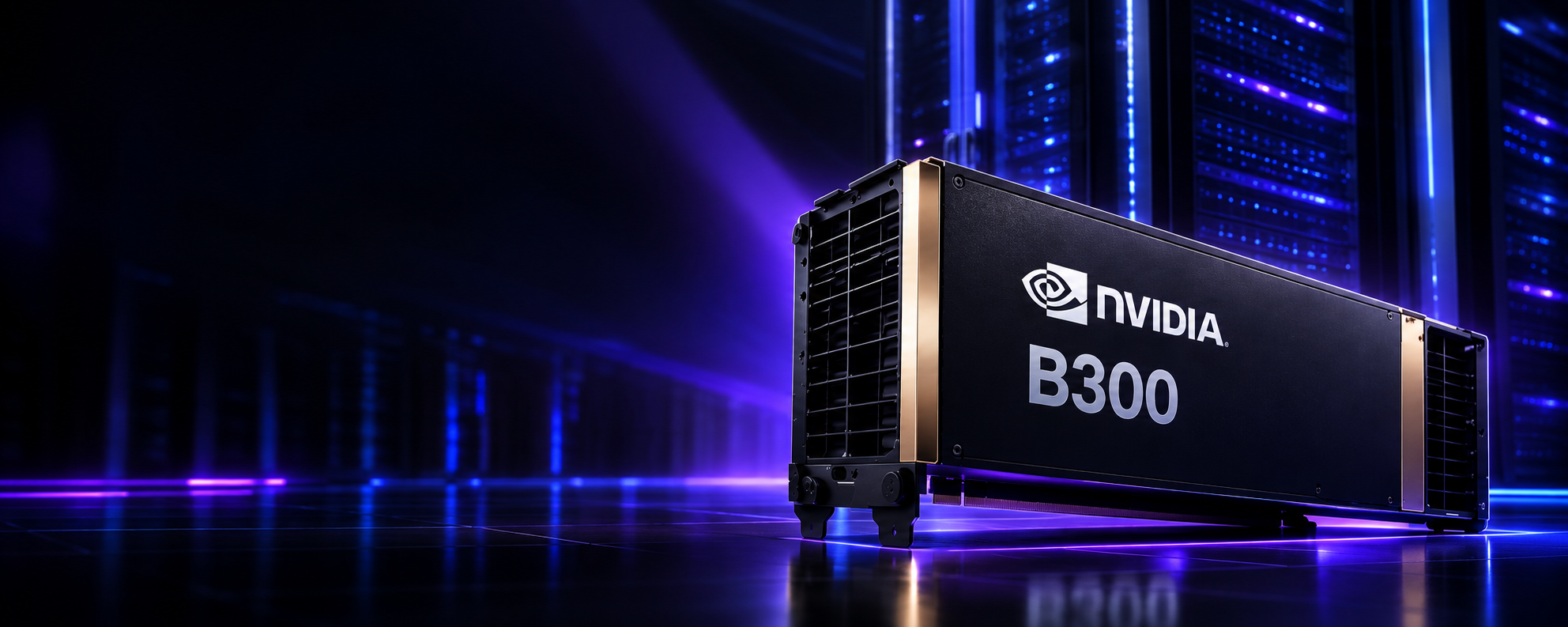
The NVIDIA B300 is the Blackwell Ultra architecture GPU — a significant memory and compute upgrade over the B200, which was itself a generational leap over the H100 Hopper family. Think of it as the top tier of the Blackwell platform.
It doesn't ship as a standalone card. The B300 is deployed inside:
- DGX B300 — NVIDIA's 8-GPU server node delivering 192 petaFLOPS for inference and 70 petaFLOPS for training
- HGX B300 — OEM server platform for system integrators and hyperscalers
- GB300 NVL72 — rack-scale system combining 72 B300 GPUs over NVLink, achieving 1.1 exaflops of FP4 compute in a single rack
NVIDIA B300 GPU: Full Technical Specifications
|
Specification |
NVIDIA B300 (Blackwell Ultra) |
NVIDIA B200 |
NVIDIA H100 SXM5 |
|
Architecture |
Blackwell Ultra |
Blackwell |
Hopper |
|
HBM Memory |
288 GB HBM3e |
192 GB HBM3e |
80 GB HBM3 |
|
Memory Bandwidth |
8 TB/s |
8 TB/s |
3.35 TB/s |
|
FP4 Tensor Performance |
15 petaFLOPS |
9 petaFLOPS |
N/A |
|
FP16 TFLOPS |
~3,500 TFLOPS |
~2,250 TFLOPS |
~1,979 TFLOPS |
|
FP8 Tensor Performance |
~9 petaFLOPS |
~9 petaFLOPS |
~3.9 petaFLOPS |
|
TDP (Power Draw) |
~1,400 W |
~1,000 W |
700 W |
|
Interconnect |
NVLink 5.0 (1,800 GB/s) |
NVLink 4.0 |
NVLink 4.0 |
|
Cooling Requirement |
Direct Liquid Cooling |
Direct Liquid Cooling |
Air or Liquid |
|
Tensor Core Gen |
5th Gen (native NVFP4) |
5th Gen |
4th Gen |
|
PCIe Generation |
PCIe Gen 6 |
PCIe Gen 5 |
PCIe Gen 5 |
|
Transformer Engine |
2nd Gen |
2nd Gen |
1st Gen |
Five Features That Define the NVIDIA Blackwell B300 GPU
1. Memory That Changes the Game: 288 GB HBM3e
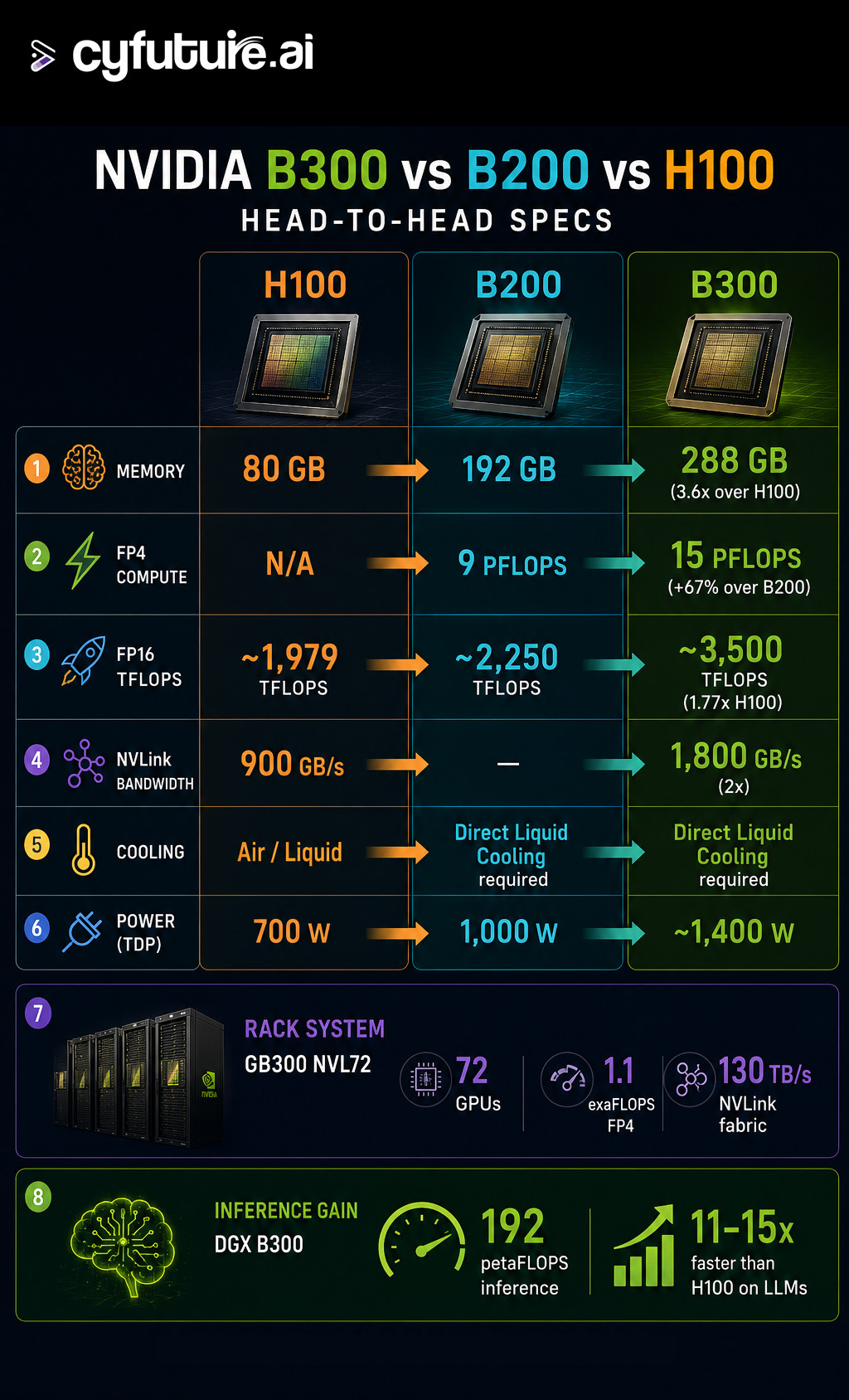
This is the headline. The B300 ships with 288 GB of HBM3e per GPU — 50% more than the B200's 192 GB, roughly double the H200's 141 GB, and 3.6x the H100's 80 GB. Why does this matter more than raw compute?
Modern AI inference bottleneck isn't always FLOPS — it's memory capacity. KV caches for long-context windows, optimizer states during training, and model weights for 200B+ parameter models all compete for GPU memory. The B300's 288 GB means:
- Trillion-parameter dense transformer training without model parallelism across nodes
- Inference serving of 200B+ parameter models on a single GPU
- Context windows of 500K–1M tokens without memory spillover
- Large-scale reinforcement learning with massive replay buffers
2. FP4 Compute: 15 Petaflops of Dense Low-Precision Throughput
The NVIDIA B300 Blackwell GPU's 5th-generation Tensor Cores deliver 15 petaFLOPS at FP4 precision — 67% more than the B200's 9 petaFLOPS and roughly 18x more than the H100. FP4 matters because it reduces memory footprint by approximately 1.8x compared to FP8 while maintaining near-equivalent model accuracy, directly translating into higher inference throughput per GPU-hour.
3. NVLink 5.0: 1,800 GB/s Bidirectional Bandwidth
Multi-GPU scaling is where Blackwell Ultra sets itself apart at the rack level. NVLink 5.0 delivers 1,800 GB/s of bidirectional bandwidth per GPU. In the GB300 NVL72 configuration, 72 GPUs are interconnected at 130 TB/s all-to-all — effectively creating a single exascale supercomputer inside one rack. For large-scale distributed training, this eliminates the inter-node communication bottleneck that plagues multi-node H100 deployments.
4. Inference-Optimized Architecture
The DGX B300 delivers 192 petaFLOPS for inference alone. According to SemiAnalysis InferenceX benchmarks (Q1 2026), Blackwell Ultra systems achieve up to 50x higher throughput per megawatt and up to 35x lower cost per token versus NVIDIA Hopper for low-latency agentic workloads. The HGX B300 achieves up to 11x higher inference performance over H100 for models like Llama 3.1 405B.
5. Direct Liquid Cooling — Built for Modern Data Centers
At 1,400W TDP per GPU (11.2 kW for an 8-GPU DGX B300 system before CPUs and networking), the B300 requires direct liquid cooling (DLC) as standard. This is a hard infrastructure requirement — air cooling is not viable. But for operators already running DLC infrastructure (like Cyfuture AI's 10 MW liquid-cooled facility), the B300 delivers unprecedented compute density per rack.
NVIDIA B300 GPU Cloud Pricing: What Does It Actually Cost?
Let's talk numbers. The NVIDIA B300 GPU price in the cloud varies significantly by provider, billing model, and contract term. Here's the current market picture as of July 2026:
|
Provider Tier |
Pricing Model |
B300 Hourly Pricing (per GPU) |
Notes |
|
Specialist GPU Clouds |
On-Demand |
$6.94 – $8.55/hr |
RunPod lowest at $6.94/hr |
|
Specialist GPU Clouds |
Spot |
~$3.67/hr |
Variable availability |
|
Specialist GPU Clouds |
Reserved (36-month) |
~$3.27/hr |
Best TCO for committed work |
|
Hyperscalers |
On-Demand |
$12.00 – $18.00+/hr |
Oracle Cloud up to $18/hr |
|
Market Median (mid-2026) |
Blended |
~$8.23/hr |
Per AI Multiple GPU Index |
|
Single B300 (list price estimate) |
On-Prem Purchase |
~$53,000/GPU |
Tech-Insider, July 2026 |
|
DGX B300 System (8 GPUs) |
On-Prem Purchase |
$300K – $350K |
8x B300 + NVLink + DLC |
|
GB300 NVL72 (72 GPUs) |
On-Demand Rack |
$756 – $1,944/hr |
Full rack allocation |
Bottom line on B300 GPU hourly pricing: neocloud GPU-first providers offer the best entry points, while hyperscalers carry 2–3x premiums during this early-availability window. The H100 followed this exact curve — dropping from $8/hr in early 2024 to under $3/hr by mid-2026. B300 pricing will follow as Vera Rubin (R100) pulls demand off Blackwell Ultra, likely in 2027.
For teams evaluating NVIDIA B300 GPU rental as a strategy: reserve now, before capacity fills. Early-mover advantage on B300 GPU as a Service translates directly into competitive AI model performance.
Who Should Rent B300 GPU Servers? (And When to Wait)
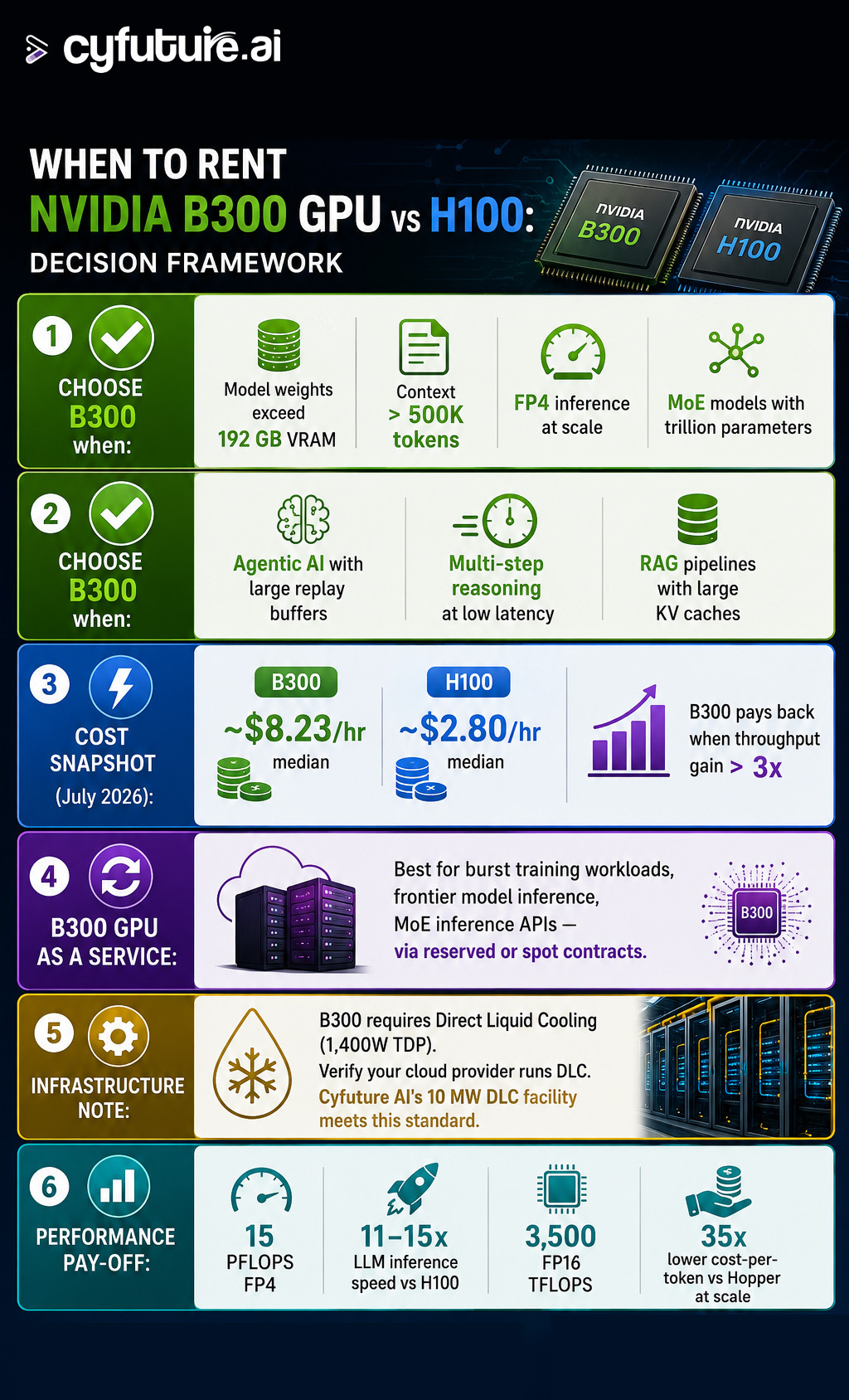
Renting B300 GPU server capacity makes sense when:
- You're training or fine-tuning models with 70B+ parameters that exceed B200 VRAM at 192 GB
- Your inference workload is latency-sensitive and needs maximum FP4 throughput per GPU
- You're running RAG pipelines or long-context applications with 500K+ token windows
- You're building agentic AI systems that process multi-step reasoning with large intermediate states
- Your team is deploying MoE models like DeepSeek-R1 (671B) and wants single-node inference
When to hold off on NVIDIA B300 GPU Cloud access: if your workload runs well within H100's 80 GB VRAM and your team is optimizing cost-per-token above all else, H100 at under $3/hr remains the most efficient option for standard batch inference. The B300's advantages are specific and premium — pay for them only when you need them.
How Cyfuture AI Supports NVIDIA B300 GPU Workloads
Access to the B300 GPU is only half the equation. The infrastructure running it determines whether you actually extract that performance.
|
🏢 Cyfuture AI: Built for Blackwell-Class Workloads
▸ India's first 10 MW Direct Liquid Cooled AI Data Center — the only infrastructure spec that supports B300's 1,400W TDP at scale ▸ 240 kW per rack density — handling the full GB300 NVL72 rack-scale footprint without power derating ▸ NVIDIA Vera Rubin NVL72 and AMD MI450/MI455X Helios GPU fleet alongside Blackwell — future-proofed compute roadmap ▸ PUE < 1.3 — delivering 50x higher throughput per megawatt consistent with B300's efficiency claims ▸ ISO 27001:2022 certified & DPDP Act 2023 compliant — critical for regulated AI workloads in BFSI, healthcare, and government ▸ SEZ-based facility with duty-free benefits — lowest NVIDIA B300 GPU cloud pricing available to Indian enterprises |
Pre-book your NVIDIA B300 GPU capacity at Cyfuture AI before allocation windows close. B300 on rent with dedicated support, SLA-backed uptime, and India-first data residency — that's the Cyfuture AI advantage.
The Verdict: Why NVIDIA B300 GPU Is the Compute Event of 2026
The NVIDIA B300 Blackwell GPU isn't an incremental upgrade. It's a memory architecture inflection point — 288 GB HBM3e, 15 petaFLOPS FP4, and NVLink 5.0 at 1,800 GB/s are specs that redefine what a single GPU can hold and compute in a single pass.
For AI teams training frontier models, serving trillion-parameter inference, or building the next generation of agentic AI applications — the question isn't whether you'll need B300-class compute. It's whether you'll have access to it when you need it.
NVIDIA B300 GPU cloud availability is constrained and demand is outpacing supply. The teams pre-booking capacity today are the ones who'll ship models tomorrow.
Cyfuture AI is ready. The infrastructure is live. Reserve your B300 GPU on rent now.
FAQs
1. What workloads benefit most from the NVIDIA B300 GPU?
The B300 excels at large-model training and high‑throughput inference: pretraining and fine‑tuning 30B–200B+ LLMs, multimodal generative models, long‑context retrieval-augmented generation (RAG) with 500K–1M token windows, and MoE or agentic AI pipelines. Use B300 when memory capacity and raw low‑precision throughput materially reduce engineering complexity and total training time.
2. How does B300 performance compare to previous generations (B200 / H100)?
The B300 (Blackwell Ultra) offers a major jump in memory (288 GB HBM3e), FP4 tensor throughput (~15 PFLOPS), and NVLink 5.0 interconnect bandwidth. Practically, that means fewer splits/shards, faster epoch completion, and higher batch throughput versus B200 or H100—especially for trillion‑parameter or very long‑context workloads.
3. What are the infrastructure requirements to run B300 GPUs?
B300-class hardware requires direct liquid cooling (DLC) and high‑density power (approx. 1,400 W per GPU). For multi‑GPU nodes or rack-scale deployments you also need NVLink‑class networking. Choose providers with DLC, high rack power density, and proven operational SLAs—like Cyfuture AI’s liquid‑cooled data center.
4. What should I budget for B300 GPU cloud pricing and rental?
Market rates (mid‑2026) vary widely: specialist GPU clouds show blended rates roughly $6–9/hr on-demand, while hyperscalers can be $12–18+/hr; spot and long‑term reserved rates are substantially lower. Factor in storage, network egress, multi‑GPU interconnect, and orchestration costs. For exact NVIDIA B300 GPU price or B300 GPU hourly pricing in your region, request a quote—Cyfuture AI offers competitive pricing and reserved options.
5. When should my team pre‑book or rent B300 capacity versus waiting?
You can connect with the Cyfuture AI team to reserve B300 GPU capacity in advance, share your workload requirements, and lock the right configuration for training or inference. This is especially useful when you need guaranteed access, liquid-cooled infrastructure, and enterprise support for large AI jobs.
Author Bio:
Meghali is a tech-savvy content writer with expertise in AI, Cloud Computing, App Development, and Emerging Technologies. She excels at translating complex technical concepts into clear, engaging, and actionable content for developers, businesses, and tech enthusiasts. Meghali is passionate about helping readers stay informed and make the most of cutting-edge digital solutions.