


 IND
IND UAE
UAE SA
SA


Why Enterprises Are Comparing B300 and B200
NVIDIA B300 vs B200 has become one of the most common questions AI infrastructure teams ask heading into the second half of 2026. Both GPUs sit inside NVIDIA's Blackwell family, both target the same large-model training and inference workloads, and both are available through major clouds and GPU rental platforms. Yet they are not interchangeable, and the gap between them shows up clearly once you look past the marketing slide and into the actual specification sheet.
The short version: the NVIDIA B200 GPU is the original Blackwell flagship, now a mature, widely available part with competitive pricing. The NVIDIA B300 GPU — officially "Blackwell Ultra" — is a refined, higher-memory version of the same underlying design, built for teams pushing into trillion-parameter models, long-context inference, and agentic AI workloads where memory capacity, not raw compute, becomes the bottleneck.
This comparison walks through architecture, memory, performance, power draw, and pricing for both GPUs, then breaks down which one makes sense depending on whether you're training foundation models, serving inference at scale, or running a mixed enterprise AI workload. Where public data is limited or provider-reported figures vary, we say so directly rather than presenting a single number as gospel — NVIDIA B300 pricing and availability in particular are still settling as supply ramps through 2026.
What Is the NVIDIA B300 GPU?
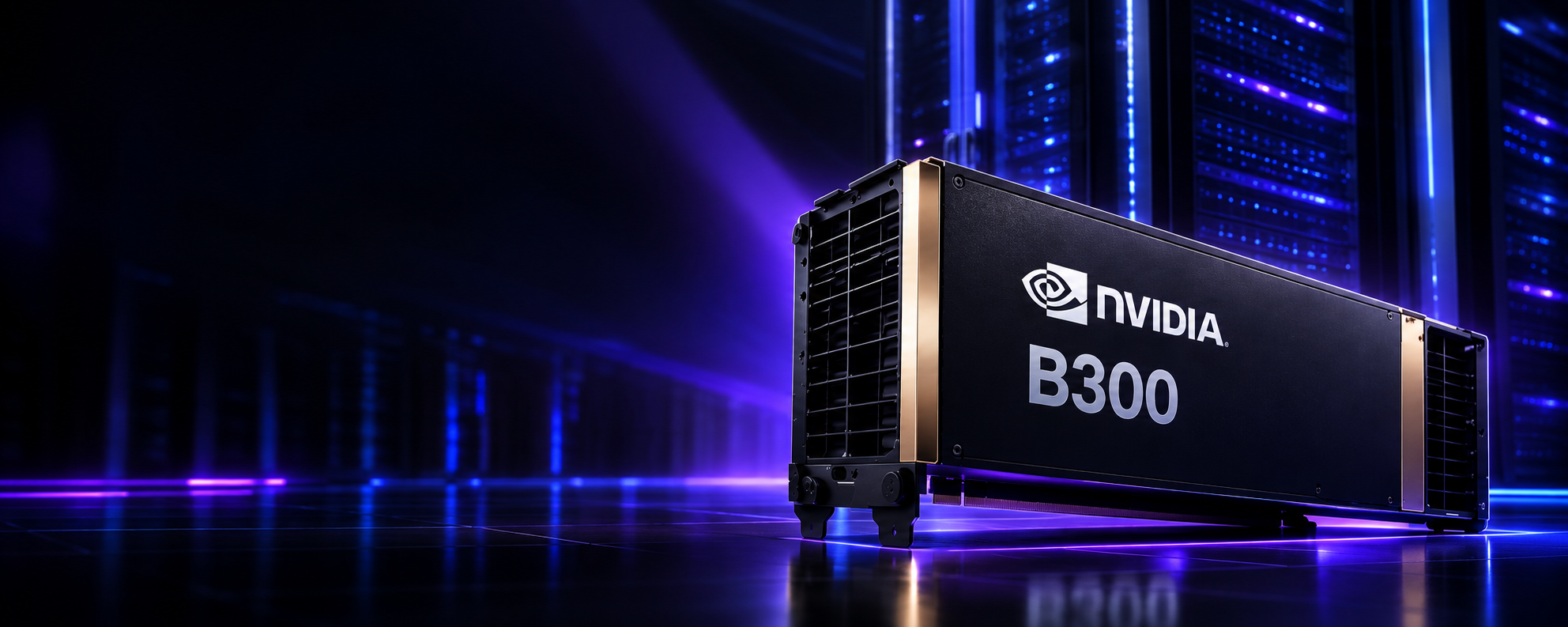
The NVIDIA B300 GPU belongs to the Blackwell Ultra generation, NVIDIA's mid-cycle refresh of the original Blackwell architecture. It is not a new silicon architecture from the ground up — it's better described as Blackwell pushed closer to its physical limits: higher-density memory stacks, higher clocks, and a thermal design built to sustain that extra headroom. NVIDIA began shipping B300 hardware through partner systems in the second half of 2025, with broader cloud availability opening up through early and mid-2026.
The defining change in Blackwell Ultra is memory. The B300 carries up to 288GB of HBM3e memory per GPU, built using 12-high memory stacks instead of the 8-high stacks used on the B200. That's a 50% jump in on-package memory without a change in underlying memory technology. Memory bandwidth stays in the same class as the B200 — roughly 8 TB/s per GPU — so the B300's advantage isn't that data moves faster, it's that far more of it can sit resident on a single card.
On the compute side, the B300 delivers dense FP4 Tensor Core performance of roughly 15 petaflops per GPU, compared to around 9 petaflops dense FP4 on the B200 — an improvement in the range of 60-66%. FP4 is the low-precision format NVIDIA's second-generation Transformer Engine relies on for inference-heavy workloads, and it's where the B300's gains are most pronounced. The trade-off is power: B300 modules draw up to 1,400W, a meaningful step up from the B200's 1,000W, which pushes liquid cooling from "recommended" to essentially mandatory at any meaningful cluster scale.
The B300 is built for workloads where the model itself — or the KV cache it generates — no longer fits comfortably on a B200. That means trillion-parameter mixture-of-experts models, agentic AI systems that hold long conversation histories in memory, and reasoning models that generate extended chains of thought before answering. In an 8-GPU node, the B300 provides roughly 2.3 TB of aggregate HBM3e, enough to hold very large models entirely in memory without offloading to slower storage tiers.
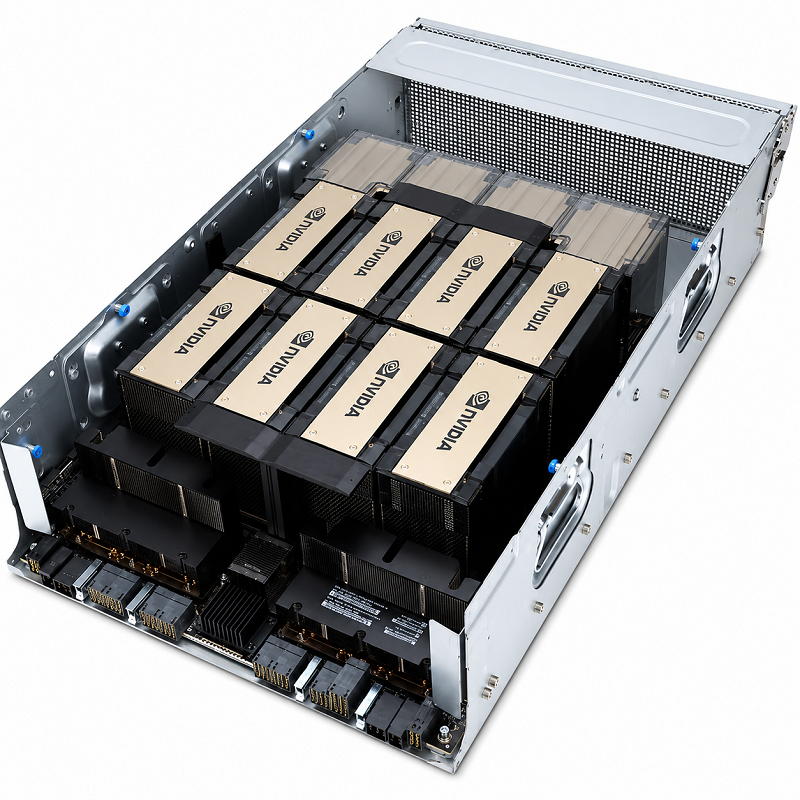
In practical deployment terms, the NVIDIA B300 GPU is rarely deployed as a single card. It ships inside HGX B300 baseboards (eight GPUs per board) and, at rack scale, inside the GB300 NVL72 system — 36 Grace Blackwell Superchips connected through NVLink 5 and NVSwitch, delivering 72 GPUs functioning as a single coherent memory domain. That rack-scale design is what allows extremely large models to be trained or served without the communication overhead that comes from splitting a model across many smaller, less-connected nodes.
What Is the NVIDIA B200 GPU?
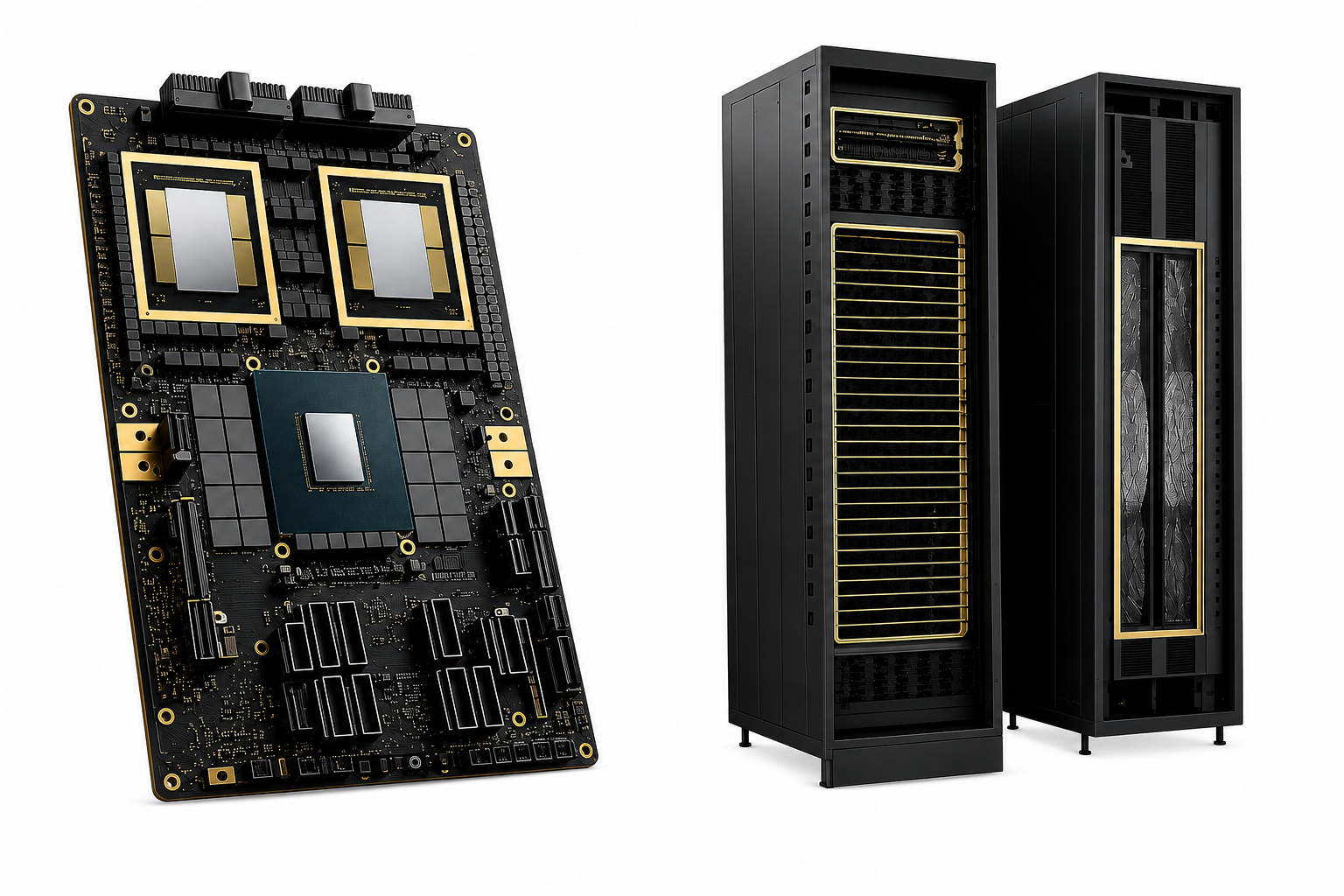
The NVIDIA B200 GPU is the original flagship of the Blackwell generation — NVIDIA's direct successor to the H100 and H200. It began shipping in early-to-mid 2025 and, by mid-2026, has matured into the default high-end accelerator across most cloud GPU providers, with far broader availability and considerably more stable pricing than the newer B300.
Architecturally, the B200 uses a dual-die design built on TSMC's 4NP process, packing roughly 208 billion transistors — connected internally through a high-bandwidth die-to-die interconnect that lets the two dies behave as one logical GPU to software. It carries up to 192GB of HBM3e memory across 8-high stacks, with around 8 TB/s of memory bandwidth, more than double what the H100 offered. NVIDIA's second-generation Transformer Engine on the B200 introduced native FP4 precision support, which roughly halves memory footprint versus FP8 for inference workloads while preserving accuracy close to higher-precision formats.
On raw compute, the B200 delivers dense FP4 performance in the neighborhood of 9 petaflops per GPU, with FP8 dense throughput in the thousands-of-teraflops range depending on how a given vendor reports sparsity. NVLink 5 interconnect provides roughly 1.8 TB/s of bidirectional bandwidth per GPU — the same generation of NVLink used on the B300, which is one of the reasons the two GPUs slot into similar multi-GPU system designs. TDP sits at up to 1,000W per GPU, still firmly in liquid-cooling territory for dense deployments but a step down from the B300's power draw.
It's tempting to treat the B200 as an outgoing part now that the B300 exists, but that's not an accurate read of the market. The NVIDIA B200 GPU remains NVIDIA's most widely deployed Blackwell part, with mature driver support, deep availability across cloud providers, and pricing that has compressed meaningfully as TSMC 4NP yields have improved through 2026. For a large share of enterprise training and inference workloads, the B200 remains the more practical choice — the B300 earns its premium only on specific, memory-bound use cases.
The B200 is designed for the full range of enterprise AI workloads: pretraining and fine-tuning large language models, high-throughput inference serving, retrieval-augmented generation pipelines, and general high-performance computing where FP64 precision still matters for scientific workloads. It is, in effect, the workhorse of the current Blackwell generation — while the B300 is the specialist part for the workloads that specifically need more onboard memory.
Not Sure Which Blackwell GPU Fits Your Workload?
Cyfuture AI's infrastructure team can help you profile your model size, context length, and throughput needs against B300 and B200 before you commit. Get architecture guidance alongside dedicated or bare-metal NVIDIA B300 GPU Server and NVIDIA B200 GPU Server access — hosted in liquid-cooled Indian data centers with INR billing.
NVIDIA B300 vs B200: Quick Comparison Table
Here's the B300 vs B200 GPU comparison distilled into a single reference table. Figures reflect NVIDIA's published Blackwell and Blackwell Ultra specifications and commonly reported values across major GPU cloud and hardware sources as of mid-2026; some figures (particularly power and precision throughput) vary slightly by system configuration (standalone GPU, HGX baseboard, or GB-series superchip module).
| Specification | NVIDIA B300 (Blackwell Ultra) | NVIDIA B200 (Blackwell) |
|---|---|---|
| Architecture | Blackwell Ultra (refined Blackwell, dual-die) | Blackwell (dual-die, TSMC 4NP) |
| GPU Memory | Up to 288 GB | Up to 192 GB |
| Memory Type | HBM3e (12-high stacks) | HBM3e (8-high stacks) |
| Memory Bandwidth | ~8 TB/s per GPU | ~8 TB/s per GPU |
| Tensor Core Generation | 5th-gen, enhanced Transformer Engine | 5th-gen, 2nd-gen Transformer Engine |
| Dense FP4 Compute | ~15 PFLOPS per GPU | ~9 PFLOPS per GPU |
| FP4 / FP8 Support | Native FP4, FP6, FP8 | Native FP4, FP6, FP8 |
| NVLink | NVLink 5, ~1.8 TB/s per GPU | NVLink 5, ~1.8 TB/s per GPU |
| PCIe | PCIe Gen 6 (select SKUs) | PCIe Gen 5 |
| TDP | Up to 1,400W | Up to 1,000W |
| Rack-Scale System | GB300 NVL72 (72 GPUs) | GB200 NVL72 (72 GPUs) |
| Best Workloads | Trillion-parameter MoE, long-context inference, agentic AI | General LLM training/inference, RAG, HPC, mixed workloads |
| Availability (mid-2026) | Ramping — supply-constrained | Broadly available |
NVIDIA B300 vs B200 Performance
Raw specification sheets only tell part of the story. What actually matters is how each GPU behaves across the workload types enterprises run in production.
Large Language Model Training
For pretraining and fine-tuning transformer models up to roughly 200 billion parameters, the B200 and B300 perform comparably on a per-GPU basis — both use the same NVLink 5 fabric and similar memory bandwidth, so distributed training throughput scales similarly across a cluster. The B300's advantage shows up specifically on very large mixture-of-experts models, where its 288GB of memory lets more experts stay resident per GPU, reducing the all-to-all communication that otherwise dominates MoE training time.
AI Inference
This is where the gap is most visible. The B300's larger memory pool and higher FP4 throughput let it serve larger batch sizes and longer context windows per GPU, which directly reduces the number of GPUs needed to hit a given tokens-per-second target on large models. For models in the 70B-parameter range or smaller, the B200 already has ample headroom, and the practical inference-latency difference between the two GPUs narrows considerably.
Agentic AI and RAG Applications
Agentic workloads — where a model holds a long-running conversation state, calls tools, and reasons across multiple steps — are memory-hungry by nature. The KV cache alone can consume tens of gigabytes per active session at long context lengths. The B300's extra memory headroom directly translates to more concurrent agent sessions per GPU. Retrieval-augmented generation pipelines are typically less memory-bound (retrieval happens outside the GPU), so the B200 handles most production RAG deployments comfortably.
Computer Vision, Recommendation Systems, and Scientific Computing
Vision and recommendation workloads are generally less memory-capacity-bound than LLM inference, so the B200's compute and bandwidth are usually sufficient without needing the B300's extra headroom. For scientific computing workloads that lean on FP64 precision, both GPUs offer comparatively modest FP64 throughput relative to specialized HPC accelerators — Blackwell's design priority is clearly the lower-precision AI formats, not double-precision scientific compute.
Multi-GPU Scaling
Both GPUs scale through the same NVLink 5 and NVSwitch fabric, and both are available in 72-GPU rack-scale configurations (GB200 NVL72 and GB300 NVL72). Scaling efficiency is comparable between the two at the interconnect level; the practical difference at scale comes down to how many GPUs a given model actually needs — and that's where the B300's memory advantage can reduce total GPU count for extremely large models, even if per-GPU throughput is similar.
B300 Pulls Ahead When…
- Models exceed 192GB in FP16/BF16 — trillion-parameter MoE architectures, large reasoning models
- Context windows run past 128K tokens and KV cache pressure becomes the limiting factor
- Agentic sessions run long and concurrent, holding extensive state per user
- You want fewer GPUs per model to reduce cross-node communication overhead
B200 Holds Its Own When…
- Models are under ~100B parameters — most enterprise LLM deployments fit comfortably
- Budget and availability matter — broader supply, more stable pricing
- Workloads are mixed — training, inference, RAG, and HPC on the same fleet
- You need proven, mature tooling — a full year-plus of production hardening
NVIDIA B300 vs B200 Memory Comparison
Memory is the single biggest architectural difference between these two GPUs, so it deserves its own section rather than a line in a spec table.
Both GPUs use HBM3e — the same underlying memory technology — but the B300 packs more of it into the same physical footprint by moving from 8-high to 12-high memory stacks. That's a manufacturing and packaging change, not a new memory standard, which is part of why NVIDIA was able to introduce it as a mid-cycle "Ultra" refresh rather than a full architectural generation.
In practice, 192GB on the B200 is enough to hold a 70-billion-parameter model in FP16 with room to spare for KV cache and reasonable batch sizes — comfortably covering the large majority of production LLM deployments today. The B300's 288GB moves the ceiling meaningfully higher: a single B300 can hold significantly larger models, or the same 70B model with dramatically more headroom for long-context serving and large concurrent batch sizes.
At the node level, an 8-GPU B300 system provides roughly 2.3 TB of aggregate HBM3e, versus roughly 1.5 TB on an 8-GPU B200 system. For teams building around massive context windows — 128K tokens and beyond — that additional memory reduces how often a model needs to be sharded across GPUs purely to fit in memory, which in turn reduces the communication overhead that model parallelism introduces.
If your model and its expected KV cache fit inside 150GB with reasonable headroom, the B200 is very likely sufficient. If you're routinely bumping against that ceiling — or planning for models that clearly won't fit — the B300's memory advantage becomes a genuine architectural requirement rather than a nice-to-have.
NVIDIA B300 vs B200 Power Efficiency
Power draw is where the B300's extra capability shows its cost most directly. At up to 1,400W per GPU, the B300 draws roughly 40% more power than the B200's 1,000W ceiling — a meaningful difference once you're planning a rack, not just a single card. Both GPUs sit well past the point where air cooling is practical at scale, but the B300 pushes liquid cooling from a strong recommendation to a near-absolute requirement for any dense deployment.
NVIDIA frames the efficiency story in terms of performance-per-watt at the rack level rather than per-GPU wattage alone. A GB300 NVL72 rack is positioned to deliver substantially higher throughput per megawatt than equivalent Hopper-generation infrastructure, because the additional power draw comes with proportionally larger memory and compute gains rather than a flat efficiency tax. Whether that trade-off pays off depends entirely on whether your workload actually uses the extra memory and FP4 throughput — if it doesn't, you're paying the power premium without capturing the corresponding benefit.
For enterprises evaluating either GPU, power and cooling infrastructure is not a footnote — it's a deployment prerequisite. This is one of the practical reasons many teams choose to run Blackwell-class GPUs through a managed GPU as a Service provider rather than building out liquid-cooled facilities in-house. A Liquid-Cooled AI Data Center purpose-built for 1,000W-1,400W accelerators removes that infrastructure burden entirely from the buyer's side.
NVIDIA B300 vs B200 Pricing
Pricing is the area where public information is least standardized, and it changes frequently as supply shifts. The figures below reflect broadly reported market ranges as of mid-2026 and should be treated as directional rather than a quote — NVIDIA B300 price and NVIDIA B200 price both vary meaningfully by provider, region, commitment length, and whether you're buying hardware outright or renting capacity.
Purchase Pricing
NVIDIA does not publish official list prices for either GPU. Market-reported figures place a single B300 GPU in the tens of thousands of dollars, with full DGX B300 8-GPU systems commonly cited in the $300,000-$350,000 range, versus roughly $280,000-$320,000 for comparable DGX B200 systems — reflecting the B300's higher memory and power specification rather than a fundamentally different manufacturing cost.
Cloud and Rental Pricing
On-demand cloud GPU-hour rates vary widely across providers:
| GPU | Typical Market Range | Reported Median | Availability |
|---|---|---|---|
| NVIDIA B200 | ~$2.80-$27/hour | ~$6-$6.50/hour | Wide — most major clouds |
| NVIDIA B300 | ~$5.63-$18/hour | ~$7.50-$8.23/hour | Growing — supply-constrained |
The B300 typically carries a 15-30% premium over the B200 on a per-GPU-hour basis — consistent with the pattern seen in earlier NVIDIA generation transitions, where a new flagship commands a premium until production volume and provider competition bring pricing down. Hyperscaler pricing tends to sit well above neocloud and specialized GPU-rental pricing for both GPUs, sometimes by a factor of three to five, so the provider you choose matters as much as the GPU generation itself.
Cloud GPU pricing for both B200 and B300 has moved noticeably month to month through 2026 as supply, provider competition, and demand shift. Any figure quoted in an article — including this one — should be verified against current provider pricing before it's used in budgeting or procurement decisions.
Enterprise TCO and Cost Efficiency
The per-GPU-hour rate is rarely the number that should drive a purchasing decision. What matters for total cost of ownership is cost per unit of useful output — cost per training step for pretraining workloads, or cost per generated token for inference. Because the B300 can often serve a given model with fewer GPUs (thanks to its memory advantage) or fewer nodes for very large MoE models, its higher hourly rate can still work out cheaper on a per-token or per-training-run basis for workloads that genuinely need the extra memory. For workloads that don't need that headroom, the B200's lower hourly rate wins on TCO in almost every case.
Rent NVIDIA B300 GPU or NVIDIA B200 GPU on Cyfuture AI
Deploy Blackwell-class AI infrastructure without the capex. Cyfuture AI offers NVIDIA B300 GPU Cloud and NVIDIA B200 GPU Cloud with hourly and monthly INR billing, dedicated and bare-metal AI infrastructure, liquid-cooled India data centers, and enterprise support for training and inference at scale.
Which GPU Is Better for AI Training?
For most enterprise training workloads, the honest answer is that the B200 remains the more practical choice. Its per-GPU training throughput is close to the B300's for models that comfortably fit in 192GB, its pricing is more stable, and its availability across cloud providers is significantly deeper. Distributed training scales through the same NVLink 5 and NVSwitch fabric on both GPUs, so cluster-level scaling efficiency doesn't meaningfully favor one part over the other at moderate model sizes.
The calculus changes for organizations training genuinely massive models — trillion-parameter mixture-of-experts architectures, or foundation models pushing past what fits cleanly on a B200 fleet without heavy sharding. In those cases, the B300's memory headroom reduces the degree of model and pipeline parallelism required, which cuts down on communication overhead and can meaningfully shorten training wall-clock time even accounting for the higher hourly cost.
If your training runs involve models under roughly 200B parameters, budget for B200. If you're training frontier-scale MoE models or expect to within the next planning cycle, evaluate B300 clusters specifically for the model-parallelism reduction, not just the raw FLOPS increase.
Which GPU Is Better for AI Inference?
Inference is where the B300 makes its strongest case. Its combination of higher dense FP4 throughput and substantially more onboard memory means it can serve larger batch sizes, longer context windows, and more concurrent users per GPU than a B200 running the same model. For high-throughput inference on large models — particularly reasoning models that generate long chains of thought, or agentic systems maintaining extensive conversation state — the B300 typically achieves better cost-per-token economics despite its higher hourly price, simply because fewer GPUs are needed to hit the same throughput target.
That advantage narrows considerably for smaller models. Serving a 7B, 13B, or even 70B-parameter model at moderate context lengths rarely pushes against the B200's 192GB ceiling, and in that range the B200's lower cost per GPU-hour usually wins on total inference cost. The decision genuinely comes down to whether your inference workload is memory-bound (favor B300) or throughput-bound within comfortable memory limits (favor B200).
Which GPU Should Enterprises Choose?
There's no single right answer across every industry — the right choice depends on model size, workload type, and how quickly your compute needs are expected to grow.
AI Startups
Start on B200. Lower hourly cost and wide availability let you iterate fast without over-committing capital to headroom you may not need yet. Move specific workloads to B300 only once memory becomes a measured bottleneck.
Large Enterprises
A mixed fleet usually makes the most sense — B200 for the bulk of training and standard inference, B300 reserved for large-context, high-concurrency, or frontier-model workloads where the memory premium pays for itself.
Research Labs & Universities
B300's memory ceiling is valuable for training exploratory large-scale architectures, but budget constraints and grant cycles often favor B200's lower cost and broader availability for day-to-day research compute.
FinTech & BFSI
Fraud detection, risk modeling, and document-heavy RAG pipelines generally fit within B200's memory profile. Agentic compliance assistants with long session context are a stronger case for B300.
Healthcare
Clinical documentation, imaging models, and diagnostic support tools mostly run comfortably on B200. Long-context medical reasoning models handling full patient histories benefit more directly from B300's memory capacity.
Manufacturing
Predictive maintenance, computer vision on production lines, and digital-twin simulation workloads are typically compute-bound rather than memory-bound — the B200 covers these well at a lower operating cost.
Media & Entertainment
Generative video, image, and audio pipelines increasingly push into large multi-modal model territory, where B300's memory headroom can reduce the number of GPUs needed per rendering or generation pipeline.
General Recommendation
Profile your actual model sizes and context lengths before committing to either GPU exclusively. Most organizations get the best cost efficiency from a mixed B200/B300 fleet rather than standardizing on one part.
Build a Mixed B200/B300 Fleet on Cyfuture AI
Run standard training and inference on NVIDIA B200 GPU Cloud, and reserve NVIDIA B300 GPU Cloud for your memory-bound, long-context, and agentic AI workloads — all on one platform with unified billing, dedicated support, and enterprise-grade AI Infrastructure built for Indian compliance requirements.
B300 or B200: Which Offers Better ROI?
ROI on GPU infrastructure isn't a single number — it depends entirely on whether the workload uses what each GPU is actually good at. Framed simply:
Before committing budget to either GPU, model your workload's memory footprint against 192GB with realistic batch sizes and context lengths. If you're consistently within that ceiling with headroom, B200 delivers the better ROI in nearly every case. If you're routinely exceeding it or actively building toward architectures that will, the B300's premium is an investment in reduced GPU count and simpler infrastructure, not just raw speed.
Why Choose Cyfuture AI
Whichever GPU your workload calls for, deploying it well matters as much as the hardware choice itself. Cyfuture AI provides both NVIDIA B300 GPU Cloud and NVIDIA B200 GPU Cloud through a single GPU as a Service platform, built specifically for enterprises that need production-grade AI Infrastructure without taking on the capital cost and operational complexity of building it themselves.
Dedicated GPU Servers & Bare-Metal Infrastructure
Choose between shared GPU-as-a-Service capacity and dedicated, bare-metal B300 or B200 servers depending on your isolation and performance requirements — with full control over the software stack when you need it.
Liquid-Cooled AI Data Centers
Both B300 and B200 push well past 1,000W per GPU. Cyfuture AI's data centers in Noida, Jaipur, and Raipur are built with liquid-cooling infrastructure designed for this generation of accelerators, removing the thermal engineering burden from your team.
Flexible Hourly and Monthly Billing
Run short experiments on hourly GPU rental or commit to monthly and longer terms for production workloads — with transparent INR pricing and GST-compliant invoicing, avoiding the forex overhead of USD-billed international clouds.
High-Speed Networking & Enterprise Support
NVLink and high-throughput fabric within nodes, paired with enterprise-grade networking between them, plus dedicated support for deployment, scaling, and workload optimization across training and inference.
Compliance Built for Indian Enterprises
ISO 27001:2022 certified and SOC 2 Type II attested infrastructure, with data handling aligned to the Digital Personal Data Protection (DPDP) Act — relevant for BFSI, healthcare, and government workloads that require India-based data residency.
Frequently Asked Questions
The main difference is memory. The B300 (Blackwell Ultra) ships with up to 288GB of HBM3e using 12-high memory stacks, a 50% increase over the B200's 192GB on 8-high stacks. The B300 also draws more power (up to 1,400W vs 1,000W) and delivers roughly 60-66% higher dense FP4 compute, but both GPUs share the same core Blackwell dual-die design, NVLink 5 interconnect, and similar per-GPU memory bandwidth.
For most enterprise training workloads under roughly 200B parameters, the B200 delivers comparable per-GPU throughput at a lower cost. The B300's real training advantage appears on trillion-parameter mixture-of-experts models, where its larger memory pool reduces the model parallelism needed and cuts communication overhead, which can shorten wall-clock training time.
The B300 generally wins on inference for large models, long context windows, and high-concurrency agentic workloads because its extra memory lets it serve more per GPU. For smaller models under roughly 70B parameters at moderate context lengths, the B200's lower hourly cost typically produces better inference economics.
NVIDIA does not publish an official list price. Cloud rental rates for the B300 are broadly reported in the $5.63-$18 per GPU-hour range with a market median near $7.50-$8.23/hour as of mid-2026, typically a 15-30% premium over B200 rates. Purchase pricing for full DGX B300 systems is commonly cited around $300,000-$350,000. These figures shift as supply increases through 2026.
B200 cloud rental pricing is reported in a wide range of roughly $2.80-$27 per GPU-hour depending on provider, with a market median near $6-$6.50/hour as of mid-2026. Neoclouds and specialized GPU rental platforms tend to price meaningfully below hyperscaler on-demand rates for the same hardware generation.
Yes. Both GPUs are available through cloud GPU providers and GPU-as-a-Service platforms, including Cyfuture AI, with hourly and monthly billing. Renting avoids the capital cost of purchasing hardware and the operational burden of building liquid-cooling infrastructure, which is close to mandatory for both GPUs at any meaningful cluster scale.
Practically, yes. At up to 1,400W per GPU, the B300 is designed around liquid-cooled rack systems such as the GB300 NVL72. Air cooling is not a realistic option at any meaningful density for a GPU in this power class.
Blackwell Ultra is NVIDIA's mid-cycle refresh of the Blackwell architecture, implemented in the B300 GPU. It uses the same fundamental dual-die design as the original Blackwell B200 but increases memory capacity through denser 12-high HBM3e stacking, raises clock speeds, and enhances the Transformer Engine — rather than introducing an entirely new architecture.
Most AI startups are better served starting with the B200. It offers a lower hourly cost, wider availability, and sufficient memory and compute for the large majority of early-stage model sizes. Moving specific workloads to B300 makes sense once memory capacity becomes a measured, not theoretical, bottleneck.
The B300 has up to 288GB of HBM3e memory per GPU. The B200 has up to 192GB of HBM3e memory per GPU. Both use the same HBM3e memory technology; the B300 achieves higher capacity through 12-high memory stacks versus the B200's 8-high stacks.
Yes. Cyfuture AI offers both NVIDIA B300 GPU Cloud and NVIDIA B200 GPU Cloud through its GPU as a Service platform, including dedicated and bare-metal server options, hourly and monthly INR billing, and liquid-cooled data centers in Noida, Jaipur, and Raipur.
Not in the near term. The B200 is likely to remain in wide production use for standard training and inference workloads for some time, similar to how H100 remained heavily used well after H200 and B200 arrived. The B300 is better understood as a specialized addition to the Blackwell lineup for memory-bound workloads rather than an outright replacement.
NVIDIA B300 vs B200 — Deploy Either on Cyfuture AI
Whether you're training next-generation LLMs or deploying AI inference at scale, Cyfuture AI provides enterprise-grade NVIDIA B300 and B200 GPU infrastructure with flexible hourly and monthly pricing, liquid-cooled AI data centers, and expert deployment support.
Related Articles