

 IND
IND UAE
UAE SA
SA


|
|
|
|
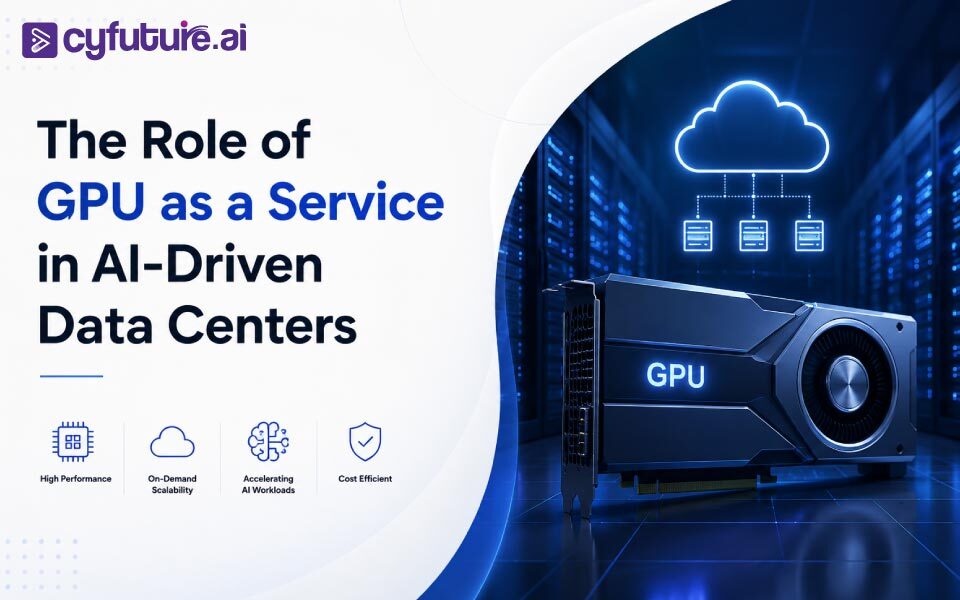
The AI Boom Has a Hardware Problem — And GPUaaS Is the Answer
Think about it: Just a few years ago, 'running an AI model' was something only large tech corporations or well-funded research institutions could afford. Today, a startup in Bangalore can train a billion-parameter language model this afternoon — and pay only for the hours it takes.
That shift didn't happen by accident. It happened because of GPU as a Service (GPUaaS).
In 2026, AI is no longer a futuristic concept — it is the operating system of modern business. And at the heart of every AI system, every large language model (LLM), every generative AI tool, and every real-time recommendation engine sits one critical piece of hardware: the Graphics Processing Unit (GPU).
But here's the thing — GPUs are expensive. A single NVIDIA H100 server can cost upwards of ₹2–5 crore. For most enterprises, startups, and research teams, that capital expenditure is simply not viable. So what do you do when you need world-class AI compute power — but you can't afford to own it?
You rent it. That's exactly what GPUaaS makes possible. Let's dig deep into what this means for AI-driven data centers, the businesses building on them, and why 2026 is a pivotal year for this market.

1. The Staggering Growth of GPUaaS: What the Numbers Say in 2026
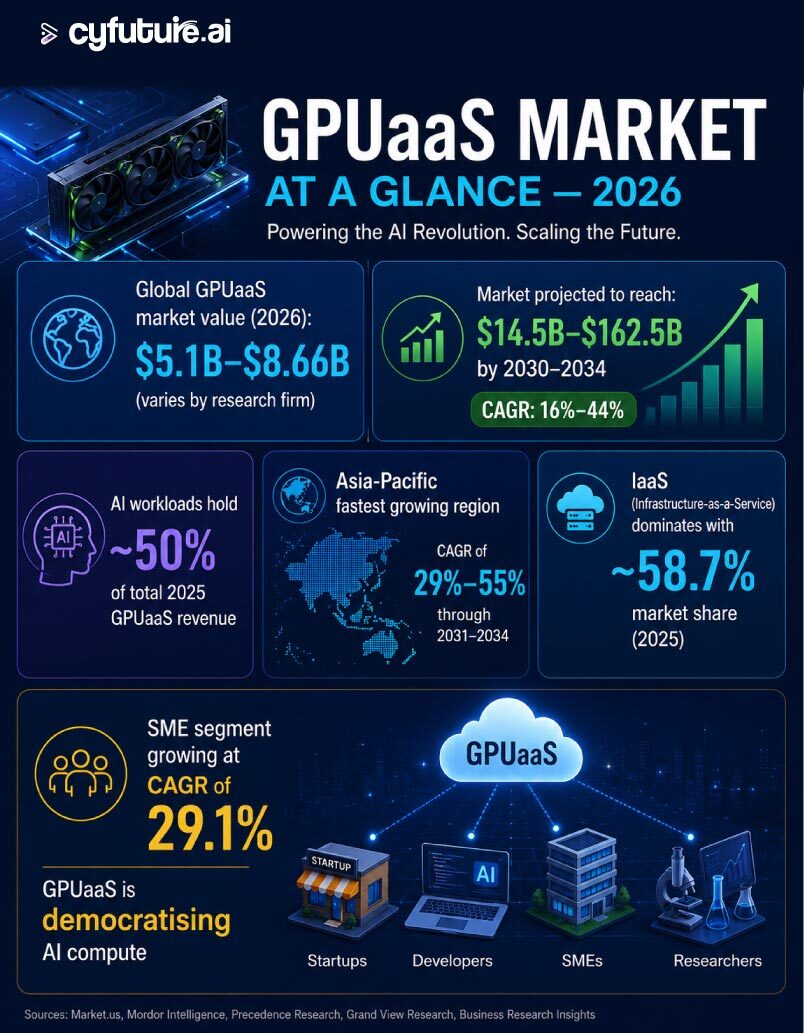
The numbers don't lie, and in the case of GPU as a Service, they scream opportunity.
The market is being propelled by a single unstoppable force: AI workload volume is growing faster than any enterprise can buy hardware. According to the IEA (April 2026), electricity demand from AI-focused data centers grew well beyond the 17% surge seen across all data centers in 2025 — outpacing global electricity demand growth of just 3%. Power consumption from AI-focused data centers is set to triple by 2030.
That's not just a stat. That's a wake-up call for every CTO, data center architect, and AI team lead reading this.
Wait — what's driving this surge? Two words: scale and speed. Enterprises need AI compute on-demand, without 6-month procurement cycles. GPUaaS delivers exactly that.
2. What Is an AI-Driven Data Center — and Why GPUs Are Its Engine?
Traditional data centers were built around CPUs — general-purpose chips great at handling sequential tasks. But AI changed the rules of computing fundamentally.
Training a large language model like GPT-style systems requires executing billions of mathematical matrix operations in parallel. A CPU, no matter how powerful, handles these tasks in a linear queue. A GPU — with thousands of smaller cores designed for parallel processing — can handle all of these operations simultaneously.
The result? What a CPU takes days to compute, a modern NVIDIA H100 GPU completes in hours.
|
|
|
|
|
|
|
|
|
|
|
|
AI-driven data centers are purpose-built environments with three defining characteristics:
- High-density GPU clusters (H100, A100, L40S) rather than commodity CPU servers
- Advanced cooling — liquid cooling, Direct-to-Chip (D2C), or immersion systems for rack densities of 50–240 kW
- High-speed GPU interconnects — NVIDIA NVLink (900 GB/s intra-node) and InfiniBand NDR (200 Gb/s inter-node) for distributed training
And GPU as a Service sits on top of this infrastructure — abstracting away the hardware complexity and delivering pure compute power to any team, anywhere, instantly.
3. The Core Roles GPUaaS Plays in Modern AI Data Centers
Here's where it gets interesting. GPUaaS isn't just a pricing model — it's a fundamental shift in how AI infrastructure is consumed, managed, and scaled. Here are its five defining roles:
Role 1: Elastic Compute for AI Model Training
Training an LLM from scratch on a 7B parameter model requires sustained GPU compute over hours or days. GPUaaS allows teams to spin up 8×H100 clusters in seconds, run the training job, and terminate instantly when done. No idle hardware. No wasted spend.
Role 2: Scalable Inference Infrastructure
Inference — deploying a trained model to respond to real user queries — now accounts for 80–90% of total AI computing (IEA, 2025), and will represent 75% of total AI energy demand by 2030. GPUaaS enables businesses to auto-scale inference capacity up and down based on traffic, paying only for actual usage.
Role 3: Democratising Access for SMEs and Startups
The SME segment in GPUaaS is growing at a CAGR of 29.1%. Why? Because GPUaaS eliminates the ₹2–5 crore upfront barrier. A healthcare startup can run medical imaging models. An edtech company can build personalised learning engines. All on a subscription or pay-per-hour model.
Role 4: Data Sovereignty and Regulatory Compliance
For Indian enterprises, this is non-negotiable in 2026. India's DPDP Act 2023 mandates data localisation for sectors like BFSI, healthcare, and government. GPUaaS providers with India-hosted infrastructure make compliance automatic — not an afterthought.
Role 5: Enabling Multi-Node Distributed AI Training
The largest AI models today — from multimodal systems to scientific foundation models — require clusters of GPUs working in concert across nodes. GPUaaS platforms with InfiniBand networking and NVLink interconnects bring enterprise-grade distributed training to any team without hardware procurement complexity.
4. On-Premise GPUs vs. GPU as a Service: Side-by-Side
Still not sure whether GPUaaS makes sense for your organisation? Let the numbers speak.
|
|
|
|
|
|
|
|
|
|
|
|
|
|
|
|
|
|
|
|
|
|
|
|
|
|
|
|
|
|
|
|
The verdict is clear: for most organisations — including large enterprises with unpredictable workloads — GPUaaS dramatically outperforms the CapEx model on cost, agility, and time-to-value.
5. Who Is Using GPUaaS in AI-Driven Data Centers? Real-World Use Cases
Across every sector that touches AI — which in 2026 is essentially every sector — GPUaaS is the infrastructure of choice:
- BFSI (Banking, Financial Services & Insurance): Real-time fraud detection, risk modelling, algorithmic trading inference — all demand millisecond latency and DPDP compliance. GPUaaS delivers both.
- Healthcare & Life Sciences: Medical imaging analysis, drug discovery simulations, genomic sequencing — GPU-accelerated workloads that were once confined to academic research institutions are now accessible to any hospital or biotech firm.
- Generative AI & LLM Development: Building, fine-tuning, and serving large language models (LLaMA, Mistral, Gemma) on H100 clusters. GPUaaS is the only viable path for teams without hardware procurement budgets.
- Media, VFX & Content Creation: AI-powered video generation, 3D rendering, Stable Diffusion workloads — the L40S GPU in the cloud is replacing entire on-premise render farms.
- Research & Academia: IITs, IIMs, and research labs accessing GPU compute on spot instances at up to 70% off market rates — enabling frontier research without frontier budgets.
- Government & Defence: MeitY-empanelled GPUaaS platforms enabling sovereign AI projects — from Bhashini language AI to public sector document intelligence.
6. Cyfuture AI: India's Sovereign GPU Cloud for AI-Driven Data Centers
Here's something worth knowing if you're evaluating GPUaaS in India in 2026.
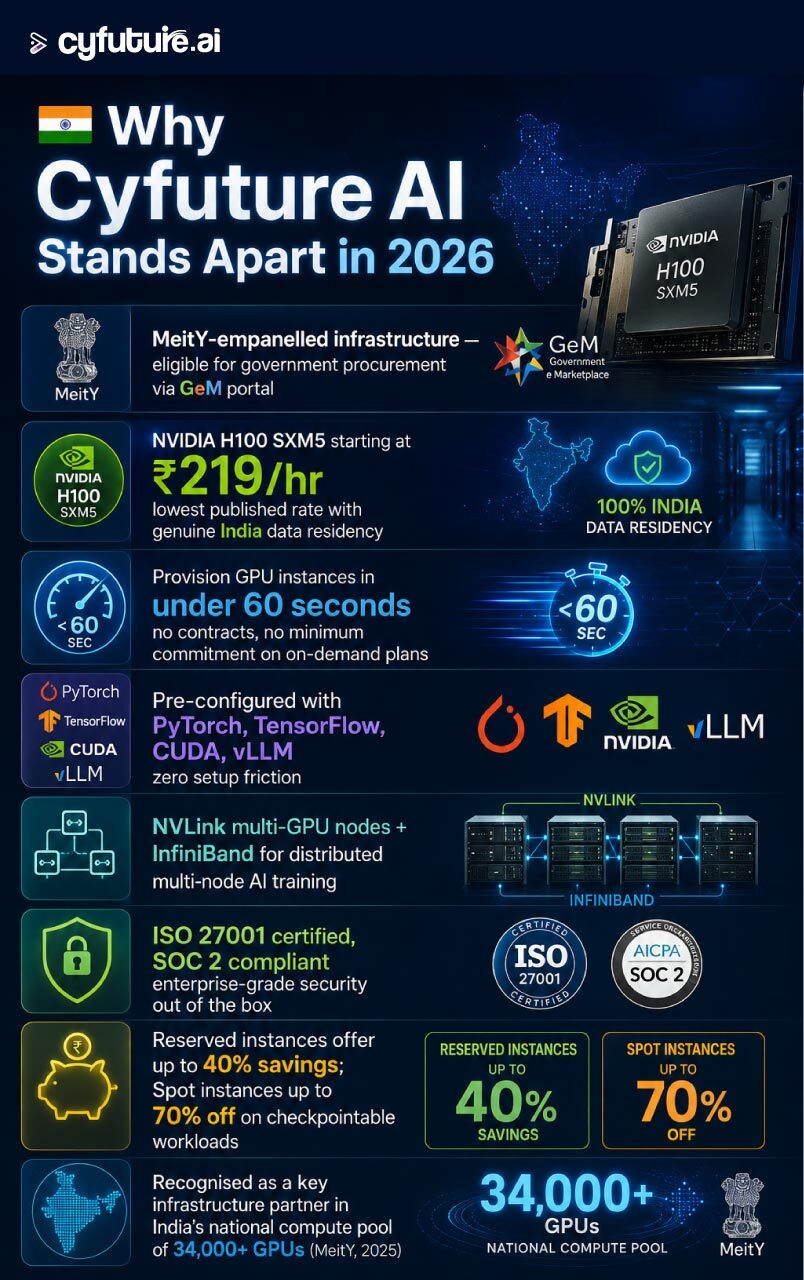
Cyfuture AI has emerged as India's leading GPU as a Service provider — the only platform that simultaneously offers enterprise-grade NVIDIA H100, A100, and L40S compute; 100% India-hosted data centers (Noida, Jaipur, Bangalore, Raipur); full DPDP Act 2023 compliance; and published INR pricing that runs 60–70% below AWS Mumbai equivalents.
The comparison to hyperscalers is stark: AWS H100 in Mumbai costs an estimated ₹600–740/hr. Cyfuture AI starts at ₹219/hr — with data that never leaves India, support that's available 24/7, and an AI ecosystem that includes fine-tuning, serverless inference, RAG AI, vector databases, and AI model libraries — all co-located in the same Indian data centers.
7. The Road Ahead: GPUaaS and AI Data Centers in 2026 and Beyond
So where does this all go from here?
Three major trends will define GPUaaS and AI data centers through 2030:
- Liquid Cooling Goes Mainstream: GPU racks now exceed 140 kW/rack (NVIDIA Blackwell density). Air cooling is physically incapable of handling this density — liquid cooling adoption is accelerating rapidly. Data centers built without liquid cooling infrastructure are already becoming obsolete for frontier AI workloads.
- Inference Displaces Training as the Primary Workload: With inference representing 80–90% of AI compute today and growing, GPUaaS providers are optimising for low-latency, high-throughput inference — not just training clusters. Serverless inference with per-second billing is the next frontier.
- Sovereign AI Mandates Drive Regional GPUaaS Growth: Asia-Pacific is projected to grow at a CAGR of 29–55% through 2031–2034. India's DPDP Act, data localisation policies, and government AI mandates will accelerate demand for India-hosted GPUaaS platforms specifically.

Bottom line
The organisations that access GPU compute most flexibly, most affordably, and most compliantly will win the AI race. GPUaaS is not a stopgap — it is the permanent infrastructure model of the AI era.
Author Bio:
Meghali is a tech-savvy content writer with expertise in AI, Cloud Computing, App Development, and Emerging Technologies. She excels at translating complex technical concepts into clear, engaging, and actionable content for developers, businesses, and tech enthusiasts. Meghali is passionate about helping readers stay informed and make the most of cutting-edge digital solutions.