


 IND
IND UAE
UAE SA
SA


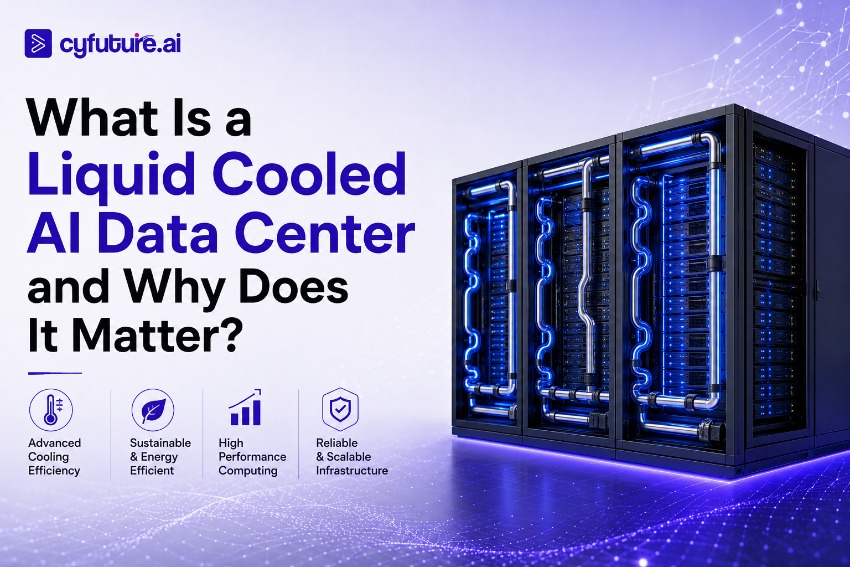
AI workloads are burning hotter than ever. Large language models, generative AI, and GPU-accelerated training are driving unprecedented power density in racks, pushing traditional cooling systems to — and beyond — their design limits. For technology leaders and infrastructure buyers, this isn’t a theoretical problem: rising temperatures reduce performance, shorten hardware life, inflate power and cooling costs, and limit the ability to scale. Enter liquid-cooled AI data centers — a practical, high-impact response that lets enterprises run denser, faster, and greener AI infrastructure.
What is a liquid cooled AI data center?
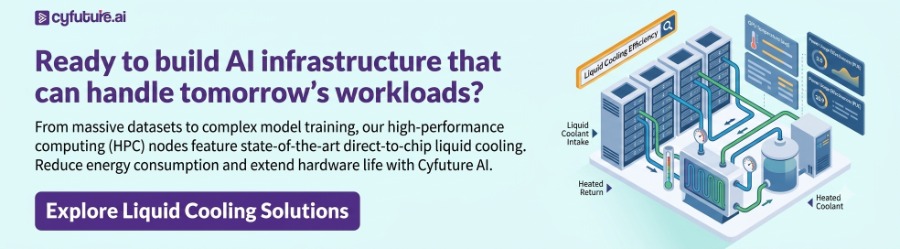
A liquid cooled AI data center uses fluids — typically dielectric coolants or water-based systems with careful electrical isolation — to remove heat directly from high-heat components (GPUs, CPUs, memory) rather than relying primarily on air moved by fans. Cooling can occur at different points: cold plates attached to processors (direct-to-chip), rear-door heat exchangers that capture exhaust heat, or immersion cooling where entire servers sit in thermally conductive dielectric liquids. All approaches move heat more efficiently than air by leveraging liquids’ higher heat capacity and thermal conductivity.
How liquid cooling differs from traditional air cooling
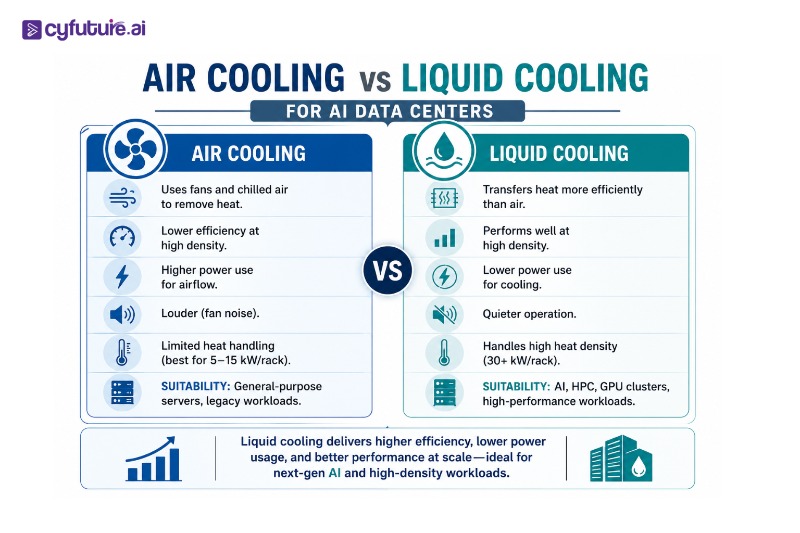
- Mechanism: Air cooling circulates chilled air with CRAC/CRAH units and fans; liquid cooling conducts heat away with fluid flow and heat exchangers.
- Efficiency: Liquids transport more heat per unit volume; they require lower flow rates and less mechanical energy to move heat.
- Density handling: Air cooling works well for moderate rack power (5–15 kW); liquid cooling is suited for high-density racks (30+ kW) common with GPU clusters.
- Noise and airflow complexity: Air-cooled facilities have high fan noise and complex hot/cold aisle containment; liquid-cooled facilities reduce fan load and simplify airflow design.
- Hardware proximity: Liquid cooling removes heat at or very near the source, minimizing thermal gradients that harm performance.
Why liquid cooling matters for AI and GPU clusters
Modern AI workloads concentrate enormous compute in compact form factors. A single high-end GPU can draw 300–600+ W under sustained load; multi-GPU servers push rack power well above what conventional air systems were designed for. The result:
- Thermal throttling: When chips hit temperature limits, they reduce clock speeds — directly cutting model throughput.
- Component stress: Persistent high junction temperatures degrade reliability, shortening MTBF and increasing replacement costs.
- Scaling barriers: To add capacity, some operators must spread workloads across more rooms, increasing footprint and operational overhead.
Liquid cooling addresses these issues by keeping temperatures lower and more uniform, enabling higher sustained performance per GPU, increasing system reliability, and allowing much greater compute density in the same footprint.
Key benefits for enterprise AI infrastructure
- Better thermal efficiency: Liquids remove heat far more efficiently than air, shrinking the cooling energy needed per kW of IT load.
- Improved performance: Lower and more stable operating temperatures reduce throttling, so GPUs sustain peak throughput during long training runs and inference spikes.
- Lower energy usage: Reduced reliance on large-volume air movement and chilled water plants cuts Power Usage Effectiveness (PUE) and operational expenses.
- Space optimization: Higher rack densities reduce floor space needs, saving real estate costs or enabling more compute in existing facilities.
- Support for next-gen hardware: As GPU memory, packaging, and power increase, liquid cooling provides a forward-compatible path for future AI accelerators.
- Sustainability gains: More efficient heat rejection and integration with heat-reuse or free-cooling systems reduce emissions tied to cooling.
Practical considerations: cost, implementation, scalability, and sustainability
- Upfront cost and ROI: Liquid-cooled systems typically involve higher initial CAPEX (cold-plate hardware, piping, heat-exchange systems, immersion tanks). However, total cost of ownership often becomes favorable within 2–5 years for dense AI deployments because of lower energy bills, reduced facility upgrades, and higher rack utilization. ROI models should account for increased compute-per-floor-area and extended hardware lifecycles.
- Implementation complexity: Direct-to-chip and immersion systems require planning across IT, facilities, and procurement. Integration steps include retrofitting or selecting compatible chassis, plumbing and leak-detection design, and establishing fluid-handling procedures. That said, modular liquid solutions are increasingly vendor-supported and designed for enterprise datacenter operations.
- Operations and maintenance: Staff need training for fluid systems, filtration, and leak mitigation. Immersion solutions reduce moving parts (fewer fans), potentially lowering routine maintenance. Monitoring and telemetry for coolant flow, temperature differentials, and pump health become operational priorities.
- Scalability: Liquid cooling scales horizontally by adding more liquid-cooled racks and vertically by increasing rack density. Modern designs support incremental deployment so organizations can start with hot spots (GPU clusters) and expand.
- Sustainability and heat reuse: Waste heat from liquid systems is easier to capture for secondary uses (building heating, absorption chillers) because it’s higher-grade and more concentrated than dispersed hot air, improving opportunities for heat recovery and lowering overall carbon footprint.
Examples and use cases
- Training clusters: Large-scale model training benefits directly from liquid cooling’s sustained thermal control, reducing iteration time and cloud-like performance consistency in private data centers.
- Inference densification: Edge or colocation sites requiring high inference throughput in compact footprints can deploy immersion or direct-to-chip racks to achieve low-latency, high-density inference at scale.
- HPC and scientific computing: Research centers that run prolonged Monte Carlo or simulation workloads gain performance stability and reduced waste heat dispersion with liquid cooling.
- Cloud/GPU-as-a-Service providers: Offering denser GPU tenancy with lower PUE improves margins and lets providers offer more performant SLAs.
Future outlook: enabling the next wave of AI growth
Liquid cooling is a foundational technology for the next wave of AI. As chip vendors push power envelopes and interconnect bandwidth increases, thermal management will be a gating factor for performance. Liquid cooling enables:
- Continued scaling of model size and distributed training without exponentially expanding footprint or power infrastructure.
- More efficient edge and regional compute nodes that bring AI inference closer to users.
- Integration with renewable power and heat-reuse systems to improve sustainability metrics for AI workloads.
- New hardware form factors (chiplets, 3D-stacked ICs) that will demand advanced heat extraction methods — a space where liquid cooling is well suited.
Why partner with Cyfuture AI
Cyfuture AI combines deep infrastructure expertise with practical deployment experience to help enterprises transition to liquid-cooled, AI-ready data centers. We provide:
- End-to-end assessments: density mapping, workload profiling, and ROI modelling tailored to your AI roadmap.
- Modular implementation: phased deployments that de-risk upgrades and let you realize benefits early in targeted clusters.
- Operational enablement: staff training, monitoring integration, and maintenance plans aligned with enterprise SLAs.
- Sustainability guidance: strategies for heat reuse, PUE reduction, and carbon accounting that align with corporate ESG goals.

Conclusion
AI’s compute evolution is rewriting the rules for data center design. Air cooling reached its practical limits when confronted with the power density of modern GPUs and AI accelerators. Liquid cooling delivers the thermal control, energy efficiency, and density that enterprise AI workloads demand — enabling higher performance, lower operational costs, and more sustainable growth. For CIOs and CTOs planning AI infrastructure, readiness means evaluating liquid-cooled architectures now, then partnering with experienced providers like Cyfuture AI to implement phased, scalable solutions. Make the investment in cooling today — it will unlock the compute capacity and reliability your long‑term AI strategy requires.
Author Bio:
Meghali is a tech-savvy content writer with expertise in AI, Cloud Computing, App Development, and Emerging Technologies. She excels at translating complex technical concepts into clear, engaging, and actionable content for developers, businesses, and tech enthusiasts. Meghali is passionate about helping readers stay informed and make the most of cutting-edge digital solutions