



 IND
IND UAE
UAE SA
SA


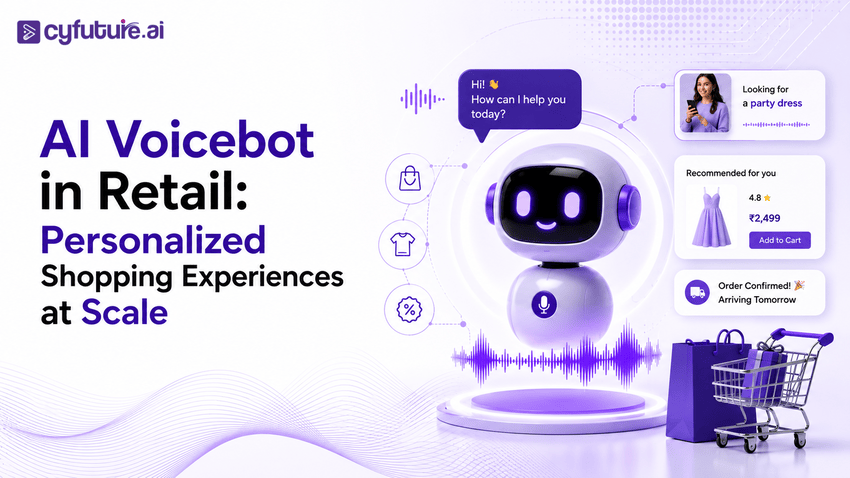
Retail in 2026 is no longer just about products, discounts, or omnichannel experiences. It is about conversations. Customers now expect brands to understand intent instantly, recommend products intelligently, and provide support without delays. And here’s the catch — they expect this experience at scale.
That is exactly where AI voicebots are reshaping the retail ecosystem.
From personalized product discovery to multilingual customer support, AI-powered voice agents are helping retailers reduce friction across the buyer journey. In fact, conversational AI has moved beyond experimental pilots and entered mainstream retail operations.
According to recent industry research, 91% of retail and ecommerce brands are either deploying or piloting AI solutions in 2026. Meanwhile, the global conversational AI market is projected to grow from USD 17.97 billion in 2026 to over USD 82 billion by 2034.
So, what makes AI voicebots such a strategic asset for retailers?
Let’s dive in.
Definition Box
|
What is AI Voicebot? An AI-powered conversational system that uses speech recognition, natural language processing (NLP), and machine learning to interact with users through human-like voice conversations. In retail, AI voicebots assist customers with product discovery, order tracking, recommendations, returns, and support operations. |
Why Retailers Are Investing Heavily in AI Voicebots
Traditional customer support models simply cannot keep up with modern retail demand. Peak shopping seasons, multilingual customers, rising operational costs, and 24/7 engagement expectations are pushing enterprises toward automation.
But wait — this is not just about cost savings anymore.
Retailers are now using AI voicebots to create emotionally intelligent and highly contextual shopping experiences.
Read More: AI Voicebot for Call Centers: Benefits + ROI
Key Drivers Behind Adoption
- 24/7 customer interaction capabilities
- Hyper-personalized shopping recommendations
- Reduced call center workload
- Faster order resolution
- Voice commerce integration
- Multilingual customer engagement
- Omnichannel retail support
According to retail AI studies published in 2026:
- 89% of retailers are actively using or testing AI technologies.
- 96% of conversational-AI-enabled brands use AI for customer support automation.
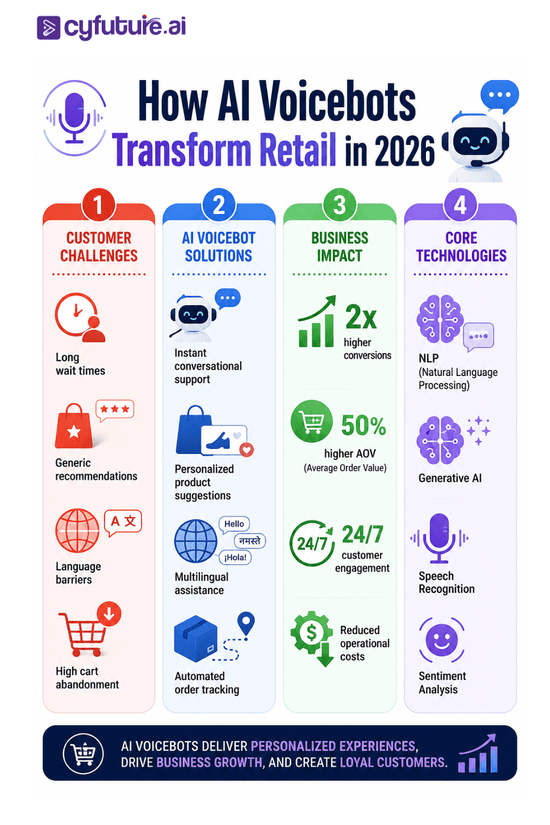
- AI-driven personalization can deliver up to 2x conversion uplift and 50% higher average order value (AOV).
Now here’s where things get interesting…
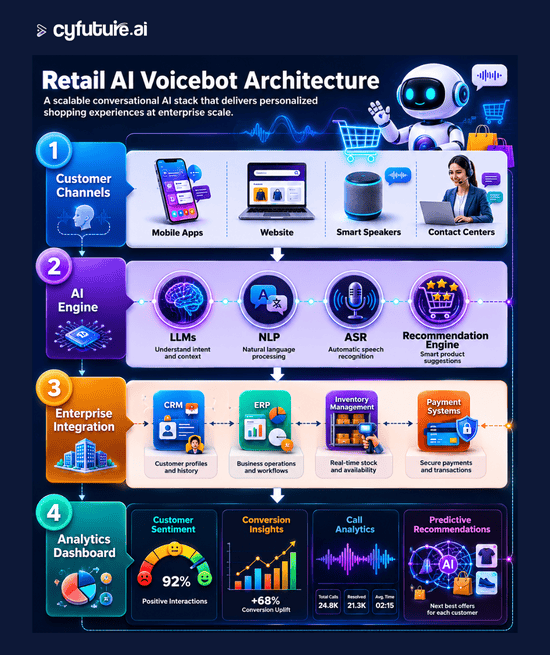
Voicebots are no longer rule-based IVR systems. Modern AI voice agents leverage:
- Large Language Models (LLMs)
- Retrieval-Augmented Generation (RAG)
- Speech-to-Text (STT)
- Text-to-Speech (TTS)
- Sentiment analysis
- Real-time recommendation engines
This enables retailers to deliver dynamic, human-like interactions.
How AI Voicebots Personalize Retail Experiences
1. Intelligent Product Recommendations
AI voicebots analyze:
- Purchase history
- Browsing patterns
- Customer preferences
- Cart activity
- Seasonal trends
The result?
Highly relevant recommendations delivered conversationally.
For example:
“Based on your previous skincare purchases, would you like to explore dermatologist-recommended SPF products currently on discount?”
That feels personal — because it is.
2. Voice Commerce and Hands-Free Shopping
Voice commerce is becoming a major retail channel in 2026.
Customers can:
- Search products
- Compare features
- Place orders
- Track shipments
- Initiate returns
— entirely through voice interactions.
This is particularly impactful for:
- Mobile-first consumers
- Accessibility-focused retail
- Smart device ecosystems
- Quick commerce platforms
3. Real-Time Multilingual Support
Global retailers often struggle with multilingual customer operations.
AI voicebots solve this challenge through:
- Real-time translation
- Accent recognition
- Natural language understanding
- Regional language adaptation
And that matters because customer experience directly influences retention.
According to industry benchmarks, 71% of consumers are more likely to repurchase from brands delivering personalized experiences.
Core Technologies Behind Retail AI Voicebots
|
Technology |
Role in Retail Voicebots |
|
NLP (Natural Language Processing) |
Understands customer intent |
|
ASR (Automatic Speech Recognition) |
Converts speech into text |
|
TTS (Text-to-Speech) |
Generates human-like voice responses |
|
Machine Learning |
Learns from customer interactions |
|
Generative AI |
Produces contextual conversations |
|
RAG Architecture |
Retrieves accurate business data in real time |
|
Sentiment Analysis |
Detects customer emotions |
Enterprise Benefits of AI Voicebots in Retail
Faster Customer Resolution
AI voicebots reduce average handling time by automating repetitive queries.
Scalable Peak Season Support
Retailers can manage massive festive traffic without increasing support headcount.
Cost Optimization
Conversational AI reduces operational costs while improving response consistency.
Omnichannel Continuity
Voicebots integrate across:
- Websites
- Apps
- Contact centers
- Smart speakers
- POS systems
Better Data Intelligence
Every interaction becomes a source of customer insight.
Challenges Retailers Must Solve
Of course, deployment is not plug-and-play.
Retail enterprises still face:
- AI hallucination risks
- Data privacy concerns
- Integration complexity
- Voice authentication security
- Model governance requirements
That is why enterprise-grade AI infrastructure matters.
And this is where solutions providers like Cyfuture AI are helping businesses scale securely.
How Cyfuture AI Supports Intelligent Retail Automation
Cyfuture AI provides enterprise-ready AI infrastructure and conversational AI capabilities designed for high-scale digital transformation.
Key strengths include:
- Scalable GPU-backed AI infrastructure
- Low-latency AI deployment environments
- Enterprise-grade cloud ecosystem
- AI model hosting and optimization
- High-availability architecture for real-time retail workloads
Cyfuture AI’s cloud-native ecosystem helps enterprises deploy AI voicebots capable of handling thousands of concurrent retail interactions with reduced latency and improved conversational accuracy.
And here’s the bottom line…
Retail personalization at scale is impossible without intelligent automation.
AI voicebots are becoming the operating layer of next-generation customer engagement.
Also Check: AI Voicebot Pricing (2026): Real Costs, Models & What Businesses Actually Pay
The Future of AI Voicebots in Retail
The next evolution of retail AI will include:
- Emotion-aware voice commerce
- Agentic AI shopping assistants
- Predictive conversational selling
- AI-powered in-store kiosks
- Autonomous customer service orchestration
Gartner predicts conversational AI will manage more than 50% of enterprise customer interactions by 2027.
The shift is already underway.
Retailers that adopt AI voicebots early will gain:
- Better customer loyalty
- Faster operational efficiency
- Higher conversion rates
- Scalable personalization
And in a hypercompetitive market, that advantage matters.
Conclusion
AI voicebots are fundamentally transforming retail engagement in 2026. What started as basic customer support automation has evolved into intelligent, real-time, personalized shopping assistance.
From product discovery and multilingual engagement to voice commerce and predictive recommendations, AI voicebots are helping retailers create seamless customer journeys at enterprise scale.
For organizations looking to modernize customer experience, improve operational agility, and unlock AI-driven retail intelligence, conversational voice AI is no longer optional — it is strategic infrastructure.
Author Bio:
Meghali is a tech-savvy content writer with expertise in AI, Cloud Computing, App Development, and Emerging Technologies. She excels at translating complex technical concepts into clear, engaging, and actionable content for developers, businesses, and tech enthusiasts. Meghali is passionate about helping readers stay informed and make the most of cutting-edge digital solutions.