

 IND
IND UAE
UAE SA
SA


The Multimodal Compute Shift
Multimodal AI is changing the economics of AI infrastructure. The workloads enterprises ran in 2023 — a text-only LLM behind a chat interface — bear almost no resemblance to what production AI looks like in 2026. Today's models read a clinical image while parsing a radiology report. They watch a surveillance feed while transcribing the audio inside it. They take a customer's photo of a damaged product and write the claim narrative.
This shift breaks a lot of the planning assumptions infrastructure teams brought from the single-modality era. Memory budgets that worked fine for 4K-token text inputs collapse the first time a model has to encode a 1080p video clip. Inference servers tuned for predictable token streams behave erratically when half the requests carry a 2,048-token vision payload and the other half don't.
The hardware hasn't failed enterprise AI here — most teams just inherited an inference stack designed for a workload class that no longer exists. GPU cloud is the layer that absorbs that mismatch: it gives architecture teams access to the memory, bandwidth, and interconnect topology that multimodal models actually require, without the multi-million-dollar capital commitment that comes with owning Blackwell-class hardware.
What Is Multimodal AI?
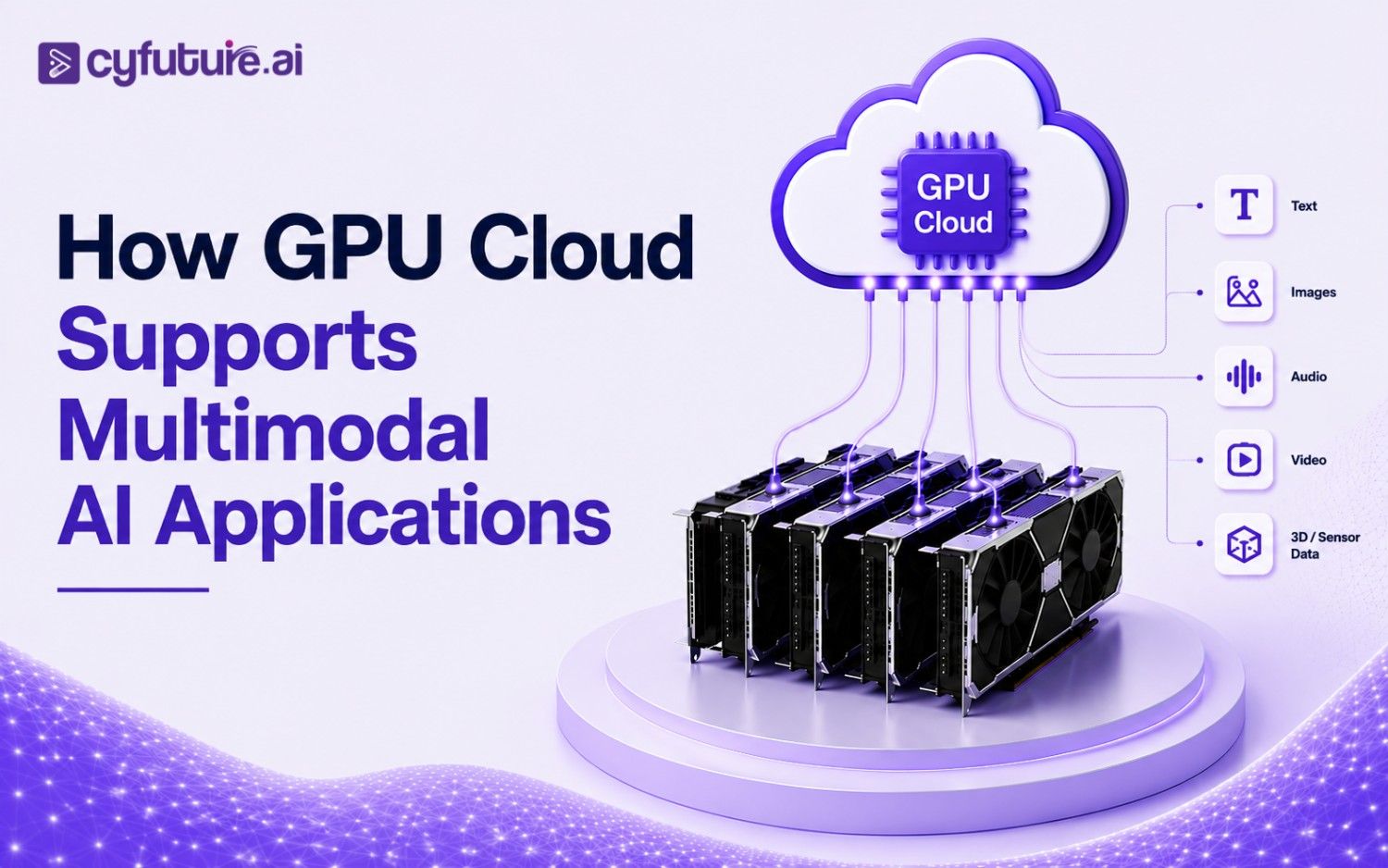
Multimodal AI refers to systems that process and reason across multiple data modalities — text, images, video, audio, and structured signals — within a single unified model or coordinated pipeline. Unlike single-modality systems that handle one input type at a time, multimodal models build joint representations across modalities, enabling tasks like visual question answering, video understanding, speech-grounded reasoning, and sensor fusion.
The shift from single-modality to multimodal isn't an upgrade — it's a different problem. A text-only LLM operates on a stream of tokens. A multimodal model has to first translate every input into that token space, which means running modality-specific encoders (a Vision Transformer for images, Whisper-class models for audio, frame-sampling networks for video) before the language backbone ever sees the request.
Each encoder produces its own tokens, with its own memory and compute footprint. A single high-resolution image can produce thousands of vision tokens. A minute of video, hundreds of thousands. The unified transformer then has to attend across all of them in the same context window as the user's text.
The Practical Categories Enterprise Teams Deploy
- Text + Image (Vision-Language Models) — the dominant production class. Models like GPT-4o, Claude, Gemini, Qwen-VL, and InternVL handle visual question answering, document understanding, OCR, and multimodal RAG. The infrastructure profile most enterprise AI teams will encounter first.
- Audio + Text (Speech-Language) — voice-driven AI assistants, real-time transcription with semantic understanding, call-center analytics. Latency-sensitive, often running alongside ASR pipelines on the same GPU pool.
- Video Understanding — temporal reasoning over frame sequences. Surveillance analytics, content moderation, sports analytics, manufacturing QA. The most memory-hungry profile, since context grows with both spatial resolution and clip duration.
- Sensor Fusion — LIDAR, radar, camera, and telemetry combined for autonomous systems, robotics, and industrial monitoring. Real-time constraints dominate the infrastructure conversation.
- Multimodal Reasoning Agents — agentic systems that take a screenshot, parse a document, transcribe a voice note, and act on all three within a single decision loop. The fastest-growing category and the one that exposes GPU memory limits most quickly.
Native multimodal models (a single transformer trained on mixed modalities) and composed pipelines (separate models stitched together with orchestration) are not the same workload. Native models concentrate memory pressure on one GPU pool. Composed pipelines spread it across several. The infrastructure choice differs accordingly.
Why Multimodal AI Is Computationally Expensive
Multimodal AI is expensive to run because every additional modality multiplies the parallel tensor operations the model must execute per request, while inflating the KV cache that the GPU's HBM memory has to hold throughout inference. The bottleneck is rarely raw FLOPS — it is memory bandwidth and capacity at sustained utilization.
If you've only deployed text-only LLMs, the first multimodal model you put in production will surprise you. Throughput drops. Tail latency stretches. GPU memory utilization sits at 90%+ on requests that should have headroom. The reasons are architectural, not configuration.
Simultaneous Modality Processing
Each input modality runs through its own encoder before the joint reasoning step. These encoders are themselves substantial models — a ViT-Large is ~300M parameters, Whisper-Large is ~1.5B, and video encoders frequently exceed both. The GPU is now hosting multiple models in memory, not one, and they all need to execute on overlapping batches.
Memory Bandwidth Is the Real Constraint
Tensor cores are fast enough that, for most multimodal workloads, the GPU spends meaningful time waiting on memory rather than compute. The H100's 3.35 TB/s HBM3 bandwidth and the H200's 4.8 TB/s HBM3e bandwidth exist precisely because feeding the tensor cores is harder than keeping them busy. Multimodal inference makes this worse: every additional modality pulls more data through the same memory pipe.
Long Context Compounds Everything
Vision-language models routinely operate at 32K, 128K, or longer context windows because a single high-resolution image easily contributes 2,000+ tokens, and a 1-minute video clip pushes past that order of magnitude. KV cache memory scales linearly with sequence length and model size — a 70B model at 128K context can require 40GB+ of KV cache per concurrent request before you've allocated anything for weights or activations.
Parallel Compute Demands Sustained Utilization
Production multimodal inference is not bursty in a way that's easy to schedule. Encoders and decoder backbones contend for the same tensor cores. Batched requests must align across modalities, or one slow vision encode stalls a batch of fast text queries. Keeping a GPU at high sustained utilization without latency degradation requires more aggressive batching, KV cache management, and dynamic scheduling than text-only inference ever needed.
Teams provision multimodal inference based on weight footprint alone — forgetting KV cache scales with both context length and batch size. A 70B model that "fits" on an 80GB GPU at single-request inference will OOM at production concurrency once vision tokens enter the mix. Capacity planning has to model KV cache, not just weights.
How GPU Cloud Enables Multimodal AI
GPU cloud isn't just remote GPUs. The reason it works for multimodal AI is that the surrounding infrastructure — interconnects, cooling, storage, provisioning — is engineered for the workload class, not retrofitted to it. Six layers matter operationally.
Tensor Cores
Modality encoders and the transformer backbone are both dominated by matrix multiplications. Hopper-generation tensor cores (FP8, BF16, TF32) and Blackwell-generation tensor cores (with native FP4 and second-gen Transformer Engine) execute these in hardware at throughput that CPUs and even prior-generation GPUs can't approach. FP8 in particular doubles effective throughput for multimodal inference workloads where the precision budget is forgiving.
High-Speed Interconnects
Native multimodal models with 70B+ parameters don't fit on a single GPU. Tensor-parallel sharding requires every forward pass to exchange activations between GPUs — within the node over NVLink, between nodes over InfiniBand. NVLink 4.0 (H100) provides 900 GB/s GPU-to-GPU bandwidth; NVLink 5.0 (B200) provides 1.8 TB/s. The interconnect is what makes sharded multimodal inference economically viable. Underprovision it and the GPUs sit idle waiting for activations.
Multi-GPU Scaling
Production multimodal inference rarely runs on one GPU. A common pattern is to pin the vision encoder on one GPU, the language decoder on another, and pipeline-parallel the longer backbone across multiple. GPU clusters exist because this scaling pattern is the rule, not the exception — and clusters need the orchestration, fabric, and storage to support it without becoming the bottleneck themselves.
Advanced Cooling
An H100 SXM5 draws 700W. A B200 SXM draws ~1000W. Eight of either in a single chassis pushes per-rack power past anything air cooling can dissipate economically. Production multimodal AI at scale runs in liquid-cooled facilities — direct-to-chip or immersion — because the thermal density of these systems leaves no other option. Cloud GPU providers absorb this engineering cost so enterprise teams don't have to.
Flexible GPU Provisioning
Multimodal workloads are heterogeneous. Training needs a different GPU profile than inference. Encoding a video batch needs a different profile than serving real-time vision-language requests. Cloud lets teams switch between profiles by API rather than by procurement cycle. GPU-as-a-Service exists precisely because this elasticity is the dominant economic argument for cloud over on-prem for AI workloads.
NVLink and InfiniBand
Two interconnects, two roles. NVLink handles GPU-to-GPU communication within a node — the high-bandwidth, low-latency path that makes tensor-parallel inference work. InfiniBand NDR (400 Gbps) or HDR (200 Gbps) handles node-to-node communication for training jobs that span multiple servers. The combination is what allows a multimodal model larger than a single node to train without the network becoming the rate-limiter.
Tensor Cores + FP8
Hopper FP8 doubles effective throughput over BF16 for multimodal inference. Blackwell FP4 doubles it again where precision allows. The hardware accommodates the precision-throughput trade-off without code rewrites — the inference runtime exposes the option.
NVLink Domain
8-GPU NVLink domains let a sharded multimodal model treat 8 H100s as a single logical accelerator with ~640GB aggregate HBM. This is what makes 70B–200B multimodal inference economically tractable — the interconnect, not the per-GPU memory.
Liquid Cooling
30–60 kW per rack is the new normal for production AI infrastructure. Air cooling is no longer economically competitive at this density. Cloud providers operating purpose-built liquid-cooled facilities absorb the capital cost of this transition.
MIG Partitioning
Multi-Instance GPU partitions an A100 or H100 into up to 7 isolated slices. For multi-tenant multimodal serving where each request fits a smaller GPU profile, MIG turns one physical GPU into multiple billable inference endpoints — a foundational cost lever.
Parallel Storage
Multimodal training jobs load thousands of images, audio clips, and video frames per second. Parallel file systems (GPFS, Lustre, WEKA) deliver the IO that keeps GPUs at high utilization. Without them, GPUs starve on data loading and effective utilization drops below 50%.
Elastic Provisioning
Training bursts and inference baselines have different shapes. Cloud lets teams allocate a 256-GPU training cluster for a week, then return to a steady-state inference fleet — a procurement pattern that on-prem capex cannot match for irregular workloads.
Real-World Multimodal AI Applications
The cleanest way to understand the infrastructure implications of multimodal AI is to look at four production workload classes that already run on enterprise GPU cloud — and trace what each one demands from the hardware.
Healthcare
Radiology, Pathology, Clinical Decision Support
Workload: A vision-language model reads a chest X-ray or DICOM volume while simultaneously parsing the patient's clinical notes and prior reports. The output is a structured finding plus a draft report. Technical requirement: high-resolution medical imagery produces thousands of vision tokens per study; volumetric data (CT, MRI) pushes this 10× higher. Infrastructure implication: H100 SXM5 or H200-class GPUs with sufficient HBM headroom for KV cache. Strict data residency — Indian healthcare data cannot legally cross borders for processing — which makes India-hosted GPU cloud the only compliant deployment path. ISO 27001 and HIPAA-equivalent controls are non-negotiable.
Retail
Visual Search, Catalog Understanding, Conversational Commerce
Workload: A customer uploads a photo and asks a chatbot to find similar products. The model embeds the image, retrieves candidates from a vector store, and grounds its response in product data — all within a 500ms latency budget. Technical requirement: high-throughput, low-latency multimodal inference at variable batch sizes, often with traffic spikes during sale events. Infrastructure implication: H100 inference fleets with MIG partitioning for cost efficiency, dynamic batching, and inference-as-a-service patterns that auto-scale. The cost ceiling is set by per-query economics — a workload where elastic GPU cloud beats fixed-capacity on-prem by a wide margin.
Automotive
ADAS, Sensor Fusion, Driver Monitoring
Workload: Camera, LIDAR, radar, and telemetry data are fused for object detection, scene understanding, and decision-making — typically with both an edge-deployed component for real-time inference and a cloud-deployed component for fleet learning. Technical requirement: training on petabyte-scale sensor logs at sustained GPU utilization, plus simulation environments for validation. Infrastructure implication: large multi-node training clusters with InfiniBand NDR fabric, parallel storage saturating GPU input pipelines, and checkpoint capacity for model iteration cycles. Cloud GPU clusters are the practical training environment; edge runtime is a separate hardware stack.
Financial Services
Document Intelligence, KYC, Fraud Analysis
Workload: A multimodal model reads scanned KYC documents (Aadhaar, PAN, utility bills), extracts structured fields, cross-checks against application data, and flags inconsistencies. Fraud teams use the same models to read screenshots, chat logs, and transaction records jointly. Technical requirement: high-volume, low-latency inference on documents of variable quality, with strict audit logging and data residency. Infrastructure implication: India-hosted GPU cloud (DPDP Act compliance), SOC 2 controls, and inference orchestration that supports per-tenant isolation. For BFSI workloads, the deployment location is as much a hardware decision as the GPU SKU is.
GPU Architecture for Multimodal AI
Picking the GPU comes down to one question: what's the memory envelope of your worst-case multimodal request, and what's the latency budget around it? Everything else — FLOPS, NVLink topology, software stack — follows from that.
H100 — The Production Standard
For most enterprise multimodal AI in 2026, H100 SXM5 is still the right answer. 80GB HBM3 at 3.35 TB/s handles 7B–70B vision-language models at production batch sizes with reasonable concurrency. NVLink 4.0 in 8-GPU domains gives 640GB aggregate memory for sharded inference. The software stack (TensorRT-LLM, vLLM, SGLang) is fully mature on Hopper. The economic case is strongest here: H100 inference per query costs significantly less than B200 inference for workloads that don't need the latter's memory headroom.
H200 — For Long-Context Vision-Language
The H200 is the same Hopper compute architecture as the H100 with HBM3e memory replacing HBM3 — 141GB at 4.8 TB/s. For multimodal workloads, this is the practically useful upgrade: KV cache budget grows 76% per GPU, which directly translates into either longer context, larger batches, or both, without changing the rest of the deployment. H200 is the right answer when your H100 deployment is memory-bound rather than compute-bound — a profile increasingly common in multimodal inference.
B200 and Blackwell-Class
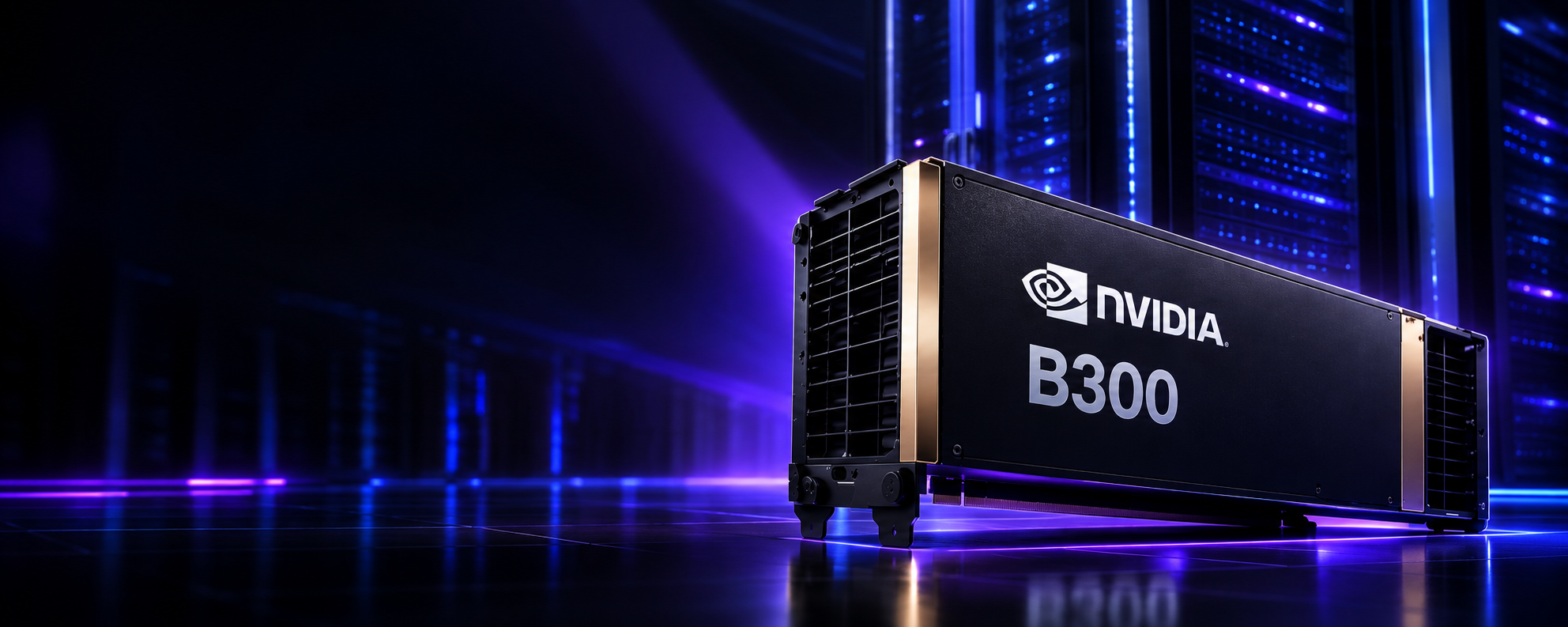
B200 SXM ships with 192GB HBM3e at ~8 TB/s and NVLink 5.0 at 1.8 TB/s — designed for frontier training and very large multimodal inference where H100/H200 memory limits force complex sharding. For most enterprise multimodal teams in India, the B200 conversation in 2026 is mostly a 2026–2027 planning conversation: allocation goes to hyperscalers first, and the operational complexity of Blackwell-class infrastructure isn't justified for workloads that run comfortably on H100/H200.
Pick GPUs by memory profile, not by FLOPS. A 7B–13B vision-language model: A100 80GB or H100. A 70B-class model with long context: H100 in NVLink domain, or H200 single GPU. Long-context video reasoning or 100B+ multimodal: H200 or B200 — when available. Match the GPU to the worst-case request you actually serve.
Production Deployment Architecture
The architecture that takes a multimodal model from notebook to production has more in common across deployments than first-time teams expect. The hard parts are not novel — they are well-understood. The risk is skipping them.
Model Architecture Selection
Decide between native multimodal (single transformer trained on mixed modalities — Qwen-VL, InternVL, Llama 3.2 Vision) and composed pipelines (vision encoder + LLM stitched with orchestration). Native simplifies inference and improves quality but constrains model choice. Composed is more flexible but operationally heavier. The choice locks in the GPU profile downstream.
GPU Provisioning
Size for the worst-case request, not the average. Worst case = max context length × max batch size × KV cache per token + weight footprint + activation overhead. If the worst case overflows a single GPU, plan tensor parallelism inside an NVLink domain. For training workloads, separate the training pool from the inference pool — they have incompatible utilization patterns.
Distributed Training
Multimodal training above 7B parameters typically requires tensor parallelism (within node) + data parallelism (across nodes). FSDP and DeepSpeed ZeRO-3 are the standard frameworks. The interconnect must match: InfiniBand NDR (400 Gbps) for clusters above 16 GPUs; HDR (200 Gbps) acceptable below. Underprovisioned fabric makes the cluster slower than a single node at large scales.
Inference Deployment
Use a production inference engine — TensorRT-LLM, vLLM, or SGLang — that supports multimodal models, continuous batching, and PagedAttention. Bare PyTorch serving will leave 60–80% of GPU throughput unrealized. Inferencing-as-a-Service packages these engines with autoscaling and observability so teams don't rebuild the runtime.
Orchestration
Kubernetes with the NVIDIA GPU Operator is the dominant orchestration substrate. Add Triton Inference Server for multi-model serving, KServe for declarative deployments, and Prometheus + DCGM exporters for GPU-level observability. Without GPU metrics — utilization, HBM usage, NVLink throughput — capacity planning becomes guessing.
Batching
Continuous (in-flight) batching with paged KV cache is non-negotiable for multimodal inference. Static batching wastes GPU on requests with variable encode times. PagedAttention and similar techniques allow the engine to interleave decode steps across requests with different sequence lengths — the difference between 30% and 80% sustained GPU utilization at production load.
Quantization
FP8 (Hopper) and FP4 (Blackwell) quantization halves and quarters the memory footprint of weights with minimal quality loss for most vision-language workloads. Calibration matters more for multimodal than text-only — modality encoders can be more sensitive to precision loss than the language backbone. Quantize, then evaluate on the actual production task distribution, not generic benchmarks.
Match your multimodal AI workload to the right GPU profile.
Vision-language inference, video understanding, and sensor-fused agents have meaningfully different memory and interconnect requirements. Discuss the GPU architecture options for your specific multimodal AI deployment with Cyfuture AI — India-hosted, DPDP-compliant H100 and A100 infrastructure available today.
Cost Optimization Strategies
Multimodal inference is expensive not because GPUs are expensive — they always have been — but because the workload pattern wastes GPU cycles in ways text-only inference did not. Four levers move the cost curve materially.
Spot GPU Instances
For training, fine-tuning, batch embedding, and offline video annotation — anything that's interruptible and checkpoint-able — spot GPU pricing is typically 40–70% lower than on-demand. The discipline required is checkpoint frequency and a job runner that handles preemption gracefully. For inference, spot is rarely appropriate; the predictability isn't worth the savings at production SLA.
MIG Partitioning
Multi-Instance GPU lets a single A100 80GB or H100 SXM5 be carved into up to seven hardware-isolated slices, each with its own memory and SM allocation. For multi-tenant multimodal serving where individual requests fit a 10GB or 20GB profile, MIG turns one physical GPU into multiple billable endpoints — a 3–5× cost lever for the right workload class. MIG is not appropriate for models that need the whole GPU; the trade-off is concrete.
Hybrid Cloud Architecture
Training bursts and inference baselines have opposite cost profiles. A common production pattern: train on cloud GPU clusters during model development cycles (high burst utilization), then deploy steady-state inference on a smaller reserved fleet (predictable cost). Some teams keep edge inference on-prem for latency-critical paths and burst to cloud for capacity. The hybrid model only works when the cloud provider's billing granularity matches the workload pattern.
Right-Sizing GPU Selection
The most expensive deployment mistake in multimodal AI is over-provisioning the GPU. A 7B vision-language model running on H100 SXM5 when an A100 40GB would have served the workload represents a 2–3× per-query cost premium for no quality benefit. Right-sizing requires actually profiling the worst-case request — context length, vision tokens, batch size — and selecting the smallest GPU that absorbs that envelope with reasonable headroom.
Per-query cost is set by sustained GPU utilization more than by GPU SKU. A B200 at 30% utilization costs more per query than an H100 at 80% utilization. Continuous batching, KV cache reuse, and right-sized routing matter more than picking the newest hardware.
Performance Benchmarks
Benchmark numbers are useful as relative anchors, not absolute commitments. The figures below are drawn from published NVIDIA datasheets and reflect order-of-magnitude differences between GPU generations on representative multimodal workloads. Real-world performance depends heavily on model architecture, batch size, sequence length, and inference engine — production deployments should be profiled directly.
Training Performance (Relative, BF16/FP8)
| GPU | BF16 Tensor TFLOPS | FP8 Tensor TFLOPS | Relative Training Throughput |
|---|---|---|---|
| A100 SXM4 (80GB) | 312 | — | 1.0× Baseline |
| H100 SXM5 (80GB) | 989 | 1,979 | ~3.2× BF16 / ~6× FP8 |
| H200 SXM (141GB) | 989 | 1,979 | Same as H100 + memory headroom |
| B200 SXM (192GB) | ~2,250 | ~4,500 | ~2× over H100 |
Inference Latency Profile
| Workload | Recommended GPU | Typical TTFT | Concurrency Pattern |
|---|---|---|---|
| 7B vision-language, single image | A100 / H100 | 200–500 ms | High concurrency, MIG-friendly |
| 70B VLM, document understanding | H100 / H200 | 500 ms–1.5 s | Continuous batching essential |
| Video reasoning, 1-min clip | H200 / B200 | 1–4 s | Memory-bound, low batch |
| Long-context multimodal agent | H200 / B200 | 1–3 s + tokens | KV cache reuse critical |
Scaling Efficiency Across GPUs
Linear scaling beyond a single node is the exception, not the rule, for multimodal training. With well-configured NVLink + InfiniBand NDR and frameworks like FSDP or DeepSpeed ZeRO-3, real-world scaling efficiency on multimodal training typically ranges from 85–92% per doubling up to ~64 GPUs, falling off as cluster size grows. The drop is dominated by cross-node activation exchange — the same constraint that makes interconnect bandwidth the deciding factor at cluster scale.
Peak FLOPS numbers from datasheets are theoretical maxima. Sustained throughput on real multimodal workloads is typically 40–65% of peak after accounting for memory-bound segments, batch construction overhead, and inter-modality synchronization. Compare GPUs at sustained throughput, not at the cover page.
Emerging Trends
Five shifts will shape multimodal AI infrastructure decisions over the next 18 months. None of them are speculative — all are visible in production roadmaps today.
Unified Multimodal Transformers
The composed-pipeline pattern (separate encoders bolted onto an LLM) is giving way to natively multimodal transformers trained on mixed-modality data from initialization. Gemini, GPT-4o, and Qwen-VL2.5 are early examples; open-weight equivalents are converging on the same architecture. The infrastructure impact: memory pressure consolidates onto one GPU pool, simplifying serving but raising per-GPU memory requirements. Expect more workloads that genuinely need H200 / B200 memory profiles.
Real-Time Multimodal Inference
Voice-driven assistants with visual grounding, live video understanding, and real-time agent loops are pushing latency budgets toward 200–400ms end-to-end. This requires not just faster GPUs but careful pipeline engineering — speculative decoding, KV cache prefetching, and pre-warmed model replicas. The infrastructure implication is more inference replicas at lower per-replica utilization, which makes MIG partitioning and right-sizing more economically important, not less.
Edge AI Integration
Multimodal inference at the edge — on Jetson, mobile NPUs, or in-vehicle accelerators — is moving from prototype to deployment in automotive, industrial, and retail use cases. The cloud half doesn't go away: edge devices run distilled, quantized models, while the cloud runs the larger reference models, retraining pipelines, and fleet learning. Hybrid edge-cloud is the architecture, not edge-only.
AI Agents and Tool Use
Agentic systems that plan, call tools, and act over multi-step horizons combine long-context reasoning with multimodal inputs (screenshots, documents, audio). Each agent step incurs a multimodal inference call, and sessions can run minutes long with persistent state. The GPU memory profile is dominated by KV cache, not weights — an environment where the H200 and B200 memory advantages compound over the H100.
Multimodal Reasoning Systems
Reasoning-trained models (the "thinking" model class) extended to multimodal inputs add another dimension: inference compute scales with reasoning length, not just input length. A multimodal reasoning request can spend 30–120 seconds of GPU time before producing a final answer. Serving these at concurrency requires aggressive batching of reasoning streams, which most current inference engines don't yet handle gracefully. Engine maturity here will be a meaningful infrastructure variable through 2027.
Security & Compliance
Multimodal AI workloads frequently process sensitive data that single-modality text systems didn't touch — medical imagery, KYC documents, voice biometrics, video of physical environments. Compliance frameworks aren't optional in these deployments; they constrain the GPU cloud choice.
Sensitive Multimodal Data Profile
A vision-language model processing radiology images handles patient-identifiable health information. A document-understanding model processing KYC handles personal financial data and identity documents. A voice-driven assistant captures biometric voice signatures. Each modality has its own regulatory surface; the multimodal system inherits all of them simultaneously.
Healthcare and BFSI Implications
For Indian healthcare entities, patient data must remain within India under DPDP Act 2023 and sectoral guidance. For BFSI, RBI guidelines combine with DPDP to require data residency, audit logging, and demonstrable access controls. The practical consequence: GPU infrastructure for these workloads must be physically located in India and operated under Indian regulatory jurisdiction. US-hosted hyperscaler GPU capacity is non-compliant for these data classes, regardless of how attractive the hardware roadmap is.
Encryption and Access Controls
Encryption at rest (AES-256), encryption in transit (TLS 1.3), and ideally confidential computing (Hopper supports CC for tenant isolation) are baseline requirements. Customer-managed keys, audit-logged access, and tenant-level network isolation are operational expectations for regulated workloads. The cloud provider's certifications — SOC 2 Type II, ISO 27001:2022, HIPAA-equivalent controls — define what the enterprise can defensibly deploy.
India AI Infrastructure Perspective
India's GPU cloud market is growing on three forces at once: enterprise demand for multimodal AI in healthcare and BFSI, the IndiaAI Mission's ₹10,371 crore allocation to sovereign compute capacity, and DPDP Act-driven data residency that closes off US-hosted alternatives for regulated workloads. The result is a structural opening for India-hosted GPU infrastructure that wasn't there 24 months ago.
Latency is the second factor. Cross-border GPU inference for India-based users adds 80–200ms of network round-trip on top of model inference latency. For real-time multimodal applications — voice assistants, live document processing, retail visual search — that margin is the difference between acceptable and unacceptable UX. India-hosted inference removes that variable.
Compliance is the third. For an Indian hospital running a multimodal radiology assistant, the question isn't "which GPU is fastest" — it's "which GPU is fastest within DPDP-compliant infrastructure my legal team will sign off on." That filter eliminates most options before performance is even compared.
Cyfuture AI operates NVIDIA A100 and H100 GPU cloud infrastructure across India-based data centers in Noida, Jaipur, and Raipur — ISO 27001:2022 certified and operating under DPDP Act compliance. For multimodal AI workloads in healthcare, BFSI, retail, and government, GPU-as-a-Service delivers production-ready capacity with the regulatory posture these workloads require, available today rather than 18 months out.
For most enterprise multimodal AI workloads in India in 2026 — deploy on H100 / A100 in India-hosted GPU cloud now. The hardware envelope is sufficient for 7B–70B vision-language models at production scale, the compliance posture satisfies DPDP and sectoral requirements, and the latency profile is competitive with anything cross-border infrastructure offers. Plan B200 / B300 access through the same provider as availability scales in 2026–2027.
Final Takeaway
The future of enterprise AI is multimodal, and multimodal AI is fundamentally an infrastructure problem before it becomes an application problem. The models are downloadable. The frameworks are open. What's not free is the GPU memory headroom, the interconnect bandwidth, the cooling envelope, and the compliance posture that turn a working notebook into a production system serving real users at scale.
GPU cloud is the layer that absorbs that infrastructure complexity. Picking it well — by workload profile, by compliance requirement, by economic shape — is the highest-leverage decision an enterprise AI team makes in 2026. The hardware will keep evolving. The discipline of matching workload to substrate won't.
Deploy multimodal AI workloads on India-hosted GPU cloud, today.
NVIDIA H100 and A100 capacity, NVLink-equipped GPU clusters, dedicated inference pools, and the orchestration stack production multimodal AI requires — operated under DPDP Act and ISO 27001:2022 compliance. Talk to Cyfuture AI about matching the right GPU profile to your specific workload.
Frequently Asked Questions
Multimodal AI is a class of system that takes more than one type of input at the same time — text, images, audio, video, structured data — and reasons about them jointly. A model that reads a photo of a damaged product while also reading the customer's text complaint is multimodal. A model that only reads the text is not. The practical advantage is that the system can use information from multiple modalities together, which often produces better answers than processing each modality separately.
The underlying operations in multimodal AI — matrix multiplications inside vision encoders, transformers, and audio models — are massively parallel. GPUs execute these on dedicated tensor cores at 10–50× the throughput of comparable CPUs, and they do it while moving data through high-bandwidth HBM memory that ordinary system RAM can't match. CPU-based multimodal inference is technically possible but practically uneconomical at any serious scale; the per-query latency and cost gap versus GPU inference is too wide.
It depends on the workload envelope, not the headlines. For 7B–13B vision-language models at production concurrency, A100 80GB or H100 SXM5 is appropriate and economical. For 70B-class models with longer context, H100 in an NVLink domain or a single H200 SXM is the sweet spot. For frontier multimodal training or very long-context video reasoning, B200 SXM and Blackwell-class hardware become necessary — when available. For India-hosted regulated workloads, H100 and A100 on Cyfuture AI infrastructure deliver production-grade performance with DPDP Act data residency today.
GPU cloud provides four layers that production multimodal AI needs and that most enterprises can't economically build in-house: high-bandwidth tensor accelerators (H100, H200, B200-class GPUs), low-latency interconnects (NVLink for intra-node, InfiniBand NDR for cluster scale-out), elastic provisioning that lets training bursts and inference baselines run on appropriately-sized fleets, and operational substrate — direct liquid cooling, parallel storage, MIG partitioning, orchestration — that turns raw GPUs into a service. The cloud removes the capital cost barrier without sacrificing the performance ceiling.
Production multimodal AI has five infrastructure layers: GPU compute (H100-class or higher with sufficient HBM for vision token caches); interconnect (NVLink inside the node, InfiniBand NDR 400 Gbps or better between nodes for multi-node workloads); storage (parallel file systems — WEKA, Lustre, GPFS — capable of feeding GPUs without starving them on data loading); orchestration (Kubernetes with the NVIDIA GPU Operator, an inference engine like TensorRT-LLM or vLLM, and GPU observability via DCGM); and facility infrastructure (direct liquid cooling, 30–60 kW per rack power, redundancy). Cloud GPU providers package these layers as a managed service.
No — and for most enterprise multimodal AI workloads, waiting is the wrong call. H100 and H200 hardware handles 7B–70B vision-language models, document understanding, multimodal RAG, and most agentic AI workloads at production scale today. The B300 advantage applies to frontier training and very large multimodal inference that few enterprise teams currently run. Deploy on India-hosted H100/A100 infrastructure now; plan B200/B300 access through the same provider when availability scales and your workload genuinely needs it.
Four levers move the cost curve materially. First, right-size the GPU to the actual worst-case request — don't deploy 70B on H100 when 13B on A100 serves the workload. Second, use continuous batching with PagedAttention via a production engine (TensorRT-LLM, vLLM, SGLang) — naive serving leaves 60–80% of GPU throughput on the table. Third, partition with MIG where requests fit smaller GPU slices. Fourth, route training and offline workloads to spot pricing where preemption is acceptable. Per-query cost is set by sustained utilization more than by GPU SKU.
Multimodal AI workloads frequently process data classes that are regulated under DPDP Act 2023 and sectoral rules — patient health information, KYC documents, voice biometrics, video of identifiable individuals. For Indian entities, personal data must be processed under Indian jurisdiction. This makes US-hosted hyperscaler GPU capacity non-compliant for these workloads, regardless of the hardware's performance. India-hosted GPU infrastructure — like Cyfuture AI's data centers in Noida, Jaipur, and Raipur — satisfies this requirement and removes data residency as a constraint on which models can be deployed.
A native multimodal model is a single transformer trained on mixed-modality data from initialization — vision, language, and sometimes audio share the same parameter space. Examples: GPT-4o, Gemini, Qwen-VL, InternVL. A composed pipeline stitches together separate models — a vision encoder feeding a language model with an adapter layer — and orchestrates them at inference time. Native is simpler operationally and typically produces higher quality; composed is more flexible and lets teams swap components independently. The choice affects GPU memory pressure: native concentrates it on one pool, composed spreads it across several.
Yes — and for most enterprise teams, this is the practical path to a domain-specialized multimodal model rather than training from scratch. LoRA, QLoRA, and full fine-tuning on 7B–70B base models all run on H100 / A100 GPU cloud with reasonable training budgets. The Cyfuture AI fine-tuning service handles the operational details — checkpointing, distributed training setup, evaluation harness — so teams can focus on dataset preparation and task definition rather than infrastructure.
Related Blogs