


 IND
IND UAE
UAE SA
SA


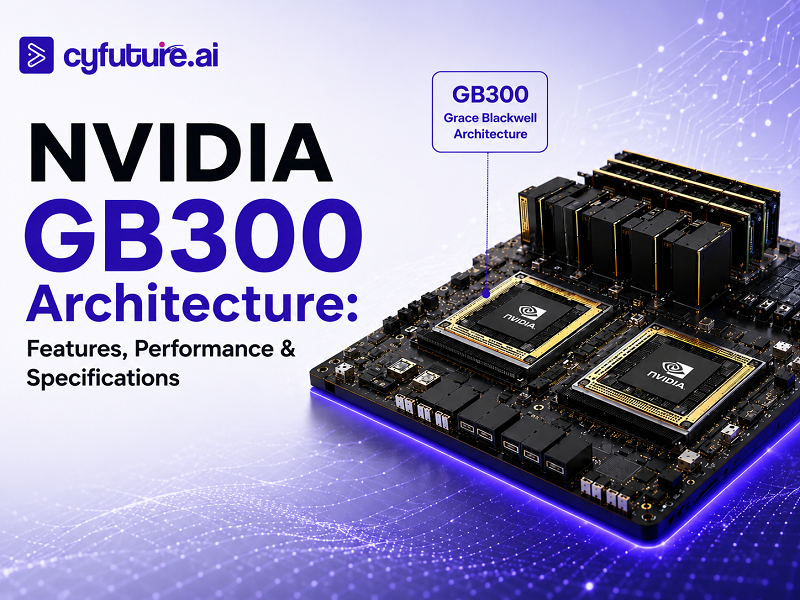
NVIDIA’s GB300 architecture arrives at a time when AI models are growing exponentially in size and complexity, while enterprises and cloud providers demand higher throughput, lower latency, and more efficient power and space utilization. For AI leaders, infrastructure teams, and enterprise buyers evaluating next-generation GPU platforms, GB300 represents a strategic step forward: it is purpose-built to accelerate large-scale model training, dense inference, and mixed HPC/AI workloads across cloud and on-prem data centers.
This article explains what makes the NVIDIA GB300 architecture important, breaks down its core design and features, reviews its performance advantages, and summarizes the technical specifications and enterprise value in a concise, scannable format.

Why GB300 matters now
- Models and datasets are ballooning: LLMs, multimodal models, and foundation models routinely require memory and compute scales that previous GPU generations strain to support.
- Cloud and edge deployments need greater efficiency: Operators want better throughput per watt and smaller rack footprints to reduce TCO.
- Heterogeneous workloads require flexibility: Enterprises need hardware that can pivot between training, inference, and HPC without wasted resources.
GB300 responds to these demands by delivering hardware-level innovations in memory architecture, interconnects, and power efficiency, enabling faster training, denser inference, and more efficient multi-node scaling.
GB300 architecture: design and role in next-gen AI infrastructure
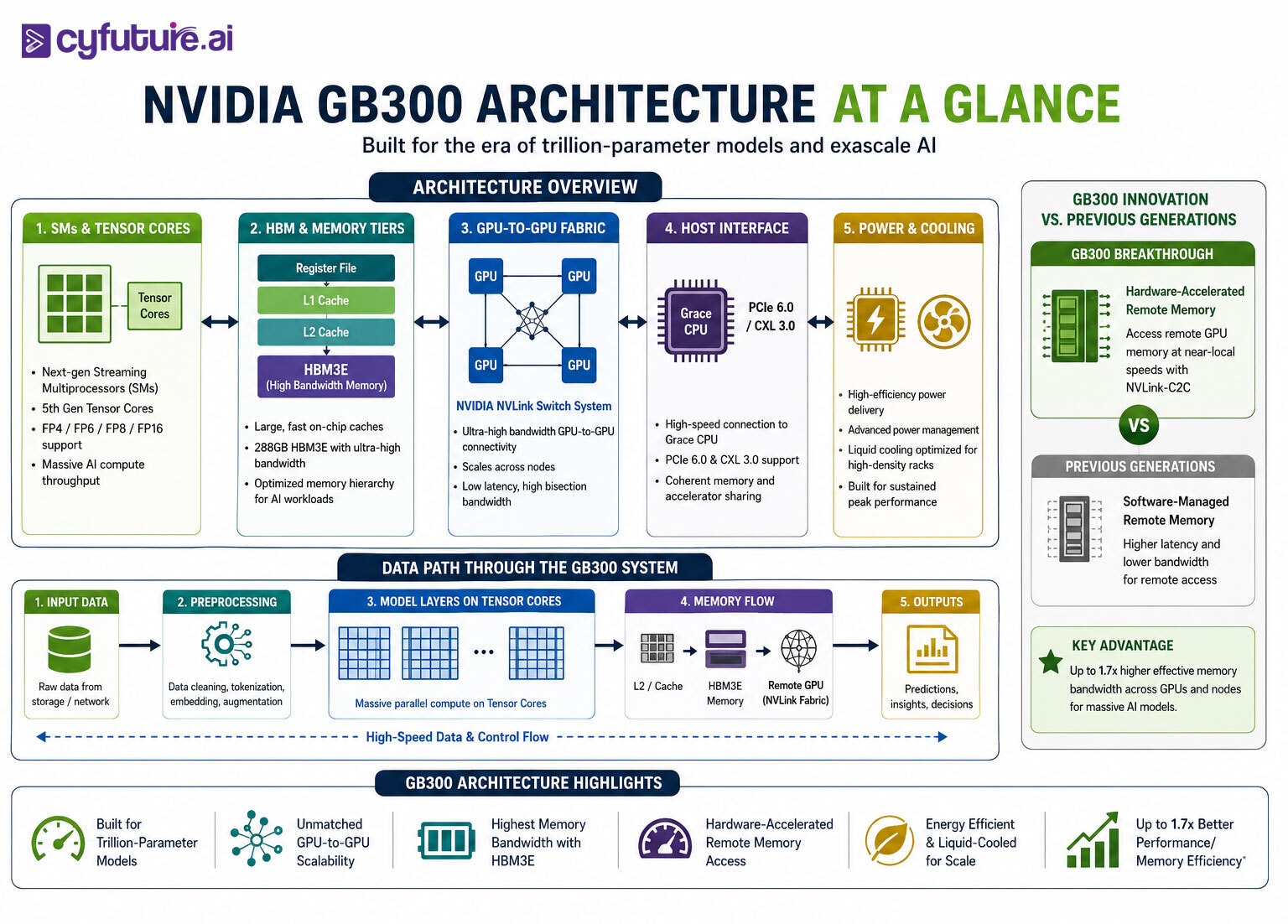
At a high level, the NVIDIA GB300 architecture continues NVIDIA’s trajectory of combining massive parallel compute with optimized memory and interconnect subsystems. GB300 builds on lessons from Hopper and Blackwell lines but emphasizes balanced memory bandwidth, low-latency NVLink-like connectivity, and system-level power efficiency tailored to scale-out deployments.
Core design principles:
- Balanced compute-to-memory ratio: GB300 targets larger model sizes by increasing effective on-GPU memory bandwidth and introducing smarter memory hierarchy techniques (HBM enhancements plus unified caching and software-managed remote memory).
- High-bandwidth, low-latency interconnects: Improved point-to-point fabric and system-level coherence allow multi-GPU clusters to behave more like a single large accelerator for model-parallel training.
- Energy and space efficiency: Architectural optimizations and power-management features reduce watts per TFLOP and enable higher GPU density per rack.
- Software-hardware co-design: GB300 integrates tightly with updated CUDA toolchains, libraries (cuDNN, cuBLAS), and frameworks (TensorFlow, PyTorch) to expose new performance primitives and memory-swap capabilities.
Key GB300 features
- Hardware design
- Optimized SMs and tensor cores tuned for mixed-precision math (FP8/FP16/BF16/FP32), with dedicated paths for sparse and quantized operations.
- Modular board-level designs to support single-GPU, dual-GPU, and multi-GPU server configurations using a common architecture.
- Memory
- Larger per-GPU effective memory via next-gen HBM stacks, combined with hardware-accelerated remote memory access to host or peer GPUs.
- Improved cache hierarchies and software-exposed memory tiers to reduce expensive host transfers during model sharding.
- Interconnects
- High-throughput, low-latency fabric that extends NVLink concepts for faster GPU-to-GPU communication.
- Scalable topology support for tens to hundreds of GPUs with coherent memory and fine-grained synchronization.
- Power efficiency
- Dynamic voltage and frequency scaling tuned per workload, plus workload-aware power-slicing features to maximize performance per watt.
- Thermal and packaging improvements that enable higher density without throttling.
- Scalability
- Architecture and firmware to support elastic scaling (adding/removing GPUs dynamically) and improved partitioning for multi-tenant cloud environments.
- Better multi-node synchronization primitives to improve scaling efficiency for large-batch training.
- AI optimization
- Enhanced tensor-core units and instruction-level optimizations for transformers and attention-based models.
- Native support for sparsity, quantization, and accelerated kernels for inference pipelines (beam search, token sampling) to lower latency.
Read More: NVIDIA GB300 Superchip: Everything You Need to Know
GB300 performance: what changes for training, inference, and throughput
Training
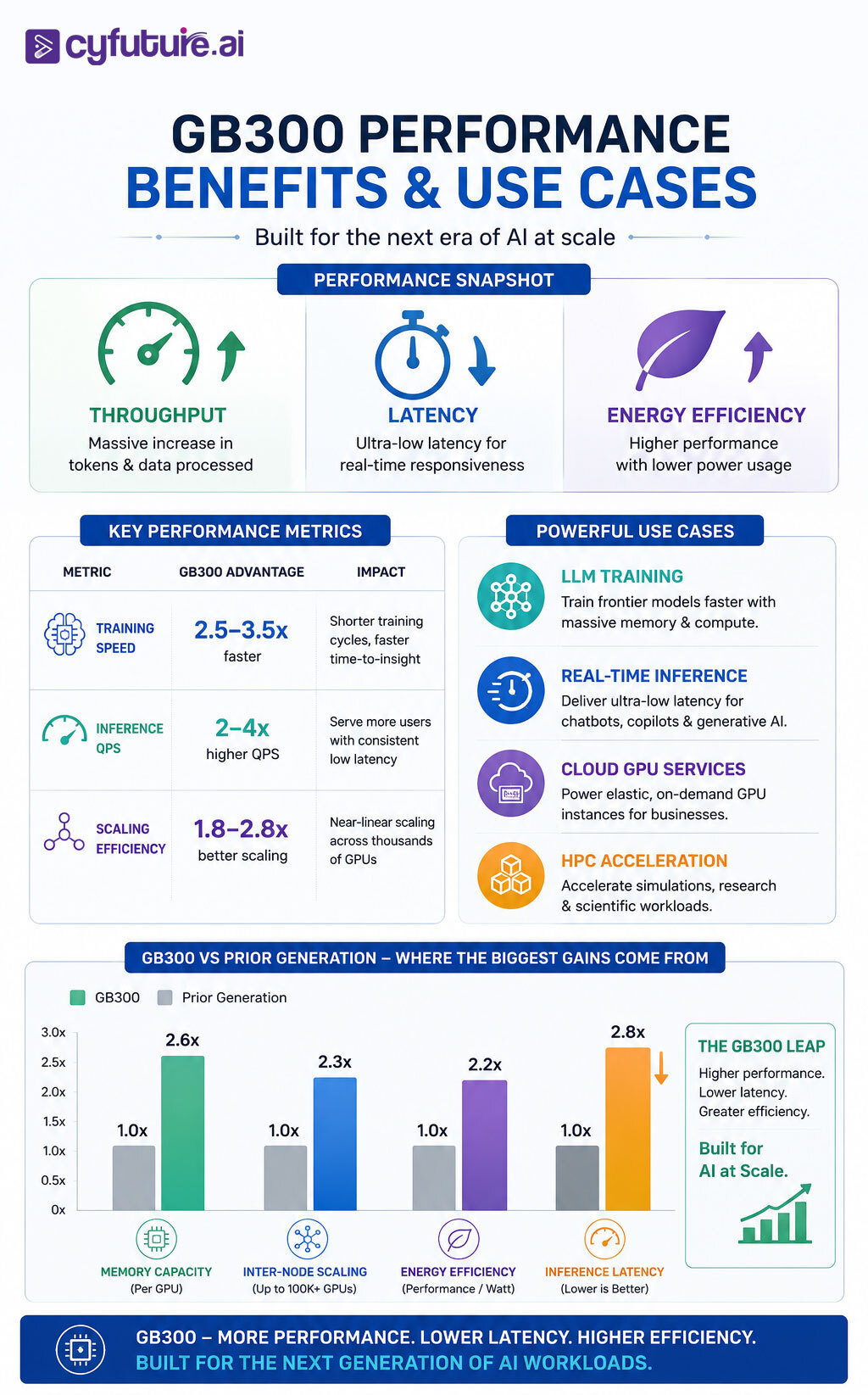
- Larger effective memory and improved interconnect dramatically reduce the need for model sharding or out-of-core swapping for many large models. That translates to shorter time-to-train and fewer engineering trade-offs when scaling model parallelism.
- GB300’s tensor cores and mixed-precision optimizations boost throughput for transformer-based workloads, delivering higher TFLOPS in FP16/BF16/FP8 modes compared to the prior generation.
Inference
- The architecture’s low-latency pathways and enhanced support for sparsity and quantized kernels result in lower end-to-end inferencing latency and higher queries-per-second (QPS) for large LLMs.
- Dynamic batch sizing and hardware-backed quantization routines improve throughput for both real-time and batch inference scenarios.
Throughput and large-scale workloads
- In multi-node training, the improved interconnect and coherent memory reduce communication overhead, increasing scaling efficiency across racks. This yields higher effective throughput for distributed training jobs.
- For mixed workloads (HPC + AI), GB300 maintains higher sustained performance over longer runs thanks to thermal improvements and power management features.
Simple, scannable technical specifications
- Compute
- Tensor cores: Next-gen tensor units optimized for FP8/FP16/BF16 and structured sparsity.
- CUDA cores: High-density SM layout for parallel workloads.
- Memory
- HBM capacity per GPU: larger stacks (exact capacities vary by SKU).
- Effective memory features: hardware remote memory access, improved cache tiers.
- Interconnect
- Native GPU-to-GPU fabric: multi-lane coherent links (up to multi-hundred GB/s aggregate per GPU).
- Multi-node topologies: support for scale-out fabrics with low-latency collective operations.
- Power & thermal
- Power envelope: tuned models for different TDP targets (varies by SKU).
- Cooling: advanced packaging and improved thermal dissipation for dense racks.
- Platform & software
- CUDA and libraries: optimized drivers, cuDNN/cuBLAS enhancements, and framework integrations for model-parallel primitives
Who benefits: Enterprise, AI labs, cloud providers, and data centers
-
Enterprises and AI labs
- Faster experimentation and iteration: fewer constraints on model size and faster training turnaround mean faster R&D cycles.
- Reduced infrastructure complexity: higher on-device memory and better scaling reduce engineering overhead for sharding and checkpointing.
-
Cloud providers
- Better utilization and multi-tenancy: hardware partitioning and elastic GPU capabilities make it easier to serve varied workloads and customers.
- Competitive offerings: improved throughput-per-rack and power efficiency translate to lower TCO and more attractive pricing models.
-
Data centers and colocation
- Higher density and lower cooling costs per unit of compute improve facility economics.
- Easier migration paths from prior NVIDIA generations, due to software compatibility and proven driver ecosystems.

FAQ'
1. What is the NVIDIA GB300 Architecture?
The NVIDIA GB300 Architecture is a next-generation AI computing platform based on the Blackwell GPU architecture. It is designed to accelerate AI training, inference, high-performance computing (HPC), and large language model (LLM) workloads with improved performance and efficiency.
2. What are the key features of the NVIDIA GB300 Architecture?
The NVIDIA GB300 offers advanced Blackwell GPUs, high-bandwidth memory (HBM), faster interconnects, enhanced AI acceleration, improved power efficiency, and scalable networking technologies to support demanding enterprise AI applications.
3. How does NVIDIA GB300 improve AI performance?
NVIDIA GB300 delivers higher compute power, increased memory bandwidth, and optimized AI processing capabilities, enabling faster training and inference for generative AI, deep learning, and large-scale machine learning models.
4. Which workloads are best suited for NVIDIA GB300?
The NVIDIA GB300 is ideal for generative AI, large language models (LLMs), AI inference, deep learning, scientific simulations, data analytics, high-performance computing (HPC), and enterprise AI deployments.
5. What makes NVIDIA GB300 different from previous GPU architectures?
Compared to earlier GPU generations, the NVIDIA GB300 provides significant improvements in AI compute performance, memory capacity, energy efficiency, networking bandwidth, and scalability, making it a powerful solution for next-generation AI infrastructure.
Conclusion — future-focused viewpoint
The NVIDIA GB300 architecture represents a practical evolution designed for the realities of 2026-scale AI: larger models, mixed workloads, and cloud-native economics. By combining balanced memory improvements, faster interconnects, and workload-aware power efficiency with mature software support, GB300 reduces the friction of scaling and accelerates time-to-value. For enterprises, AI labs, and cloud providers, adopting GB300-based infrastructure can mean faster model iteration, denser deployments, and lower total cost of ownership—positioning organizations to more rapidly capitalize on the next wave of AI applications.
Author Bio:
Meghali is a tech-savvy content writer with expertise in AI, Cloud Computing, App Development, and Emerging Technologies. She excels at translating complex technical concepts into clear, engaging, and actionable content for developers, businesses, and tech enthusiasts. Meghali is passionate about helping readers stay informed and make the most of cutting-edge digital solutions.