


 IND
IND UAE
UAE SA
SA


The RAG Failure That Confuses Everyone
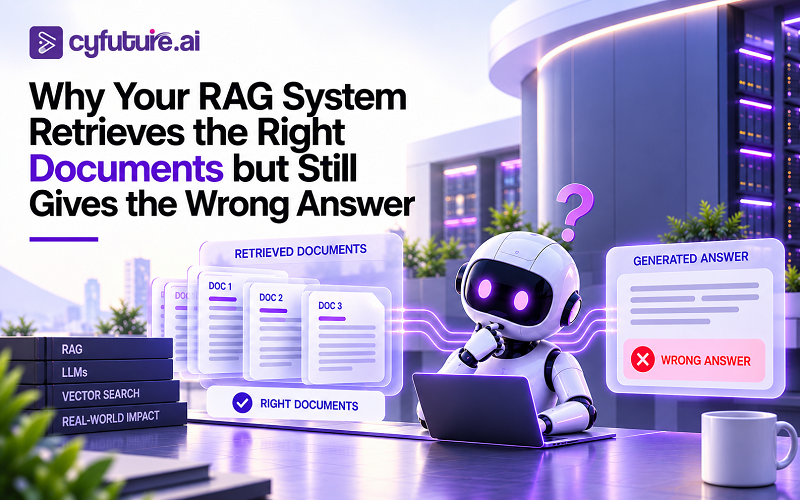
You run a query through your RAG system. The pipeline surfaces the correct policy document — the one with the exact clause that answers the question. You can see it in the retrieved results. The passage is there, readable, unambiguous. The final answer, delivered to your user three seconds later, is wrong.
This is not a retrieval failure. The retrieval worked. Something downstream went wrong — and diagnosing it requires understanding that a RAG pipeline has at least two distinct correctness problems that almost nothing in popular RAG tooling forces you to separate.
The scenario is more common than most teams realise. An enterprise deploys a knowledge-base assistant over internal HR documents. Retrieval recall sits at 92%. Users keep getting incorrect answers about leave entitlements. The team adds more documents. The recall goes up. The wrong answers persist. Nobody is looking at the right problem.
Getting retrieval right is necessary but not sufficient. A model that receives the correct evidence can still produce an incorrect answer — by ignoring the passage, mixing it with irrelevant context, answering from its pretraining instead, or simply misreading what the passage says. Each of these is a different failure mode with a different fix.
Retrieval Success Does Not Guarantee Answer Correctness
The standard mental model of RAG treats the pipeline as a search problem with an LLM tacked on the end. Fix the search, fix the answers. That model is wrong — or at minimum, dangerously incomplete.
A more useful way to think about it:
Answer Quality = Retrieval Quality × Context Quality × Model Grounding × Generation Reliability
This is a conceptual framework, not a performance equation. Each factor can fail independently. A system with perfect retrieval but poor chunking still delivers broken context. A system with great context but a poorly grounded model still hallucinates. The overall output quality is the product of all four, which means any single factor failing significantly degrades the entire output.
Here is what the pipeline actually looks like when you map where failures can occur:
The model processes only what arrives inside its context window. The quality of that context — its completeness, ordering, noise level, and chunk coherence — is entirely determined by decisions made upstream of the model call. Retrieval recall tells you whether the right document made it into the candidate set. It tells you nothing about what the model actually received or how it processed what it received.
The Right Document Is Not Always the Right Context
Document relevance and chunk relevance are not the same thing. A document can be exactly correct — the right HR policy, the right product spec, the right legal clause — while the specific passage sent to the model is incomplete, stripped of its qualifying conditions, or split at exactly the wrong boundary.
Four things determine whether a retrieved document becomes useful context:
- Document relevance — is this the right source?
- Passage relevance — does this document contain the answer?
- Chunk relevance — is the specific chunk that gets retrieved the one containing the answer?
- Answer relevance — does the chunk contain everything the model needs to answer correctly?
Each level can fail independently of the levels above it. A document that clearly contains the answer to a question about refund eligibility may produce an incorrect answer if the retrieved chunk contains the general rule but the exception is three sentences later in the next chunk. The retrieval system found the right document. The chunking strategy cut the answer in half.
Real examples of this failure pattern are straightforward once you recognise them:
- A product return policy chunk retrieves the standard 30-day rule but the exception for electronics (7 days) is in the following chunk.
- A compliance document's chunk contains a regulation number but not the regulation text, which begins at chunk boundary.
- A table is split across two chunks such that column headers appear in one and data rows in the other, making both chunks individually uninterpretable.
- A multi-step process retrieves steps 3–5 but the precondition that makes step 4 conditional is in steps 1–2, which ranked lower.
Fixing these requires looking upstream of retrieval entirely — at how you split your documents before they ever enter the vector store.
Chunking Is Often the Real Problem
Chunking receives far less engineering attention than retrieval models, embedding models, and LLM selection — which is precisely why it causes so many production failures that never get correctly diagnosed. The way you divide documents before indexing determines what the model can ever receive, regardless of how sophisticated the retrieval system above it is.
Fixed-Size Chunking
The default in most tutorials and many production systems. Split every document at 512 tokens (or 256, or 1024) with some overlap (typically 10–20%). Fast, simple, consistent. The problems emerge at content boundaries. A sentence that begins at token 500 and ends at token 530 gets split across chunks. A numbered list where item 5 answers the user's question gets split from items 1–4, which explain the conditions under which item 5 applies. Fixed-size chunking is a retrieval-convenience strategy dressed up as a content strategy.
Overlap mitigates some of this but introduces its own problem: the overlapping tokens appear in multiple chunks, increasing the chance of sending duplicate or near-duplicate evidence to the model, which compounds context noise.
Semantic Chunking
Rather than splitting at fixed token counts, semantic chunking splits at meaning boundaries — usually detected by comparing sentence embedding cosine similarity between adjacent sentences. When similarity drops sharply, a new chunk begins. This preserves logical units significantly better than fixed-size splitting. A policy paragraph and its exception stay together. A numbered process stays intact.
Semantic chunking has its own failure modes. Documents with uniform embedding similarity throughout (dense technical manuals, legal contracts with consistent register) may produce chunks that are too large for effective retrieval. The boundary detection depends on the quality of the sentence embedding model, which may not understand domain-specific terminology well enough to identify semantic boundaries accurately.
Hierarchical (Parent-Child) Retrieval
A more robust approach for complex documents: index small child chunks for high-precision retrieval but retrieve the full parent document or section for context. A child chunk of 128 tokens is specific enough to match a precise query accurately. The parent section of 1,000 tokens provides the surrounding context that makes the child chunk interpretable. This preserves retrieval precision while providing generation quality.
The tradeoff is that parent chunks can become large enough to dilute the signal when passed directly to the LLM alongside other chunks. Parent-child retrieval works best when the parent scope is carefully chosen — section rather than full document.
Structure-Aware Chunking
Documents are not bags of paragraphs. Technical documentation has headings, code blocks, and callout boxes. Legal contracts have numbered clauses with sub-clauses. Medical records have structured fields followed by narrative text. A chunking strategy that ignores document structure treats a Markdown table the same as a paragraph — which means splitting table rows across chunk boundaries, separating code examples from their explanations, and discarding heading context that tells the model what section the content belongs to.
Structure-aware chunking recognises document elements as semantic units and treats them accordingly. A table stays together. A code block plus its docstring stays together. A heading plus the first paragraph under it forms the beginning of a chunk. This requires more engineering than token-counting but produces substantially more coherent context for generation.
Most teams optimise chunking to improve retrieval metrics — does the right chunk appear in top-K? That's the wrong optimisation target. The right question is: does the chunk, once retrieved, contain everything the model needs to answer correctly? A chunk can rank first in retrieval and still produce an incorrect answer if it's structurally incomplete.
The LLM May Be Looking at Too Much Context
A common response to poor RAG accuracy is to retrieve more documents. Retrieve top-10 instead of top-5. Increase the context window. Give the model more information to work with. This approach is often counterproductive.
Adding more chunks to the context introduces several problems simultaneously:
- Context dilution: The correct passage now competes for attention with 9 or 14 other passages, some of which are semantically adjacent to the query but don't actually answer it.
- Distractor documents: Passages that discuss related concepts without being directly relevant. An LLM asked about refund policy for electronics may receive chunks about general refund policy, return shipping policy, and warranty terms — all related, none correct.
- Conflicting evidence: Two retrieved chunks may contain different answers if documents haven't been versioned or deduplicated. The model must choose between them with no clear signal about which is authoritative.
- Attention competition: Transformer attention is distributed across the entire input. A longer context means less relative attention per token, and the model's ability to find and weight the relevant passage degrades as context length increases.
The empirical research on this is clear enough to inform system design. Stanford researchers documented that performance on multi-document QA tasks degrades when the relevant document appears in the middle of a long retrieved context — worse than when it appears first or last. This lost-in-the-middle effect is not a bug in a specific model; it reflects how transformer attention mechanisms distribute across long inputs.
The practical implication: for most production RAG workloads, sending 3–5 high-quality, reranked chunks outperforms sending 10–15 chunks that include everything semantically adjacent to the query. Less context, better positioned, delivers better answers.
The Relevant Evidence May Be in the Wrong Position
Even without context dilution, where evidence appears inside the context window affects how reliably the model uses it. The lost-in-the-middle finding — documented across multiple model families and context lengths — has direct implications for how you assemble context before the LLM call.
Placing the highest-confidence evidence first, rather than ordering chunks by document metadata or retrieval timestamp, improves answer grounding in practice. Some teams further improve this by placing a brief statement of the query at the beginning and end of the context block — using the model's higher attention at boundary positions to anchor its understanding of what it's being asked.
The important caveat: model behaviour varies. What works for one architecture at one context length may not generalise. Context ordering is an empirical tuning decision, not a rule that can be derived from first principles. Test it on your specific model and workload before treating any ordering strategy as universal.
Strategies that tend to help in practice:
- Reranking before context assembly, so the highest-relevance chunks go first
- Deduplicating near-identical chunks before assembly
- Removing chunks below a relevance score threshold rather than always filling the full context window
- Grouping evidence from the same source document together to reduce context fragmentation
Reranking: Beyond What Vector Search Can Do
Vector similarity retrieval optimises for one thing: proximity between a query embedding and document chunk embeddings in the vector space. That's a good proxy for topical relevance but a poor proxy for answer relevance — the question of whether a specific passage actually answers the specific query.
A product manual chunk about "refund initiation" has high embedding similarity to a query about "how do I get a refund." It may rank higher than a chunk that explains the precise eligibility conditions under which refunds are approved. The first chunk is topically relevant. The second chunk actually answers the question. Vector search frequently cannot distinguish between them.
Cross-encoder rerankers evaluate relevance differently. Where a bi-encoder (the typical embedding model used in retrieval) encodes the query and each document independently and compares their embeddings, a cross-encoder takes the query and each candidate passage together as a joint input and produces a single relevance score. This joint processing captures the direct relationship between query and passage rather than relying on proximity in a shared embedding space.
For most production RAG systems, the recommended approach is: retrieve top-50 candidates with hybrid search, apply a cross-encoder to select top-5, then pass those 5 to the model. The increased retrieval latency from cross-encoder reranking (typically 50–200ms for top-50 candidates) is almost always worth the improvement in answer quality.
Stop Debugging RAG Failures Alone
Cyfuture AI's RAG Platform is built for enterprise teams who need grounded, production-reliable retrieval-augmented generation — not another proof-of-concept. Hybrid retrieval, reranking, structured grounding, and GPU-accelerated inference on India-hosted infrastructure. DPDP compliant. INR billing.
When the Model Ignores Your Evidence
Parametric knowledge is what an LLM has learned during pretraining — facts, patterns, associations, and reasoning heuristics encoded in its weights. In a grounded RAG system, this knowledge should be suppressed in favour of the retrieved evidence. In practice, it frequently isn't.
The problem is clearest when retrieved evidence contradicts the model's pretraining. A language model trained on web data through a specific cutoff has strong representations of common facts. When you retrieve an internal document stating that your company's standard payment terms are net-60 days, and the model's pretraining encodes "typical enterprise payment terms are net-30," the model may answer net-30 regardless of what the retrieved context says.
Grounding strategies that help in practice:
- Explicit instructions in the system prompt: answer only from the provided context; cite the specific passage that supports each factual claim; if the context does not contain the answer, say so explicitly rather than speculating.
- Allowing abstention: systems that require the model to always produce an answer are significantly more prone to hallucination than systems that allow "I cannot find sufficient information in the provided documents."
- Structured output formats that require citation: asking the model to produce a JSON object with separate "answer" and "supporting_evidence" fields makes grounding failures immediately visible rather than buried in fluent-sounding prose.
Prompt instructions can significantly improve grounding behaviour but cannot guarantee it. Even with explicit "answer only from context" instructions, models with strong parametric knowledge will occasionally override retrieved evidence on topics where their pretraining is confident. This is a model selection consideration as much as a prompt design one — models vary substantially in how well they follow grounding instructions under adversarial conditions.
When Retrieved Context Contains Conflicting Evidence
A knowledge base that has been accumulating documents over years almost certainly contains contradictions. An old product specification and a new one. A policy that was updated but where the old version wasn't removed. Regional variations of the same rule stored in the same corpus without geographic metadata.
When multiple conflicting passages are retrieved and passed to the model, it faces a problem it was never trained to solve consistently: which source is authoritative? Without metadata providing explicit signals about document recency, version, jurisdiction, or authority, the model is effectively guessing.
The fixes are structural:
- Document versioning: Index documents with version and date metadata. Metadata filtering at retrieval time can exclude documents older than a specified date for time-sensitive queries.
- Source authority: Assign authority scores to document types. An official policy PDF outranks an email thread discussing that policy. A signed contract outranks a contract template.
- Deduplication: Near-duplicate detection before indexing prevents multiple versions of the same content competing in retrieval.
- Freshness signals: Add a freshness component to the reranking step for queries where recency is likely to matter.
The vector database cannot resolve source authority automatically. The signal must come from how documents are indexed and how the retrieval pipeline is designed to use the metadata attached to them.
RAG Systems Retrieve Before They Understand
Standard RAG pipelines retrieve first and reason second. The query goes to the vector store, documents come back, the model synthesises an answer. There's no step where the system first determines what the query is actually asking for, whether it contains ambiguity, or whether it needs to be decomposed before retrieval can succeed.
Query failure modes that standard pipelines don't handle:
- Ambiguity: "What is the cancellation policy?" — for which product? Which geography? Which tier? Retrieval returns an average across all of them.
- Multi-intent: "How do I update my billing address and what are the fees for international transfers?" — two separate queries, each requiring different document retrieval. A single embedding can't optimise for both simultaneously.
- Domain terminology: Users phrase queries in their own language. Internal documents use official terminology. The embedding space may not bridge this gap reliably.
- Entity references: "What did we agree with Acme in the last contract revision?" requires understanding that "Acme" maps to a specific contract and that "last revision" is a temporal filter — not information that vector search handles natively.
Query rewriting — using an LLM to reformulate the query before retrieval — helps with ambiguity and terminology mismatches. Query decomposition — breaking a compound query into sub-queries, each of which retrieves its own evidence — handles multi-intent queries. Hypothetical Document Embeddings (HyDE) — generating a hypothetical answer first and embedding that for retrieval — can improve recall for abstract or underspecified queries.
The risk with aggressive query transformation is intent drift. The rewritten query may not represent what the user was asking. Transformation should be applied conservatively and evaluated carefully on real query logs rather than synthetic test sets.
Multi-Hop Questions Break Simple RAG Pipelines
Many real enterprise queries require combining evidence from multiple sources to construct a correct answer. The question "Is our standard SLA for enterprise customers above what our contract with Client X specifies?" requires retrieving the internal SLA policy, the Client X contract, and synthesising both — without either document alone containing the answer.
Single-pass RAG fails on multi-hop questions even when both relevant documents are retrieved. If the system retrieves the SLA policy and the contract, the model must determine the relationship between them and reason across both. For simple comparisons this may work. For more complex chains — where the answer from document A determines which part of document B is relevant — single-pass retrieval is fundamentally unsuited.
Better architectures for multi-hop questions:
- Query decomposition: Break the compound question into sequential sub-queries before retrieval. Answer each sub-query, then use those answers to synthesise the final response.
- Iterative retrieval: Retrieve evidence, generate an intermediate answer, use that answer to formulate follow-up retrieval queries.
- Agentic retrieval: An LLM plans and executes multiple retrieval steps with access to tools — essentially treating retrieval as a sequence of decisions rather than a single operation.
These approaches add latency and complexity. They're also the only architectures that reliably handle the class of queries that actual enterprise users ask most frequently — questions that span multiple policies, documents, or time periods.
The Model May Misread the Retrieved Evidence
Even with the right document, complete chunks, minimal context noise, and strong grounding instructions, the model may simply misinterpret what the evidence says. Evidence retrieval and evidence reasoning are separate problems.
Several categories of evidence are particularly prone to misinterpretation:
Tables and Structured Data
Models struggle with complex tables — especially when column meanings are implied by position rather than repeated in each row. Pricing tables, comparison matrices, and exception tables are frequently misread. A table with 8 columns and a header describing conditions may cause the model to conflate columns when retrieving specific cells.
Negation and Conditions
Sentences like "this policy does not apply to employees hired after January 2024" are correctly retrieved but frequently answered affirmatively. Negation in retrieved context is one of the most consistent sources of factual error in production RAG — the model often drops the "not" and states the condition as though it were unconditional.
Legal and Contractual Language
Legal documents use defined terms, cross-references, and subordinate clauses that change the meaning of a sentence depending on context defined elsewhere. "Subject to Section 12.3" is retrievable — but Section 12.3 may not be in the same chunk, making the model's interpretation of the clause materially incorrect.
Numeric Reasoning
Arithmetic and numerical comparisons inside retrieved context are error-prone even when the relevant numbers are explicitly present. "Eligible employees receive a base benefit of 3% of salary plus 1.5% per year of service above 5 years" requires the model to compute a specific figure given an employee's tenure — a task that requires reasoning over the retrieved numbers, not just retrieving them.
Cross-Document Synthesis
Combining information from two documents retrieved from different parts of a knowledge base — mapping a product name in one to a specification in another, or reconciling different date formats — requires reasoning that goes beyond reading individual passages. Models vary significantly in how reliably they perform this synthesis.
Temporal and Versioned Content
Evidence that says "as of Q2 2025, the rate is X" is correctly retrieved but may be misapplied to a current query if the model doesn't attend to the temporal qualifier. Historical documents frequently produce correct-looking but temporally incorrect answers.
Prompts That Accidentally Encourage Hallucination
System prompt design shapes model behaviour more than most teams realise — and poorly designed prompts systematically produce worse answers even when everything upstream is working correctly.
Common prompt failure modes in RAG systems:
- Requiring an answer at all costs: Prompts that say "always provide a helpful, complete answer" discourage abstention. The model learns to generate something even when evidence is insufficient, which means confident-sounding hallucinations in exactly the cases where the system should say "I don't have that information."
- Vague grounding instructions: "Use the provided documents to answer the question" is significantly weaker than "Answer only using information from the documents below. If the answer is not found in the documents, respond with: 'The provided documents do not contain sufficient information to answer this question.'"
- Requesting elaboration beyond the evidence: "Provide a detailed, thorough answer" pushes the model to expand beyond what the retrieved context supports. The retrieved passage may contain two sentences. A "detailed" answer requires five paragraphs. Three of them are hallucinated.
- Conflicting instructions: A system prompt that says "be concise" combined with a user instruction that says "explain in detail" creates ambiguity the model resolves inconsistently across queries.
- Missing citation requirements: Without explicit requirements to cite supporting passages, models rarely ground their outputs in specific retrievals. Citation requirements don't guarantee faithfulness but make failures immediately visible rather than hidden inside fluent prose.
Better prompt design for grounded generation: state the task explicitly, require evidence-based answers with specific passage citations, define what to do when evidence is absent, specify a structured output format that separates the answer from its supporting evidence, and test the prompt on queries where the correct answer is "I don't know" to verify that the system abstains correctly rather than hallucinating.
Your RAG Evaluation May Be Measuring the Wrong Thing
Most RAG evaluation frameworks measure retrieval. Recall@5, Precision@10, MRR, nDCG — all of these tell you whether the right document appeared in the top-K results. None of them tells you whether the final answer was correct.
Teams that optimise exclusively on retrieval metrics often ship systems with excellent recall and poor answer quality. The metrics looked good in evaluation. Production users reported wrong answers. The gap is that retrieval quality and answer quality are separate dimensions that require separate measurement.
A complete RAG evaluation framework separates at least four layers:
Retrieval Evaluation
Measures whether the correct evidence was retrieved. Metrics: Recall@K (did the correct document appear in top-K results?), Precision@K (what fraction of top-K was relevant?), MRR (where did the first correct result appear?), nDCG (how well was the ranking ordered by relevance?). Requires ground-truth relevance judgements — either manually annotated or derived from downstream answer evaluation.
Context Evaluation
Measures the quality of context actually sent to the model. Context relevance: what fraction of the tokens in the assembled context are relevant to the query? Context completeness: is the retrieved context sufficient to answer the question, or is critical information missing? Context noise: are distractor passages present that might mislead the model? These require evaluating the context construction step independently of retrieval.
Generation Evaluation
Measures whether the model's answer is correct and grounded. Faithfulness: does the answer make only claims supported by the context? Groundedness: can each statement in the answer be traced to a specific passage? Answer correctness: is the answer factually correct against the known ground truth? Completeness: does the answer address all parts of the query? These cannot be measured with retrieval metrics alone.
End-to-End Evaluation
Measures whether users actually got what they needed. Task success rate, human preference evaluation, downstream outcome tracking (did the user take the correct action based on the answer?). This is the only evaluation layer that directly measures what matters to the business — and it requires real user queries, not synthetic benchmarks.
How to Debug a RAG System Step by Step
When a RAG system produces a wrong answer, the instinct is to improve retrieval — add more documents, tune the embedding model, increase K. This is often the wrong move. Debugging should start by identifying which stage actually failed.
Save the Original User Query
Log the exact query text, not a cleaned or reformatted version. Real user queries contain the ambiguity, terminology mismatches, and phrasing that cause failures. If you're debugging on synthetic test queries, you're likely missing the real failure cases.
Inspect the Rewritten Query (If Query Rewriting Is Active)
Does the rewritten query still represent what the user was asking? Query rewriting can introduce intent drift — the rewritten query retrieves different documents than the original would have, which may explain why relevant evidence is missing from the retrieved set.
Inspect Top-K Retrieved Results
Is the correct document or passage present in the retrieved set? If it isn't, the failure is in retrieval — chunking strategy, embedding model, or index configuration. If it is present, move to the next step. Many teams stop debugging here and conclude "retrieval is fine." That's the diagnostic gap.
Inspect the Reranker Output
Did the correct evidence survive reranking? Was it promoted to position 1–3 (high attention zone) or demoted to position 6+ (low attention zone)? A reranker that promotes irrelevant passages over the correct one is a reranking failure — separate from retrieval.
Inspect the Exact Context Sent to the LLM
What exactly was in the prompt? Is the correct passage present, complete, and at a high-attention position? Is the context contaminated with distractor passages, outdated versions, or duplicate content? Many teams log retrieved chunks but don't log the assembled context — a gap that makes context-stage failures invisible.
Compare the Answer Against the Evidence
If the correct evidence was present in the context and the answer is still wrong, the failure is in generation — grounding, reasoning, or prompt design. Specifically: did the model ignore the relevant passage? Did it contradict it? Did it correctly retrieve it but then reason incorrectly about it? Each is a different problem with a different fix.
Classify the Failure and Fix the Right Stage
Don't fix retrieval when the problem is chunking. Don't fix chunking when the problem is grounding. The failure taxonomy below maps symptoms to stages and typical remedies. Misidentifying the failure stage is why many RAG improvement efforts produce minimal gains despite significant engineering effort.
Production RAG Is an Infrastructure Problem Too
Every failure mode above — context dilution, retrieval latency, multi-hop queries, long-context reasoning — has an infrastructure dimension. Cyfuture AI's RAG Platform runs on liquid-cooled GPU infrastructure in India — purpose-built for low-latency retrieval and grounded LLM inference at enterprise scale. No forex risk. GST-compliant invoices. Deployed in hours.
RAG Failure Taxonomy
| Failure Type | Retrieval | Context | Generation | Typical Fix |
|---|---|---|---|---|
| Correct document not retrieved | Fail | Fail | N/A | Improve embedding model, hybrid search, or document coverage |
| Correct document retrieved, wrong chunk | OK | Fail | Fail | Fix chunking strategy — semantic or hierarchical chunking |
| Correct chunk retrieved, diluted by distractors | OK | Fail | Fail | Reduce K, add reranking, remove below-threshold chunks |
| Correct chunk buried at wrong position | OK | Partial | Fail | Rerank for answer relevance, place top chunk first |
| Correct context, model hallucinates from parametric memory | OK | OK | Fail | Strengthen grounding instructions, require citation, allow abstention |
| Correct context, model misreads evidence (negation, table, condition) | OK | OK | Fail | Improve prompt, structure output format, evaluate model capability on this evidence type |
| Conflicting evidence from multiple sources | OK | Partial | Fail | Add metadata filters for version/date, deduplication, source authority scoring |
| Multi-hop question with single-pass retrieval | Partial | Partial | Fail | Query decomposition, iterative or agentic retrieval |
A Better Architecture for Production RAG
A production RAG system needs to address every failure mode described above — not by adding complexity for its own sake, but by inserting the right safeguards at the stages where failures actually occur. The architecture below represents a more complete approach than the minimal retrieve-and-generate pipeline that most tutorials describe.
Not every production system needs every layer. A simple internal FAQ assistant may work well with basic retrieval and a well-designed prompt. An enterprise contract analysis system that must handle multi-hop questions, version conflicts, and legal language needs most of these layers. The architecture should match the actual failure modes of your specific workload — not cargo-cult the most complex possible configuration.
The Infrastructure Behind Reliable RAG
Software architecture decisions drive the most impactful RAG improvements. Infrastructure quality determines whether a well-designed pipeline can actually run at production scale.
A few infrastructure bottlenecks that are often overlooked until they cause failures in production:
Vector Database Performance
An ANN index that returns in 20ms at 10 concurrent queries may degrade to 400ms at 100 concurrent queries depending on its implementation and hardware. For synchronous user-facing applications, retrieval latency is directly visible to the user. Index configuration, HNSW parameters, and sharding strategy all affect both latency and recall at scale.
GPU Inference Capacity
LLM inference is the most compute-intensive step in the RAG pipeline. For long-context workloads (which better-designed RAG systems deliberately avoid, but some use cases require), GPU memory capacity and bandwidth become the primary bottlenecks. A cross-encoder reranker running on CPU at high concurrency introduces enough latency to make real-time RAG unusable.
Storage and I/O
For knowledge bases with frequent document updates — product documentation, legal repositories, compliance databases — the indexing pipeline must process new documents quickly enough that retrieval remains current. Storage I/O and embedding throughput determine how freshly your vector index reflects your document corpus.
Memory Bandwidth for Long Contexts
When longer context windows are genuinely necessary — for multi-hop reasoning or complex document synthesis — HBM bandwidth becomes the performance constraint. GPU generations vary substantially on this metric. An enterprise RAG deployment that must handle 32K or 128K token contexts needs a GPU infrastructure spec that accounts for the memory access patterns of long-context inference, not just peak FLOPS.
Infrastructure cannot compensate for poor retrieval logic, bad chunking, or weak grounding instructions. Equally, a well-designed RAG pipeline will hit hard limits at scale if the underlying GPU capacity, storage throughput, and network latency aren't provisioned for the workload. Both layers matter in production.
Build RAG Infrastructure Built for Production Workloads
Production RAG systems need more than a vector database and an LLM API. Retrieval, inference, storage and networking must work together as workloads scale. Cyfuture AI offers enterprise-grade GPU as a Service and AI inference infrastructure from India-hosted, liquid-cooled data centers — INR billing, DPDP compliant, ISO 27001:2022 certified.
How to Improve RAG Answer Accuracy — A Practical Checklist
Measure retrieval and answer quality separately
Track Recall@K for retrieval and answer correctness for generation as independent metrics. A single end-to-end accuracy score hides which stage is failing.
Log and inspect actual contexts sent to the LLM
Log the exact assembled prompt, not just the retrieved chunks. The context assembly step is where correct retrieval most commonly becomes incorrect input.
Fix chunk boundaries for your document types
Audit a sample of wrong answers. Check whether the correct information was split across chunk boundaries. If so, switch to semantic or hierarchical chunking for those document types.
Add a cross-encoder reranker
Retrieve top-50 with dense/hybrid search, rerank to top-5 with a cross-encoder. This single change typically improves answer accuracy more than tuning the embedding model.
Reduce irrelevant context
Set a minimum relevance score threshold. Drop chunks below the threshold rather than always filling the maximum context window. Less context, better placed, outperforms more context most of the time.
Add metadata filters for freshness and source authority
Index documents with version, date, and source type. Use metadata pre-filters to exclude outdated content before embedding search runs.
Allow abstention explicitly in the system prompt
Define the exact phrase the model should return when evidence is insufficient. Test the system on queries that have no answer in the knowledge base to verify abstention works correctly.
Require evidence citation in structured output
Require the model to return a structured object with the answer and its supporting passages separately. Grounding failures become immediately visible rather than hidden in fluent prose.
Evaluate on real user queries, not synthetic benchmarks
Real users ask compound, ambiguous, and domain-specific questions that synthetic evaluation sets rarely capture. Sample from production query logs, annotate outcomes, and track regression on these real queries as you make changes.
Build a regression test set from known failures
Every time a wrong answer is reported, add it to a regression set with the correct answer. Every improvement you make should pass the full regression set before deployment.
Monitor production for failure patterns
Track which query types produce wrong answers, which documents appear most frequently in failed retrieval, and which failure categories dominate. Production monitoring data will tell you where to focus improvement effort more reliably than synthetic evaluation.
Handle multi-hop queries with decomposition or iterative retrieval
If your users regularly ask questions that span multiple documents or require combining evidence from different sources, single-pass RAG will consistently fail on this query class. Implement query decomposition for these cases.
When RAG Is Not the Right Architecture
RAG is the right tool for a specific problem: questions that can be answered by retrieving and reasoning over text from a knowledge corpus. Several common enterprise AI requirements fall outside this scope — and building a RAG pipeline for them often produces worse results than simpler alternatives.
✓ RAG Works Well For
- Knowledge base question-answering over documents that change over time
- Long-tail queries where the answer cannot be encoded in model weights
- Enterprise search with interpretable source citations
- Regulatory and compliance Q&A where source traceability is required
- Questions where the model's pretraining knowledge is insufficient or outdated
→ Consider Alternatives When
- Fine-tuning when the task requires a specific response style, format, or domain reasoning pattern that retrieval can't supply
- Structured databases or SQL when queries target structured records with precise filtering and aggregation requirements
- Knowledge graphs when relationships between entities matter as much as document content
- Tool calling / agents when the answer requires computation, lookup from live APIs, or multi-step reasoning with external systems
- Rule engines for deterministic business logic that should not be left to probabilistic model reasoning
The honest version of this: retrieval-augmented generation is a powerful approach that works well when deployed on the right problem. It produces overengineered, unreliable results when deployed as the default answer to any enterprise AI question. Diagnosing whether the failure is with the RAG implementation or with the choice of RAG as the architecture is worth doing early — before extensive investment in pipeline tuning.
Designing RAG for Enterprise AI?
Cyfuture AI supports the infrastructure foundation behind production AI applications — from GPU compute and inference capacity to scalable AI infrastructure for demanding LLM workloads. India-hosted on liquid-cooled AI data centers, DPDP compliant, enterprise-ready.
Frequently Asked Questions
Retrieval and generation are independent pipeline stages. A RAG system can surface the correct document while still producing an incorrect answer due to poor chunking (the relevant passage is split across chunk boundaries), context dilution (correct evidence is buried inside irrelevant documents at a low-attention position), model grounding failures (the LLM answers from parametric pretraining instead of the retrieved context), or prompt design issues that discourage abstention when evidence is incomplete. Diagnosing which stage failed requires inspecting retrieval results, assembled context, and model output separately — not just the final answer.
Yes. RAG hallucination occurs not only when retrieval fails but also when the model ignores, misreads, or overrides the retrieved context with its own pretraining knowledge. A model with strong parametric representations of a topic will sometimes answer from those representations even when the system prompt instructs it to use only the supplied evidence. This is especially common when retrieved evidence contradicts the model's pretraining — for instance, internal policies that differ from industry defaults the model was trained on.
Retrieval accuracy measures whether the correct document or passage appears in the retrieved set — typically expressed as Recall@K or Precision@K. Answer accuracy measures whether the final generated response is factually correct, faithful to the retrieved evidence, and complete. A system can achieve 90%+ retrieval recall while producing incorrect final answers if chunking is poor, context is diluted, the model is not grounded, or the query was misunderstood. These are separate measurements that require separate evaluation tooling.
Several factors cause models to override retrieved context: the model's parametric knowledge is strong and conflicts with retrieved evidence; the relevant passage appears at a low-attention position inside a long context (the lost-in-the-middle effect); the system prompt does not explicitly require evidence-grounded responses; or the retrieved chunk is incomplete and appears to contradict itself, causing the model to fall back on pretraining. Stronger grounding instructions, reduced context size, and high-attention positioning of critical evidence all help.
Significantly. Chunks that are too small lose the surrounding context needed to interpret a sentence correctly. Chunks that are too large introduce noise that dilutes the relevant passage. Fixed-size chunking frequently splits logical units — policy conditions, table rows, numbered steps — across boundaries, producing incomplete context that leads to incorrect or hallucinated answers even when the source document is retrieved. The optimal chunk size depends on document structure, query type, and the target model's context window.
Context dilution occurs when too many retrieved documents are passed to the LLM, causing correct evidence to compete with irrelevant or redundant passages for the model's attention. The lost-in-the-middle effect documents that LLMs attend more reliably to information at the beginning and end of long contexts than to information in the middle — so correct evidence at position 8 of 15 chunks may be effectively invisible to the model. Reducing K to 3–5 high-quality reranked chunks typically outperforms sending 10–15 semantically adjacent chunks.
Vector retrieval maximises semantic similarity between query and document embeddings — but semantic similarity does not always equal answer relevance. A cross-encoder reranker evaluates each candidate passage jointly with the query, scoring direct answer relevance rather than embedding distance. This joint processing captures the specific relationship between query and passage that bi-encoder retrieval cannot. Reranking typically improves final answer accuracy more than tuning the underlying embedding model, even when retrieval recall is already high.
Effective grounding strategies include: explicit system prompt instructions requiring evidence-only answers with passage citations; structured output formats that separate the answer from its supporting evidence (making grounding failures immediately visible); allowing abstention with a defined response when evidence is insufficient; and selecting models that reliably follow grounding instructions. Prompt instructions significantly improve grounding but cannot guarantee it across all queries and models — this is also a model selection consideration.
RAG hallucinations have multiple distinct causes: (1) retrieval failure — the correct evidence was never retrieved; (2) chunking failure — the correct document was retrieved but the specific chunk is incomplete; (3) context dilution — correct evidence is present but buried and under-attended; (4) parametric override — the model answers from pretraining rather than retrieved context; (5) misreading — the model misinterprets negation, conditions, or table structure in the retrieved evidence; (6) prompt failure — the system prompt encourages confident answers even when evidence is insufficient.
Evaluate retrieval and generation as separate stages. Retrieval evaluation uses Recall@K, Precision@K, MRR, and nDCG to measure whether correct evidence appears in top-K results. Context evaluation measures relevance, completeness, and noise in the context sent to the model. Generation evaluation measures faithfulness (does the answer only claim what the evidence supports?), groundedness (can each statement be traced to a specific passage?), and answer correctness. End-to-end evaluation measures task success on real user queries — the only layer that directly measures what matters to users.
For retrieval: Recall@K, Precision@K, MRR (Mean Reciprocal Rank), nDCG. For context quality: context relevance ratio, context completeness, distractor ratio. For generation: faithfulness (answer supported by context?), groundedness (traceable to specific passages?), answer correctness (against ground truth), completeness (all query parts addressed?). For end-to-end: task success rate on real user queries, human preference evaluation on a held-out set. Use automated metrics for scale, human evaluation for calibration and edge case analysis.
Debug by inspecting each stage independently: (1) save the original query; (2) check the rewritten query if query rewriting is active; (3) inspect top-K retrieved chunks — is the correct evidence present?; (4) check the reranker output — was correct evidence promoted to position 1–3?; (5) inspect the exact context sent to the model — is it complete, correctly ordered, and free of distractors?; (6) compare the model's answer against the evidence — did it use the evidence or override it?; (7) classify the failure as retrieval, chunking, context construction, or generation to target the correct fix.
Lost in the middle refers to the empirical finding that LLMs attend more reliably to information at the beginning and end of long contexts than to information in the middle. Documented by Stanford researchers across multiple model families and context lengths, this effect means that correct evidence at position 8 of a 15-chunk context may be less likely to influence the answer than the same evidence placed first or last. For RAG pipelines, this translates to: place your highest-ranked evidence first, reduce context size to minimise the middle zone, and evaluate context ordering empirically on your specific model.
Hybrid retrieval combines dense vector search with sparse lexical search (BM25 or similar). Use it when queries contain specific product codes, version numbers, legal references, exact identifiers, or domain terminology that dense embeddings may not capture reliably. Hybrid retrieval is particularly effective for technical documentation, legal and compliance knowledge bases, and medical records where exact token matching is as important as semantic similarity. For general conversational queries over narrative documents, dense-only retrieval is often sufficient.
RAG is not always the right solution. Consider fine-tuning when the task requires a specific response style, domain reasoning pattern, or format that retrieval cannot supply. Use structured databases or SQL when queries target structured records with filtering and aggregation requirements. Use knowledge graphs when entity relationships matter as much as document content. Use tool calling or agentic systems when the answer requires computation, live API access, or multi-step reasoning with external systems. Use rule engines for deterministic business logic that should not be left to probabilistic LLM reasoning. Not every enterprise AI question should be answered by retrieving text and asking a model to synthesise it.
Reliable RAG Requires More Than Better Retrieval
The right document is only the beginning. A production RAG system must retrieve the right evidence, construct useful context, and ensure the model remains grounded in what it retrieved — across every query, at scale. As AI applications move into production, the infrastructure behind retrieval and inference matters too. Cyfuture AI helps organisations build scalable AI infrastructure for demanding LLM, inference, and enterprise AI workloads — on India-hosted liquid-cooled GPU infrastructure, DPDP compliant, ISO 27001:2022 certified, billed in INR.
Related Articles