


 IND
IND UAE
UAE SA
SA


AI Infrastructure Reality in 2026
Enterprise AI infrastructure decisions are no longer about buying the fastest GPU. They are about balancing memory capacity, scalability, power efficiency, and operational cost against workloads whose shape is changing faster than the silicon underneath them.
Model sizes have not flattened. Context windows are pushing past 1M tokens. Inference concurrency is the dominant cost line in most production AI deployments. And the gap between what a single GPU can hold and what a frontier model needs has widened with every generation.
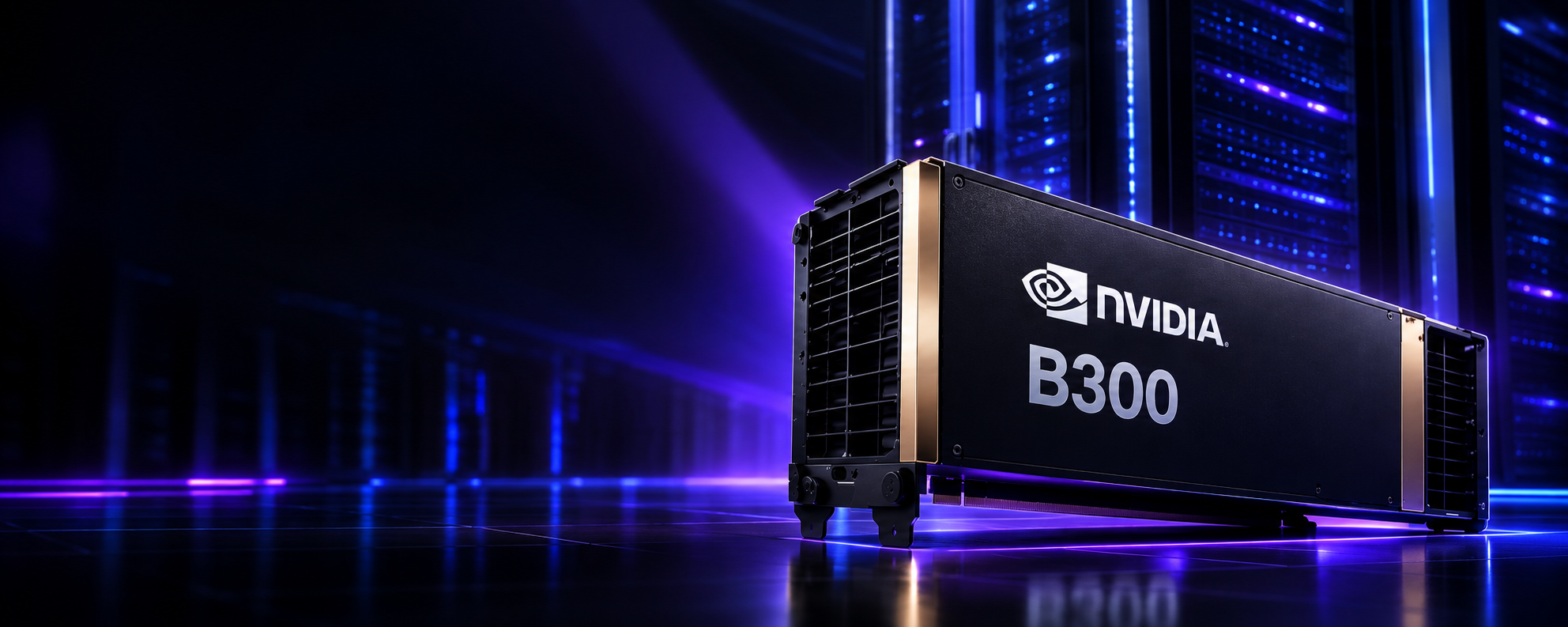
Two NVIDIA GPUs sit at the center of this decision today: the H200, a memory-focused Hopper refresh shipping in production, and the B300, the next-generation Blackwell Ultra accelerator that resets the ceiling on AI compute density. They are not competing for the same socket. They are competing for the same budget — at very different timelines and with very different infrastructure assumptions.
What Are the NVIDIA H200 and B300 GPUs?
The NVIDIA H200 is a Hopper-architecture data center GPU optimised for current-generation large-scale AI inference and training, shipping with 141GB HBM3e memory and approximately 4.8 TB/s of memory bandwidth. The NVIDIA B300 is a next-generation Blackwell Ultra accelerator targeted at frontier LLM training, long-context inference, and agentic AI workloads, with significantly higher memory capacity, bandwidth, and NVLink scale than the H200.
The H200 is best understood as an in-place upgrade. Same Hopper compute architecture as the H100, same software stack, same form factors, same cluster networking. What changed is memory: HBM3e instead of HBM3, 141GB instead of 80GB, faster bandwidth. For teams already running H100 fleets, the H200 slots in. Access H200 capacity on demand via GPU as a Service from Cyfuture AI.
The B300 is a different conversation. New architecture (Blackwell Ultra), new interconnect generation (NVLink 5.0 class), new thermal envelope, new rack design. It is not a drop-in upgrade for anything. It is the platform on which the next generation of frontier model training and trillion-parameter inference will run — and the infrastructure shift it requires is closer to a data center rebuild than a refresh.
- Hopper architecture — direct successor to H100 with HBM3e memory upgrade
- 141GB HBM3e at ~4.8 TB/s bandwidth — enables larger model footprints per GPU
- Drop-in compatible with existing HGX H100 systems and NVLink topologies
- Production-ready software stack — full CUDA, TensorRT-LLM, vLLM maturity
- Conventional rack power — 10–14kW per node, air or hybrid cooling
- Best for serving 70B+ models, KV cache–heavy inference, RAG at concurrency
- Blackwell Ultra architecture — next-generation tensor cores, new sparsity formats
- Significantly higher HBM3e capacity and bandwidth than H200 (projected)
- NVLink 5.0–class interconnect — larger NVL domains, higher GPU-to-GPU bandwidth
- FP4 inference path with second-generation Transformer Engine
- Liquid-cooled rack design required — 30–60kW power density
- Best for 200B+ training, frontier multimodal, long-context agentic AI
Where Each NVIDIA GPU Sits in the Enterprise AI Stack
BASELINE
- 80 GB HBM3 memory
- 4th-gen NVLink (8-GPU domain)
- Production-mature CUDA stack
- Air-cooled 10–14 kW racks
- Strong for 7B–70B serving
- Established procurement supply
- BFSI & healthcare deployments
UPGRADE
- 141 GB HBM3e memory
- ~4.8 TB/s memory bandwidth
- Drop-in for H100 clusters
- Same software stack as H100
- Larger KV cache headroom
- Lower cost-per-token serving
- Available now via cloud
FRONTIER
- Blackwell Ultra architecture
- NVLink 5 · NVL72 domain
- FP4 Transformer Engine v2
- Liquid-cooled 30–60 kW racks
- 200B+ frontier training
- Long-context agentic inference
- Hyperscaler-first allocation
H200 vs B300: Architecture Differences
The architectural gap between H200 and B300 is bigger than the naming suggests. H200 is Hopper carrying HBM3e. B300 is a generational change in compute fabric, memory subsystem, and cluster interconnect — all at once.
Compute architecture
H200 retains H100's fourth-generation Tensor Cores, FP8 support via the first-generation Transformer Engine, and the same compute throughput envelope. The improvement is entirely in memory feed: more capacity, higher bandwidth, fewer stalls on memory-bound workloads.
B300 introduces second-generation Transformer Engine with native FP4 inference, an updated tensor core design, and significantly higher peak throughput per GPU. For workloads bottlenecked on compute rather than memory — large-batch training, long-context attention — the gap is substantial.
Memory subsystem
Both ship HBM3e, but at different scales. H200 lands at 141GB per SXM. B300 is expected to push meaningfully higher per-device capacity and significantly higher aggregate bandwidth — the difference between holding a 70B model comfortably on one GPU versus holding a much larger model with room for production-grade KV cache.
NVLink and cluster scaling
This is where the divergence is largest in practical terms. H200 uses the same fourth-generation NVLink as H100, with 8-GPU NVLink domains in an HGX node. B300 platforms are built around NVL72-class topologies — 72 GPUs in a single NVLink coherency domain, with NVLink 5.0–generation per-link bandwidth.
For tensor-parallel inference on a 200B+ model, the NVLink domain size determines whether the model fits at low latency or whether you fall back to slower inter-node communication. This is the silent multiplier on B300's value, and it is invisible on a spec sheet that lists only per-GPU numbers.
Power and cooling direction
H200 stays inside the H100 thermal envelope. Existing rack designs, existing PDUs, existing cooling. B300 does not. The density it requires assumes direct liquid cooling, three-phase high-amperage power, and rack designs built around 30–60kW envelopes. The architectural shift here is as much a facility decision as a chip decision.
The H200 is a memory upgrade for the Hopper generation. The B300 is a generational reset — compute, memory, and cluster interconnect all moving together. Comparing them on a single spec line understates how different the deployment realities are.
Access Enterprise NVIDIA GPU Compute in India
Deploy H100 and H200 GPU instances on India-hosted, DPDP-compliant infrastructure. On-demand and reserved capacity available for LLM training, fine-tuning, and high-throughput inference workloads.
Specification Comparison
The table below summarises confirmed H200 specifications alongside B300 projections based on NVIDIA's public architectural trajectory. B300 numbers should be treated as engineering expectations until official NVIDIA disclosure.
| Specification | NVIDIA H200 | NVIDIA B300 |
|---|---|---|
| Architecture | Hopper (refresh) | Blackwell Ultra |
| Memory Type | HBM3e | HBM3e (higher stack) |
| Memory Capacity (SXM) | 141 GB | Significantly higher (projected) |
| Memory Bandwidth | ~4.8 TB/s | Substantially higher (projected) |
| Tensor Engine | Transformer Engine v1 (FP8) | Transformer Engine v2 (FP4 / FP8) |
| NVLink Generation | NVLink 4 · 8-GPU domain | NVLink 5 class · NVL72-scale domain |
| AI Training Profile | Strong for ≤70B models | Built for 200B+ frontier training |
| AI Inference Profile | High-throughput production serving | Trillion-scale, long-context, agentic |
| Power Profile (node) | 10–14 kW per HGX node | 30–60 kW rack density |
| Cooling Requirement | Air or hybrid liquid | Direct liquid cooling required |
| Availability (2026) | Broadly available | Hyperscaler-first allocation |
| Best Use Case | Production inference, mid-scale training | Frontier training, agentic inference |
B300 specifications above reflect projected values based on NVIDIA's Blackwell architecture trajectory and B200 baselines. Final confirmed specifications are subject to NVIDIA's official product disclosure. Hallucinated benchmark numbers are deliberately omitted.
H200 vs B300 for AI Training
For training models up to 70B parameters, the H200 is the practical choice — available, deployable, and matched to current-generation cluster designs. For 200B+ parameter frontier training, the B300 changes cluster economics significantly: higher per-GPU memory reduces required tensor parallelism, larger NVLink domains cut inter-node communication overhead, and total cluster size drops for equivalent throughput.
Where H200 wins on training
For most enterprise training workloads — fine-tuning, domain adaptation, training models in the 7B–70B range — sit well within H200's envelope. The 141GB memory eliminates much of the activation-checkpointing pressure that constrained H100 fine-tuning. The software stack is fully mature. And availability is real. The AI Model Library covers production-ready open models optimised for H200 deployment.
For teams running supervised fine-tuning, LoRA adapter training, RLHF on mid-scale models, or production model retraining cycles, H200 hits the right point on the curve. The hardware is not the bottleneck — model architecture decisions and data pipeline throughput usually are. AI Software Services can accelerate how quickly teams design and deploy these pipelines.
Where B300 changes the equation
Frontier training is where B300 matters. A 200B+ parameter model on H200 forces aggressive tensor parallelism — splitting weights across many GPUs, multiplying NCCL all-reduce traffic, and pushing inter-node communication onto InfiniBand at every gradient step.
B300's higher per-GPU memory cuts the required parallelism degree. Its larger NVLink domain (NVL72-class) means more of that parallelism stays inside fast intra-domain communication rather than spilling onto slower fabric. The net effect on a frontier training run can be a substantial reduction in time-to-trained-model and total cluster size.
Distributed training overhead
The under-discussed point: at frontier scale, training throughput is often gated by collective communication, not raw FLOPS. Each generation of NVLink and each expansion of the NVLink domain compounds this advantage. B300's value for training is as much about the cluster topology it enables as the per-GPU compute it delivers.
H200 vs B300 for AI Inference
Inference is becoming the dominant enterprise AI workload, not training. For high-concurrency serving of 7B–70B models, the H200 delivers strong production throughput with H100-class operational simplicity. The B300's inference advantage becomes decisive for very large models, long-context workloads (100K+ tokens), and agentic AI with persistent KV caches — where B300's memory capacity and NVLink scale reduce serving cost per token at the upper end of the model size distribution.
For most enterprises, training is a periodic event. Inference is a 24/7 cost line. The economics of which GPU to serve on shape the unit economics of every AI feature shipped. Teams building and iterating rapidly can get started on an AI IDE Lab — GPU-powered dev environments with pre-configured ML frameworks for rapid experimentation.
Throughput and concurrency
H200's larger HBM3e capacity changes inference at the level that matters most: more room for KV cache, which is what gates concurrent request count on long-context serving. For a 70B model with 8K context windows, the H200 can hold meaningfully more concurrent sessions than the H100 it replaces — directly improving GPU utilization economics.
B300 extends this curve further. Higher memory and bandwidth, combined with FP4 inference paths from the second-generation Transformer Engine, push throughput per dollar on very large models substantially above what H200 achieves. For 200B+ inference, this is not a marginal improvement — it is the difference between viable and not viable.
Latency and token generation
Time-to-first-token and inter-token latency on memory-bandwidth-bound workloads scale with HBM throughput. H200's bandwidth uplift over H100 directly improves these numbers for production LLM serving. B300's larger bandwidth uplift continues the curve, with most of the practical benefit visible on long-context decoding where the KV cache read pattern is bandwidth-limited.
Long-context and agentic AI
This is where the H200/B300 gap is widest. Agentic AI workloads — multi-turn reasoning, tool use, multi-step task execution — accumulate context aggressively. Sessions of 100K+ tokens, with persistent state across reasoning steps, push KV cache into territory where H200 memory becomes the binding constraint and B300's higher capacity becomes architecturally necessary.
For RAG pipelines, AI chatbots, and standard inference profiles at moderate context length, H200 remains the right serving target on cost and availability. An AI App Hosting platform makes it straightforward to deploy and scale these workloads without managing infrastructure. For agentic systems and long-context production deployments, B300 is the platform that doesn't force compromise.
The shift to inference-dominant workloads changes the GPU decision criteria. Memory per dollar and concurrency per GPU now outrank peak FLOPS on the buyer's spec sheet. Both H200 and B300 are designed around this reality — they just optimise for different points on the model-size distribution.
Build Differentiated AI Services on Cyfuture GPU Infrastructure
Monetise existing H100 and H200 GPU capacity by serving multi-tenant AI workloads with isolated workspaces, dedicated inference queues, and enterprise-grade access controls — SSO, RBAC, and per-tenant network segmentation enforced at the data center layer.
Full visibility over GPU allocation, user priorities, and team quotas — with precise control over fine-tuning queues, inference rate limits, and training job scheduling across H100/H200 cluster fleets without manual operational overhead.
Granular per-tenant reporting on GPU-hours consumed, tokens served, storage used, and API calls invoked. Issue invoices grounded in real consumption data instead of flat estimates — directly improving margin visibility on AI workloads.
Layer Inferencing-as-a-Service, RAG pipelines, fine-tuning workflows, vector databases, and agentic AI orchestration on top of GPU capacity — turning a hardware fleet into a full enterprise AI platform deployable on India-hosted, DPDP-compliant infrastructure.
Which GPU Is Better for Enterprise AI?
No single answer fits every team. The right GPU depends on workload scale, deployment timeline, infrastructure assumptions, and budget envelope. The decision framework below captures the practical splits we see across enterprise AI teams in 2026.
on Your Existing Infrastructure
Mixed-fleet orchestration across H100, H200, and reserved B300 capacity multiplies effective throughput per compute cluster — without rebuilding the data center.
Illustrative — actual gains depend on workload mix, NVLink topology, model parallelism strategy, and orchestration efficiency.
Real Infrastructure Considerations
GPU performance alone does not determine real-world AI throughput. What surrounds the GPU — power, cooling, networking, storage — determines whether the silicon actually runs at its rated throughput, and whether the deployment is operationally sustainable.
Cooling and rack density
H200 inherits H100's thermal envelope. Existing data center cooling designs handle it. Air cooling works at standard rack densities; hybrid liquid is available for higher-density deployments but not strictly required.
B300 inverts this assumption. The 30–60kW per rack density it operates at is thermally infeasible on air. Direct-to-chip liquid cooling or immersion cooling is mandatory. For most existing enterprise data centers, this is not a retrofit — it is a new facility build or a colocation move into a purpose-built AI data center.
Networking
Training clusters at scale are bottlenecked on collective communication. InfiniBand NDR (400 Gbps) is the production standard for H200 clusters today. B300 deployments push toward 800 Gbps InfiniBand or NVIDIA's Spectrum-X Ethernet at equivalent bandwidth — and the NVLink 5.0 domain expansion changes how much traffic stays on-fabric versus crossing onto the network in the first place.
NVLink topology
An 8-GPU NVLink domain (H200) is enough for most production inference and mid-scale training. An NVL72-class domain (B300) is a different kind of system — it allows tensor parallelism strategies that simply do not fit on the previous generation, and it changes the design of the training pipeline.
Storage and data pipeline
Both H200 and B300 deployments require parallel file systems (GPFS, Lustre, or WEKA) capable of saturating GPU network bandwidth during data loading. At B300 cluster scale, checkpoint sizes alone reach petabyte territory — storage architecture stops being an afterthought and becomes a primary engineering concern.
For most enterprises, the cloud GPU path makes both H200 and B300 deployable without owning the facility complexity. A provider already operating purpose-built AI data centers absorbs the infrastructure delta — the customer accesses GPUs on demand.
GPU Cloud Without the Infrastructure Overhead
Run production AI workloads on NVIDIA H100 and H200 infrastructure today. Pay for what you use, scale when you need it, and stay compliant with India data residency requirements.
Cost and Availability Reality
The spec sheet rarely tells the procurement story. What actually shapes the decision is unit cost, availability timing, and the operational cost of running the hardware once it lands.
Capex vs cloud economics
An owned H200 cluster is a capex commitment for hardware that depreciates against a new architectural generation already on roadmap. For most enterprise teams, the cloud GPU model — paying for what you use, on infrastructure already built around the right cooling and networking — is the better unit economics path. GPU as a Service delivers enterprise-grade NVIDIA compute on India-hosted, DPDP-compliant infrastructure, without the capex burden.
B300 amplifies this. The facility investment required to operate B300 at design density is meaningful enough that most enterprises will only see this hardware through cloud providers. Hyperscalers and a small number of AI-native data center operators carry the buildout cost.
Supply and allocation
H200 supply has normalised. Production capacity is at scale, and enterprise customers can procure or rent at expected lead times. B300, following the standard NVIDIA allocation pattern, ships first to hyperscalers and large AI labs. Enterprise customers and second-tier cloud providers receive allocation as production scales — typically 12–24 months after initial launch.
Total cost of ownership
Power draw, cooling overhead, networking infrastructure, software licensing, and operational staffing all contribute to TCO. For H200 deployments, much of this overlays existing H100 operational practice. For B300, the operational learning curve is non-trivial — purpose-built facilities, new orchestration patterns, new failure modes.
Often the cheaper path is not the cheaper GPU. It is the GPU your team can actually deploy on the timeline your business needs.
India AI Infrastructure Perspective
The AI compute conversation in India is reshaping faster than in most markets. The IndiaAI Mission has committed substantial public investment to sovereign AI compute, the DPDP Act 2023 has created hard requirements for data localisation on personal data workloads, and enterprise AI adoption — particularly in BFSI, healthcare, and retail — is accelerating against a backdrop of regulatory compliance requirements.
What this means for GPU decisions
For Indian enterprises processing personal data — customer conversations, transaction records, health information — US-hosted hyperscaler GPU capacity is non-compliant. The data has to stay in India. This forces the GPU decision toward India-hosted providers operating in-country data centers.
India-hosted H100 and H200 capacity is available now through providers like Cyfuture AI. B300 availability follows the same hyperscaler-first global allocation pattern — realistic India-hosted access through cloud providers is expected in late 2026 to 2027.
The practical path for Indian enterprises
For most workloads — RAG pipelines, AI chatbots, AI voicebots, fine-tuning, mid-scale training — deploying on India-hosted H100 and H200 infrastructure today is the right answer. The B300 advantage applies to a narrower workload profile than most teams need, and waiting for it means delaying production for hardware advantages most enterprise AI applications won't meaningfully use.
For teams genuinely operating at frontier scale, the path is reserved B300 capacity as it arrives in India — typically via cloud providers with active hyperscaler partnerships and DPDP-compliant facility designs.
Future Outlook
The H200 and B300 represent two stages of the same trajectory. AI workloads are getting larger, more multimodal, more inference-heavy, and more context-bound. GPU architecture is moving to absorb each of those vectors.
Inference will dominate compute spend
Training is the headline. Inference is the cost. As production AI features scale across enterprise deployments, the per-token serving cost compounds — and the GPU optimised for inference economics wins on platform unit economics, regardless of which one wins on training benchmarks.
Long-context becomes default
Context windows are not stopping at 128K. Million-token contexts, persistent agent memory, and document-scale reasoning push KV cache requirements into territory where memory capacity is the binding architectural constraint. B300 is the first generation designed around this reality; the generation after will go further.
Data centers diverge from general-purpose
The AI data center is becoming a different kind of facility than the cloud data center of the last decade. Liquid cooling, three-phase high-density power, dedicated InfiniBand fabric, parallel storage at petabyte scale. Enterprises that try to run B300-class hardware in conventional data centers will find the operational economics don't work — the future is purpose-built enterprise cloud infrastructure, accessed as a service.
Mixed-fleet becomes the default deployment model
Few enterprises will standardise on a single GPU SKU. H200 for production serving, A100/H100 for fine-tuning and cost-sensitive workloads, B300 reserved capacity for frontier needs. The orchestration layer that schedules across heterogeneous GPU fleets is becoming as important as the GPUs themselves.
What Cyfuture AI Offers
Final Takeaway
For most enterprises, the decision between H200 and B300 will not be about benchmark numbers alone. It will be about infrastructure efficiency, deployment scale, and long-term AI economics.
The H200 is the right choice when the work is production AI at the scale most enterprises actually run — fine-tuning mid-scale models, serving 7B–70B inference at high concurrency, building RAG pipelines, deploying AI chatbots and voicebots. It is available, it is compatible with existing infrastructure, and it has the software stack maturity that makes production deployments boring in the best sense.
The B300 is the right choice when the workload genuinely sits at frontier — training 200B+ parameter models, serving very large inference at scale, building agentic systems with long-context state. The infrastructure cost is real, the availability timeline is constrained, and the operational complexity is meaningful. But for the workloads it targets, no other hardware is the architecturally correct answer.
The infrastructure decision in 2026 is not which GPU is faster. It is which GPU your workload actually needs, on a timeline your business can absorb, in a facility your data residency requirements permit.
Run Your AI Workloads on Cyfuture AI Infrastructure
India-hosted NVIDIA H100, H200, and A100 GPU cloud — DPDP compliant, ISO 27001:2022 certified, with NVLink clusters and InfiniBand-class fabric for production AI training and high-throughput inference. B300 access as availability scales.
Frequently Asked Questions
The H200 is a Hopper-architecture refresh of the H100 with 141GB HBM3e memory and ~4.8 TB/s bandwidth — a memory upgrade that retains H100's compute architecture, NVLink generation, and software stack compatibility. The B300 is a next-generation Blackwell Ultra accelerator with new tensor core design, second-generation Transformer Engine (FP4), substantially higher memory capacity and bandwidth, NVLink 5.0–class interconnect with NVL72 domain scaling, and a thermal envelope requiring purpose-built liquid-cooled rack infrastructure. H200 is a deployment-ready upgrade; B300 is a generational platform shift.
Yes — substantially, across both training and inference workloads. B300 delivers higher AI throughput per GPU, higher memory bandwidth, larger memory capacity, and a larger NVLink coherency domain (NVL72-class). Where the gap is widest is on frontier-scale models (200B+ parameters) and long-context inference, where H200's per-GPU memory becomes the binding constraint. For workloads that fit comfortably within H200's envelope — most enterprise AI in 2026 — the practical performance difference is meaningfully smaller than the headline numbers suggest.
For training models up to 70B parameters — covering most enterprise fine-tuning, domain adaptation, and production retraining workloads — the H200 is the right choice. It is available, deployable on existing cluster designs, and matched to the software stack most teams already operate. For 200B+ parameter frontier training, the B300 changes cluster economics significantly: higher memory cuts required tensor parallelism, larger NVLink domains reduce inter-node communication overhead, and time-to-trained-model drops substantially. The decision is workload scale, not raw performance.
For high-throughput serving of 7B–70B models, RAG pipelines, AI chatbots, and standard enterprise inference profiles, the H200 delivers strong throughput per dollar and operational simplicity. Its 141GB HBM3e increases KV cache room over H100, raising concurrent session capacity. For very large model inference (200B+), long-context workloads (100K+ tokens), and agentic AI with persistent state, the B300 becomes architecturally necessary — H200 memory becomes the binding constraint at this scale.
B300 GPU availability follows the standard NVIDIA hyperscaler-first allocation pattern. Initial production runs in 2026 are allocated to Google, Microsoft, Amazon, and Meta. Cloud GPU providers and enterprise customers receive allocation as production scales — typically 12–24 months after initial launch. India-hosted B300 access through cloud providers is expected in late 2026 to 2027. For most enterprise teams, the practical path is deploying current workloads on India-hosted H100 and H200 infrastructure today, with B300 access on the operational roadmap as availability scales.
Not as a drop-in. H100 to H200 is essentially a drop-in upgrade — same HGX form factor, same NVLink topology, same software stack. H100 to B300 is a platform-level change: new rack design (30–60 kW density), direct liquid cooling, new NVLink coherency domain (NVL72), and a software stack retuned for FP4 inference and Blackwell Ultra tensor cores. For most enterprises, the practical path is H200 as the next deployable upgrade and B300 as reserved capacity through a cloud provider operating purpose-built infrastructure.
B300 deployments require purpose-built data center infrastructure most conventional facilities lack. Power: 30–60 kW per rack with three-phase high-amperage feeds and high-density PDUs. Cooling: direct liquid cooling or immersion — air cooling is thermally infeasible at this density. Networking: 800 Gbps InfiniBand or Spectrum-X Ethernet equivalent for training fabric. Storage: parallel file systems (GPFS, Lustre, WEKA) capable of saturating GPU network bandwidth with petabyte-scale checkpoint capacity. These are facility-scale investments, not incremental upgrades — which is why most enterprises will access B300 through cloud providers rather than owning the deployment.
Deploy now. For the workload profile most Indian enterprises run — RAG pipelines, AI chatbots, AI voicebots, fine-tuning, mid-scale training — H100 and H200 infrastructure is production-ready, available through India-hosted providers, and DPDP Act compliant. Waiting for B300 means delaying production by 12–24 months for hardware advantages most enterprise AI applications won't meaningfully use. For teams genuinely operating at frontier scale, the right approach is deploying current workloads on H200 today and reserving B300 capacity through a cloud provider as it arrives in India.
The Digital Personal Data Protection Act 2023 creates data localisation obligations for personal data processed by Indian entities. AI systems handling customer conversations, financial records, health information, or employee data must run on India-jurisdiction infrastructure. For BFSI, healthcare, and e-commerce teams, this makes US-hosted hyperscaler GPU capacity non-compliant for personal data workloads. India-hosted GPU infrastructure — such as Cyfuture AI data centers in Noida, Jaipur, and Raipur — satisfies this requirement. The same principle applies to H200 and B300: India-hosted access from local cloud providers satisfies DPDP; US-hosted capacity does not.